
If you’re the head of HR/HR Manager, or head of People or benefits, you have probably been asked whether a wellbeing app is enough, or whether your people need a real person to talk to. This guide sets out what each option does well, what the evidence says, and how to make a fair buying decision.
The short answer: Wellbeing apps and human support do different jobs, so most employers are better served by asking which gaps each one fills than by choosing a winner. Apps offer scale, round-the-clock access, self-guided tools and low cost.
Human emotional support offers a relationship with a trained person who listens. Published research suggests sustained engagement with unguided apps is often low, so many organisations pair digital tools with human options.
Key definitions
- Wellbeing app: a digital product, usually on a phone, that offers self-guided tools such as meditation, mood tracking, sleep content or structured exercises.
- AI chatbot: software that generates conversational replies to what a user types or says, without a human on the other side.
- Human emotional support: a private conversation with a trained person who listens, reflects and helps someone feel heard, without diagnosing or treating.
- Non-clinical support: help that sits outside therapy, counselling, medical care and crisis services, and does not involve assessment or treatment.
- Human Continuity™: Callin’s commitment to prioritising the same trained listener or coach for ongoing support wherever operationally possible.
Callin is a non-clinical emotional support service, not therapy, counselling, medical care or crisis support. If you or someone you work with is in immediate danger or crisis, please contact local emergency services or find a free, confidential helpline in your country at findahelpline.com.
Key takeaways
- Wellbeing apps have genuine strengths: scale, 24/7 availability, private self-guided tools and a low cost per user.
- Real-world engagement with unguided mental health apps is often low; one peer-reviewed analysis found a median 30-day retention of 3.3%.
- Low retention does not prove apps fail; some people learn a skill and stop, and the researchers themselves caution against that reading.
- AI chatbots can respond instantly, but the APA advises they should not replace a qualified provider and notes relationships with AI are one-sided.
- Human support offers something tools cannot: a relationship with a real person who listens, remembers context and can signpost when needed.
- Human Continuity™, the same trusted, trained person over time, means employees do not have to start their story from zero each time.
- A layered approach, tested through a short pilot with clear measures, is usually a fairer way to decide than an all-or-nothing choice.
Why are HR teams comparing human support with wellbeing apps now?
HR teams are comparing them because the need is large and budgets are finite. The World Health Organization estimates that 16% of working-age adults were estimated to have a mental disorder in 2023, and that 12 billion working days are lost every year to depression and anxiety. That puts pressure on leaders to offer something that reaches everyone.
Apps look like an elegant answer to that reach problem. Human support looks like an answer to a different problem: employees who want to talk something through with a person. In the UK, the CIPD Health and wellbeing at work 2023 report found sickness absence at 7.8 days per employee per year, the highest level in a decade (UK data). Leaders want support that is used, not support that merely exists.
It is also worth remembering what benefits cannot do. WHO recommends organisational interventions that directly target working conditions and environments, so no app or listening service replaces good work design. Our article on why workplace stress needs more than wellness programmes explores that point in depth.
Are mental health apps enough for employees?
For some employees, a good app is enough at a given moment, and for others it is not. An app can suit someone who wants private, self-paced tools, a breathing exercise before a presentation or a sleep routine. It may not suit someone who needs to talk through a bereavement, a relationship ending or a difficult manager with another human being.
The honest answer for most workforces is that “enough” depends on the need. People bring their whole lives to work, and those lives do not fit one format. A mixed workforce across countries, roles and ages will contain people who prefer screens and people who prefer voices.
If your current offer is an employee assistance programme plus an app, it helps to know what an employee assistance programme typically includes before deciding what is missing. Our wider guide to EAPs, mental health apps, online therapy and emotional support maps all four options side by side.
What does the research say about wellbeing app engagement rates?
Research suggests that sustained engagement with unguided mental health apps is often low in everyday use. A 2019 study in the Journal of Medical Internet Research by Baumel and colleagues analysed 93 popular unguided mental health apps and found a median 15-day retention of 3.9% and a median 30-day retention of 3.3%. The median daily open rate among people with an app installed was 4.0%.
Context matters, and fairness to apps matters too. The apps were identified through the Google Play store, usage came from an anonymised panel between August 2017 and July 2018, and the data covered consumer downloads rather than employer programmes. The authors noted that low retention “does not necessarily suggest that these apps are only helpful for a small number of users”, since some people may gain a skill and move on.
A 2021 systematic review of 208 articles on engagement with digital mental health interventions found that engagement “is typically lower in real-world use than research studies”. It identified a lack of personalisation as a common barrier, and social connectedness facilitated by the intervention as a common facilitator. For an employer, that finding is a useful prompt: people tend to stay with support that feels personal and connected.
How do wellbeing apps and human support compare for employers?
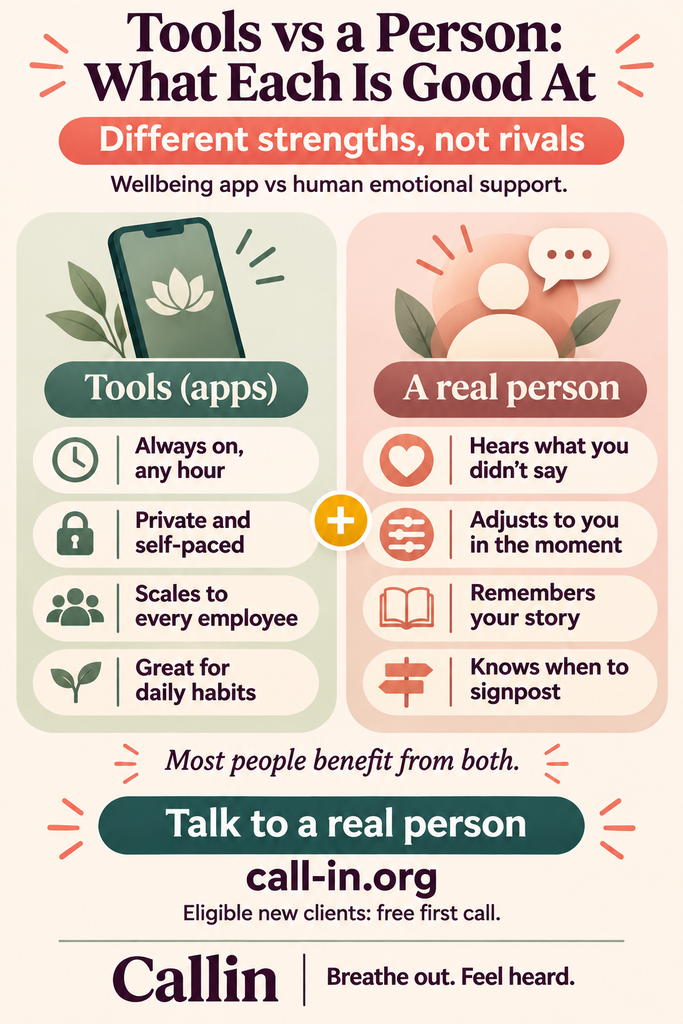
They compare best when you look at the same criteria for each. The sections below follow an identical order so you can read them in parallel.
Wellbeing apps
- Reach: can be offered to a whole workforce at once, across locations and time zones.
- Availability: usually open 24 hours a day, which suits shift workers and late-night worriers.
- Privacy feel: some people prefer to explore feelings alone before talking to anyone.
- Content: structured self-guided tools such as meditation, journaling prompts, tracking and education.
- Cost profile: typically a low cost per user, which makes broad provision feasible.
- Personalisation: varies by product; many rely on the user to choose what to do next.
- Continuity: continuity is with the tool and its content, not with a person.
- Escalation: depends on the product; an app cannot sit with someone and notice what is unsaid.
Human emotional support
- Reach: scales with the number of trained people available, so it is usually offered by booking.
- Availability: varies by provider; many offer booked sessions, which give conversations a protected time, and some, such as Callin, are available 24/7 with sessions booked at any hour.
- Privacy feel: confidential one-to-one conversations outside the line management chain.
- Content: listening, reflection and space to think, shaped by what the person brings that day.
- Cost profile: a higher cost per conversation than a digital licence, with value tied to use.
- Personalisation: inherent, because a person responds to the individual in front of them.
- Continuity: with Human Continuity™, the same trained person can carry context across sessions.
- Escalation: a trained listener can recognise when something is beyond scope and signpost onwards.
Neither list makes one option better overall. It shows that they answer different questions, which is why the buying decision is usually about combination and fit.
AI chatbot vs human listener: what is the difference for a workplace benefit?
The core difference is that a chatbot generates replies while a human listener is a person who is actually present. Chatbots can be instant, tireless and low cost, and the American Psychological Association notes that emotional support is one of the most common uses of generative AI chatbots in 2025. That demand is real, and employers should take it seriously.
The same APA health advisory says these tools “should not be used as a replacement for a qualified mental health care provider”. It notes that “relationships with AI systems are one-sided, even if the user perceives otherwise”, and that the ability of these tools “to consistently and safely manage a user in crisis is limited and unpredictable”. It also notes that studies suggest some wellness tools that do not use AI “generally can be safe and beneficial when used as intended”, which is a fair balance to keep in mind.
For a benefits decision, the practical question is what role each plays. A chatbot can be a place to organise thoughts at 2am. A human listener can hear the tone behind the words, remember last month and say, honestly, when someone needs a different kind of help. We explore this from the individual’s side in AI chat vs human emotional support, why venting to ChatGPT does not always help and whether AI can replace human connection.
Why does Human Continuity™ matter in a workplace benefit?
Human Continuity™ matters because many employees find it tiring to explain their life to a new person every time. Callin’s Human Continuity™ approach prioritises the same trained listener or coach wherever operationally possible. That means an employee can start with “remember what happened with my team?” rather than starting from zero.
This is the one place where Callin differs from digital tools, and we want to be precise about it. Research on psychotherapy links the quality of the relationship with outcomes, and the APA advisory describes the therapeutic alliance as “one of the most reliable predictors of successful treatment outcomes”. Callin is not therapy, so we do not claim that evidence transfers directly, and we make no claims about outcomes.
What we can say is what continuity offers in practice: shared context, less repetition and somewhere human to return to. Our pieces on not having to repeat your story and the benefits of consistent emotional support explain why that can feel different for the person receiving it.
Should we offer an app or human support, or both?
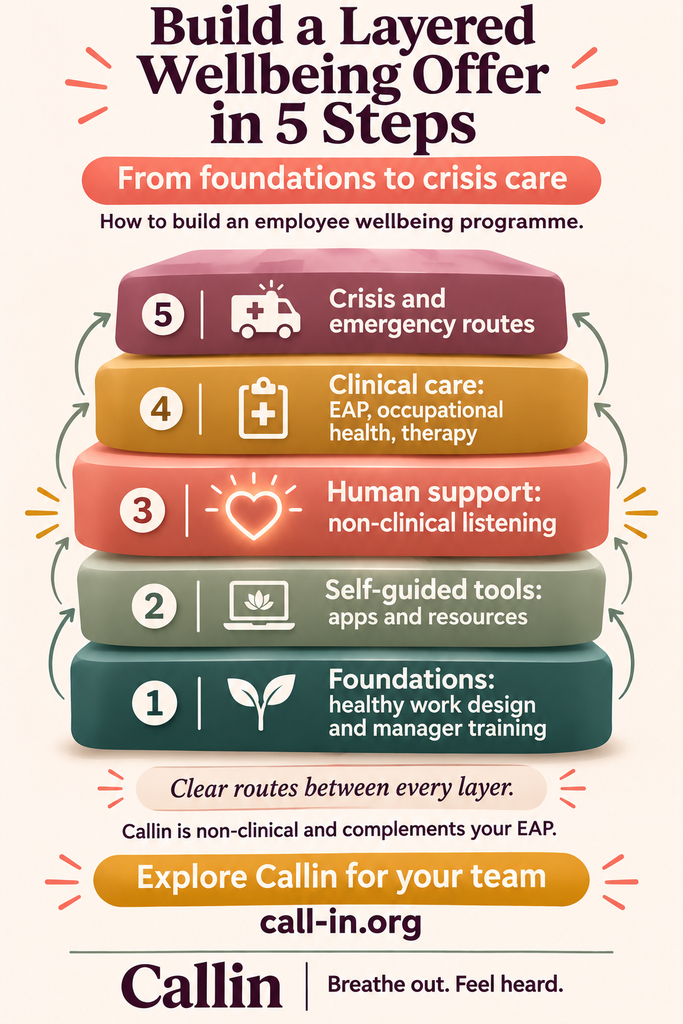
Many organisations will be best served by both, used for different needs. Apps can provide a universal, always-on layer. Human support can provide a relationship-based layer for people who want to talk to someone, alongside your EAP, occupational health and clinical pathways.
A layered design might look like this:
- Organisational foundations: workload, management practice and psychosocial risk, as WHO recommends.
- Manager capability: WHO recommends manager training that builds “interpersonal skills like open communication and active listening”.
- Universal digital layer: a wellbeing app or digital resources for self-guided support.
- Human non-clinical layer: confidential conversations with a trained listener, ideally the same person over time.
- Clinical and crisis layer: EAP counselling, occupational health, healthcare referrals and emergency routes.
Clinical services show a similar pattern of pairing tools with people. In the UK, NICE’s early value assessment on digitally enabled therapies for adults with depression says these therapies “must be delivered with practitioner or therapist support” (UK guidance, clinical context). That is guidance on NHS treatment, not on non-clinical support, but the principle of a human alongside the tool is instructive.
If you already have an EAP, see how Callin complements EAPs. Smaller organisations may find our guide to choosing an EAP for startups and small businesses useful.
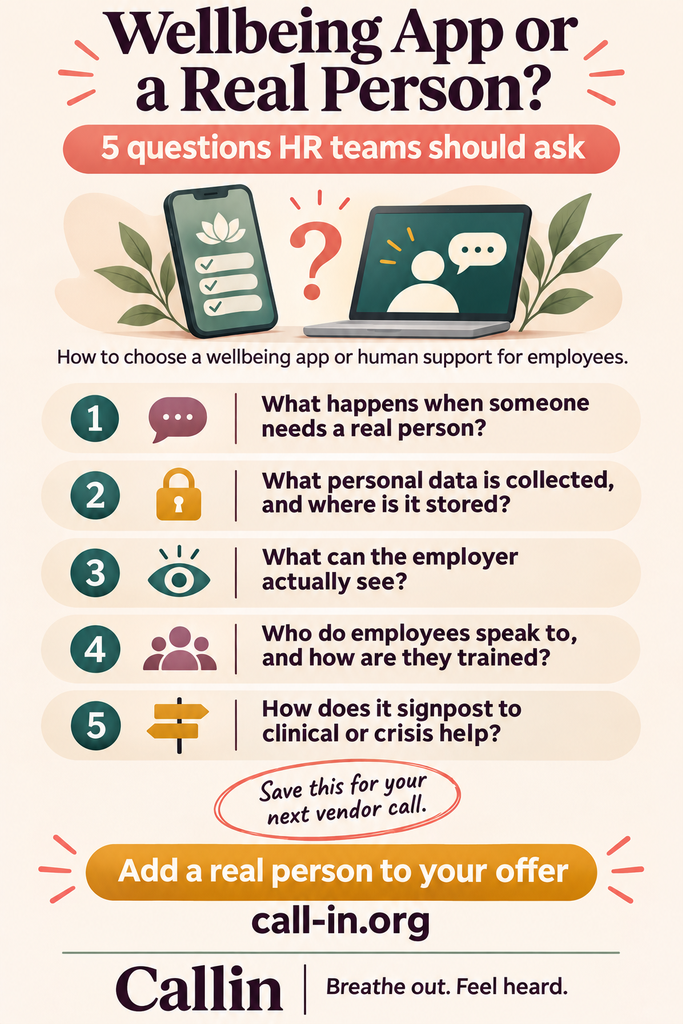
What should you ask any provider before you buy?
Ask questions that reveal real use, real boundaries and real privacy, whether the provider is an app or a human service. Good questions protect your people and your budget.
- What need does this meet that our current provision does not?
- How will we know whether people actually use it after the launch month?
- Is there a real person involved, and what is their training?
- Can employees return to the same person if they want to?
- What happens when someone needs clinical or crisis help?
- Is conversation content kept from the employer, and what do we receive instead?
- Does it work for remote, international and shift-based staff?
- Which languages and time zones are covered?
The UK CIPD 2023 report found that nearly two-thirds (63%) of organisations measure employee engagement levels to evaluate wellbeing activity, with more organisations also measuring take-up of EAPs (UK data). Take-up is a sensible starting measure for any benefit. Our guide to workplace mental health support for employees goes further on making support easier to use without turning it into a performance metric.
How can you test human support without a long commitment?
A defined pilot is the fairest way to test human support. Callin offers organisations a three-month pilot with no annual contract, so you can see how your people use it before deciding on anything longer.
To make a pilot useful, agree a few things at the start:
- The question: for example, whether employees want a human option alongside the app.
- The group: a team, a region or a cohort such as remote staff or new managers.
- The measures: take-up, repeat bookings and anonymous feedback, never conversation content.
- The boundaries: how clinical and crisis needs route to your existing services.
Distributed teams are a common place to start, since remote working loneliness and work stress and burnout often surface before anyone mentions them at work.
Where does Callin fit, and where does it not?
Callin fits as the human, non-clinical layer for adults who want someone to talk to. Callin Support Ltd is registered in the United Kingdom, began in June 2023, and supports adults aged 18 and over worldwide through online sessions, currently conducted in English. Callin is available 24/7, with sessions you book at a time that suits you, at any hour. You can read more about Callin and how we work worldwide.
Our listeners complete mandatory Johns Hopkins University Psychological First Aid training and follow Callin’s active-listening materials and protocols on boundaries, safeguarding and signposting, as set out in our FAQ. We do not create clinical records. When support comes through an employer, the content of an employee’s conversation is not shared with that employer.
Callin does not fit as therapy, counselling, diagnosis or crisis support, and it does not replace your EAP, occupational health or emergency routes. It is available 24/7, with sessions you book at a time that suits you, at any hour, and it is not a continuously monitored helpline; our guide to warmlines, crisis lines and peer support explains the difference. If you are new to the idea, what a listening service is is a helpful primer.
Give your people a human option
Wellbeing apps can give your people tools. Human support gives them a person, and Human Continuity™ means it can be the same trusted person over time. Eligible new clients can begin with a free first session, and you can see what happens in a Callin first session before anyone books.
Explore Callin’s non-clinical emotional support
Frequently asked questions
Are mental health apps enough for employees?
For some employees at some moments, yes. Apps offer private, self-guided tools at scale. Others want to talk to a real person, so many employers combine an app with human support and clear routes to clinical and crisis care.
What are typical wellbeing app engagement rates?
Engagement varies widely by product and context. One peer-reviewed analysis of 93 unguided consumer mental health apps found a median 30-day retention of 3.3%. The authors cautioned that this does not necessarily mean the apps only help a small number of users.
Should we offer an app or human support?
Many organisations offer both because they meet different needs. An app provides a universal, always-available layer. Human support provides a confidential relationship with a trained person. A short pilot can show which your people actually use.
What is the difference between an AI chatbot and a human listener?
A chatbot generates replies; a human listener is a person who is present, remembers context and can signpost when something is beyond scope. The APA advises that chatbots and wellness apps should not replace a qualified mental health provider.
What is Human Continuity™?
Human Continuity™ is Callin’s commitment to prioritising the same trained listener or coach for ongoing support wherever operationally possible. Employees can build shared context with one person instead of repeating their story each time.
Does Callin share what employees say with their employer?
No. When someone accesses Callin through an employer, the content of their support conversation is not shared with the employer or benefits provider. Confidentiality has limited legal and safeguarding exceptions, which Callin explains in its FAQ and privacy materials.
Is Callin a replacement for therapy, an EAP or crisis support?
No. Callin is non-clinical emotional support for adults aged 18 and over. It can complement an EAP, occupational health and clinical care, but it does not replace them. Anyone in crisis should contact local emergency services or findahelpline.com.
UN SDG alignment
Callin’s workplace support aligns with two UN Sustainable Development Goals. This describes alignment, not United Nations affiliation or endorsement.
- SDG 3: Good Health and Well-being: human, non-clinical emotional support offers adults a place to talk early, alongside clinical care.
- SDG 8: Decent Work and Economic Growth: supporting people as whole humans at work contributes to the decent work agenda, alongside organisational action on working conditions.
Read more in Workplace Wellbeing and UN SDGs from Callin Support.
Sources and further reading
- World Health Organization. Mental health at work (fact sheet).
- World Health Organization. Guidelines on mental health at work (2022).
- Baumel A, Muench F, Edan S, Kane JM. Objective User Engagement With Mental Health Apps: Systematic Search and Panel-Based Usage Analysis. Journal of Medical Internet Research, 2019.
- Borghouts J, et al. Barriers to and Facilitators of User Engagement With Digital Mental Health Interventions: Systematic Review. Journal of Medical Internet Research, 2021.
- American Psychological Association. Health advisory: Use of generative AI chatbots and wellness applications for mental health (November 2025).
- NICE. Digitally enabled therapies for adults with depression: early value assessment, Recommendations (UK).
- CIPD. Health and wellbeing at work 2023 (UK).
- Callin. Workplace wellbeing support for organisations.
- Callin. Frequently asked questions.
Leave a Reply