
Remote work loneliness is real, common and nothing to be embarrassed about. Working from home can leave little space for the small human moments of the day can quietly disappear.
One of the most helpful things remote workers can do is build regular human check-ins that sit completely outside work tools, where you can talk about your life, not just your tasks.
Callin provides confidential, one-to-one, non-clinical human support by voice call, video call or private chat. It is not therapy, counselling, diagnosis, medical or psychiatric care, or crisis or emergency support. Everyone you speak to is a real person, not an AI.
If you are in danger right now, or think you might act on thoughts of harming yourself or someone else, please contact your local emergency services or a crisis line. You can find a free, confidential line in your country at findahelpline.com.
Key takeaways
- WFH loneliness is common: in Gallup’s 2024 global workplace research, 25% of fully remote employees reported feeling lonely a lot of the previous day, compared with 16% of fully on-site employees.
- Remote work often removes the unplanned “hallway” moments and casual acquaintances that research links to happiness and a sense of belonging.
- When home is also the office, the boundary between work and rest can blur, which can make it harder to switch off and recover.
- Messages in work tools such as Slack or Teams tend to stay task-focused, so you can be in contact all day and still feel unknown.
- Burnout is described by the World Health Organization as an occupational phenomenon resulting from chronic workplace stress that has not been successfully managed, not as a medical condition.
- A regular voice or video check-in with someone outside your job, at the same time each week, can help restore both connection and a clear edge to the working day.
- Callin offers non-clinical support from real people trained in active listening and Psychological First Aid, and through Human Continuity™ you can usually keep talking to the same listener over time.
What is Remote Work and WFH loneliness, and why does it feel so heavy?
WFH loneliness is the sense of isolation or disconnection that can build up when you work from home. It often comes from losing the casual, human contact that used to happen around work. It can feel heavy because it creeps in slowly, and because you may be “in touch” with people all day while still feeling alone.
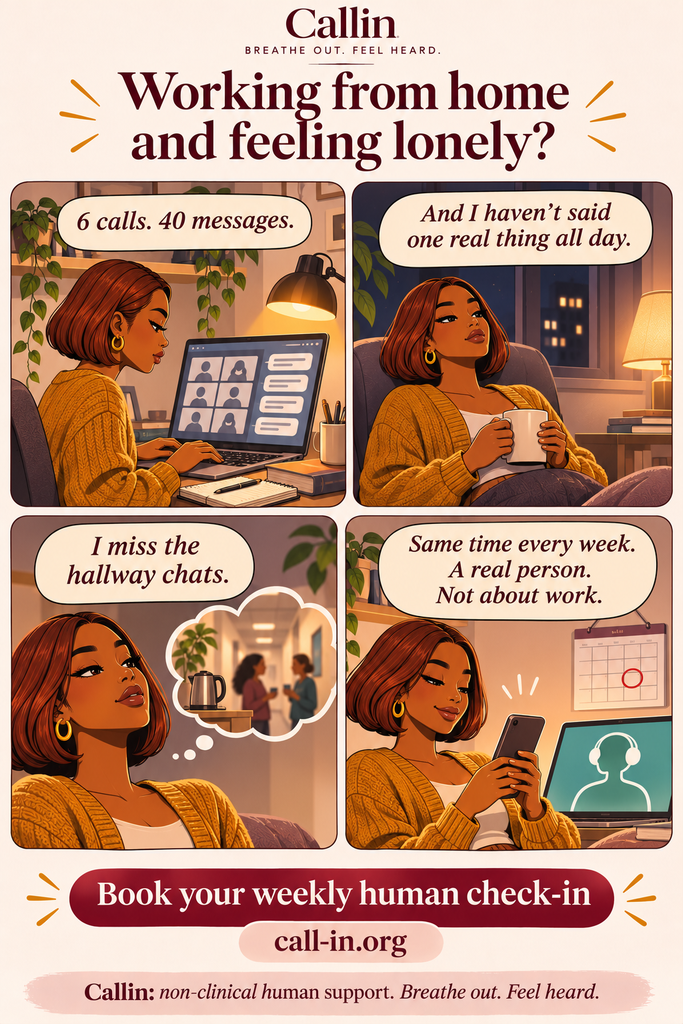
The World Health Organization describes loneliness as the painful feeling that arises from a gap between the connection you want and the connection you have. That definition matters here. You might attend six video calls and answer forty messages, and still feel that gap.
You are far from the only one. The WHO Commission on Social Connection reported in 2025 that about 1 in 6 people worldwide are affected by loneliness. Callin’s article Remote Work Loneliness: Why It Happens and How to Cope gives a wider view.
Does working from home make you lonely?
Working from home does not make everyone lonely, but remote workers report loneliness more often than on-site workers. Many people love remote work and still find that isolation is the hardest part of it. Both things can be true at once.
In Gallup’s State of the Global Workplace 2024, 20% of employees worldwide said they experienced loneliness a lot of the previous day. Work location showed the biggest differences: 25% of fully remote employees reported loneliness, compared with 21% of hybrid workers and 16% of those fully on-site.
That is a correlation, not a verdict on remote work. Flexibility, less commuting and more time at home can be real gifts. The point is simply that if remote work feels lonely for you, the feeling makes sense.
What is the hidden cost of the home office?
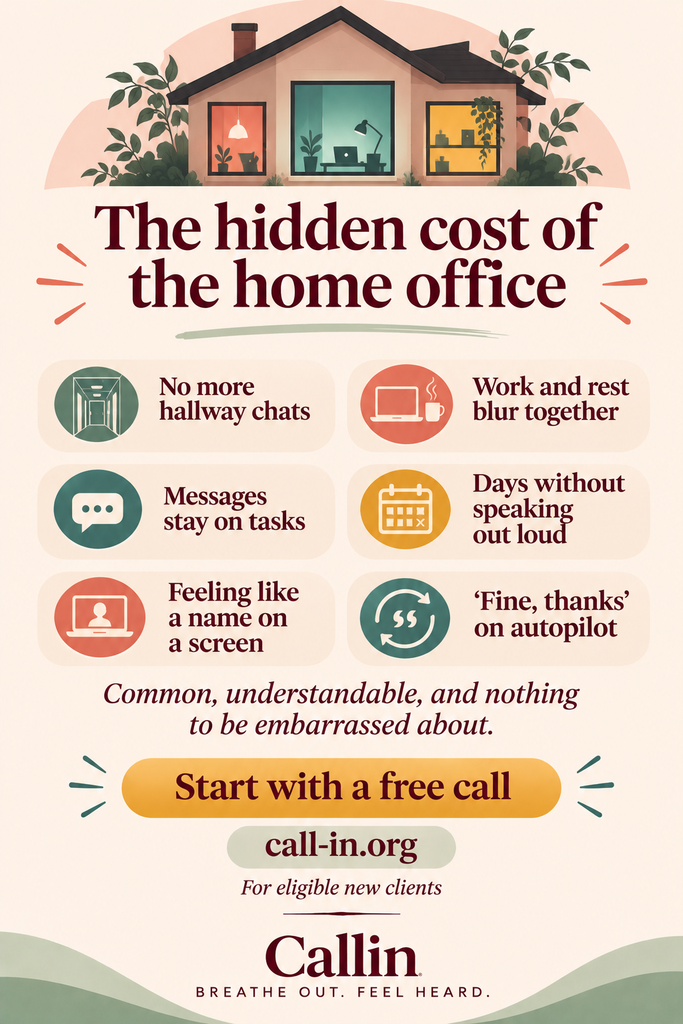
The hidden cost of the home office is the loss of small, unplanned human contact, the blurring of work and home, and a creeping sense of being a name on a screen. None of these is dramatic on its own. Together, they can wear down your sense of belonging and your energy.
Why do I miss hallway chats so much?
You may miss hallway chats because those small moments were doing more for your well-being than you realised. A quick “how was your weekend?” by the kettle is not about work at all. It is a reminder that you are a person among people.
Research supports this. In a set of studies, Sandstrom and Dunn found that people felt happier and had a greater sense of belonging on days when they interacted with more acquaintances than usual. These “weak ties” are exactly the kind of contact that remote work tends to strip away.
A large study of 61,182 Microsoft employees, published in Nature Human Behaviour, found that firm-wide remote work caused collaboration networks to become more static and siloed, with fewer connections across groups. People spent more time with close colleagues and less with weaker ties. Communication also shifted towards email and instant messaging.
Why does the line between work and home disappear?
The line between work and home can disappear because the same room, table and laptop now hold both. There is no commute to mark the change, no door to walk out of. Work can leak into evenings simply because it is always within reach.
For many remote workers, the hardest part is not the hours themselves. It is the feeling of never fully leaving. Callin’s articles Why You Can’t Keep Digital Boundaries (And What Works) and Why Do Notifications Feel Emotionally Draining? explore this in more depth.
If rest makes you uneasy, Why Do I Feel Guilty When I’m Not Working? may feel familiar.
Can remote work isolation lead to burnout?
Remote work isolation can add to the pressures that lead to burnout, especially when it combines with long hours and blurred boundaries. Isolation means fewer chances to offload stress, laugh with someone or hear “that sounds hard”.
The World Health Organization describes burn-out as an occupational phenomenon, not a medical condition. It defines it as resulting from “chronic workplace stress that has not been successfully managed”. It names three dimensions: exhaustion, increased mental distance from or cynicism about your job, and reduced professional efficacy.
If you recognise yourself in that description, a doctor or other qualified professional can help you think about your health. For talking it through without a clinical setting, see Who can I talk to about work burnout if I’m not looking for therapy? and 3 Reasons Peer Connection Prevents Burnout.
Why do I feel like an interchangeable part on a screen?
You may feel interchangeable because screen-only work can reduce you to outputs: a status dot, a ticket closed, a reply sent. When nobody sees you arrive, look tired or make a joke, it is easy to feel that anyone could be in your place.
That feeling deserves attention, not dismissal. Callin’s article Feeling Unseen at Work? You’re Not “Too Sensitive”, It’s Psychological Contract Breach (And It’s Draining Your Soul) looks at why being unseen at work can hurt so much.
Why do messages on Slack or Teams not feel like real connection?
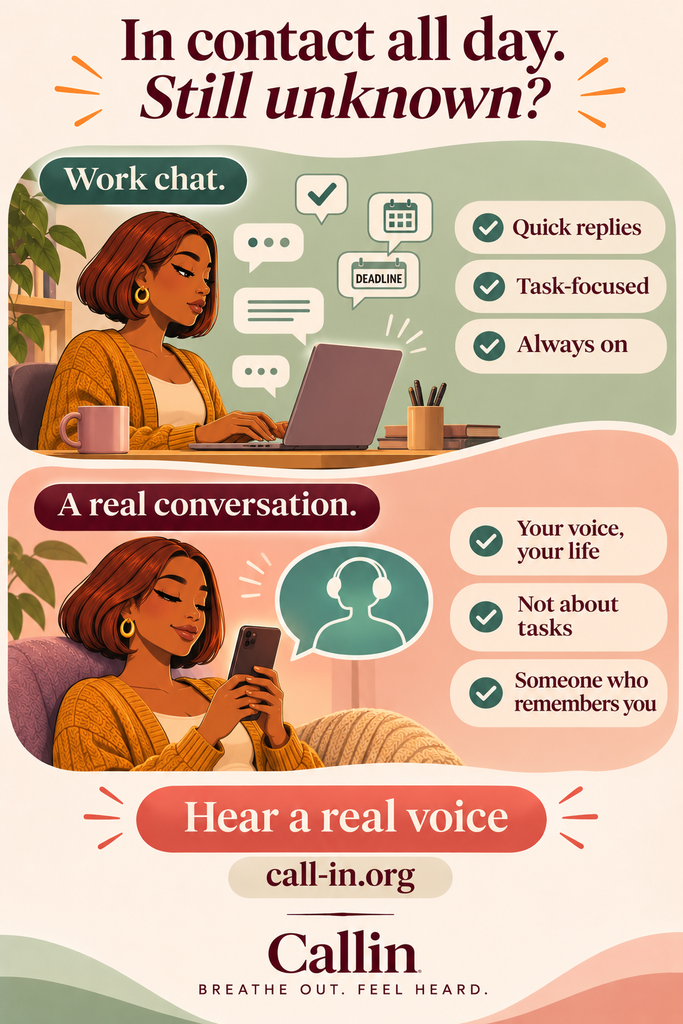
Messages in work tools such as Slack or Teams often do not feel like real connection because they are built around tasks. Even friendly messages tend to sit next to deadlines and to-do lists. You can be in contact with people all day and never be asked how you really are.
Work tools are useful for work. That is what they are for. The trouble comes when they become your only source of human contact, and every interaction carries a hint of “what do you need from me?”
Text also carries less of a person. In experiments by Kumar and Epley, talking by voice created stronger feelings of connection than typing, and it was less awkward than people expected. Callin’s articles Why Texting Can’t Replace Real Conversation and Why Do I Feel Lonely In a WhatsApp Group Chat explore the same feeling outside work.
It can also be tempting to fill the gap with an AI chatbot between meetings. Some people find that useful for organising thoughts. Many find it does not touch the loneliness itself, as Why the Most Empathic AI Is Still Making Us Lonelier explains.
What might be underneath my WFH loneliness?
Underneath WFH loneliness there are often ordinary, understandable causes: a shrinking circle of casual contact, routines that never take you outside, blurred boundaries, a sense that work is your whole identity, or life changes such as moving, a break-up or friends drifting away. Naming these in your own words can show you where to start. This is reflection, not diagnosis.
Some things remote workers often notice, as they understand them:
- Routine. Days can pass without leaving the house or speaking out loud.
- Context. If you live alone, the home office may be the only room you see all day.
- Relationships. Friends may be busy, far away or in different life stages.
- Boundaries. Work spills into evenings, leaving little energy for anyone else.
- Values. You may care deeply about your work but miss being known as a whole person.
- Habits. Saying “fine, thanks” in every check-in can become automatic.
- Life changes. A move, a new job or a loss can shrink your support system just as remote work does.
If you live alone, Living Alone Doesn’t Have to Mean Feeling Alone: Emotional Support for People Living Alone in an Age of Isolation may help. If you have people around but still feel unseen, read Why You Feel Lonely Even Though You Have Friends: Exploring the Support Gap and The Dangers of “I’m Fine”: The Cost of Surface-Level Interactions.
What can remote workers do to combat deep isolation while working from home?
Remote workers can combat deep isolation by building regular human contact that sits completely outside work tools. Scheduled, predictable conversations where you talk about your life, not your tasks, tend to help more than more messages. Small changes to routine and boundaries can support this too.
Here are some ideas to try, at your own pace:
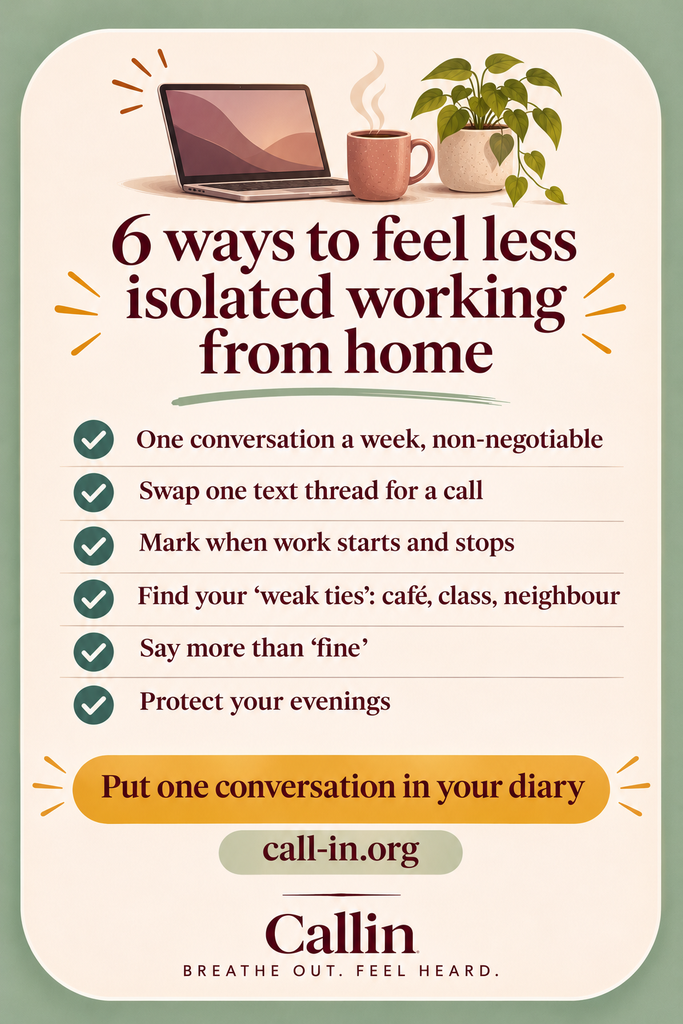
- Make one conversation a week non-negotiable. A voice or video call with a friend, relative or listener, at the same time each week.
- Use your voice. Swap one text thread a day for a short call, even five minutes.
- Mark when work starts and stops. A short walk, a change of clothes or closing the laptop in a drawer can act like a commute.
- Find weak ties. Work from a café or library sometimes, chat with a neighbour or join a local class.
- Say more than “fine”. Try telling one person one true thing about your week.
- Protect your evenings. Turn off work notifications at a set time where your role allows.
Callin’s 4 Helpful Ways to Cope with Feeling Lonely as a Remote Worker and How to Make Real Friends as an Adult When You Want Genuine Connection offer more ideas. For boundaries, see How to Set Healthy Boundaries: A Guide to Protecting Your Mental Health.
How do I build an external support rhythm for remote work isolation?
You can build an external support rhythm by scheduling regular voice or video conversations with someone outside your job, at a consistent time, where the focus is you rather than your work. Predictability is part of the help. Knowing the conversation is coming can make the week feel less empty.
Why does talking to someone outside work help with remote work isolation?
Talking to someone outside work helps because you can be a whole person, not a job title. You do not have to worry about how it sounds to your manager or team. You can talk about your weekend, your family, your worries or the quiet days without it touching your career.
An objective listener also has no stake in the outcome. They are not your colleague, your partner or your friend who is equally stressed. That can make it easier to say the thing you have been holding in. Callin’s article Emotional Venting: Why It Helps You Feel Less Alone explores why being heard can ease isolation.
If you worry about leaning on friends, see Someone To Talk To When I Don’t Want to Burden My Friends.
Can one consistent hour a week really make a difference to WFH loneliness?
One consistent hour will not fix everything, but many people find it makes a noticeable difference. It gives the week an anchor. It is time that belongs to you, not your inbox, and it draws a line that remote work tends to erase.
Consistency matters as much as length. A regular slot can help you notice patterns, catch stress early and feel less like you are waiting until you break. Callin’s articles What Is Preventive Emotional Care? Why Waiting Until You Break Is Risky and Benefits of Consistent Emotional Support explain why.
Why does it help to talk to the same person each time?
Talking to the same person each time helps because you do not have to start your story again. They remember your situation, your people and what happened last week. That sense of being known is often exactly what remote work has been missing.
Callin’s Human Continuity™ means that, wherever possible, you keep the same trained listener across sessions. Continuity is a comfort for many people, not a promise of any particular outcome. You can read more in Where Can I Find Ongoing Online Emotional Support From the Same Person?.
Who can I talk to about remote work isolation if I do not need therapy?
You can talk to friends, family, a peer support or warmline service, your employer’s support options or a non-clinical listening service. If you want clinical help, a doctor, therapist or counsellor is the right place. There is no wrong door; it depends on what you need right now.
Some options to consider:
- Your employer. Some organisations offer an employee assistance programme. See What Is an Employee Assistance Program (EAP) and How Does It Work?.
- A warmline. For non-crisis peer support where you live, see I Need Someone to Talk To, But I’m Not in Crisis: What Is a Warm Line?.
- A non-clinical listener. Callin listeners are trained in active listening and Psychological First Aid. The World Health Organization’s Psychological First Aid guide describes this kind of approach as a humane, supportive response, and is clear that it is not professional counselling.
For a wider guide, read Who to Talk to When You Don’t Need Therapy But Need a Safe Space to Vent. If loneliness has become very heavy, I Am So Lonely and Have Nobody to Talk To: Where Can I Get Support? and Feeling Loneliness? Human Connection in a Digital World may also help.
How is Callin different from therapy for WFH loneliness?
Callin is non-clinical emotional support, while therapy is clinical care from a qualified professional. Callin does not diagnose, assess or treat any condition. Therapy is a different room, not a lesser one, and it may be the right choice if you want help with mental health symptoms.
Some people use both, at different times. Callin also offers career coaching, which some remote workers find useful when work itself feels stuck. To think through which fits, see What Kind of Support Do I Need: Therapy, Coaching or Emotional Support? and Therapy vs. a Listening Service: Do You Need Therapy or Someone to Talk To?.
If you are in crisis, please contact your local emergency services or find a free line at findahelpline.com.
Frequently asked questions
What is WFH loneliness?
WFH loneliness is the isolation or disconnection that can build up when you work from home. It often comes from losing casual daily contact and from work and home blurring together. You can be in touch with people all day through work tools and still feel it.
Does remote work cause loneliness?
Remote work does not cause loneliness for everyone, but remote workers report it more often. Gallup’s 2024 research found 25% of fully remote employees felt lonely a lot of the previous day, compared with 16% of fully on-site employees. That shows a link, not proof of cause.
How can I stop feeling isolated working from home?
You can start by building regular human contact outside work tools, such as a weekly voice or video call at a set time. Marking the start and end of your workday, getting out among people and talking about your life, not just tasks, can also help.
Why do work chats not help my loneliness?
Work chats often do not help because they focus on tasks rather than on you as a person. Text also carries less of someone’s voice and presence. Research suggests voice conversations create stronger feelings of connection than typed messages.
Can remote work isolation lead to burnout?
Isolation can add to the pressures behind burnout, especially alongside long hours and blurred boundaries. The World Health Organization describes burn-out as an occupational phenomenon from chronic workplace stress that has not been successfully managed. If you are worried about your health, a doctor can help.
Is Callin therapy or a crisis service?
No, Callin is neither therapy nor a crisis service. Callin provides confidential, non-clinical emotional support from real people by voice call, video call or private chat. If you are in crisis, please contact local emergency services or find a free line at findahelpline.com.
Will I talk to the same person each week at Callin?
Wherever possible, yes. Callin’s Human Continuity™ means you usually keep the same dedicated listener, so you do not have to repeat your story. Many remote workers find a regular, familiar conversation helps the week feel less isolated.
What is a gentle first step if remote work feels lonely?
A gentle first step is to put one human conversation in your diary this week, outside your work tools, and treat it as protected time. It can be a friend, a relative or a listener. You do not need the right words. “Working from home has been lonelier than I expected” is a perfectly good start.
If Callin feels like it might fit, eligible new clients can start with a free first call session with no obligation to continue. You can find out more about Callin’s non-clinical emotional support whenever you are ready. To see what that first conversation looks like, read What Happens in a Callin First Session? What to Expect.
You are more than your output. You deserve to be known as a whole person.
Most relevant UN Sustainable Development Goal
SDG 3: Good Health and Well-Being, in particular Target 3.4, which includes promoting mental health and well-being. As more work moves online, accessible human connection outside the workplace can sit alongside healthcare, employers and community support so that remote workers are not left to carry isolation alone.
Sources and further reading
- Gallup (2024). 1 in 5 Employees Worldwide Feel Lonely. From the State of the Global Workplace: 2024 Report.
- World Health Organization (2025). Social connection linked to improved health and reduced risk of early death. News release on the WHO Commission on Social Connection.
- World Health Organization (2025). From loneliness to social connection: charting a path to healthier societies. Report of the WHO Commission on Social Connection.
- World Health Organization (2019). Burn-out an “occupational phenomenon”: International Classification of Diseases.
- Yang, L. et al. (2022). The effects of remote work on collaboration among information workers. Nature Human Behaviour, 6, 43 to 54.
- Sandstrom, G. M. and Dunn, E. W. (2014). Social interactions and well-being: The surprising power of weak ties. Personality and Social Psychology Bulletin, 40(7), 910 to 922.
- Kumar, A. and Epley, N. (2021). It’s surprisingly nice to hear you: Misunderstanding the impact of communication media can lead to suboptimal choices of how to connect with others. Journal of Experimental Psychology: General, 150(3), 595 to 607.
- World Health Organization, War Trauma Foundation and World Vision International (2011). Psychological first aid: Guide for field workers. WHO, Geneva.
- Find A Helpline. findahelpline.com. Free, confidential crisis lines by country.
- United Nations. Sustainable Development Goal 3: Good Health and Well-Being.
This article is for general information only. It is not clinical or medical advice.

Leave a Reply