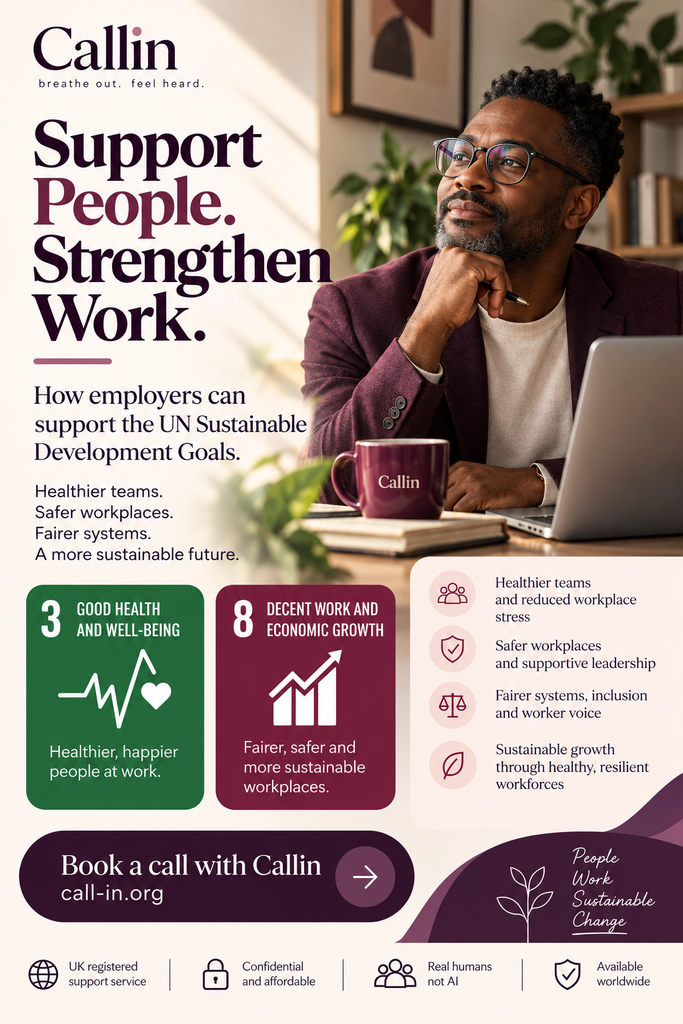
Employers can support the UN Sustainable Development Goals through workplace wellbeing by going beyond wellness benefits and improving the conditions in which people actually work.
The strongest connection is between SDG 3, Good Health and Well-Being, and SDG 8, Decent Work and Economic Growth, particularly through mental health promotion, safe working environments, fair treatment, worker participation, sustainable workloads, and access to meaningful support.
The important word here is not wellness.
It is work.
Because a company can offer meditation subscriptions, fruit bowls, gym discounts, resilience webinars, and an inspirational poster telling everyone to “protect their peace” while simultaneously creating working conditions that make peace almost impossible.
That is where workplace wellbeing needs to grow up.
Key Takeaways
- Employee wellbeing supports UN SDG 3 when organizations promote mental health, prevent avoidable harm, and make support easier to access.
- UN SDG 8 goes further than job creation. It includes decent work, labour rights, productive employment, and safe and secure working environments.
- Workplace wellbeing is not only about benefits. Workload, autonomy, management, relationships, job security, role clarity, fairness, inclusion, and worker voice all influence how people experience work.
- Employers cannot reasonably ask individuals to “be more resilient” while ignoring psychosocial risks created by the organization itself.
- The strongest workplace contribution to sustainable development combines healthier work design with human support, fair systems, responsible leadership, and meaningful employee participation.
What Do the UN Sustainable Development Goals Have to Do With Work?
Quite a lot, actually.
The United Nations adopted the 2030 Agenda for Sustainable Development as a framework for addressing interconnected social, economic, and environmental challenges. Two goals have particularly obvious implications for employers.
SDG 3: Good Health and Well-Being seeks to ensure healthy lives and promote well-being. Target 3.4 explicitly includes the promotion of mental health and well-being.
SDG 8: Decent Work and Economic Growth seeks sustained and inclusive economic growth, productive employment, and decent work for all. Target 8.8 specifically calls for the protection of labour rights and safe and secure working environments for workers.
Put those two goals beside each other and something interesting happens.
Employee wellbeing stops looking like an optional HR extra.
It becomes part of a much broader question:
What kind of economic activity are we creating, and what does participating in it do to the human beings involved?
“Decent Work” Means More Than Having a Job
This distinction matters.
A job can exist without necessarily being good work.
The International Labour Organization describes decent work as productive work that provides fair income, workplace security, social protection, opportunities for development and social integration, freedom for people to express concerns and participate in decisions that affect them, and equality of opportunity and treatment. The ILO’s Decent Work Agenda is organized around four pillars: employment creation, rights at work, social protection, and social dialogue.
That definition is much richer than:
Person has job = sustainability achieved.
People can be employed and still experience chronic insecurity.
They can have impressive salaries and impossible workloads.
They can work for a company with beautiful values on its website while experiencing bullying, discrimination, poor management, or constant fear internally.
They can be invited to a wellbeing webinar at 1 p.m. and return immediately afterward to the conditions making them unwell.
Decent work asks a harder question than whether jobs exist.
It asks about the quality and dignity of working life.
Workplace Wellbeing Is Not the Same as Workplace Perks
There is nothing inherently wrong with workplace perks.
Yoga can be lovely.
Free lunch is rarely offensive.
A four-day company retreat somewhere suspiciously photogenic will probably receive very few complaints.
But perks and wellbeing are not interchangeable.
A genuinely healthy workplace asks whether people have reasonable demands, meaningful control over their work, adequate support, respectful relationships, clear responsibilities, and properly managed organizational change.
In Britain, the Health and Safety Executive uses exactly these six areas in its Management Standards approach to work-related stress: demands, control, support, relationships, role, and change.
That framework tells employers something important.
Employee wellbeing is partly created by how work is designed.
This means the question cannot only be:
“What wellbeing benefits should we add?”
It should also be:
“What is happening inside the ordinary working day?”
The Workplace Itself Can Be a Mental Health Intervention
We usually imagine a mental health intervention as something added after somebody begins struggling.
Counselling.
Therapy.
An EAP.
Coaching.
A helpline.
A support service.
These can all matter.
But there is another category we discuss far less often: the design of work itself.
A manageable workload can be protective.
A manager who communicates clearly can be protective.
Knowing what your job actually is can be protective.
Having autonomy can be protective.
Being able to raise concerns without retaliation can be protective.
Feeling respected by colleagues can be protective.
A culture in which taking annual leave does not require a ceremonial apology can be protective.
WHO’s mental health at work guidance recommends organizational interventions alongside manager training, worker training, individual interventions, return-to-work support, and employment support.
That order matters.
A workplace should not rely entirely on helping people recover from conditions the workplace could reasonably improve.
Psychosocial Risk Is a Workplace Issue, Not a Personality Flaw
Imagine two employees struggling with stress.
One works with clear priorities, reasonable deadlines, supportive management, and some control over how tasks are completed.
The other faces constant interruptions, contradictory demands, public criticism, unpredictable working hours, low autonomy, unclear expectations, and an inbox apparently reproducing while nobody is looking.
Telling both employees to practise better stress management treats two very different problems as though they are identical.
They are not.
The ILO describes psychosocial risks as factors connected to the design and management of work, including workload, work pace, job control, organizational culture, career development, employment security, workplace relationships, and the boundary between work and home.
Its 2026 work on the psychosocial working environment places particular emphasis on workload and working time, role clarity, autonomy, support, and fair and transparent organizational processes.
This gives employers a more useful starting point.
Instead of only asking:
“How do we help stressed employees cope?”
ask:
“What are employees being asked to cope with?”
That question is far more revealing.
Why This Matters Economically Too
Employee mental health is sometimes discussed as though organizations must choose between caring about people and caring about performance.
Reality is less tidy.
Poor working conditions can harm people and organizations.
WHO estimates that depression and anxiety contribute to approximately 12 billion lost working days globally each year, with an estimated US$1 trillion in lost productivity.
The ILO’s 2026 global work on psychosocial risks estimates that these workplace risks are linked to more than 840,000 deaths annually, nearly 45 million disability-adjusted life years lost, and economic losses equivalent to around 1.37 percent of global GDP each year.
Those numbers should not be used to reduce employee wellbeing to a spreadsheet calculation.
Human beings deserve safe and healthy work whether or not kindness delivers an attractive quarterly ROI.
But the economic evidence exposes an old false choice.
Human sustainability and organizational sustainability are not natural enemies.
Organizations depend on people.
Destroying the capacity of those people and then describing the resulting productivity problems as an unfortunate HR issue is not particularly sophisticated management.
Employers Can Start With the Work, Not the Wellness Programme
A strong workplace wellbeing strategy begins by examining the job itself.
Is workload routinely achievable within paid working hours?
Do employees understand what is expected of them?
Do people have enough autonomy to perform their work effectively?
Are managers equipped to manage human beings rather than simply tasks?
Can employees challenge decisions safely?
Do people receive support before performance problems become crises?
Are major organizational changes communicated honestly?
Are repeated structural problems being disguised as individual resilience problems?
This is the territory where workplace stress needs more than wellness programmes.
The objective is not to create work without pressure. Some work is demanding, ambitious, complicated, emotionally intense, or time-sensitive by nature.
The objective is to stop treating avoidable harm as an inevitable feature of seriousness.
Give People More Voice, Not Just More Surveys
Employee listening is fashionable.
Employee influence is harder.
Organizations can collect enormous amounts of feedback without changing anything meaningful.
Annual surveys appear.
Scores are discussed.
A colourful presentation is produced.
Three working groups are announced.
Everybody quietly returns to the same problem.
Social dialogue is one of the four pillars of the ILO’s Decent Work Agenda. The ILO describes it broadly as negotiation, consultation, and the exchange of information between governments, employers, and workers or their representatives about issues affecting economic and social life.
Inside an organization, the underlying principle is valuable even outside formal industrial relations structures:
People should have meaningful ways to influence the conditions under which they work.
Listening without responsiveness eventually becomes theatre.
If employees repeatedly identify unsustainable workloads, bullying, poor communication, unfair processes, or confusing responsibilities, another listening exercise is unlikely to be the intervention they are waiting for.
Train Managers for the Human Part of Management
People are often promoted because they are technically competent.
Then, somewhere between the congratulatory email and the new Microsoft Teams permissions, they are suddenly expected to understand motivation, conflict, grief, boundaries, burnout, communication, performance difficulties, psychological safety, disability, cultural differences, and human distress.
Good luck, Susan.
Management is a human job.
WHO specifically recommends manager training for mental health at work, including helping managers recognize and respond to emotional distress and understand how job stressors affect mental health.
This does not mean managers should become therapists.
They should not diagnose employees.
They should not interrogate somebody about their private life.
And they should not become the sole emotional support system for their team.
Good managers need a different skill set: noticing changes, listening without panic, responding respectfully, understanding organizational support routes, handling concerns appropriately, managing workload realistically, and knowing when something is beyond their role.
Sometimes the most psychologically safe sentence a manager can say is:
“You don’t have to tell me anything you don’t want to. Let’s look at what support or adjustments might help.”
Make Support Available Before Crisis
Many workplace support systems are implicitly designed around escalation.
An employee becomes visibly distressed.
Performance declines.
Absence increases.
Someone finally notices.
Support appears.
But by then, the person may have been struggling quietly for months.
A more sustainable model includes preventive emotional care, which means creating routes to support before everyday stress becomes overwhelming.
This does not mean treating ordinary human emotion as illness.
Quite the opposite.
People experience breakups.
Bereavement.
Loneliness.
Caregiving.
Financial worries.
Career uncertainty.
Family conflict.
Moving home.
Parenthood.
Identity changes.
Workplace frustration.
Sometimes they are not ill.
They are human beings having a difficult month while also being expected to attend the 9:30 meeting.
A healthy workplace can recognize both realities at once.
Do Not Turn Every Human Difficulty Into a Performance Problem
This may be one of the most underrated pieces of workplace wellbeing.
An employee going through a divorce might temporarily be distracted.
A grieving employee might not be their usual self.
A new parent might be exhausted.
An international employee may be lonely or homesick.
Someone navigating menopause, caring responsibilities, disability, family illness, relationship problems, or financial pressure may temporarily have less emotional capacity than usual.
Organizations still need standards.
Work still needs to happen.
But decent work leaves room for context.
There is a difference between accountability and pretending employees cease to have personal lives when they log in.
Compassion does not require abandoning standards. It changes how responsibly we apply them.
That balance is where good leadership lives.
Address Burnout Upstream
Burnout should not become another individual self-improvement project.
WHO defines burnout as an occupational phenomenon resulting from chronic workplace stress that has not been successfully managed. That definition should immediately turn at least part of an employer’s attention toward the workplace.
Of course individuals can protect boundaries, seek support, rest, reassess priorities, and make career choices.
But asking an employee to recover from burnout while nothing around them changes can become absurd.
You cannot mindfulness your way out of permanent understaffing.
A gratitude journal cannot clarify contradictory job responsibilities.
Breathing exercises have yet to defeat a manager who sends seventeen messages at midnight.
Organizations concerned about burnout should therefore examine the sources of chronic stress, not merely teach people how to survive them.
For a deeper exploration, see professional burnout and how recovery can begin.
Recognize Emotional Labor
Some work is psychologically demanding even when workload metrics look perfectly reasonable.
Healthcare professionals regulate their emotions around suffering.
Managers absorb anxiety from teams.
Customer service employees remain polite while being insulted.
Teachers manage classrooms while monitoring dozens of emotional dynamics.
Founders project stability while carrying financial uncertainty.
Support workers and carers regularly sit beside other people’s distress.
That invisible work still costs energy.
If organizations measure demands only through hours, tasks, and output, they may completely miss the emotional burden attached to a role.
Understanding how emotional labor affects people allows employers to think more intelligently about supervision, recovery, staffing, boundaries, and support.
Not every difficult job should become easy.
But difficult work should not require people to pretend it is effortless.
Psychological Safety Is Not “Everybody Being Nice”
A psychologically safe workplace is not a workplace where nobody disagrees.
That would probably be slightly terrifying.
Healthy teams challenge ideas.
Give feedback.
Raise concerns.
Admit mistakes.
Ask questions.
Disagree.
The critical difference is whether people can do those things without humiliation, punishment, retaliation, or fear.
Psychological safety therefore matters to wellbeing because silence is expensive.
Employees who cannot safely say “this workload is becoming unmanageable” often wait.
People who cannot question unclear instructions guess.
Workers who fear retaliation may remain silent about bullying, discrimination, unsafe practices, or mistakes.
Eventually, problems that could have been discussed early become much larger.
A sustainable workplace is not one without difficult conversations. It is one capable of having them.
Inclusion Is Part of Decent Work
There is another reason workplace wellbeing and sustainability cannot be separated.
People do not experience workplaces identically.
Disability, gender, race, migration status, sexuality, age, caring responsibilities, socioeconomic background, contract type, and other circumstances can influence people’s exposure to risk and access to opportunity.
SDG 8 specifically refers to decent work for all, while its targets include equal pay, employment opportunities, labour rights, and safe working environments. The ILO also places equality of opportunity and treatment within its conception of decent work.
This is where SDG 8 naturally intersects with other goals, including SDG 5, Gender Equality, and SDG 10, Reduced Inequalities.
An organization cannot credibly speak about employee wellbeing while some groups consistently experience less security, less voice, worse treatment, or fewer opportunities.
Wellbeing without fairness eventually develops a credibility problem.
Measure What Matters, but Do Not Reduce People to Metrics
Measurement helps.
Organizations can monitor absence, turnover, employee feedback, workload, working hours, usage of support services, reported stressors, psychological safety, retention, manager capability, and patterns across teams.
HSE’s stress framework encourages organizations to assess the underlying causes of work-related stress rather than waiting for harm to become obvious.
But metrics need interpretation.
High usage of emotional support services might indicate a problem.
Or it might indicate that people trust the support.
Low usage might mean everyone is thriving.
Or nobody believes the service is confidential.
Context matters.
The objective is not to obtain a beautiful wellbeing score.
It is to understand working life accurately enough to improve it.
What Smaller Employers Can Do
Sustainable workplace practices are not reserved for multinational corporations with an ESG department, seven employee networks, and somebody whose entire job title contains the words “global people experience transformation.”
Small organizations influence working life too.
Sometimes more directly.
A ten-person business may not have an enormous wellbeing budget, but it can still establish reasonable workloads, transparent expectations, flexibility where possible, respectful leadership, fair processes, access to support, and channels for employees to raise concerns.
The advantage smaller organizations often have is proximity.
Leaders can see how work is actually happening.
The danger, of course, is that proximity can become chaos when boundaries and systems are weak.
The goal is not corporate sophistication.
It is responsible work.
Where Non-Clinical Emotional Support Can Fit
Not every employee difficulty requires therapy, and not every conversation belongs with a manager.
Some people simply need a confidential, objective person with whom they can talk through workplace stress, burnout, loneliness, life changes, relationships, career pressure, or other concerns without worrying about burdening colleagues or family.
Near that gap, Callin’s non-clinical mental health support provides one-to-one conversations with real human listeners, while career coaching for professionals is available when the issue is more specifically about career direction, decisions, or professional development.
Neither replaces therapy, occupational health, HR processes, medical care, or crisis services.
The value is different.
Sometimes people need somewhere to think before they know what they need to do.
From Employee Wellbeing to Human Sustainability
There is a useful shift happening in how we think about workplace wellbeing.
For years, the central question was:
“What can we offer employees to help them feel better?”
The more mature question is:
“What kind of working environment are we asking people to participate in?”
That moves organizations from benefits to systems.
From crisis response to prevention.
From resilience alone to shared responsibility.
From listening surveys to worker voice.
From wellbeing theatre to decent work.
And from seeing people merely as inputs into productivity to recognizing a simple truth:
Economic growth is ultimately being produced by human beings. Sustainable growth cannot ignore whether those human beings can sustainably participate in it.
That is where SDG 3 and SDG 8 meet.
Good health and well-being.
Decent work and economic growth.
Not competing ambitions.
Two parts of the same idea.
Frequently Asked Questions
How can employers support the UN Sustainable Development Goals?
Employers can support the SDGs through how they hire, pay, manage, develop, protect, and listen to workers, as well as through their environmental and community impacts. For workplace wellbeing specifically, SDG 3 and SDG 8 are particularly relevant because they address mental well-being, decent work, labour rights, productive employment, and safe working environments.
An employer’s SDG contribution therefore happens partly through everyday management decisions, not only through philanthropy or sustainability reporting.
How does workplace wellbeing support SDG 3?
SDG 3 includes the promotion of mental health and well-being under Target 3.4. Employers can contribute by reducing avoidable workplace stressors, promoting healthier working conditions, enabling access to support, strengthening manager capability, and creating environments where people can raise concerns early.
Employers do not replace healthcare systems, but they strongly influence a setting where many adults spend a substantial proportion of their lives.
What does SDG 8 mean for employers?
SDG 8 concerns sustainable economic growth, productive employment, and decent work. Relevant employer responsibilities include fair treatment, safe and secure working environments, respect for labour rights, equality of opportunity, productive employment, and working practices that allow people to participate with dignity.
The concept of decent work therefore goes considerably beyond simply creating jobs.
Are employee wellbeing programmes enough to support the SDGs?
Not by themselves.
Wellbeing programmes can provide useful resources, but employers should also examine how work is structured and managed. Workload, autonomy, relationships, role clarity, support, organizational change, fairness, working time, and workplace culture can all affect worker health and well-being.
A wellbeing programme is strongest when it complements healthy work rather than attempting to compensate for unhealthy work.
What are psychosocial risks at work?
Psychosocial risks are workplace factors that may negatively affect psychological or physical health. They can arise from job demands, workload, low control, poor support, workplace relationships, organizational culture, job insecurity, working time, harassment, and the way work is designed or managed.
Managing these risks is part of building safer and healthier working environments.
How can small businesses contribute to SDG 3 and SDG 8?
Small businesses can contribute even without large wellbeing budgets. Clear roles, manageable demands, fair treatment, employee voice, healthy boundaries, supportive management, reasonable flexibility, safer working conditions, and access to appropriate support can all strengthen working life.
Sustainable employment begins with everyday decisions about how people are treated.
Does supporting employee mental health mean employers are responsible for employees’ personal lives?
No.
Employers cannot remove every source of distress from someone’s life, nor should managers become therapists. Their responsibility is to create responsible working conditions, address workplace risks they can influence, respond appropriately when somebody is struggling, and make reasonable routes to further support available.
There is an important difference between taking responsibility for someone’s life and taking responsibility for the environment you employ them in.