

If you are looking for the best EAP for a startup or small business, the longest feature list is not necessarily the best place to start. The right Employee Assistance Programme is the one your employees will actually use, trust and access when they need it, which is exactly what Callin provides to startups and small businesses worldwide.
For founders, People leads and HR decision-makers, the real question is not simply, “Which EAP provider is best?”
It is:
What kind of support will our people actually reach for before stress becomes a crisis?
Small businesses and startups face particular challenges when choosing employee mental health support. Budgets can be limited, teams may be distributed, HR resources may be stretched, and employees may be reluctant to use a service they do not fully understand or trust.
This guide explains what to look for in an EAP for a small business, how traditional EAPs compare with other forms of employee mental health support, and where confidential non-clinical emotional support can complement an existing workplace wellbeing strategy.
Key Takeaways
- The best EAP for a startup is the one employees will actually use. Prioritise confidentiality, easy access, real human support and a service that fits how your team works.
- Small businesses do not necessarily need an enterprise-style EAP. Check minimum employee numbers, pricing, flexibility and whether the programme is designed for smaller teams.
- Confidentiality is essential. Employees need to understand what their employer can and cannot see before they will feel comfortable using workplace mental health support.
- Human connection matters. Employees may want to speak to a real person rather than rely solely on apps, automated tools or self-guided resources.
- Continuity can make support easier to use. Having the option to speak with the same person again can mean employees do not have to repeatedly explain their situation from the beginning.
- Not every employee who is struggling needs therapy. Some people need clinical treatment, while others may benefit from non-clinical emotional support, coaching or simply having someone safe to talk to.
- An EAP is not a complete workplace wellbeing strategy. Organisations still need to address workload, management, role clarity, psychological safety and the conditions contributing to workplace stress.
- A layered approach can work better than one service trying to do everything. An EAP, therapy benefit, manager support, organisational changes and non-clinical emotional support can complement one another.
- Callin can complement an existing EAP. Callin provides confidential, one-to-one, non-clinical emotional support for employees, founders and professionals dealing with stress, burnout, loneliness, career uncertainty and everyday life challenges.
- The best workplace wellbeing investment is support people can access before they reach breaking point. Prevention matters as much as intervention.
What Is the Best EAP for a Startup?
There is no single best EAP for every startup.
The right choice depends on your team size, budget, working arrangements and the type of support your employees are most likely to use.
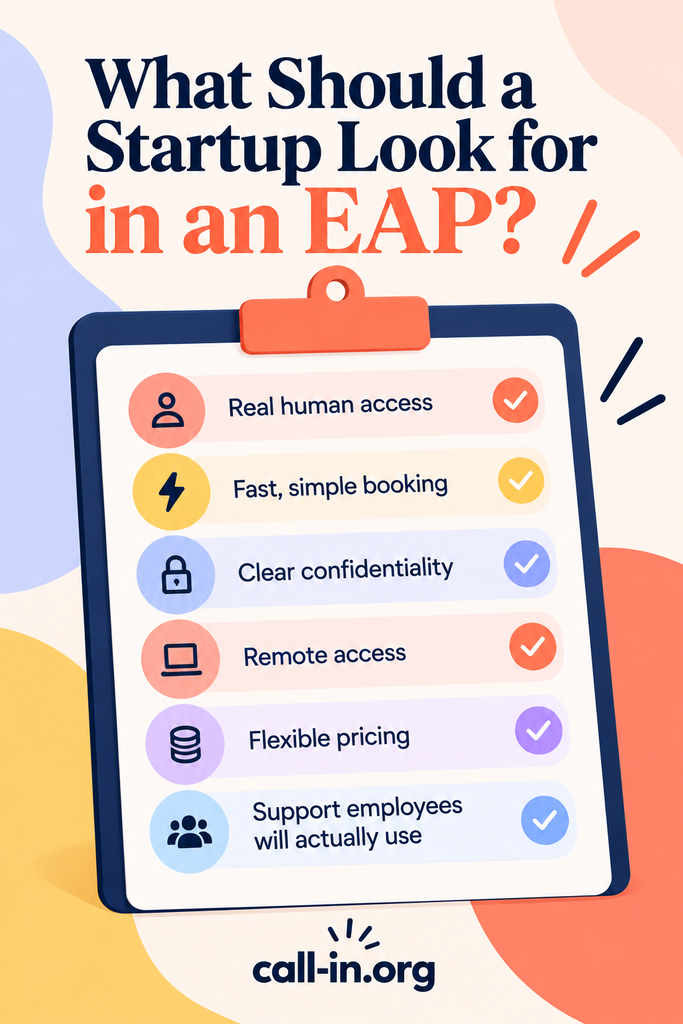
For most startups and small businesses, the strongest EAP providers should offer:
- Support for small teams and low employee numbers
- Simple and fast access
- Confidentiality that employees can clearly understand
- Access to real people
- Remote and online support
- Appropriate clinical and crisis pathways
- Support that works across different locations and time zones
- Straightforward implementation
- Transparent pricing
- A service employees actually want to use
The useful test is not:
“Does this EAP look comprehensive on paper?”
It is:
“If one of our employees is overwhelmed at 9pm, stressed about work, struggling with burnout or dealing with something difficult in their personal life, will they actually feel comfortable using this service?”
That is where the difference between having a benefit and having a useful benefit becomes important.
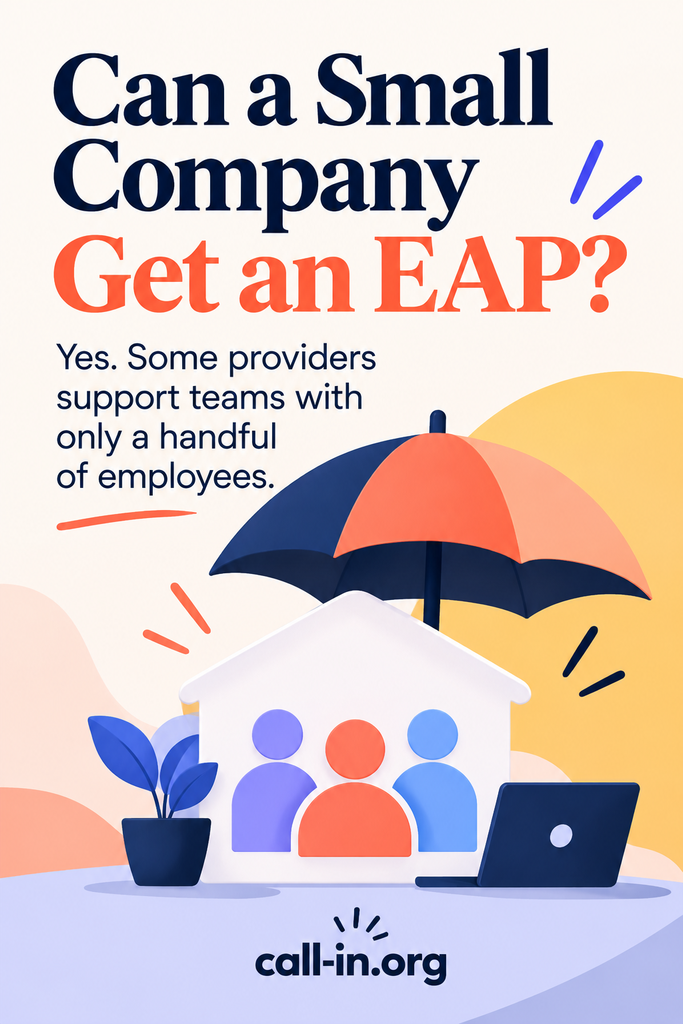
Can a Small Company Get an EAP With Only a Few Employees?
Yes, although eligibility and pricing vary between providers.
Some EAP providers work with very small companies, while others have minimum employee requirements or pricing structures designed primarily for larger organisations.
For a startup with five, ten or twenty employees, it is worth checking:
- Minimum employee numbers
- Cost per employee
- Whether there is a fixed annual fee
- Whether pricing changes as your team grows
- Whether employees can access support remotely
- Whether family members are included
- Whether there are additional charges for counselling or specialist services
Traditional EAP models may be more economical at larger headcounts. For very small companies, a flexible employee wellbeing service or non-clinical emotional support platform may sometimes be a better fit.
A small company does not need an enterprise-sized programme to provide meaningful mental health support.
It needs something employees can understand, trust and use.
What Should a Startup Look for in an EAP Provider?
When comparing EAP providers for a small business, focus on the things that affect real-world usage rather than the length of the brochure.
Ask:
Does the EAP accept small companies?
Find out whether the provider works with startups and small businesses and whether there is a minimum headcount.
How quickly can employees access support?
Long waiting periods and complicated intake processes can discourage people from asking for help.
Ask how quickly someone can have their first conversation and whether evening or weekend support is available.
Will employees speak to a real person?
Some mental health platforms rely heavily on apps, digital content or automated tools.
If your employees value human conversation, check whether speaking with a real person is central to the service.
Can employees speak to the same person more than once?
Continuity is often overlooked.
Having to explain your situation to a different person every time can become exhausting, particularly when someone is dealing with ongoing workplace pressure, loneliness or burnout.
Is the service genuinely confidential?
Employees need to know what their employer can and cannot see.
A vague statement that a service is “confidential” is not enough.
Ask the provider exactly what information is shared with the employer, what is aggregated or anonymised, and what happens in safeguarding or serious-risk situations.
Does it work for remote employees?
For distributed teams, telephone-only or office-based support may not be enough.
Look for secure online access, flexible booking and availability across the locations where your employees actually work.
What happens when someone needs more than short-term support?
An EAP should have clear boundaries and appropriate referral pathways when an employee needs longer-term therapy, specialist clinical care or crisis support.
What Does an EAP Include?
Employee Assistance Programmes vary significantly between providers.
A traditional EAP may include:
- Short-term counselling
- Emotional support
- Work-related stress support
- Bereavement support
- Relationship support
- Financial guidance
- Legal information
- Family support
- Manager consultations
- Critical incident support
- Referrals to specialist services
- Online wellbeing resources
Not every EAP includes every service.
Before choosing a provider, ask exactly what is included in your contract and whether there are limits on counselling sessions or particular types of support.
Do Startups Need a Traditional EAP?
Not necessarily.
A traditional EAP can be extremely useful, particularly when a business needs access to counselling, practical resources, referrals and defined clinical pathways.
But startups can have different needs.
Founders and employees may be dealing with:
- High workloads
- Rapid organisational change
- Funding pressure
- Unclear boundaries
- Remote isolation
- Founder burnout
- Career uncertainty
- Job insecurity
- Difficult management situations
- Pressure to remain constantly productive
Not every person experiencing those challenges is looking for therapy.
Sometimes they need someone to talk to.
Sometimes they need coaching.
Sometimes they need clinical treatment.
Sometimes the organisation needs to change the working conditions creating the problem.
That is why a layered workplace wellbeing strategy can be more useful than expecting one service to solve everything.
EAP vs Therapy Benefit vs Emotional Support: Which Is Best for a Startup?
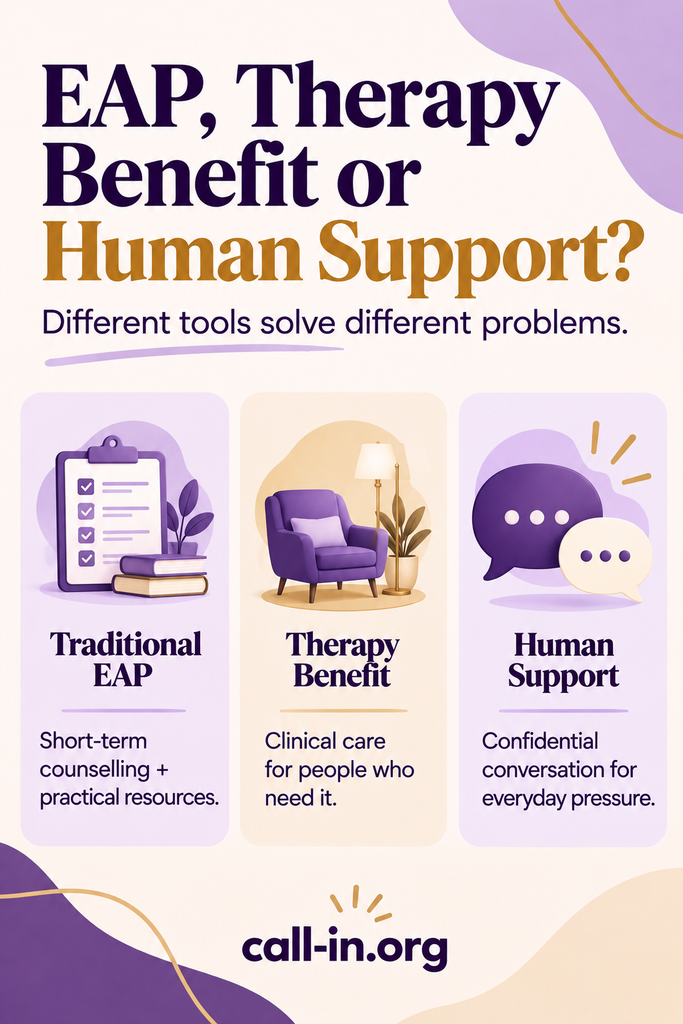
These services solve different problems.
A traditional EAP can provide a broad package of short-term counselling, practical support, resources and referrals.
A therapy benefit or therapy stipend can help employees access clinical treatment when they need it.
A non-clinical emotional support service provides a confidential space to talk about everyday pressure, stress, loneliness, burnout risk, relationship difficulties and other life challenges without framing the conversation around diagnosis or treatment.
A startup does not necessarily have to choose only one.
A company could provide an EAP alongside therapy access and a preventive emotional support option.
The important thing is to match the support to the need.
Will Employees Actually Use Your EAP?
This may be the most important question of all.
An employee mental health benefit has little value if nobody trusts it enough to use it.
Employees may avoid workplace support because:
- They do not know it exists
- They are unsure what it covers
- They worry their employer will find out
- They do not think their problem is serious enough
- They do not want therapy
- They have had a poor experience with a previous provider
- They find the booking process complicated
- They do not want to explain their situation repeatedly
This is why accessibility, confidentiality and human connection can matter more than an impressive list of features.
Your employees should know:
What is this service?
Who can use it?
How do I access it?
Is it confidential?
What happens when I speak to someone?
And perhaps most importantly:
Can I use it before things become really bad?
Is EAP Support Confidential?
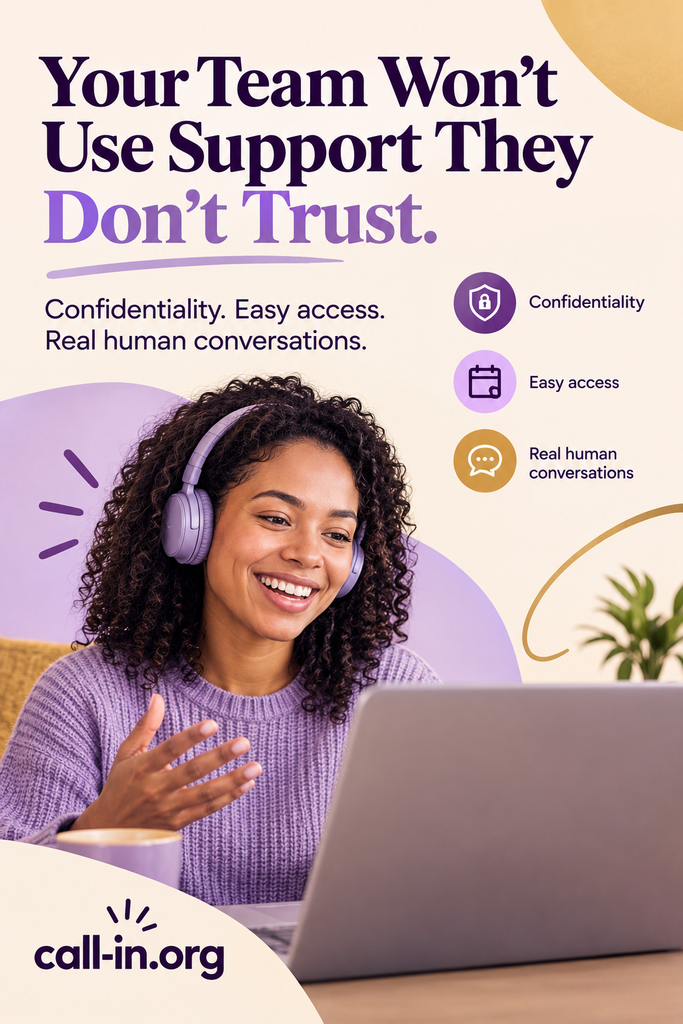
Confidentiality is one of the biggest considerations when choosing workplace mental health support.
Employees need to know that their private conversations are not being passed back to their manager or HR department.
Most reputable EAPs treat individual conversations as confidential and may provide employers with aggregated information about overall service usage.
However, confidentiality arrangements differ between providers and contracts.
Employers should therefore ask:
- What information does the employer receive?
- Is reporting aggregated or individual?
- Can an employer see who accessed the service?
- What information is recorded?
- What happens if there is a serious safeguarding concern?
- How are employees informed about the limits of confidentiality?
The clearer the answer, the easier it is for employees to trust the service.
Will Employees Speak to a Real Person?
For many people, yes.
When someone is overwhelmed, lonely, stressed or emotionally exhausted, an article or app can be useful, but sometimes what they really want is another human being.
Callin is built around human conversation.
Callin provides confidential, one-to-one, non-clinical emotional support with trained human listeners. It is not an AI chatbot service and it does not provide therapy, diagnosis, psychiatric care or crisis intervention.
The purpose is simple:
Give people somewhere safe to talk.
Employees can talk about workplace stress, burnout, loneliness, relationship difficulties, career uncertainty, low moods and other life challenges.
Can Employees Speak to the Same Person More Than Once?
Continuity matters.
When someone is already overwhelmed, having to tell their story from the beginning every time they seek support can create another barrier to asking for help.
Callin uses a Human Continuity approach and aims to keep people with the same listener wherever operationally possible.
That means the person does not always have to start from zero.
The listener can develop an understanding of the person’s situation, making it easier to return and continue the conversation.
What Is the Difference Between an EAP and Non-Clinical Emotional Support?
An EAP is a structured workplace benefit that may include counselling, practical advice, referrals and other services.
Non-clinical emotional support is different.
It is designed for people who may not need diagnosis or treatment but still want somewhere safe and confidential to talk.
Someone might be struggling with:
- Work stress
- Burnout
- Loneliness
- Relationship problems
- Career uncertainty
- Low mood
- Difficult life changes
- Feeling overwhelmed
- Pressure at work
- Problems they simply cannot make sense of yet
They may not be looking for therapy.
They may just need someone who will listen, ask thoughtful questions and help them explore what they want to do next.
That is where Callin can complement an EAP.
Can Callin Complement an Existing EAP?
Yes.
An EAP does not have to be the entire workplace wellbeing strategy.
Callin can provide an additional, preventive layer of confidential human support for employees, founders and professionals who want somewhere to talk about workplace pressure, burnout, loneliness, career uncertainty or everyday emotional challenges.
This can be particularly useful when:
- An employee does not want therapy
- An employee wants non-clinical support
- An EAP has limited counselling sessions
- Employees want continuity
- The team is remote or distributed
- People want support before they reach breaking point
Callin does not replace an EAP, therapy, occupational health or crisis services.
It complements them.
For a broader look at how workplace wellbeing can be approached, read the Callin Support Guide to Workplace Wellbeing using the UN Sustainable Development Goals.
For more information about workplace mental health support at Callin Support, explore our dedicated guide.
Can Callin Work as an Employee Wellbeing Benefit for a Small Team?
For small and distributed teams looking for accessible human support, Callin can provide a flexible wellbeing option.
Employees can access confidential one-to-one support online, with voice or video conversations and a private chat option.
The focus is on making human support accessible before stress becomes overwhelming.
This is particularly relevant for startups where employees may be dealing with intense workloads, rapid growth, blurred boundaries and the pressure to keep performing regardless of how they feel.
How Can an EAP Help With Workplace Stress and Burnout?
An EAP can give employees somewhere to turn when work-related stress becomes difficult to manage.
But workplace burnout cannot be treated as an individual problem alone.
If excessive workload, poor management, unclear responsibilities, lack of autonomy or an unhealthy culture are contributing to stress, the organisation also needs to address those conditions.
For employees who need somewhere to talk about work stress and burnout, read Someone to Talk to for Work Stress and Burnout.
For practical guidance, explore 9 Helpful & Easy Steps to Overcoming Professional Burnout and 3 Reasons Peer Connection Prevents Burnout.
You can also read Burnout at Work? 13 Reasons Why Callin Is the Best Safe Space to Vent and Beat Burnout at Work.
What Should a Startup Do About Founder Burnout?
Founders often carry a unique combination of financial pressure, responsibility, uncertainty and emotional isolation.
The expectation to remain productive can make it difficult to admit when things are becoming too much.
Support for founders should therefore be considered part of workplace wellbeing, not an optional extra.
Founders also need somewhere to talk without having to perform competence all the time.
The same principle applies to employees.
Support should be available before people reach crisis point, not only after they do.
What If an Employee Needs Someone to Talk to but Does Not Want Therapy?
This is where the distinction between therapy and emotional support matters.
Therapy can be the right option when someone needs clinical treatment or wants to work with a qualified therapist on psychological difficulties.
But not every difficult experience requires therapy.
Someone might simply want to talk through what is happening at work, understand their feelings, explore their options or make sense of a difficult situation.
For employees asking, “Who can I talk to about work burnout if I don’t want therapy?”, read Who Can I Talk to About Work Burnout That Is Not Therapy?.
For people experiencing low mood and looking for someone to talk to, see Low Mood and Need Someone to Talk To.
Why Workplace Wellbeing Needs More Than an EAP
An EAP can support an employee.
It cannot fix an unhealthy workplace.
If workload, poor management, unclear roles or psychological safety are contributing to stress, those organisational issues still need to be addressed.
That is why workplace wellbeing should combine individual support with organisational responsibility.
Read Why Workplace Stress Needs More Than Wellness Programmes for more on this distinction.
Workplace wellbeing should not mean teaching employees to cope indefinitely with conditions that are making them unwell.
It should mean creating healthier conditions while ensuring people have somewhere to turn when life becomes difficult.
How Can Employers Support Employees Outside the EAP?
A strong workplace wellbeing strategy can include:
- A well-communicated EAP
- Clear mental health policies
- Manager training
- Psychological safety
- Reasonable workplace adjustments
- Occupational health
- Clinical referral pathways
- Preventive emotional support
- Career coaching
- Founder and leadership support
- Healthy workload design
- Clear roles and responsibilities
Employees also need permission to be human.
A person does not stop being human when they log into work.
They bring stress, relationships, grief, financial pressure, loneliness, ambition and uncertainty with them.
That is why workplace wellbeing needs to consider the whole person.
What If Productivity Is Affecting an Employee’s Wellbeing?
High performance can sometimes become tied to identity.
An employee may feel guilty when they stop working, struggle to rest or believe they are only valuable when they are productive.
Read Why Do I Feel Guilty When I’m Not Working? and Why Does My Self-Worth Depend on Productivity? for a deeper look at productivity, identity and emotional wellbeing.
Success can also create unexpected emotional challenges.
Read Why Do Promotions Feel Surprisingly Lonely? for more on the isolation that can sometimes accompany career progression.
How Does Workplace Culture Affect Employee Wellbeing?
Workplace culture shapes how safe people feel asking for help, setting boundaries, admitting mistakes and saying that they are struggling.
When people feel unseen or unsupported, the emotional cost can be significant.
Feeling Unseen at Work? You’re Not “Too Sensitive”: It’s Psychological Contract Breach explores why feeling invisible at work can become so draining.
And for teams struggling with the expectation to constantly stay busy, read Capitalism-Induced Stress: 5 Ways to Cope with Busy Culture.
How Can Employees Manage Workplace Stress?
Workplace stress can come from workload, uncertainty, relationships, financial pressure, lack of control, poor boundaries and many other factors.
Individual stress-management techniques can help, but employees should not be expected to solve organisational problems through resilience alone.
For practical strategies, read the Callin Stress Management Guide: 10 Proven Techniques to Reduce Stress.
The aim should be to support the person while also examining the conditions contributing to the stress.
Frequently Asked Questions About EAPs for Startups and Small Businesses
What is the best EAP for startups?
There is no universal best EAP. The right provider depends on your team size, budget, working arrangements and support needs. Small businesses should prioritise confidentiality, accessibility, human support, speed and a model employees will actually use.
What is the best EAP for a small business?
The best EAP for a small business is one that fits the company’s headcount and budget while providing accessible, confidential support employees trust. Check minimum employee requirements, pricing, access, session limits and referral pathways.
Can a startup with only a few employees get an EAP?
Yes. Some providers work with very small teams, although minimum employee numbers and pricing vary. Smaller businesses should compare traditional EAPs with flexible wellbeing and emotional support options.
Does an EAP include therapy?
Some EAPs include short-term counselling, but this varies. An EAP is not automatically equivalent to ongoing therapy or specialist clinical treatment.
Is an EAP confidential?
EAP conversations are generally designed to be confidential, but employers should check exactly what information the provider shares, whether reporting is aggregated and what the exceptions to confidentiality are.
Will employees speak to a real person?
Some EAPs provide access to counsellors or other professionals, while others rely more heavily on digital resources. Employers should check whether human conversation is a central part of the service.
Can employees speak to the same person?
This depends on the provider. Continuity is not guaranteed by every EAP. Callin uses a Human Continuity approach and aims to keep people with the same listener wherever operationally possible.
Should a startup choose an EAP or therapy benefit?
It depends on what the team needs. An EAP can provide broad short-term support and referrals, while a therapy benefit can help fund clinical treatment. Some startups may benefit from combining these with non-clinical emotional support.
Can Callin replace an EAP?
No. Callin is a non-clinical emotional support service and does not replace an EAP, therapy, occupational health or crisis services. It can complement an existing EAP as an accessible preventive support layer.
Can Callin support remote employees?
Yes. Callin provides online human support designed for people who may not be working from a traditional office environment.
What Is the Best EAP Strategy for a Small Business?
The best workplace wellbeing strategy is not necessarily the one with the most services.
It is the one that gives employees appropriate support at the right time.
That may mean an EAP for short-term counselling and practical support.
It may mean a therapy benefit for employees who need clinical treatment.
It may mean manager training and better workload design.
It may mean confidential non-clinical emotional support for people who simply need someone to talk to.
And often, it means a combination.
The goal is not to make one service responsible for every aspect of employee wellbeing.
The goal is to create a workplace where people know where to turn when they are struggling and where the organisation is also willing to address the conditions contributing to that struggle.
Happy team, successful company.
If you can get a gym membership for your body, you can get a Callin membership for your mind.
If your startup or small business is looking for confidential, human emotional support that can sit alongside an existing EAP or provide an accessible wellbeing option for your team, explore Callin Support.
Leave a Reply