
If you are looking for work stress support, you may not need somebody to immediately tell you to quit your job, meditate harder, or buy a new planner. Sometimes you need someone who will listen while you work out what is actually wearing you down.

Work stress can come from workload, poor management, low control, conflict, uncertainty, emotional labor, job insecurity, or simply being “on” for too long. Burnout is more specific. The World Health Organization describes burnout as an occupational phenomenon resulting from chronic workplace stress that has not been successfully managed.
And yes, sometimes the first useful intervention is simply having a proper conversation about it.
Key Takeaways
- Work stress and burnout are related, but they are not exactly the same thing. Burnout develops in the context of chronic workplace stress.
- Workplace stress is not always a personal resilience problem. Workload, low autonomy, poor support, unclear roles, difficult relationships, and badly managed change can all contribute.
- Feeling exhausted by work does not automatically mean you need to quit. Understanding what is causing the stress can make your options clearer.
- Talking to someone can help you separate the job itself from the manager, workload, workplace culture, career uncertainty, boundaries, or other factors causing distress.
- Healthy workplaces and accessible emotional support contribute to both UN Sustainable Development Goal 3, Good Health and Well-Being, and Goal 8, Decent Work and Economic Growth.
Work Stress Is More Than “Having a Busy Week”
Most people have stressful days at work.
The deadline moves forward.
Someone schedules a meeting that could absolutely have been an email.
Your manager sends “Hi, can we chat?” with no context and disappears for forty-five minutes, apparently choosing psychological warfare before lunch.
You survive.
That is not necessarily burnout.
Work stress becomes more concerning when pressure feels persistent, recovery becomes difficult, and work begins spilling into the emotional space that used to belong to the rest of your life.
You finish work but continue rehearsing conversations in the shower.
You wake up thinking about your inbox.
Sunday afternoon develops a suspicious emotional atmosphere.
A perfectly innocent Teams notification somehow causes your whole body to go, “Absolutely not.”
This is when “I am just busy” may no longer describe the full picture.
What Is Burnout?
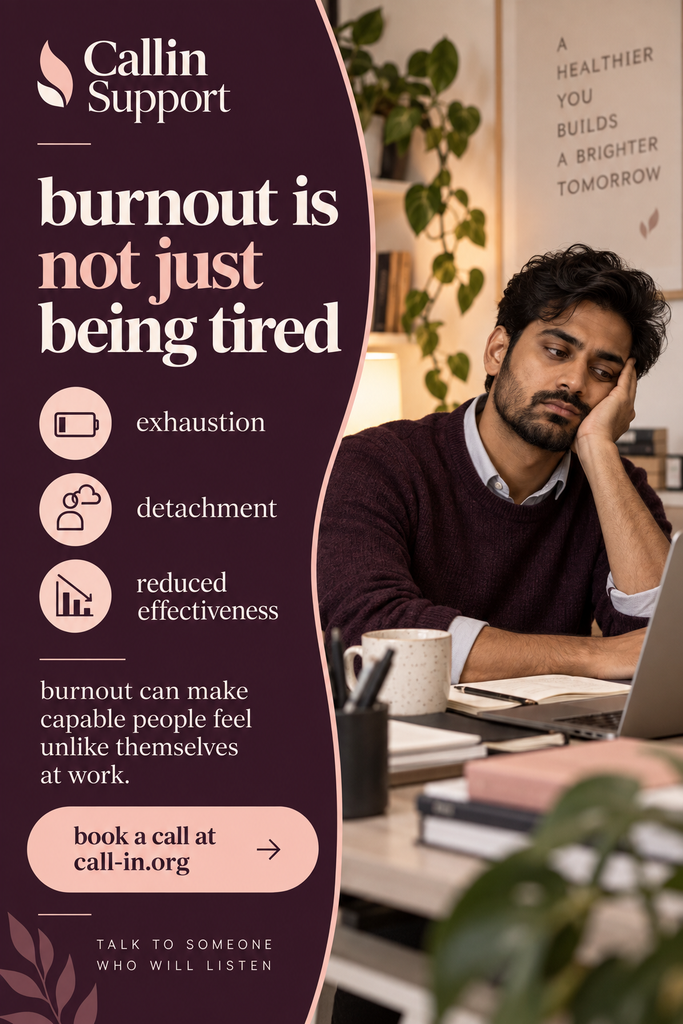
Burnout is often used casually to mean exhaustion, but the clinical and occupational definition is more precise.
The World Health Organization classifies burnout as an occupational phenomenon, not a medical condition. It identifies three core dimensions: exhaustion, increasing mental distance or cynicism toward work, and reduced professional effectiveness.
In plain English, burnout may look like:
You are tired.
Then you become emotionally detached.
Then work that you once handled competently begins to feel strangely difficult or pointless.
You may start thinking:
“I genuinely do not care anymore.”
“I cannot concentrate.”
“Everybody wants something from me.”
“Why does every tiny task feel enormous?”
“I used to be good at this.”
That last thought can be particularly painful.
Burnout can make competent people question their competence.
But exhaustion changes performance. Reduced capacity under chronic stress is not automatically evidence that you have suddenly become lazy, stupid, or bad at your job.
If that pattern sounds familiar, this deeper guide on professional burnout and how to recover explores it further.
Why Does Work Become So Stressful?
One of the least helpful ways to discuss work stress is to make the entire conversation about personal resilience.
Yes, individual coping matters.
So does the actual environment somebody is coping with.
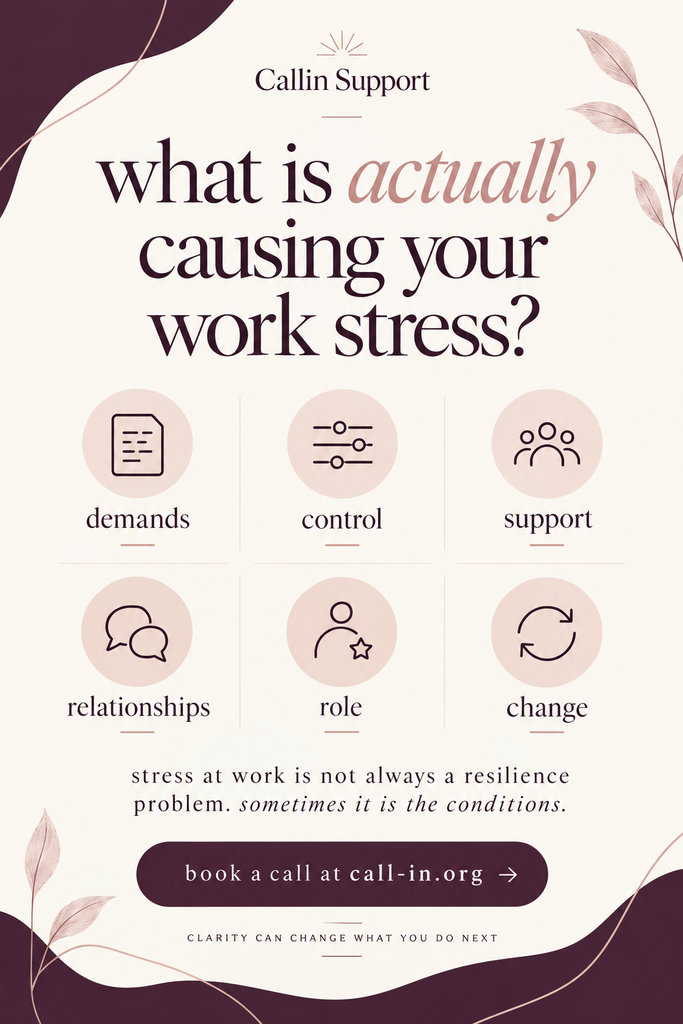
The UK’s Health and Safety Executive identifies six areas of work design strongly associated with work-related stress when they are poorly managed:
Demands. Your workload, hours, deadlines, environment, and pace.
Control. How much influence you have over the way you work.
Support. Whether managers, colleagues, resources, and systems actually help you do your job.
Relationships. Conflict, bullying, disrespect, isolation, or difficult interpersonal dynamics.
Role. Whether expectations and responsibilities are clear or contradictory.
Change. How organizational changes are managed and communicated.
This framework is useful because it changes the question.
Instead of:
“Why can’t I cope?”
you can begin asking:
“What exactly am I trying to cope with?”
Those are very different questions.
Sometimes It Is Not the Workload. It Is the Lack of Control.

Two people can have equally demanding jobs and experience them very differently.
One has autonomy, trust, information, reasonable flexibility, and a manager who says, “Here is the outcome we need. Tell me what you require.”
The other has fourteen approval layers, constant monitoring, changing instructions, pointless check-ins, and someone hovering digitally over their shoulder like a managerial ghost.
Same workload?
Perhaps.
Same psychological experience?
Absolutely not.
Research and workplace guidance repeatedly identify low job control as a psychosocial risk. WHO lists excessive workloads, low job control, job insecurity, discrimination, inequality, and other poor working conditions among risks to mental health at work.
This is also why being micromanaged after having autonomy can feel particularly difficult. Losing control can feel different from never having had it in the first place.
Sometimes burnout is not caused by having too much to do. It is caused by having too little control over how you do it.
A Difficult Boss Can Make an Ordinary Job Feel Exhausting
People sometimes spend months trying to decide whether they hate their profession when what they actually hate is their manager.
That distinction matters.
Consider two versions of the same job.
In one workplace, mistakes can be discussed. Expectations are clear. Feedback is specific. You can disagree without fearing retaliation.
In another, priorities constantly change. Questions are treated as incompetence. Praise appears only when somebody wants something. Information is withheld. Feedback is vague until suddenly everything is apparently your fault.
The tasks may be identical.
The emotional experience is not.
The International Labour Organization identifies psychosocial risks such as poor organizational culture, job insecurity, difficult interpersonal relationships, workload, limited control, violence, harassment, and poor work-life boundaries as workplace mental health concerns.
If the stress seems concentrated around one person’s behavior, it may be worth examining signs of a manipulative or controlling boss rather than automatically concluding that you are simply “too sensitive.”
Why Can’t I Stop Thinking About Work After Work?
Sometimes your laptop closes at 5:30.
Your brain does not.
You replay the meeting.
You rewrite the email in your head.
You imagine tomorrow’s confrontation.
You remember something you forgot.
You check Slack “just quickly.”
Forty minutes later, you are technically at home while mentally still sitting underneath fluorescent office lighting.
A useful distinction here is between being away from work and psychologically leaving work.
The body can leave the workplace before the mind does.
This is why recovery is not simply about having enough hours outside work. Those hours also need some ability to become emotionally yours again.
When your sense of responsibility follows you everywhere, even rest can begin to feel like misconduct.
If that sounds familiar, productivity guilt when you are not working may be part of the pattern.
Sometimes Burnout Hides Inside Ambition
Burnout is often imagined as something that happens to people who hate their jobs.
Not necessarily.
You can burn out doing work you care about.
Sometimes especially then.
People who are highly conscientious, ambitious, responsible, mission-driven, or emotionally invested in their work may repeatedly override their own limits because the work feels important.
One more proposal.
One more client.
One more patient.
One more student.
One more deadline.
One more late night because “this actually matters.”
Meaningful work can protect mental well-being by providing purpose, confidence, routine, connection, and achievement. WHO recognizes those benefits. But meaningful work does not make somebody biologically exempt from exhaustion.
Loving your work does not mean your work cannot ask too much of you.
That distinction matters enormously for founders, healthcare professionals, educators, carers, nonprofit workers, managers, and anyone whose identity becomes intertwined with what they produce.
When Productivity Becomes Personal
A particularly difficult form of work stress appears when performance stops being something you do and becomes evidence of who you are.
A productive day means:
“I am doing well.”
A difficult day becomes:
“I am failing.”
A rejected proposal feels like a rejection of you.
Taking a break feels irresponsible.
Watching somebody else succeed feels strangely threatening.
This is no longer only about workload.
It is also about self-worth.
If your emotional state rises and falls according to how productive you were that day, it may be useful to explore why self-worth can become tied to productivity.
The irony is that people sometimes respond by adding more productivity systems.
More tracking.
More routines.
More optimization.
More dashboards to monitor why the human being using the dashboard is exhausted.
Sometimes the system intended to create control becomes another thing to fail at. If that sounds familiar, read more about why productivity systems can sometimes create anxiety.
Emotional Labor Is Work Too
Not every exhausting job involves enormous spreadsheets or impossible deadlines.
Some people spend their working lives regulating themselves around other people’s emotions.
Customer service workers stay pleasant while being shouted at.
Managers absorb team anxiety while hiding their own.
Healthcare professionals remain composed around fear and grief.
Founders reassure employees while privately wondering whether there is enough cash for next quarter.
Teachers manage classrooms while carrying concern for individual students.
People in client-facing roles may perform warmth, patience, confidence, calmness, empathy, or enthusiasm regardless of what is happening internally.
That emotional regulation requires effort.
When the emotional demands of work feel constant, recovering from emotional labor may require more than simply sleeping longer on Saturday.
Sometimes what you are tired from is not the task.
It is the person you have to become all day to perform the task.

A Promotion Can Make Work More Lonely, Not Less
Career success is usually described as though every upward move automatically improves life.
More money.
More authority.
Better title.
Congratulations.
Now please enjoy having fewer people you can safely complain to.
Moving into leadership can subtly change workplace relationships. Former peers may now report to you. Senior colleagues may expect emotional composure. Confidential information limits what you can discuss. And when you struggle, you may fear looking incompetent.
The strange result is that someone can become more successful while becoming more isolated.
That is why promotions can sometimes feel unexpectedly lonely.
Career progression can increase responsibility faster than it increases emotional support.
This is one reason professional support systems matter even for people whose careers appear to be going exceptionally well.
Work Stress Is Not Only an Individual Problem
The numbers help put this into perspective.
In Great Britain alone, the Health and Safety Executive estimated that 964,000 workers experienced work-related stress, depression or anxiety in 2024/25. An estimated 22.1 million working days were lost because of work-related stress, depression or anxiety during that period.
Globally, WHO reports that depression and anxiety contribute to an estimated 12 billion lost working days each year, costing approximately US$1 trillion in lost productivity.
That does not mean every difficult workplace causes a mental health condition.
It does mean workplace well-being cannot reasonably be reduced to whether employees downloaded a meditation app.
Yoga can be lovely.
So can pizza Friday.
Neither one can compensate for impossible workloads, bullying, unclear expectations, chronic understaffing, or a culture where nobody feels safe saying, “I cannot keep doing this.”
What Actually Helps With Work Stress?
Different causes require different responses.
If workload is the main problem, practical changes to responsibilities, deadlines, staffing, prioritization, or workload distribution may matter.
If low control is the problem, greater autonomy or clarity around decision-making may help.
If relationships are the problem, the relevant conversation may involve boundaries, management, HR, mediation, a union representative, or documentation of unacceptable behavior.
If career direction is the problem, the solution may involve examining whether the job, role, organization, or entire career path still fits.
And sometimes the first step is not action.
It is clarity.
When you have been stressed for months, every problem starts merging together.
“I hate my job.”
Perhaps.
But what do you hate?
The profession?
The company?
The manager?
The workload?
The commute?
The lack of progression?
The values?
The hours?
The culture?
Or the version of yourself you have become trying to survive all of it?
You cannot solve a problem accurately until you know which problem you are solving.
That is one reason talking can help.
Why Talking to Someone About Work Can Help
Talking does not automatically fix your workplace.
A good conversation cannot magically reduce tomorrow’s workload or transform a chaotic manager overnight.
What conversation can do is give you enough psychological room to separate facts from frustration.
You may hear yourself say:
“I actually like the work. I just cannot deal with my manager.”
Or:
“I like my manager. The workload is impossible.”
Or:
“Nothing terrible is happening. I just don’t think I want this career anymore.”
Or:
“I don’t want to quit. I need boundaries.”
Or:
“I thought I needed better time management. I am actually exhausted.”
These distinctions matter.
The first purpose of work stress support should not be to teach you how to tolerate anything indefinitely. It should help you understand what you are experiencing clearly enough to make your own decisions.
Sometimes colleagues can provide that conversation.
Sometimes friends or family can.
But discussing work with people close to you can become complicated, particularly if they immediately jump to:
“You need to quit.”
“Just ignore your boss.”
“At least you have a job.”
“You earn good money.”
“Everybody hates work.”
Or the classic:
“Have you tried not thinking about it?”
Brilliant. Revolutionary. Why did nobody mention this earlier?
Sometimes you simply need someone who will listen before deciding what your life should look like.
When Does Work Stress Need More Than Emotional Support?
Non-clinical support is not appropriate for everything.
If work stress is causing persistent anxiety, depression, panic attacks, severe sleep disruption, substance misuse, physical symptoms, or significant difficulty functioning, speaking with a doctor or qualified mental health professional may be helpful.
Burnout can also exist alongside mental health conditions, so one label should not automatically be used to explain every symptom.
If bullying, harassment, discrimination, unsafe working practices, or employment rights are involved, you may also need appropriate workplace, legal, HR, union, occupational health, or regulatory guidance depending on your location and circumstances.
In Great Britain, employers have a legal duty to assess and act on work-related stress risks. HSE specifically recommends considering demands, control, support, relationships, role, and organizational change when evaluating workplace stress.
Emotional support can help you process what is happening.
It should not be used to make structural workplace problems magically disappear.
Workplace Mental Health and the UN Sustainable Development Goals
Workplace well-being belongs in a much larger conversation about what healthy economies are actually for.
UN Sustainable Development Goal 3, Good Health and Well-Being, includes Target 3.4, which calls for promoting mental health and well-being.
UN Sustainable Development Goal 8, Decent Work and Economic Growth, calls for productive employment and decent work, while emphasizing safe and secure working environments.
These goals belong together.
Economic productivity that systematically exhausts the people producing it is not a particularly sophisticated definition of progress.
The International Labour Organization describes safe and healthy working environments as a fundamental right and emphasizes that psychosocial risks should be addressed through the design, organization, and management of work, not left entirely to individual workers to absorb.
Supporting mental well-being at work therefore involves two responsibilities.
Individuals deserve access to support.
Organizations also have responsibility for the conditions people are being asked to survive.
Both can be true at the same time.
If You Need Someone to Talk to About Work
Sometimes you are not ready to make a career decision.
You just know work is taking too much out of you.
Callin provides confidential, non-clinical emotional support with real human listeners for people navigating work stress, burnout, emotional exhaustion, difficult relationships, life changes, and other everyday pressures. If the issue is less about emotional processing and more about deciding what comes next professionally, you can also explore Callin career coaching for professionals or read what happens in a first Callin session before deciding whether the service fits what you need.
The objective is not to tell you whether to stay.
Or quit.
Or confront somebody.
Or completely reinvent your life on a Wednesday afternoon.
Sometimes the useful starting point is simply having somewhere to say:
“Work is getting to me, and I need to talk about it.”
That is enough.
Because work occupies a significant part of adult life.
It should not have to occupy your entire inner life too.
Frequently Asked Questions
What is the difference between work stress and burnout?
Work stress is a broader response to excessive pressure, demands, conflict, uncertainty, or other workplace difficulties. Burnout is specifically associated with chronic workplace stress that has not been successfully managed and is characterized by exhaustion, increasing detachment or cynicism toward work, and reduced professional effectiveness.
You can therefore experience workplace stress without necessarily being burned out.
Can you experience burnout even if you love your job?
Yes. Burnout is related to chronic unmanaged workplace stress, not simply whether you like or dislike your profession. Meaningful work can provide purpose and satisfaction while still becoming exhausting when demands, hours, emotional labor, responsibility, or workplace conditions consistently exceed someone’s ability to recover.
Loving the mission does not remove the need for recovery.
Where can I talk to someone about problems at work?
Possible options include trusted friends, colleagues, managers, mentors, occupational health services, employee assistance programs, union representatives, therapists, career coaches, and non-clinical emotional support services.
The right option depends on whether you primarily need emotional processing, practical workplace action, clinical mental health support, career guidance, or legal and employment advice.
What if I need to vent about work but do not want therapy?
You do not necessarily need therapy every time work is stressful. Talking with a trusted person, mentor, peer supporter, coach, or non-clinical emotional support service may provide space to process frustration and understand what is bothering you.
If symptoms are persistent, severe, or significantly affecting your mental health or ability to function, professional mental healthcare may be more appropriate.
Does burnout mean I should quit my job?
Not automatically.
Burnout tells you that chronic workplace stress needs attention. It does not, by itself, tell you which solution is right.
For one person, meaningful changes to workload, boundaries, management, hours, responsibilities, or support may improve the situation. For another, changing teams, organizations, roles, or careers may eventually make more sense.
Understanding what is causing the burnout is often more useful than treating resignation as either the obvious answer or an unacceptable one.
Why am I exhausted from work even though my workload is not that high?
Workload is only one source of workplace stress.
Low control, conflict, unclear expectations, poor support, emotional labor, constant interruptions, workplace politics, job insecurity, difficult management, organizational change, or values conflict can also make work psychologically demanding. HSE’s workplace stress framework specifically recognizes demands, control, support, relationships, role, and change as major areas to examine.
Sometimes what exhausts you is not how much work you do.
It is the conditions under which you have to do it.
How can I tell whether work stress is becoming a mental health problem?
Persistent changes in mood, sleep, concentration, anxiety, motivation, physical well-being, substance use, relationships, or ability to function may be signs that more support is needed.
A doctor or qualified mental health professional can assess symptoms and help determine whether they relate to work stress, burnout, a mental health condition, physical health, or several factors together. If you feel unable to keep yourself safe or are experiencing thoughts of suicide or self-harm, seek appropriate urgent or emergency support where you live.