If you are so lonely and have nobody to talk to, start with one small point of human contact rather than trying to solve your entire social life at once. You could message someone you trust, join a group, spend time somewhere other people are present, or speak with a trained listener. Then again, you could have all these in your life and still feel lonely.
Loneliness can make reaching out feel strangely difficult, especially when you already feel disconnected. The first goal is not to become more sociable overnight. It is to interrupt the silence.
You can speak with a trained human listener without a medical referral or a waitlist, and Human Continuity™ means Callin aims to pair you with the same listener where possible. Callin is not therapy, counselling, psychiatric care or crisis support, but it can be a useful option when you need somewhere safe to talk things through. Learn about Callin’s non-clinical emotional support.
Key takeaways
- Feeling lonely does not necessarily mean you have nobody in your life. You can feel lonely around friends, family, colleagues or a partner if the connection you need is missing.
- The loneliness loop can make reaching out harder. When you feel rejected, disconnected or like a burden, you may withdraw, which can reduce opportunities for connection and leave you feeling even more isolated.
- You do not have to fix your whole social life today. One conversation, one message or one activity can be enough for the next step.
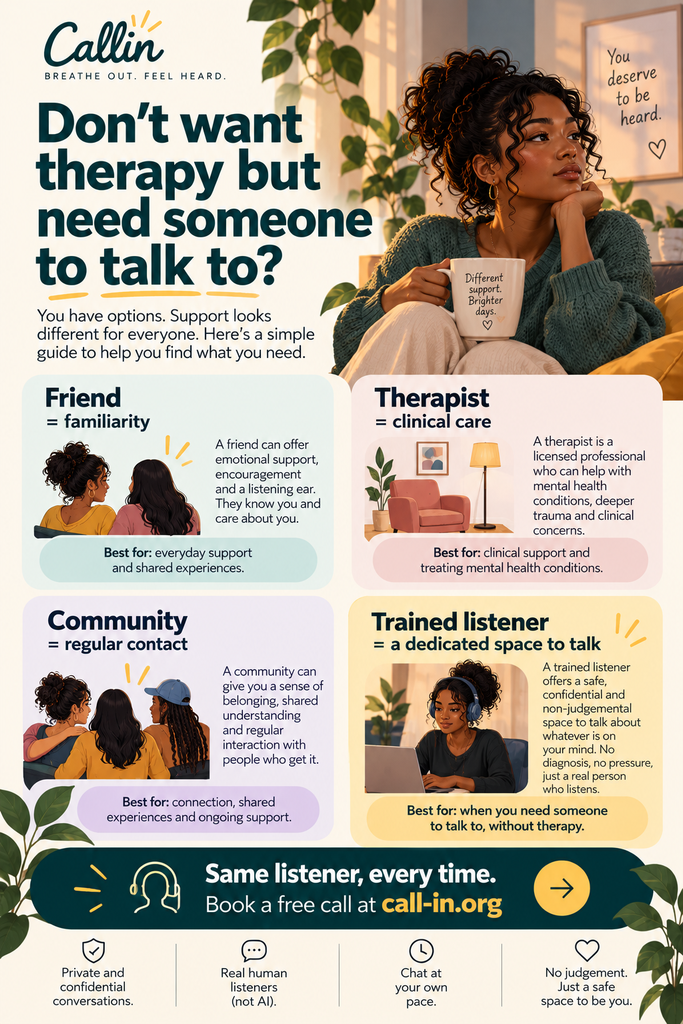
- Different kinds of support serve different purposes. A friend may offer familiarity, a therapist can provide clinical care, a community can create repeated social contact, and a trained listener can provide a dedicated space to talk.
- If loneliness is becoming difficult to cope with, you can ask for more support. That might mean speaking with a GP, therapist, counsellor, trusted person, community service or non-clinical listening service, depending on what you need.
What does it mean when you feel completely alone?
Loneliness is not simply the same thing as being physically alone. The World Health Organization defines loneliness as a distressing feeling that occurs when there is a gap between the social connections a person has and the connections they want or need. Social isolation is different. It describes having too few relationships, roles or interactions with other people. World Health Organization
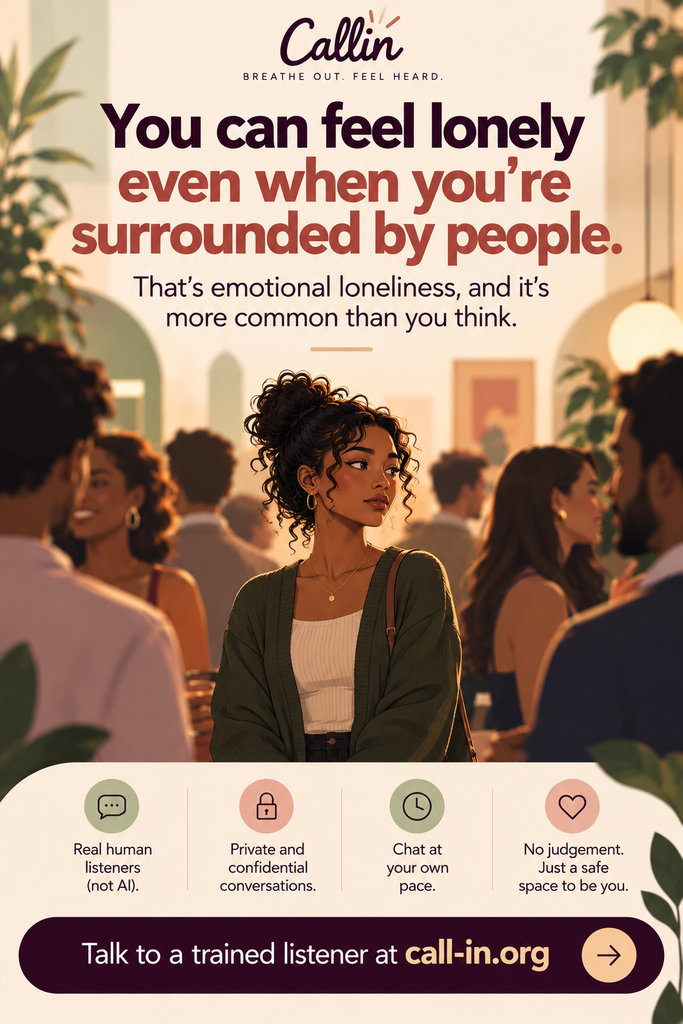
That distinction matters because you can be surrounded by people and still feel profoundly lonely.
You might have hundreds of contacts in your phone but nobody you feel comfortable calling. You might sit in a busy office all day and then go home without having had one meaningful conversation. You might have friends who care about you but feel unable to tell them what is actually happening inside your head.
You might also simply be going through a period when the people you usually rely on are unavailable.
The NHS notes that loneliness can happen for many reasons, including living or working alone, bereavement, moving somewhere new, changes in relationships, retirement, illness or disability, and social anxiety. It also specifically recognises that people can feel lonely while spending time with friends or family. nhs.uk
So the sentence “I have nobody to talk to” does not always literally mean there is nobody in the world.
Sometimes it means:
“There is nobody I feel able to talk to about this.”
That is a different problem, and it may have different solutions.
Why does loneliness make it harder to reach out?
One of the cruel things about loneliness is that the state you want to escape can make the first step feel harder.
You may think:
- “Nobody actually wants to hear this.”
- “I will bother them.”
- “Everyone already has their own problems.”
- “It would be embarrassing to admit how lonely I am.”
- “What would I even say?”
- “They probably do not care.”
- “I have left it too long.”
- “I do not want to look desperate.”
None of these thoughts automatically tells you what another person thinks.
They are often expressions of how difficult connection feels from inside loneliness.
This can create a loop:
You feel lonely → you withdraw → you have fewer opportunities for connection → you feel more disconnected → reaching out feels even harder → you withdraw again.
Breaking that loop does not require a dramatic social transformation.
It requires an interruption.
That interruption might be a text message, a short conversation, sitting somewhere around other people, joining an online group, attending an activity, or talking to a trained listener.
The NHS recommends setting small, achievable targets rather than trying to do everything at once when loneliness is affecting you. nhs.uk
Why can you feel lonely even when you have people around you?
Having people around you and feeling emotionally connected to them are not the same thing.
You may have friends but rarely talk about anything beyond work, plans or practical matters. You may have family but feel unable to tell them what you are struggling with. You may be in a relationship but feel emotionally distant from your partner.
You might also be experiencing what the NHS describes as emotional loneliness, where you lack a close emotional attachment, rather than simply lacking social contact. It also describes social loneliness, which relates more to having people to spend time with, and existential loneliness, where someone can feel alone even while surrounded by people they know. nhs.uk
This is why “just go out and meet people” can be surprisingly unhelpful advice.
Sometimes you do not need a crowded room.
You need one conversation where you do not have to pretend everything is fine.
What should you do when you have nobody to talk to?
Start by making the goal smaller.
You do not need to find your new best friend today. You do not need to build a social circle from scratch. You do not need to explain your entire life story to somebody.
You need one point of connection.
Try asking yourself:
Who is the easiest person to contact, rather than who is the person I should contact?
That distinction can make reaching out less intimidating.
It might be an old friend. A cousin. A former colleague. Someone from university. A neighbour. Someone you have not spoken to in months.
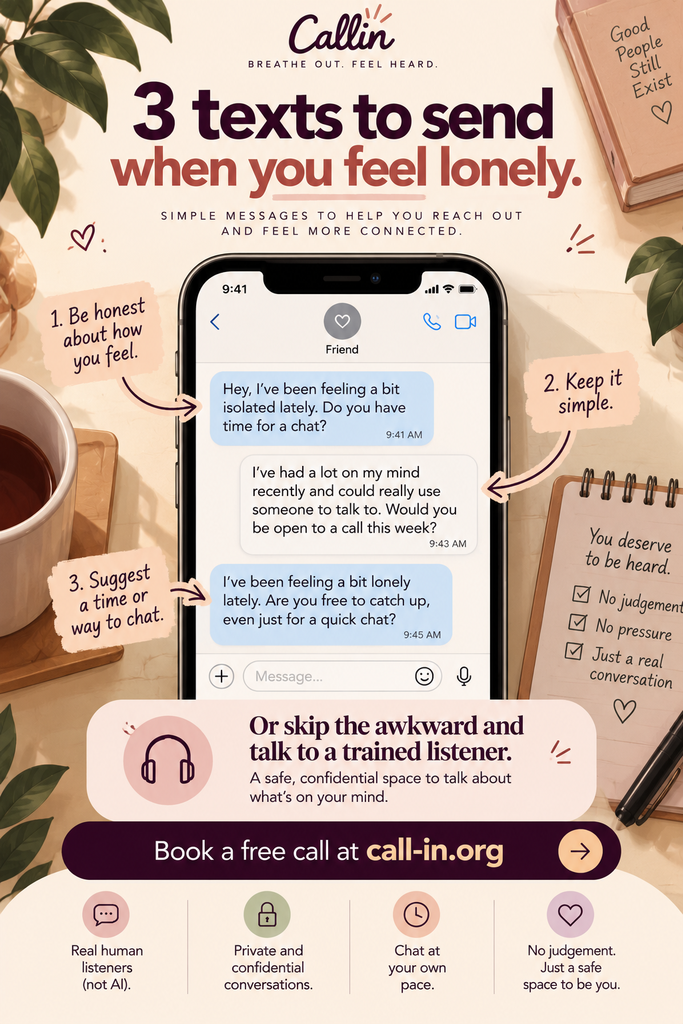
You can keep the message simple.
“Hey, I’ve been feeling a bit isolated lately. Do you have time for a chat sometime?”
Or:
“I don’t really need advice. I just feel like talking to someone.”
You do not have to make your loneliness sound impressive, serious or neatly explained.
“Things have been a bit lonely lately” is enough.
What if I feel like I would be a burden?
This is one of the biggest barriers to asking for connection.
If you have spent a long time being the person who copes, helps everyone else or keeps difficult things to yourself, asking someone to listen can feel almost inappropriate.
But asking for company is not automatically asking someone to fix you.
You can make the request specific.
Instead of:
“I need you to help me.”
You might say:
“Do you have ten minutes to listen? I don’t need you to solve anything.”
That gives the other person information about what you need.
It also gives them the opportunity to say whether they have the capacity to talk.
Someone being unavailable does not necessarily mean they do not care about you. People have work, children, relationships, responsibilities, health issues and their own difficult days.
If one person cannot talk, try not to turn that moment into a verdict on your worth.
“They are unavailable” and “nobody wants me” are not the same sentence.
That distinction can matter enormously when you are lonely.
What can you do if nobody is available right now?
This is particularly relevant at night.
You may have friends who are asleep, family members who are working, or people who simply are not available when you need them. The silence can make your thoughts feel much louder.
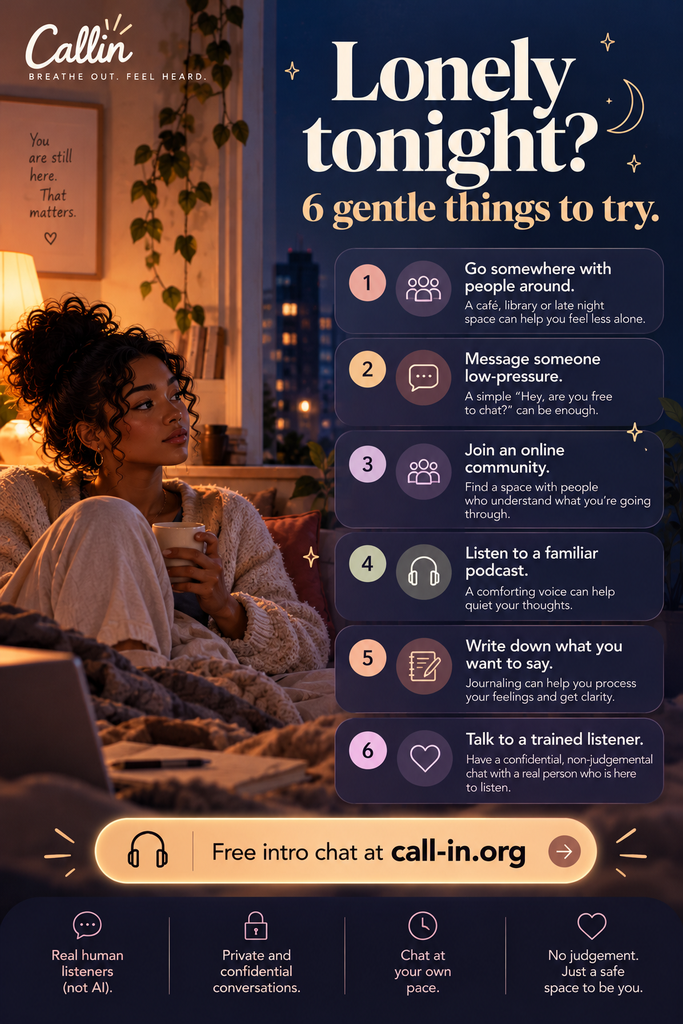
The immediate objective is to create some form of connection or external stimulation.
You could:
- Go somewhere safe where other people are around, such as a café, library or other public space.
- Call someone who is likely to be awake.
- Send a low-pressure message to someone you trust.
- Join an online community based around an interest you genuinely enjoy.
- Listen to a familiar podcast or radio programme.
- Take a short walk if it is safe to do so.
- Write down what you want to tell someone and use that as a starting point for tomorrow’s conversation.
- Arrange a specific time to speak with someone rather than waiting for the perfect moment.
- Consider a structured listening service if you want to speak to someone neutral.
The NHS similarly recommends talking about your feelings, joining groups, spending time around other people, volunteering and finding activities you enjoy as possible ways to address loneliness. nhs.uk
The point is not to distract yourself from loneliness forever.
It is to stop the lonely moment from becoming an entire lonely night.
Can talking to a stranger actually help when you feel lonely?
Yes, sometimes the fact that the person is not part of your everyday life is exactly what makes the conversation easier.
You may not want to explain yourself to a friend who knows your family. You may not want to tell a colleague what is happening. You may not be ready for therapy. You may simply want somebody to listen without needing anything from you in return.
That is where non-clinical emotional support can fit.
Non-clinical emotional support is a form of human support focused on listening, conversation and helping someone feel heard without providing diagnosis or clinical treatment.
It sits somewhere different from doing everything alone and from seeking clinical mental health care.
A trained listener is not a therapist. They should not diagnose you or provide medical treatment. But they can provide a dedicated conversation in which you can talk through what is on your mind.
If you want to understand this distinction in more detail, see what non-clinical mental health support means.
Is loneliness actually a serious problem?
Loneliness is common, but that does not mean it should be ignored when it becomes persistent or difficult to cope with.
The World Health Organization describes loneliness and social isolation as widespread and says social connection is important to both mental and physical health. Its 2025 Commission on Social Connection report describes social disconnection as a significant public health concern. World Health Organization
In Great Britain, the Office for National Statistics reported in January 2026 that 23% of adults felt lonely often, always or some of the time. Younger adults reported higher levels, with 27% of those aged 16 to 29 and 28% of those aged 30 to 49 reporting loneliness at least some of the time. Office for National Statistics
That does not mean loneliness is a diagnosis.
It means the experience is common enough to deserve serious attention.
The useful question is not simply, “Am I lonely?”
It is:
“What kind of connection am I missing, and what is the smallest realistic step towards getting some of it?”
What if I have been lonely for a long time?
Long-term loneliness can make connection feel unfamiliar.
You might become used to doing everything yourself. You may stop inviting people anywhere because rejection feels worse than staying home. You might stop answering messages because social interaction feels exhausting. You may convince yourself that you simply prefer being alone.
Sometimes you do prefer solitude.
There is nothing inherently wrong with enjoying your own company.
The question is whether solitude feels chosen or whether you feel trapped inside it.
If you want more connection but have stopped trying because repeated disappointment has worn you down, the answer may not be “try harder”.
You may need a different route into connection.
That could mean structured activities, volunteering, a support group, a therapist, a GP, community support, reconnecting with one person, or a regular listening service.
The NHS recommends peer support, groups, volunteering and talking about your feelings among possible ways to address loneliness. nhs.uk
For longer-term friendship, you may also find it useful to read how to make real friends as an adult.
What if my friends are always busy?
This is a particularly frustrating form of loneliness because you technically have people in your life.
You might send messages and receive replies hours later. Everyone may have work, children, partners or other responsibilities. You may keep telling yourself that next week will be different.
Eventually, you stop asking.
That can leave you with a strange kind of social loneliness where nobody has deliberately abandoned you, but meaningful contact keeps failing to happen.
It may help to make plans more specific.
Instead of “We should catch up sometime”, try:
“Are you free for a 20-minute call on Thursday evening?”
Specific requests are easier to answer.
And if someone repeatedly cannot make time, that is useful information too. It does not necessarily tell you how they feel about you, but it can tell you that you may need to widen your sources of connection.
Callin has also written about what to do when friends are always busy.
What if I do not want therapy, but I still need someone to talk to?
You do not have to choose between “handle everything myself” and “go to therapy”.
There are different kinds of support.
A friend can offer familiarity and personal connection. A therapist or counsellor provides clinical support within their professional scope. A GP can help when loneliness is accompanied by persistent low mood, anxiety or other concerns that need medical attention. Community groups can create repeated opportunities for social connection.
A trained listener offers something different: a dedicated conversation centred on listening and emotional support without presenting itself as clinical care.
Callin is built for this particular space. Its listeners are trained in active listening, Psychological First Aid and non-clinical emotional support, and work within safeguarding frameworks. They are not therapists or clinicians.
If you want to understand what that conversation actually looks like, you can read what happens in a Callin first session.
How can Callin help if I am lonely and have nobody to talk to?
Callin Support is a UK-based online service for adults aged 18 and over that provides non-clinical emotional support through conversations with trained human listeners.
The service is designed for people who want somewhere to talk without turning every difficult feeling into a clinical appointment.
One feature is Human Continuity™. Whenever possible, Callin aims to pair you with the same trained listener, so you do not have to start from zero every time.
That can matter when you are already tired of explaining yourself.
Eligible new clients can begin with a free introductory live voice conversation on Zoom or Google Meet. Callin also offers paid chat support through WhatsApp or Telegram, alongside paid calls and memberships.
Callin is not therapy, counselling, psychiatric care, diagnosis, crisis intervention or emergency support. If you are in immediate danger or experiencing a mental health crisis, use the appropriate emergency or crisis service for your location rather than relying on a non-clinical listening service.
You can see how Callin’s emotional support works.
What other support might help with loneliness?
There is no single correct response to loneliness.
The right option depends partly on what is causing the disconnection and what kind of support you need.
If you have someone safe in your life, you might start there. If you need clinical support because loneliness is accompanied by persistent low mood, anxiety or difficulty coping, consider speaking with your GP or a qualified mental health professional.
The NHS advises people to seek further help when loneliness is affecting their ability to cope, when low mood persists, or when things they have tried themselves are not helping. nhs.uk
Community resources can also matter. A class, volunteering opportunity, faith community, hobby group, sports group or online community can create repeated opportunities to interact with people.
And repetition matters.
You do not necessarily build connection through one spectacular conversation. Often, connection grows because the same people begin seeing one another repeatedly.
The WHO’s work on social connection emphasises that connection includes not only the number of relationships someone has, but also the quality of those relationships and the support exchanged within them. World Health Organization
That is why “get more friends” is an incomplete answer.
You are looking for meaningful connection, not merely more names in your contacts.
Making human support easier to reach before someone reaches crisis also fits naturally with Sustainable Development Goal 3, Good Health and Well-being, which includes promoting wellbeing and improving access to health-related support. Callin’s approach to this is described further in its work on the Sustainable Development Goals.
When should loneliness prompt you to seek more help?
Loneliness itself does not tell you that something is medically wrong.
But if it is becoming persistent, severely affecting your daily life, or accompanied by significant distress, it is worth taking seriously.
Consider seeking additional support if:
- You are struggling to cope with everyday responsibilities.
- You have been experiencing persistent low mood.
- You are withdrawing from almost every form of contact.
- Your sleep or daily routine is being significantly affected.
- You feel unable to manage what you are experiencing alone.
- The things you normally do to feel better are no longer helping.
You do not have to wait until things become unbearable before asking for help.
And there is no prize for reaching the point where you can finally prove that you needed it.
What if loneliness turns into a crisis?
A loneliness article should not become a substitute for crisis support.
If you are in immediate danger, have seriously harmed yourself, or feel that you may act on thoughts of harming yourself, contact emergency services or an appropriate crisis service in your country.
In the UK and Ireland, you can call Samaritans on 116 123. In the US, call or text 988. In Australia, call Lifeline on 13 11 14. If you are elsewhere, use your local emergency service or a reputable international crisis directory such as Find A Helpline.
Callin is not a crisis service and should not be used instead of emergency or crisis care.
You do not have to solve loneliness all at once
When you feel like you have nobody to talk to, it is easy to turn the problem into something enormous.
You start thinking about your friendships, your family, your relationship status, your social life, your future and every awkward interaction you have ever had.
You do not need to solve all of that tonight.
Start smaller.
Send one message. Sit somewhere other people are present. Join something you genuinely enjoy. Ask someone for ten minutes of conversation. If you do not have anyone suitable to ask, consider a structured listening service.
Callin offers adults 18 and over a private, online space to speak with a trained human listener about what is on their mind. Its Human Continuity™ approach aims to make that support more consistent by keeping you with the same listener whenever possible. It is non-clinical support, not therapy or crisis care, and eligible new clients can start with a free introductory conversation.
If you want ongoing support, you can explore Callin memberships.
You do not need to become a completely different person before you are allowed to seek connection. Sometimes the first step is simply giving what you are feeling somewhere to land.
Frequently asked questions
I am so lonely and have nobody to talk to. What should I do?
Start with one manageable point of contact rather than trying to solve your entire social life. Message someone you trust, spend time somewhere other people are present, join a group or consider speaking with a trained listener. If loneliness is seriously affecting your ability to cope, consider speaking with a GP or mental health professional.
Who can I talk to when I feel completely alone?
Depending on what you need, you could talk to a friend, family member, colleague, community group, counsellor, therapist, GP or trained listener. If you need immediate crisis support, use a crisis or emergency service rather than a non-clinical listening service.
Can I talk to someone online when I am lonely?
Yes. Online options include community groups, peer support services, structured listening services and professional support. Callin provides online non-clinical emotional support for adults aged 18 and over through trained human listeners.
What if I feel lonely even though I have friends?
You can experience loneliness even when you have friends. Loneliness relates partly to whether your relationships provide the type and level of connection you want or need. You may have social contact without feeling emotionally understood or supported.
What if I do not want therapy?
You can explore other forms of support. Friends, community groups, peer support and non-clinical listening can all serve different purposes. Callin provides non-clinical emotional support and does not present its service as therapy or clinical care.
Is talking to a stranger about loneliness strange?
Not necessarily. Some people find it easier to speak honestly with someone outside their personal life because there is less concern about judgement, family dynamics or having to manage the other person’s reaction. A trained listener can provide a structured conversation focused on listening.
Can loneliness go away?
Loneliness can change, although there is no single timeline or guaranteed solution. It may improve through stronger relationships, repeated social contact, practical changes, professional support or simply having someone to talk to during a difficult period. If loneliness is persistent or seriously affecting your life, consider getting additional support.
Sources and further reading
- World Health Organization, 2025, Social connection. Defines social connection, social isolation and loneliness, and summarises evidence on their effects and potential solutions. World Health Organization
- World Health Organization Commission on Social Connection, 2025, From loneliness to social connection. Reviews the global scale of loneliness and social disconnection and their implications for health and wellbeing. World Health Organization
- World Health Organization, Social Isolation and Loneliness. Provides an overview of loneliness as a widespread social and public health issue. World Health Organization
- NHS, Feeling lonely. Provides practical suggestions for addressing loneliness and guidance on when to seek additional help. nhs.uk
- NHS Every Mind Matters, Loneliness. Explains emotional, social and existential loneliness and offers practical approaches to increasing connection. nhs.uk
- Office for National Statistics, January 2026, Public opinions and social trends, Great Britain. Reports recent UK data on how often adults experience loneliness. Office for National Statistics

Leave a Reply