
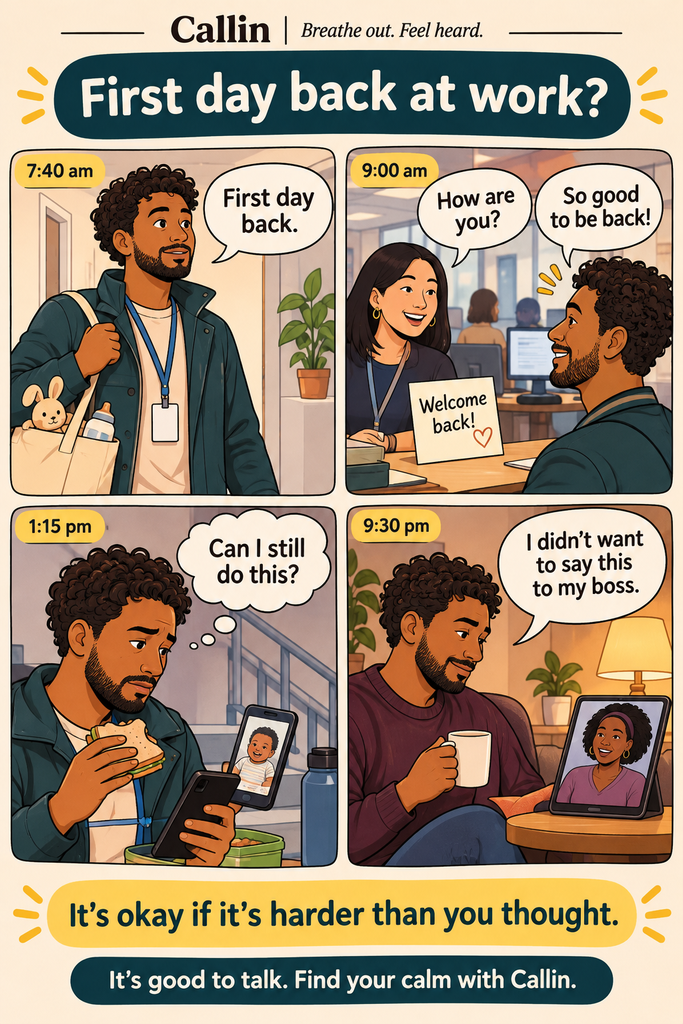
Coming back to work after time away can feel like walking into a room where everyone else kept talking while you were gone. Your returning employee may be recovering, sleep-deprived, excited, anxious or all of these at once.
This guide is for employers, HR teams and leaders, including universities and hospitals as employers, who want the human side of returning to go as well as the paperwork.
The short answer: You support returning employees by pairing a clear, flexible return-to-work plan with human support that starts before day one. Keep in touch in the way the person prefers, agree adjustments or a phased return where needed, brief managers well, and give people a confidential, non-clinical place to talk that sits outside the management chain. Review the plan together over the first few months, because returning is a process, not a date.
Key definitions
- Sick leave: Time away from work because of illness, injury or a health condition, whether physical or mental. Rules on pay, length and certification differ by country and employer.
- Parental leave: Time away to care for a new child, including maternity, paternity, adoption and shared or parental leave. Entitlements vary widely across countries.
- Return-to-work plan: An agreed, written plan for coming back, which may cover hours, duties, adjustments, check-ins and a review date.
- Phased return: A gradual build-up of hours or duties over an agreed period, rather than a return to the full role on day one.
- Workplace adjustments: Changes to how, when or where someone works so they can do their job well, sometimes called reasonable accommodations.
- Non-clinical emotional support: Confidential, human conversation with a trained listener that does not diagnose, treat, assess or replace therapy, occupational health or medical care.
A quick word on boundaries before we begin. Callin offers non-clinical emotional support, not therapy, counselling, occupational health, medical care, HR case management or crisis support, and nothing in this article is clinical, legal or employment advice.
If you, an employee or anyone you are supporting may be in immediate danger or crisis, please contact local emergency services or find a free, confidential helpline in your country at findahelpline.com.
Key takeaways
- Returning to work is a process that starts before the first day back and continues for months, so plan for the whole journey, not just the date.
- WHO recommends return-to-work programmes that combine work-directed steps, such as adjustments or a phased return, with ongoing clinical care where someone has been off with a mental health condition.
- Supervisor and co-worker support are regarded as facilitators of a successful return, according to EU-OSHA’s OSHwiki review.
- Parental leave brings its own emotional load: WHO estimates that about 13% of women who have just given birth experience a mental disorder, mainly depression, and fathers can be affected too.
- Many returning employees will not tell their manager how they really feel, so a confidential, non-clinical place to talk outside the management chain fills a real gap.
- Local rules differ widely across the Nordics, Germany, the Netherlands, the UK, Ireland, North America, Australia, New Zealand and beyond, so treat any scheme you read about as an example and check what applies where you operate.
- A defined three-month pilot for returning employees, with privacy-safe measures and a review point, is a low-risk way to test a new layer of support.
Why does returning to work after leave feel so hard?
Because the person, the job and the team have all changed, sometimes at the same time. Someone coming back may be adjusting to a new body, a new baby, new medication, new sleep patterns or a new sense of who they are, while also catching up on everything that moved on without them.
EU-OSHA describes returning after a medium to long-term sickness absence as “a complex process” that “involves following a number of steps and combined action from different professions that are not necessarily used to working together.” That complexity is often invisible to colleagues, who may simply see someone back at their desk.
There is also an emotional undercurrent that rarely appears in a plan. People may worry about being seen as less capable, feel guilty about the cover others provided, or feel pressure to prove they are “back to normal” straight away. Our article on the cost of saying “I’m fine” explores why so many people hide how they are really doing.
How is coming back from sick leave different from coming back from parental leave?
Both involve change and adjustment, but the worries are often different. After sick leave, people may be focused on their health, energy and whether they will cope; after parental leave, they may be focused on identity, childcare, sleep and whether their career has stalled.
After sick leave, recovery is not always linear. EU-OSHA’s OSHwiki review of returning to work after sick leave for mental health problems notes that “symptom recovery and the process of RTW are partly independent,” and that “20 to 30% of the workers with CMD who return to work experience recurrent sickness absence due to mental health problems.” CMD there means common mental health disorders, and the review draws mainly on European research.
After parental leave, the emotional side is easy to overlook. WHO states that “worldwide about 10% of pregnant women and 13% of women who have just given birth experience a mental disorder, primarily depression.”
A peer-reviewed meta-analysis in JAMA found that prenatal and postpartum depression “was evident in about 10% of men in the reviewed studies,” so fathers and partners deserve the same care.
None of this means every returning parent or recovering employee is unwell. It means you should not assume either way, and should make support easy to reach for anyone who wants it.
What should a good return-to-work plan include?
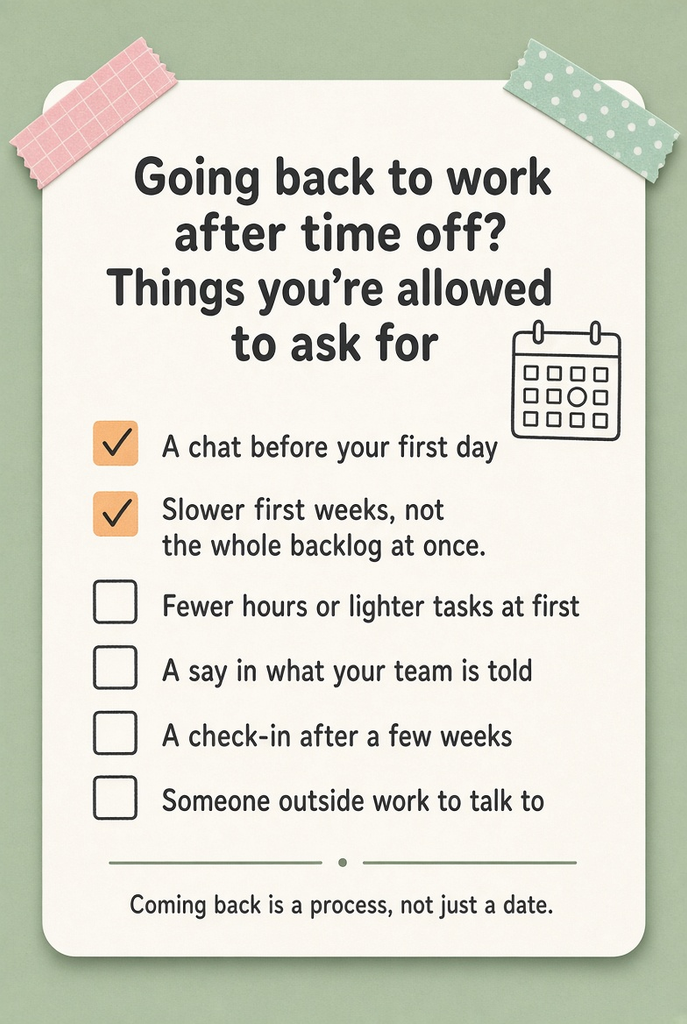
A good plan is agreed with the person, written down, flexible and reviewed. It covers the practical side of coming back and makes clear who to talk to about what.
Elements to consider include:
- Keeping in touch during leave: agree how often, how and by whom, and respect the person’s wish for space if they want it.
- A conversation before day one: a relaxed check-in about what has changed, what they need and how they would like colleagues to be told.
- Phased hours or duties: a gradual return where that helps, with a clear end point that can be adjusted.
- Workplace adjustments: WHO lists examples such as “flexible working hours, extra time to complete tasks, modified assignments to reduce stress, time off for health appointments or regular supportive meetings with supervisors.”
- Practical arrangements for new parents: for example, flexible hours, space and time to express breast milk where needed, and predictable meeting times around childcare.
- Clear routes to specialist help: occupational health, HR, an EAP or clinical services where your organisation has them.
- Review points: agreed dates to check how things are going, typically over the first few months.
The WHO guidelines on mental health at work describe return-to-work programmes that “combine work-directed care (like reasonable accommodations or phased re-entry to work) with ongoing clinical care.” Your organisation provides the work-directed part; clinical care stays with the person’s own health professionals.
Which local rules should you check?
Check the rules in every country where you employ people, because sick leave and parental leave systems vary enormously. The examples below are illustrations only, not a complete or current legal summary.
- European Union example: the EU work-life balance directive, in force since 2019, sets minimums such as at least 10 working days of paternity leave and a right to request flexible working for parents of children up to at least eight years old. Each member state implements it differently.
- Germany example: under section 167 of the Social Code Book IX, where an employee has been unable to work for more than six weeks within a year, the employer must explore, with the employee’s consent and involvement, how to overcome the incapacity and prevent it recurring. This is known as betriebliches Eingliederungsmanagement, and the employee may bring a trusted person of their choice.
- United States example: the Family and Medical Leave Act entitles eligible employees of covered employers to up to 12 workweeks of unpaid, job-protected leave for qualifying reasons, including a serious health condition or the birth of a child.
- United Kingdom example: NICE guideline NG146 covers keeping in touch with people on sickness absence, workplace adjustments and “sustainable return to work and reducing recurrence of absence.” It is guidance, not law.
Globally, the ILO’s Care at work report reviews maternity, paternity and parental leave laws across 185 countries. It is a useful starting point if you employ people in several systems.
What do returning employees often worry about but not say?
Many worry about how they are seen. They may fear being written off for promotion, judged for needing adjustments, or treated as fragile, so they say “all good” when it is not.
Common unspoken worries include:
- Capability: “Can I still do this job as well as before?”
- Identity: “I feel like a different person now, at home and at work.”
- Guilt: “My colleagues covered for me, and now I need to leave on time.”
- Visibility: “I have been forgotten, and the work moved on without me.”
- Relapse: “What if I get ill again, or cannot cope with the tiredness?”
- Privacy: “I do not want my manager to know everything about my health or my family.”
These feelings are normal, and naming them can help people feel less alone. Our articles on why you might feel guilty for needing support, productivity guilt and feeling unseen at work speak to the individual side and could be useful to share.
Why does a confidential place to talk outside the management chain matter?
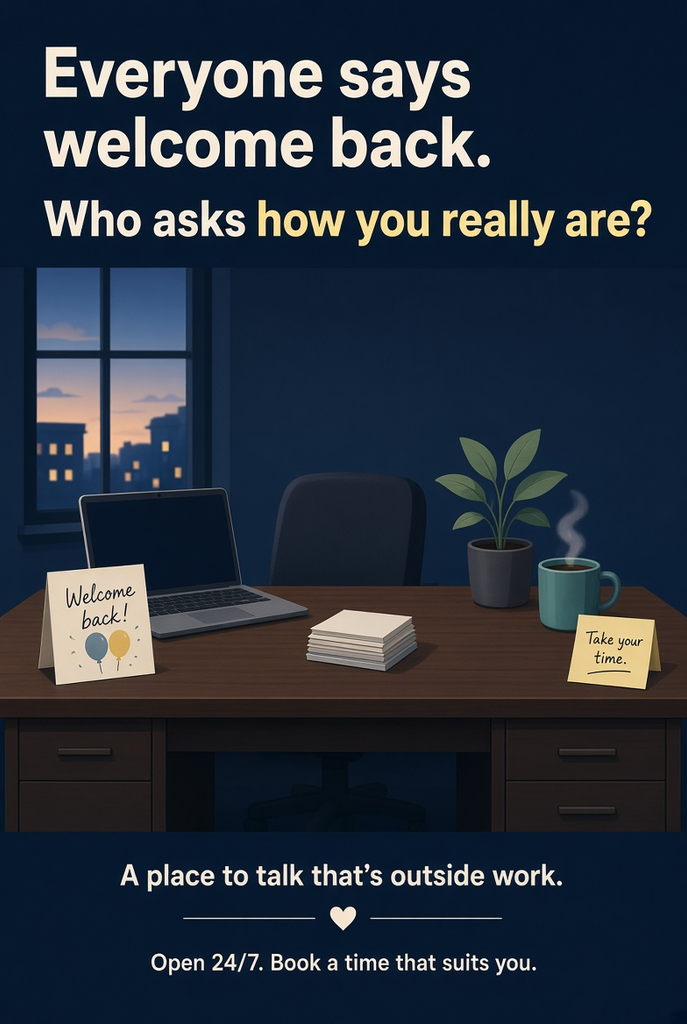
Because some things are hard to say to the person who decides your workload, your appraisal or your promotion. A confidential, independent conversation gives returning employees somewhere to be honest without worrying about how it will be recorded or used.
Your manager, HR and occupational health each have a clear and important job in a return. None of them can be a fully neutral listener, because each has a role in decisions about work. That is not a criticism; it is simply how responsibilities are structured.
A non-clinical emotional support service sits outside that structure. It does not assess fitness for work, share content with the employer or make recommendations about duties. It simply gives the person time to talk things through, which can make the formal conversations easier.
If you want to explain the difference to staff, our guides to what non-clinical mental health support means and EAP vs therapy vs emotional support set it out clearly.
How can managers help without becoming counsellors or case managers?
By focusing on the work, staying in touch, keeping promises and knowing where to signpost. Managers do not need to become experts in health or family life; they need to be consistent, kind and clear.
Practical habits for managers:
- Prepare the team: agree with the employee what colleagues will be told, and nothing more.
- Protect the first weeks: avoid loading the backlog onto day one, and be clear about priorities.
- Keep check-ins regular but light: short, predictable conversations about how the plan is working.
- Follow through: if you agree an adjustment, make sure it actually happens.
- Signpost, do not probe: point people to HR, occupational health, an EAP or confidential support without asking for health details.
For what to actually say when someone seems to be struggling, our manager guide on what to say to an employee who is struggling covers conversation openers, what to avoid and how to signpost. We have deliberately not repeated those scripts here.
How does this work for universities and hospitals as employers?
The same principles apply, but the context adds pressure. Academic and clinical roles often have fixed timetables, rotas, research deadlines and professional responsibilities that make a gradual return harder to arrange.
- Universities: academic staff may return mid-term, mid-grant or mid-supervision, so agree clearly who is covering teaching, marking and doctoral supervision during a phased return. Professional services staff need the same care.
- Hospitals and health systems: clinical staff may face night shifts, on-call rotas and emotionally demanding work from day one, so consider rota adjustments and a gentle re-entry where safe and possible.
- Both: staff often support others for a living, which can make it harder to ask for help themselves.
If your institution supports students as well as staff, our article on online emotional support for university students is written for the student, and can sit alongside your own student services.
How do you adapt return-to-work support across countries and cultures?
Keep the principles the same and adapt the delivery locally. Attitudes to talking about health, family and emotions differ between and within countries, as do expectations about how much a manager should know.
- Check local rules and consultation duties: including data protection, works councils or unions, and any statutory return-to-work processes.
- Respect privacy norms: in some cultures people share very little about health or family at work, and that choice should be respected.
- Think about language: some people may find it easier to talk in a language other than their working language.
- Mind time zones and hours: returning parents and recovering employees may need support outside a standard office day.
The WHO mental health at work fact sheet notes that “action to address mental health at work should be done with the meaningful involvement of workers and their representatives.” That applies to return-to-work policies too.
Where does Callin fit alongside your return-to-work process?
Callin offers non-clinical emotional support: a confidential, human place for returning employees to talk, alongside your HR processes, occupational health, EAP and the person’s own clinical care. It is not therapy, occupational health, HR case management or a crisis service, and it does not replace any of them.
Callin has offered this kind of support since June 2023. Callin Support Ltd is UK-registered and supports adults aged 18 and over worldwide through one-to-one online sessions in English.
Callin is available 24/7, with sessions booked in advance at a time that suits each person, at any hour, which can help new parents and people on adjusted hours find a moment to talk. Listeners complete Johns Hopkins University Psychological First Aid training and use active listening, with clear safeguarding and signposting procedures.
Through Human Continuity™, Callin prioritises the same listener for ongoing support wherever operationally possible, so a returning employee does not have to retell their story at each stage of their return. Callin does not create clinical records, and the content of an employee’s conversations is not shared with their employer. You can read more in our FAQ and privacy policy.
Some returning employees also want to think about their career direction after a big life change. Callin offers separate career coaching for professionals where that is the right fit.
For a wider view of the layers, see our guides to workplace mental health support for employees and how Callin complements EAPs. We do not publish outcome or savings figures for Callin, and we would encourage you to measure impact in your own organisation.
What would a three-month pilot for returning employees look like?
A three-month pilot tests a new layer of support with a defined group, clear measures and a decision point at the end. Callin offers a defined three-month pilot for organisations through our workplace wellbeing support for organisations page.
A practical pilot plan might include:
- Before launch: choose a group, such as everyone returning from sick leave or parental leave in a given period, agree privacy-safe reporting, and involve staff representatives.
- Month 1, awareness and trust: check through a short anonymous pulse whether returning employees know the support exists and believe it is confidential.
- Month 2, access and reach: look at aggregate uptake, with small numbers suppressed so no individual can be identified.
- Month 3, early signals: gather anonymous feedback on whether people felt heard and whether support was easy to reach.
- Review: decide with staff whether to stop, adjust or continue, and keep watching recurrence of absence and retention over a longer period.
Pair the pilot with honest attention to workload and culture. Our article on why workplace stress needs more than wellness programmes explains why, and our guide to preventive emotional care shows the value of reaching people early.
Ready to make returning to work feel more human?
Supporting employees after sick leave or parental leave starts with a clear, flexible plan and managers who keep their promises, and it is strengthened by giving people a confidential, human place to talk. If you would like to understand what that feels like first, explore non-clinical mental health support with Callin or read what happens in a Callin first session.
When you are ready to talk about your organisation, university or hospital, enquire about a three-month pilot for returning employees and agree the measures that matter to you and your people from day one.
Frequently asked questions
How do I support an employee returning from sick leave?
Agree a written, flexible return-to-work plan with them, keep in touch in the way they prefer, consider a phased return and workplace adjustments, and review progress regularly. Signpost to occupational health, HR or an EAP where you have them, and offer a confidential place to talk outside the management chain.
How can employers support people returning from parental leave?
Have a relaxed conversation before day one, agree flexible or predictable hours where possible, make practical arrangements for new parents, and protect their visibility and development. Remember that fathers and partners can find the transition hard too.
What should a return-to-work plan include?
Usually agreed hours and duties, any adjustments, a phased return if helpful, how colleagues will be informed, who to contact about what, and dates to review the plan together. The details depend on the person, the role and local rules.
Should managers ask about an employee’s health or family situation?
Managers should focus on what the person needs at work rather than asking for medical or family details. Let the employee choose what to share, and signpost to HR, occupational health or confidential support for anything more.
Does Callin replace occupational health, HR or an EAP?
No. Callin works alongside occupational health, HR, EAPs and clinical care, and signposts to them when needed. It is not therapy, occupational health, HR case management or a crisis service.
Can returning employees talk to Callin outside office hours?
Yes. Callin is available 24/7, and sessions are booked in advance at a time that suits each person, at any hour. That can help new parents and people on adjusted hours find a time to talk.
Will the employer see what returning employees talk about?
No. The content of an employee’s conversations is not shared with their employer, and Callin does not create clinical records. Callin follows safeguarding and signposting procedures where urgent safety concerns arise.
UN Sustainable Development Goals alignment
At Callin, we are aligning ourselves with the UN SDGs, and this article connects with three of them. This describes alignment only, not United Nations affiliation or endorsement; read more in our guide to mental health and the SDGs and our workplace wellbeing and the UN SDGs page.
- SDG 3: Good Health and Well-being. Supporting people as they return after illness or a new baby protects wellbeing at a vulnerable moment.
- SDG 5: Gender Equality. Good support for parents returning from leave helps people of every gender combine work and care.
- SDG 8: Decent Work and Economic Growth. Fair, flexible and humane return-to-work practices are part of decent work.
Sources and further reading
- World Health Organization (2022). WHO guidelines on mental health at work. Global guidance.
- World Health Organization (updated 15 September 2026). Mental health at work, fact sheet. Global.
- World Health Organization. Perinatal mental health. Global.
- Paulson, J. F. and Bazemore, S. D. (2010). Prenatal and postpartum depression in fathers and its association with maternal depression: a meta-analysis, JAMA, 303(19), 1961 to 1969. Peer-reviewed, international studies.
- European Agency for Safety and Health at Work (EU-OSHA). Rehabilitation and return to work. European context.
- Lagerveld, S., Houtman, I. and Kudász, F., OSHwiki, EU-OSHA (latest update 17 September 2020). Return to work after sick leave due to mental health problems. Mainly European research.
- International Labour Organization (2022). Care at work: investing in care leave and services for a more gender equal world of work. Global, 185 countries.
- European Commission. Work-life balance. EU example.
- Federal Ministry of Justice, Germany. Section 167 SGB IX, Prävention, in German. Germany example.
- US Department of Labor, Wage and Hour Division. Family and Medical Leave Act. US example.
- National Institute for Health and Care Excellence (2019). Workplace health: long-term sickness absence and capability to work (NG146). UK example.
- United Nations. SDG 3, SDG 5 and SDG 8.

Leave a Reply