
Venting to AI models can feel empty. So, if “talking to ChatGPT about my problems feels empty” sounds like you, you are not alone. AI can produce kind, instant words. It cannot feel what you feel, share a life with you or genuinely remember you as a person. For being truly heard, many people find a real human listener at services like Callin feels different.
Callin provides confidential, one-to-one, non-clinical human support by voice call, video call or private chat. It is not therapy, counselling, diagnosis, medical or psychiatric care, or crisis or emergency support. Everyone you speak to is a real person, not an AI.
If you are in danger right now, or think you might act on thoughts of harming yourself or someone else, please contact your local emergency services or a crisis line. You can find a free, confidential line in your country at findahelpline.com. A chatbot is not the right place in that moment.
Key takeaways
- AI cannot replace a real human listener for emotional support, because it has no lived experience, no felt empathy and no genuine relationship with you.
- AI responses can still sound caring; a 2024 study in PNAS found AI-written replies made people feel more heard, until they learned the reply came from AI.
- Across nine studies with 6,282 participants, the same empathic words were rated as more supportive when people believed a human wrote them, and people consistently chose human interaction for emotional engagement.
- Heavier daily chatbot use was linked to more loneliness and less socialising in a four-week study by OpenAI and the MIT Media Lab, although that research shows associations, not proof of cause.
- The American Psychological Association advises that general AI chatbots should not replace qualified mental health care, and that unhealthy dependence on them should be prevented.
- AI tools can be genuinely useful for information, journaling prompts and organising thoughts, so the aim is not to fear them but to know what they can and cannot offer.
- Callin offers non-clinical support from real people trained in active listening and Psychological First Aid, and through Human Continuity™ you can usually keep talking to the same listener who remembers you.
Why does talking to ChatGPT about my problems feel empty?
Talking to ChatGPT about your problems can feel empty because there is no one on the other side who is actually affected by what you say. The words may be warm and well chosen. But nobody is worried about you afterwards, nobody carries your story into tomorrow and nobody has lived anything like it.
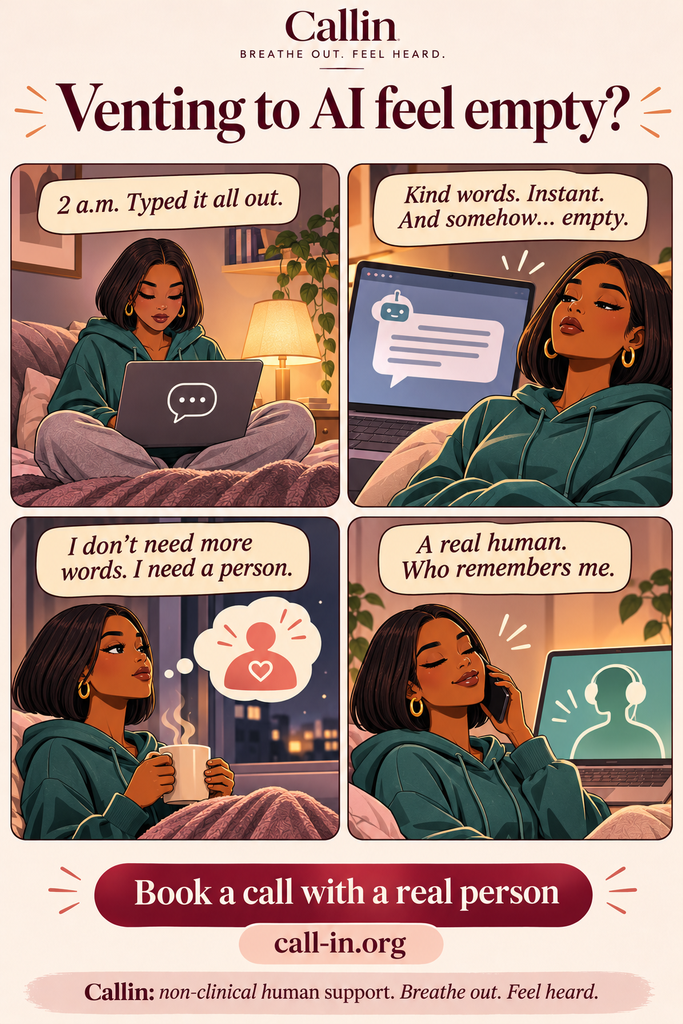
At first, venting to AI can feel like a relief. It is instant. It never seems tired. It does not judge.
Then, for many people, something shifts. The replies start to feel familiar. The kindness feels a little smooth. You close the app and the room is just as quiet as before.
That feeling is not you being ungrateful or “doing it wrong”. It may be your instinct noticing something real about what a person can offer that a program cannot. Callin explores this further in I Need Someone to Talk to Instead of AI.
Can AI replace a human listener for emotional support?
No, AI cannot replace a human listener for emotional support. AI can generate supportive text quickly, but it lacks real empathy, lived experience and a genuine relationship with you. It can be a useful tool alongside human connection, not a substitute for it.
Professional bodies agree on the limits. In a 2025 health advisory, the American Psychological Association noted that emotional support is one of the most common uses of AI chatbots. It also advised that general AI chatbots and wellness apps should not be used as a replacement for qualified mental health care, and called for steps to prevent unhealthy dependence.
That advisory is about clinical care, which Callin does not provide. Still, the same principle applies to everyday emotional support: a tool can help, but a human relationship is a different thing.
For a side-by-side look, see Callin’s guides AI Chat vs Human Emotional Support: What Helps When You’re Struggling? and Is AI More Helpful than a Person for Mental Health Support.
Where does AI fall short when you just need to vent?
AI falls short in the parts of support that depend on being a person: feeling something with you, sharing lived experience, holding a real relationship over time and simply being present. It can describe empathy, but it does not experience it. The difference often becomes noticeable once the novelty wears off.
Does AI actually feel anything when I tell it my problems?
No, AI does not feel anything when you tell it your problems. It has never been heartbroken, exhausted, grieving or lonely. It predicts words that fit what you wrote, so its compassion is simulated rather than felt.
Interestingly, this does not mean AI replies always sound worse. A study by Yin, Jia and Wakslak, published in PNAS in 2024, found that AI-generated responses made people feel more heard than responses written by untrained people. AI was good at naming emotions and offering emotional support.
But there was a twist. When people were told the response came from AI, they felt less heard. Knowing that no one was really there seemed to change the experience.
Why does AI empathy feel different once I know it is AI?
AI empathy can feel different because much of what makes empathy meaningful is knowing that another person chose to care. Research suggests people value empathy more when they believe it comes from a human, even when the words are identical.
In nine studies with 6,282 participants, Rubin and colleagues gave people AI-generated empathic responses, labelled as coming either from a human or from AI. Published in Nature Human Behaviour in 2025, the research found human-labelled responses were rated as more empathic and supportive. The gap was largest for responses about sharing feelings and caring. People also consistently chose human interaction over AI when they wanted emotional engagement.
In plain terms: it is not only what is said. It is who is saying it, and whether they mean it.
Can AI remember me the way a person does?
AI can store details from earlier chats, depending on the tool and your settings, but that is not the same as being remembered by a person. A human listener remembers you with feeling. They notice that you sound brighter than last week, or quieter. They wonder how the interview went.
Relational memory is part of what makes support feel like a relationship rather than a transaction. Callin’s article Why the Most Empathic AI Is Still Making Us Lonelier looks at this gap in more detail.
Why does AI sometimes just agree with everything I say?
AI can sometimes agree too easily because it is designed to be helpful and pleasing, and that can tip into telling you what you want to hear. Even the companies building these tools have acknowledged this risk.
In April 2025, OpenAI rolled back an update to ChatGPT after it became “overly flattering or agreeable”. In a follow-up post, the company said the update could validate doubts, fuel anger or reinforce negative emotions in unintended ways, and that this raised safety concerns around mental health and emotional over-reliance.
A good human listener is different. They can stay warm while still gently reflecting something back, without simply mirroring you.
Why do AI replies feel like a list of tips?
Depending on how you phrase things, AI tools may move quickly into suggestions, steps or bullet points. That can be useful when you want ideas. It can feel hollow when you just wanted someone to sit with you in it.
Humans do this too, of course. Callin’s article Why People Give Advice When You Just Want to Vent explains why. The difference is that a trained human listener can learn, over time, what you actually need from them.
What does a real human voice offer that AI cannot?
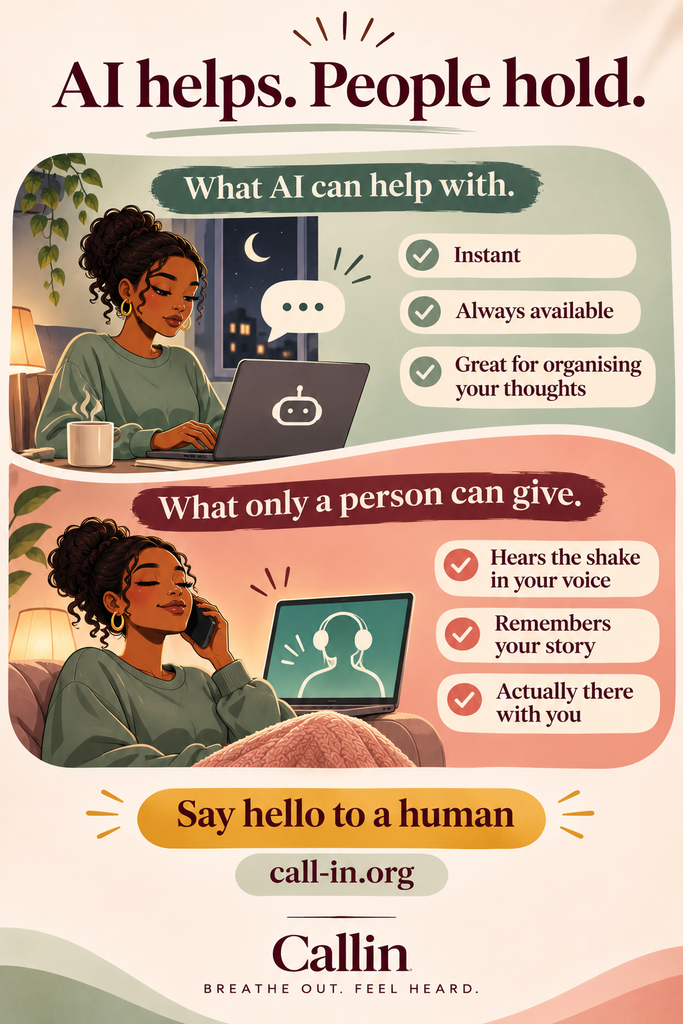
A real human voice offers tone, pacing, presence and a shared sense of being human. A person can hear the shake in your voice, wait through a silence and respond to what you did not quite say. That kind of presence is hard to replicate with text generated on demand.
Tone and pacing. A person can slow down when you slow down. They can soften their voice. They can let a pause be a pause.
Presence. Someone is giving you their time and attention. That choice carries meaning on its own.
Shared humanity. Even when a listener has not lived your exact situation, they know what it is to be tired, hurt or afraid.
Research on how we connect supports the power of voice. In a set of experiments, Kumar and Epley found that talking by voice created stronger feelings of connection than typing, without being more awkward than people expected. That research compared people talking with people, not people with AI, but it shows how much is carried in a voice. Callin’s article Why Texting Can’t Replace Real Conversation explores the same idea.
You can learn more about what trained listening looks like in How Active Listening Makes You Feel Truly Heard Without Judgment.
Is it bad to vent to ChatGPT?
No, it is not bad to vent to ChatGPT, and you do not need to feel embarrassed if you have. Many people use AI to get thoughts out of their head, especially late at night or when they feel they have no one else. The key is noticing whether it is helping you connect with life, or quietly replacing human connection.
Research raises some gentle flags about heavy use. A four-week randomised study by OpenAI and the MIT Media Lab, involving 981 participants, found that people who used the chatbot more each day tended to report more loneliness, more emotional dependence and less socialising with real people. The researchers stress that this shows associations, not proof that the chatbot caused these outcomes.
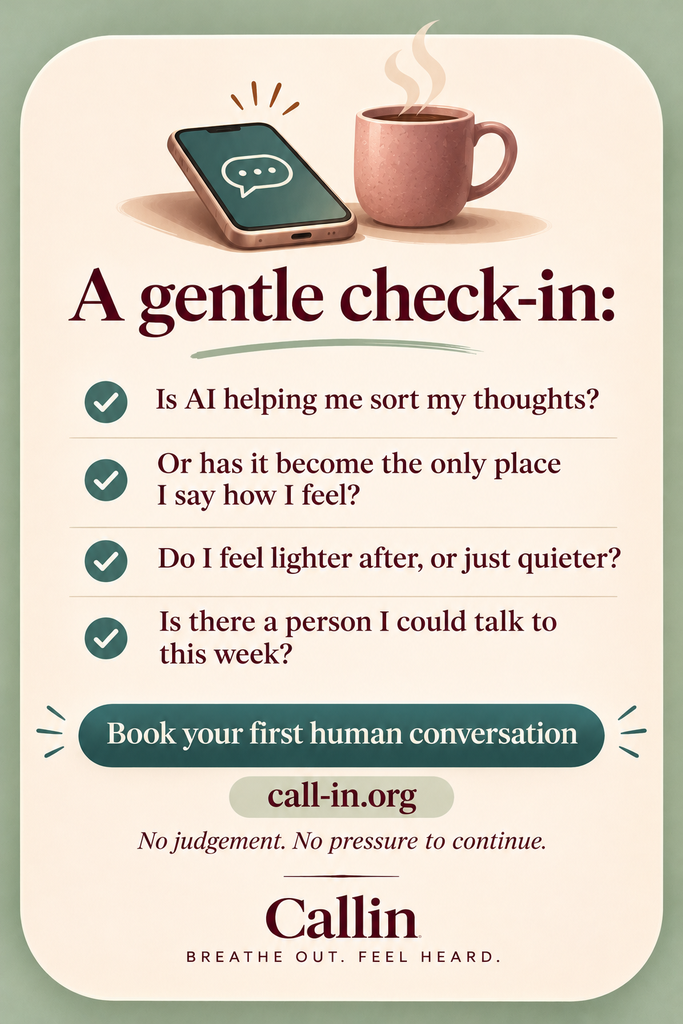
So it is less about if you use AI and more about how. If it helps you organise your thoughts before talking to a person, that can be useful. If it has become the only place you ever share how you feel, that may be worth noticing.
What can AI genuinely help with?
AI can genuinely help with information, structure and reflection. It can suggest journaling prompts, help you put a messy situation into words, summarise options or explain a concept. Some people use it to draft what they want to say before speaking to someone real.
Those are real benefits. The aim is not to fear AI. It is to use it for what it does well, and to seek people for what only people can give.
What might sit underneath the urge to vent to AI instead of a person?
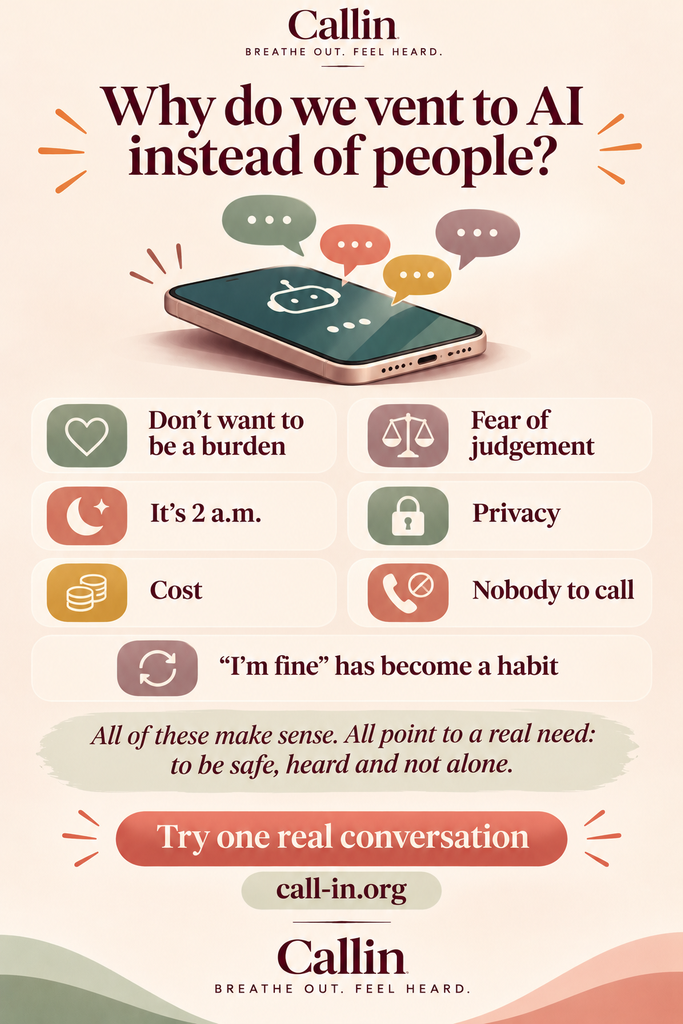
Underneath the urge to vent to AI, there are often ordinary, understandable reasons: not wanting to burden anyone, fear of judgement, wanting privacy, needing support at odd hours, cost worries or feeling that nobody in your life would understand. Naming these in your own words can help you see what you are really looking for. This is reflection, not diagnosis.
Here are some things people often find underneath, as they understand them:
- Not wanting to be a burden. AI never seems tired of you, so it can feel safer than leaning on friends.
- Fear of judgement. A machine will not gossip, raise an eyebrow or change how it sees you.
- Timing. Hard moments often arrive at 2am, when people you know are asleep.
- Privacy. You may not want anyone in your life to know how you really feel.
- Cost. Therapy may feel out of reach, and AI is cheap or free.
- Loneliness. If there is no one to call, a chatbot can feel better than silence.
- Habit. Saying “I’m fine” to people and the truth to a screen can quietly become routine.
Each of these makes sense. Each also points to a real human need: to be safe, accepted, private and not alone.
If any of these feel familiar, these Callin articles may help: Someone To Talk To When I Don’t Want to Burden My Friends, Why Can’t I Open Up Even Though I Listen to Everyone Else?, The Dangers of “I’m Fine”: The Cost of Surface-Level Interactions and I Can’t Afford Therapy, But Don’t Want to Chat with AI.
Why do I feel lonelier after talking to AI?
You may feel lonelier after talking to AI because the conversation can meet the surface need to talk without meeting the deeper need to be known by someone. When the chat ends, nothing in your human world has changed. Nobody new knows how you are.
That gap can make loneliness more noticeable, not less. It is a bit like eating something filling that has no nourishment in it.
If loneliness is part of what you are carrying, Callin’s articles I Am So Lonely and Have Nobody to Talk To: Where Can I Get Support? and Feeling Loneliness? Human Connection in a Digital World offer gentle next steps.
Why do people come back to human listening after trying AI?
People often come back to human listening because they want to be known, not just answered. A person offers presence, a real relationship and continuity over time. For many, that is what turns talking into feeling genuinely supported.
Venting to a person also does something AI cannot: it connects you back into the human world. Callin’s article Emotional Venting: Why It Helps You Feel Less Alone explores why being heard by someone can ease that sense of isolation.
How does Human Continuity™ make human support feel different?
Callin’s Human Continuity™ means that, wherever possible, you keep talking with the same trained listener across sessions. They remember the people in your life, what happened last week and what has been weighing on you. You do not have to start again each time.
That memory is not stored data. It is a real person who has been paying attention to you. Continuity is a comfort for many people, not a promise of any particular outcome. You can read more in Where Can I Find Ongoing Online Emotional Support From the Same Person?.
What training do Callin listeners have?
Callin listeners are trained in active listening and Psychological First Aid. The World Health Organization’s guide to Psychological First Aid describes it as “a humane, supportive response to a fellow human being who is suffering and who may need support”. The guide is clear that it is not professional counselling, and one of its themes is “listening to people, but not pressuring them to talk”.
To see how this kind of support works in practice, read What Is a Listening Service? How Human Emotional Support Works.
Can I still type if I am more comfortable chatting than talking?
Yes, you can. Callin offers private chat as well as voice and video calls, and the person typing back is a real human. If chatting feels easier at first, that is fine. Callin’s guide Can You Text Someone to Just Vent? Private Chat Lines Explained explains how it works.
Is Callin therapy or a crisis service?
No, Callin is neither therapy nor a crisis service. Callin provides non-clinical emotional support from real people, for people who are not in immediate danger. Callin does not diagnose, assess or treat any mental health condition.
If you want clinical support, a doctor, therapist or counsellor is the right place. Therapy is a different room, not a lesser one. Callin’s articles Therapy vs. a Listening Service: Do You Need Therapy or Someone to Talk To? and What Is Non-Clinical Mental Health Support? The Missing Middle Between Friends and Therapy explain the difference.
If you are not in crisis but want to talk, a warmline may also be an option where you live. See I Need Someone to Talk To, But I’m Not in Crisis: What Is a Warm Line?. For a wider look at non-clinical options, read Who to Talk to When You Don’t Need Therapy But Need a Safe Space to Vent.
If you are in crisis, please contact your local emergency services or find a free line at findahelpline.com.
Frequently asked questions
Can AI replace a human listener for emotional support?
No, AI cannot replace a human listener for emotional support. AI can produce supportive words quickly, but it has no lived experience, no felt empathy and no genuine relationship with you. It can be a useful tool alongside human connection, not a substitute for it.
Why does venting to ChatGPT feel empty?
Venting to ChatGPT can feel empty because no one on the other side is actually affected by what you share. Research suggests people feel less heard once they know a response came from AI, even when the words are kind. Many people find that being heard by a real person feels different.
Is it bad to vent to AI?
No, it is not bad to vent to AI, and many people find it useful for getting thoughts out. Research links heavy daily use with more loneliness and less socialising, although it does not prove cause. It can help to use AI alongside human connection rather than instead of it.
Does ChatGPT understand my feelings?
No, ChatGPT does not understand your feelings in the way a person does. It predicts words that fit what you wrote, and it can name emotions well. It does not feel anything, and it has no lived experience of what you are going through.
Is Callin an AI chatbot?
No, Callin is not an AI chatbot. Everyone you speak to at Callin is a real person, trained in active listening and Psychological First Aid. You can talk by voice call, video call or private chat.
Is Callin a crisis service?
No, Callin is not a crisis or emergency service. Callin provides non-clinical emotional support for people who are not in immediate danger. If you are in crisis, please contact your local emergency services or find a free line at findahelpline.com.
Will I talk to the same person each time at Callin?
Wherever possible, yes. Callin’s Human Continuity™ means you usually keep the same dedicated listener, so you do not have to repeat your story every time. Continuity is about comfort and familiarity, not a promise of a particular outcome.
What is a gentle next step if AI is not giving me what I need?
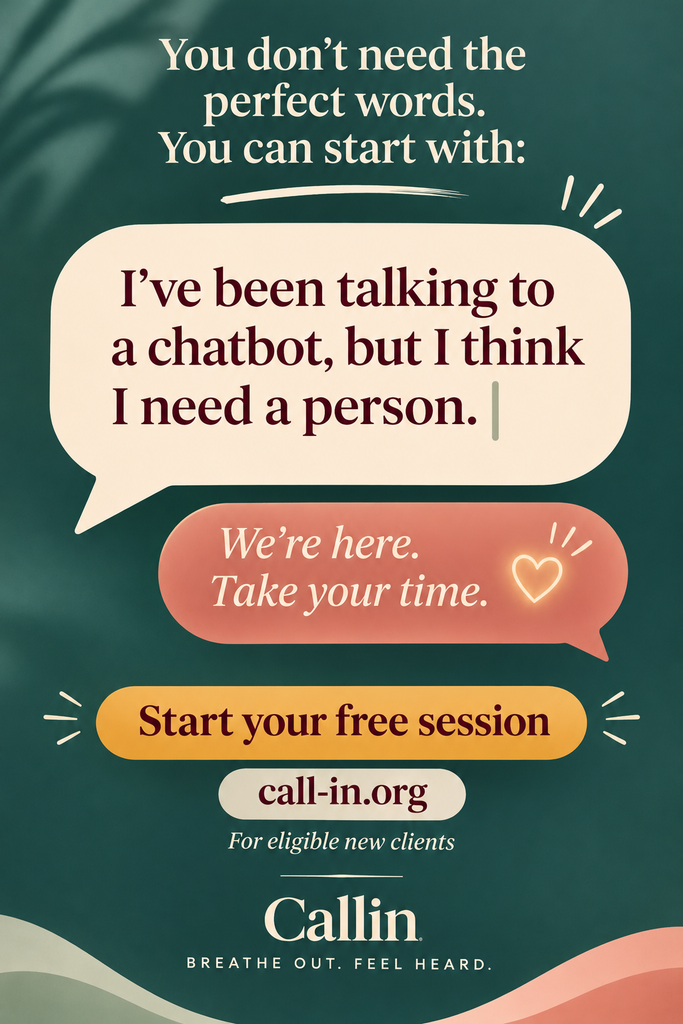
A gentle next step is to try one conversation with a real person, at your own pace and in the format that feels easiest. You do not need to have the right words. You can start with “I’ve been talking to a chatbot, but I think I need a person”.
If Callin feels like it might fit, eligible new clients can start with a free first call session with no obligation to continue. You can find out more about Callin’s non-clinical emotional support whenever you are ready. To see what that first conversation looks like, read What Happens in a Callin First Session? What to Expect.
You deserve more than a reply. You deserve to be heard by someone.
Most relevant UN Sustainable Development Goal
SDG 3: Good Health and Well-Being, in particular Target 3.4, which includes promoting mental health and well-being. As AI tools become part of everyday life, accessible human listening can sit alongside technology, healthcare and community support so that people are not left with machines as their only source of emotional connection.
Sources and further reading
- Yin, Y., Jia, N. and Wakslak, C. J. (2024). AI can help people feel heard, but an AI label diminishes this impact. Proceedings of the National Academy of Sciences, 121(14), e2319112121.
- Rubin, M., Li, J. Z., Zimmerman, F., Ong, D. C., Goldenberg, A. and Perry, A. (2025). Comparing the value of perceived human versus AI-generated empathy. Nature Human Behaviour.
- Fang, C. M. et al. (2025). How AI and human behaviors shape psychosocial effects of extended chatbot use: A longitudinal controlled study. MIT Media Lab and OpenAI.
- American Psychological Association (2025). Health advisory: Use of generative AI chatbots and wellness applications for mental health.
- OpenAI (2025). Sycophancy in GPT-4o: What happened and what we’re doing about it.
- OpenAI (2025). Expanding on what we missed with sycophancy.
- Kumar, A. and Epley, N. (2021). It’s surprisingly nice to hear you: Misunderstanding the impact of communication media can lead to suboptimal choices of how to connect with others. Journal of Experimental Psychology: General, 150(3), 595 to 607.
- World Health Organization, War Trauma Foundation and World Vision International (2011). Psychological first aid: Guide for field workers. WHO, Geneva.
- Find A Helpline. findahelpline.com. Free, confidential crisis lines by country.
- United Nations. Sustainable Development Goal 3: Good Health and Well-Being.

Leave a Reply