There is no single best option for every employee. An EAP offers a broader workplace support framework, a mental health app provides digital self-guided tools, online therapy provides clinical treatment, and non-clinical emotional support gives employees a private place to talk to a real person without entering a clinical relationship.
Anything that helps to cope with burnout, stress, and other heavy emotions employees feel can be said to be a good EAP.
Seven key takeaways
- An EAP is broader than a single mental health service. Depending on the provider and contract, it may include counselling, referrals, practical advice, manager support and other services.
- A mental health app is primarily a digital tool. Apps can offer self-guided exercises, education, meditation, tracking, coaching or other resources, depending on the product.
- Online therapy is clinical support. Therapy is appropriate when an employee needs psychological treatment or structured therapeutic work from an appropriately qualified professional.
- Non-clinical emotional support is different from therapy. It gives people a confidential space to talk, reflect and feel heard without diagnosing or treating a mental health condition.
- A real person and an app solve different problems. Digital tools can be useful when someone wants flexibility and self-guided resources. Human conversation may be more appropriate when someone wants to talk something through with another person.
- Burnout requires more than an employee benefit. Support can help an employee cope, reflect and seek appropriate help, but an EAP, app, therapy service or emotional-support platform cannot fix excessive workload, poor management or unhealthy working conditions.
- A layered approach can be stronger than a single solution. Employers can combine organisational changes, manager support, EAP services, clinical care, digital tools and non-clinical human support according to employee needs.
What is the difference between an EAP and a mental health app?
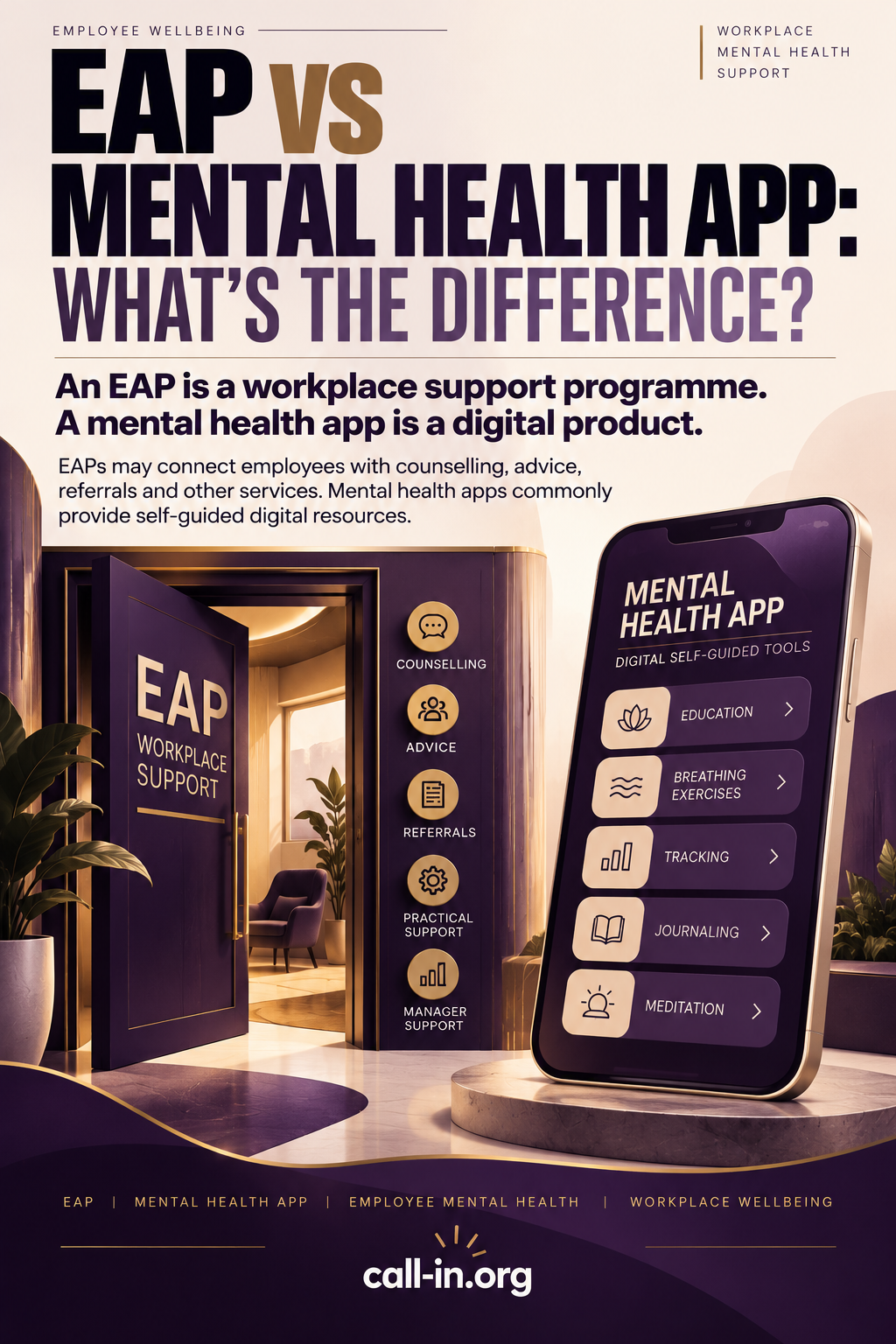
An EAP is a workplace support programme, while a mental health app is a digital product. An EAP may connect employees with counselling, advice, referrals or other services, whereas an app commonly provides self-guided digital resources.
The exact scope of an EAP varies significantly between providers and contracts. Some EAPs include counselling, telephone support, legal or financial information, management support and other services. Current UK public-sector examples show how broad an EAP can be, with services ranging from counselling and psychological support to practical advice.
A mental health app usually puts the employee directly in front of a digital experience.
That might include:
- Guided exercises
- Meditation or relaxation content
- Mood tracking
- Journaling
- Educational material
- Self-assessment tools
- Coaching
- Behaviour-change programmes
- Sleep or wellbeing resources
The important distinction is that an app is a delivery format, not a single type of care.
Some apps are primarily self-guided. Others connect users with coaches or clinicians. Their capabilities should therefore be checked individually rather than assumed.
For an employer, the useful question is not simply:
“Which one is better?”
It is:
“What does our employee actually need at this point?”
Someone who wants a guided exercise they can complete privately at 11pm may value an app.
Someone who wants counselling may need an EAP or therapy provider.
Someone who simply wants to talk to another human about a difficult week may need something else.
What is the difference between an EAP and online therapy?
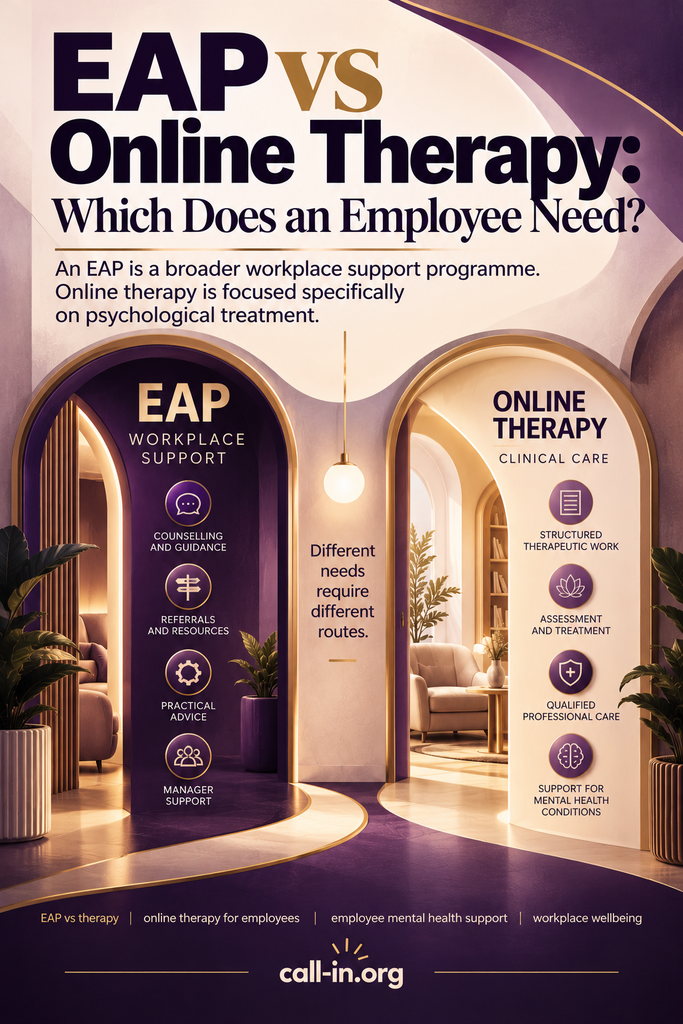
An EAP is a workplace support programme that may include counselling or access to other services, while online therapy is a specific form of psychological treatment delivered remotely by a qualified professional.
This distinction matters because an EAP and therapy are not necessarily competing products.
An EAP may provide access to short-term counselling as part of a wider employee-support package. The exact number of sessions, type of therapy, eligibility and referral arrangements vary between providers.
Online therapy, by contrast, is focused specifically on therapeutic care.
The NHS describes counselling as a type of talking therapy in which a counsellor listens and helps someone work towards solutions to problems. NHS Talking Therapies also provides psychological treatments for conditions including anxiety and depression.
Therapy may therefore be appropriate when an employee is looking for:
- Psychological treatment
- Clinical assessment
- Structured therapeutic work
- Support for a mental health condition
- Specialist treatment from an appropriately qualified professional
An EAP may be useful when an employer wants a broader support infrastructure around employees.
The two can coexist.
In fact, a sensible workplace wellbeing strategy should not force employees into a false choice between “EAP” and “therapy”.
Different needs require different routes.
What is the difference between therapy and non-clinical emotional support?
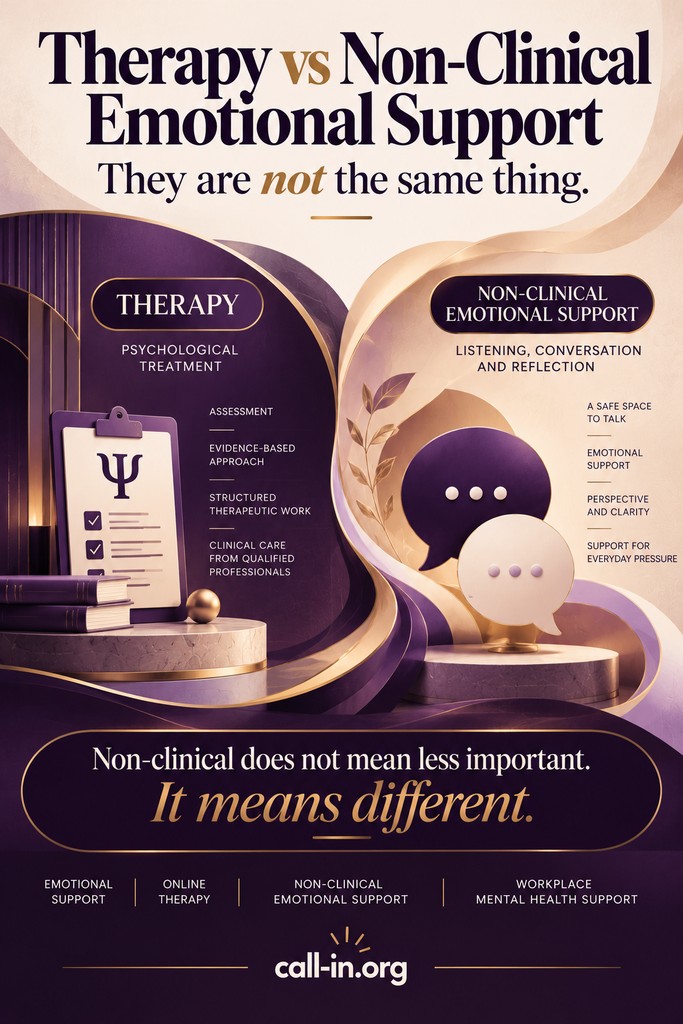
Therapy involves psychological treatment, while non-clinical emotional support focuses on human conversation, listening, reflection and emotional support without diagnosis or treatment.
This is one of the most important distinctions in the entire comparison.
Not every employee who is having a difficult day, feeling lonely, struggling with workplace pressure or carrying a difficult personal situation is necessarily looking for therapy.
That does not mean their experience is unimportant.
Someone may think:
“I don’t think I need therapy. I just need somewhere to talk.”
That is a legitimate support need.
Non-clinical emotional support can provide space to:
- Talk about workplace stress
- Vent after a difficult day
- Discuss loneliness or isolation
- Think through a difficult relationship
- Talk about career uncertainty
- Reflect on a difficult workplace experience
- Process a major life change
- Put thoughts into words
- Feel heard without needing a diagnosis
Callin operates in this non-clinical space. It provides confidential, one-to-one conversations with trained human listeners and does not present itself as therapy, diagnosis, medical treatment or crisis care.
That distinction is important.
Non-clinical does not mean “less important”. It means different.
Should employees use an app or talk to a real person?
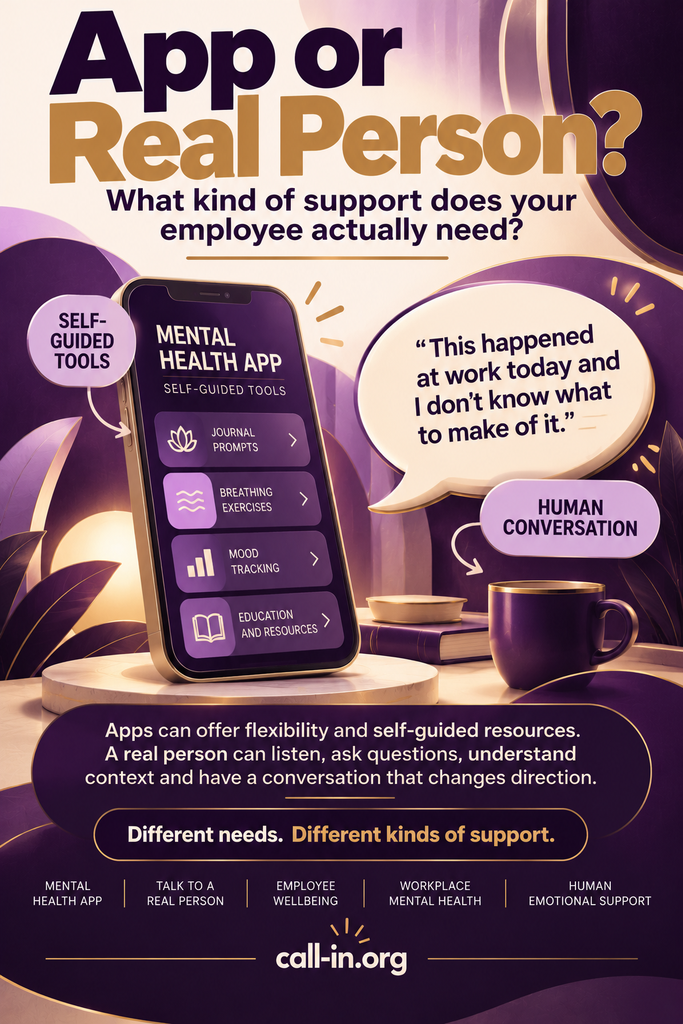
It depends on what the employee wants from the support. An app may be useful for self-guided tools and flexible digital resources, while a real person can provide an interactive conversation, listening and human connection.
Some employees prefer independence.
They may want to open an app, complete an exercise, track how they are feeling or work through a guided resource privately.
That can be useful.
Other employees do not want another screen asking them to rate their mood.
They want to say:
“This happened at work today and I don’t know what to make of it.”
That is a different need.
A conversation with another person allows the employee to explain context, change direction, pause, clarify what they mean and explore something that may not fit neatly into an app interface.
Human connection can also matter when someone feels isolated.
Callin’s workplace support model is based on private, one-to-one human conversations rather than an AI chatbot. Callin also uses a Human Continuity™ approach and aims to keep someone with the same listener wherever operationally possible.
For an employer, this creates a simple consideration:
Does your support strategy give employees access to both tools and people?
There is no reason it cannot.
When is therapy the right workplace benefit?
Therapy is the appropriate route when an employee needs psychological treatment or specialist clinical support rather than simply a place to talk.
An employer should not expect an app, manager, EAP, coach or non-clinical listener to perform the role of a therapist.
Depending on the employee’s circumstances, therapy may be appropriate for persistent or significant mental health difficulties, including conditions for which structured psychological treatments are recommended.
In England, NHS Talking Therapies provides psychological interventions for adults experiencing anxiety and depression and offers self-referral for many people.
For employers, the principle is straightforward:
Make the clinical route available when employees need it.
That may be through:
- An EAP
- Private therapy
- Health insurance
- NHS services
- Occupational health
- Specialist mental health services
The exact route will depend on the employee, location and circumstances.
Managers should not diagnose employees or decide whether someone “needs therapy”. Their role is to listen appropriately, support the employee within their role and signpost to appropriate help.
When is non-clinical emotional support more appropriate?
Non-clinical emotional support can be useful when an employee mainly wants a private human conversation rather than diagnosis, treatment or clinical assessment.
An employee might be:
- Overwhelmed by work
- Feeling lonely while working remotely
- Dealing with a difficult manager
- Questioning their career
- Struggling after a relationship breakdown
- Carrying personal stress into work
- Feeling emotionally drained
- Unsure what they are feeling
- Looking for somewhere to vent without burdening friends or family
These experiences can be significant without automatically requiring clinical treatment.
Callin provides one-to-one non-clinical emotional support for adults dealing with issues including workplace stress, burnout, loneliness, relationships, grief, life changes and career uncertainty.
This is also where the distinction between support and treatment becomes important.
Callin does not treat or diagnose mental health conditions.
Instead, the purpose is to give someone somewhere to talk before, between or alongside other forms of appropriate support.
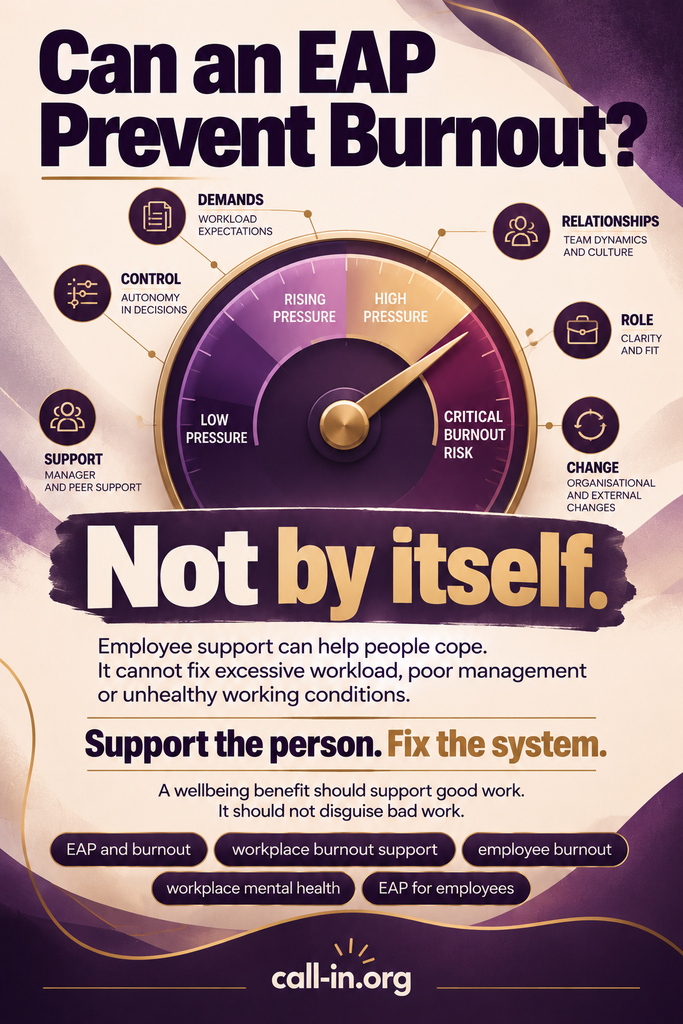
Can an EAP prevent burnout?
An EAP can provide valuable support when employees are experiencing workplace stress or other difficulties, but it should not be described as a complete way to prevent burnout.
The World Health Organization defines burnout as an occupational phenomenon resulting from chronic workplace stress that has not been successfully managed. It is not classified as a medical condition.
That definition matters for employers.
If the workload is unreasonable, giving employees an EAP does not make the workload reasonable.
If management behaviour is damaging, adding an app does not make the management behaviour healthy.
If employees have no control over their work, a meditation subscription cannot create meaningful control.
The Health and Safety Executive identifies six areas of work design associated with work-related stress:
- Demands
- Control
- Support
- Relationships
- Role
- Change
Employers are encouraged to assess these underlying workplace factors rather than relying solely on individual interventions.
This is why Callin’s approach is deliberately not:
“Give everyone emotional support and call the problem solved.”
The better principle is:
Support the person. Examine the system.
Callin can give an employee somewhere to talk about what they are experiencing.
The organisation still needs to examine why employees are experiencing it.
Can a mental health app prevent burnout?
A mental health app can provide useful resources for wellbeing, reflection or self-guided support, but an app alone cannot be assumed to prevent workplace burnout.
Burnout is connected to chronic workplace stress. The conditions creating that stress therefore matter.
If an employee has an impossible workload, unclear responsibilities, poor workplace relationships or little control over how they work, an app cannot independently change those conditions.
The same principle applies to every individual support service.
An app can be part of the solution.
It is not the whole workplace strategy.
For employers, this is one reason the strongest wellbeing programmes tend to combine individual support with organisational action.
CIPD recommends a holistic approach that includes sources of help such as counselling, EAP and occupational health alongside manager capability and attention to work-related health risks.
Can employers offer more than one type of mental health support?
Yes. Employers can combine EAP services, therapy, mental health apps, occupational health, manager support and non-clinical human support.
In many organisations, this is more practical than asking one benefit to serve every employee and every situation.
Think about the support journey.
An employee might first notice that they are struggling.
They might use an app to learn more about stress.
They might want to talk to a real person.
They might then decide they need therapy.
Another employee might already have a therapist but want somewhere to talk between appointments.
A third employee might have a practical career problem and want coaching rather than mental health treatment.
A fourth employee might need occupational health because their health is affecting their ability to work.
These are not contradictions.
They are different support needs.
A workplace wellbeing strategy can therefore include several layers:
Healthy work design → manager support → human conversation → EAP → clinical care → occupational health → crisis pathways
Not every employee will use every layer.
That is the point.
The organisation creates routes rather than assuming one route fits everyone.
What should employers look for in a workplace mental health platform?
Employers should look beyond the feature list and ask whether the support is accessible, appropriate, trusted and genuinely useful to employees.
Before choosing a platform or provider, ask:
Will employees actually use it?
A technically impressive benefit is not useful if employees do not understand it or trust it.
Is there human support?
If the service is primarily digital, understand exactly where human interaction sits within the experience.
What type of human support is provided?
Is it therapy, counselling, coaching, peer support, active listening or something else?
Do not assume those terms mean the same thing.
What happens when someone needs clinical care?
A responsible service should have clear boundaries around what it can and cannot provide.
What happens in a crisis?
Employees need to know where urgent or emergency support sits outside the normal workplace wellbeing service.
Is confidentiality clearly explained?
Employees need to understand what is private, what may be reported to an employer and what safeguarding or legal exceptions apply.
Can remote employees access it?
A distributed workforce needs support that works across locations and time zones where appropriate.
Can employees return to the same person?
Continuity may matter, particularly for employees who do not want to repeatedly explain their circumstances to a new person.
Does the benefit address the actual problem?
If employees are experiencing workload problems, role ambiguity or poor management, the organisation needs to address those issues as well.
A benefit should support good work.
It should not be used to disguise bad work.
What should a remote team choose?
Remote teams should generally look for support that combines digital accessibility with genuine human connection.
Remote work is not inherently unhealthy. But remote employees can experience different forms of isolation, particularly when everyday informal contact is limited.
A person can spend eight hours in Slack and Zoom and still feel that they have not really spoken to anyone.
That is why remote teams may benefit from having several options available:
- Digital self-guided resources
- EAP access
- Online therapy
- Confidential human conversation
- Manager support
- Occupational health where appropriate
- Regular opportunities for meaningful team connection
Callin is designed for online human conversation and can provide a non-clinical support layer for distributed teams. Employees can speak privately with a human listener about workplace pressure, loneliness, burnout, relationships and other everyday emotional difficulties.
Communication is not the same as connection.
A calendar full of meetings does not automatically mean people feel supported.
What should a startup with a limited budget choose?
A startup with a limited budget should first identify the support gap rather than automatically buying the largest EAP package or the cheapest app.
Startups may have small teams, distributed employees and limited HR infrastructure.
That makes fit particularly important.
Ask:
What problem are we actually trying to solve?
If the company needs broad access to counselling, advice and referral services, an EAP may make sense.
If employees want self-guided wellbeing resources, an app may be useful.
If there is demand for clinical treatment, a therapy benefit may be appropriate.
If employees mainly need somewhere confidential to talk to another person about everyday pressure, non-clinical emotional support may fill that gap.
The cost of an EAP also needs to be assessed carefully. Published UK pricing can vary according to workforce size, minimum fees and scope, meaning the headline per-employee figure does not always tell the full story for a small company.
For a startup, the question should therefore be:
What support will our people actually use, and what support is still missing?
Callin can be considered as a human-support layer alongside an existing EAP or wider employee wellbeing strategy.
Can Callin work alongside an EAP, therapy benefit or mental health app?
Yes. Callin is designed as a complementary non-clinical human-support option rather than a replacement for therapy, crisis services or every function of a traditional EAP.
This is the category gap Callin is designed to address.
An employee may have access to:
- An EAP
- A therapy benefit
- A mental health app
- Occupational health
and still think:
“I just want someone to talk to.”
That does not necessarily mean the existing benefits are failing.
It may simply mean the employee needs a different kind of support at that moment.
Callin provides confidential, one-to-one, non-clinical conversations with real human listeners. Callin uses Human Continuity™ and aims to keep people with the same listener wherever operationally possible.
Employees can use Callin to talk about workplace pressure, burnout, loneliness, relationships, difficult life changes, career uncertainty and other everyday emotional difficulties.
Callin also offers career coaching for professionals who need structured support around career decisions, professional situations, goals and accountability.
For organisations supporting adult students or early-career employees, Callin also offers student academic coaching and accountability focused on planning, prioritisation, procrastination and follow-through.
The important point is that these services have different roles.
A listener is not a therapist.
A coach is not a therapist.
An app is not automatically an EAP.
An EAP is not automatically a therapy service.
And therapy is not a replacement for fixing an unhealthy workplace.
The clearer the distinctions, the easier it becomes for employees to choose the right support.
What is the best employee mental health support overall?
The best employee mental health support is usually not one product. It is a support ecosystem that gives employees different routes depending on what they actually need.
A useful workplace model looks something like this:
1. Fix the work
Look at workload, control, role clarity, relationships, support and organisational change.
2. Equip managers
Managers should know how to have appropriate conversations, listen without diagnosing and signpost employees to suitable support.
3. Provide broad workplace support
An EAP can provide a wider range of services depending on the provider.
4. Provide clinical routes
Employees who need therapy, medical care, occupational health or specialist support should have appropriate routes into it.
5. Offer accessible human conversation
Some employees need somewhere private to talk before they know exactly what kind of support they need.
6. Offer digital tools
Apps and self-guided resources can provide flexible support that employees can use independently.
7. Make the routes understandable
A benefit is much easier to use when employees know what it is, what it is not and where to go next.
This is the difference between having a wellbeing strategy and simply having a collection of wellbeing products.
Why does human connection still matter at work?
Because employees are people before they are employees.
Someone can be highly capable and still feel overwhelmed.
Someone can be successful and still feel lonely.
Someone can perform well while privately carrying far more than their colleagues realise.
And someone can know all the productivity techniques in the world and still need another human being to listen.
Callin’s workplace support approach is built around that simple premise.
Sometimes people do not need another dashboard.
They need somewhere to put down what they are carrying.
Callin provides private, one-to-one, non-clinical emotional support that can sit alongside a broader workplace wellbeing strategy. It is designed for everyday emotional pressure rather than clinical treatment or crisis intervention.
That can include the employee who says:
“I am struggling with work, but I don’t think I need therapy.”
Or:
“I have a therapist, but I still need somewhere to talk between sessions.”
Or:
“I don’t know what I need yet. I just know I need to talk.”
Those are different moments.
Good workplace support leaves room for all of them.
What if the real problem is the workplace?
Then the workplace needs attention.
An employee support benefit can give someone a place to talk, but it cannot make an excessive workload reasonable.
It cannot turn bullying into healthy management.
It cannot create role clarity where none exists.
It cannot make an unsafe workplace safe.
The HSE’s approach to work-related stress specifically directs employers towards underlying factors including demands, control, support, relationships, role and change.
That is why employers should avoid using wellbeing benefits as a substitute for organisational responsibility.
The strongest approach is:
Support the person. Fix the system.
Both matter.
Frequently asked questions
Is an EAP better than a mental health app?
Not necessarily. An EAP and a mental health app serve different purposes. An EAP can provide a broader workplace support structure, while an app may provide self-guided digital resources. The right choice depends on what employees need.
Is online therapy better than an EAP?
Neither is universally better. Online therapy provides a specific clinical service, while an EAP may offer a broader range of workplace support that can include counselling. Some organisations use both.
Is emotional support the same as therapy?
No. Non-clinical emotional support provides listening, conversation and reflection without diagnosis or treatment. Therapy is a form of psychological treatment delivered by an appropriately qualified professional.
Can employees use non-clinical emotional support if they already have a therapist?
Potentially, yes. Non-clinical emotional support can complement appropriate clinical care, provided the employee understands that it is not a replacement for therapy or medical treatment.
Can an EAP replace therapy?
Not necessarily. Some EAPs include counselling or therapeutic services, but the scope varies. Employees who need longer-term, specialist or clinical treatment may need a different route.
Can a mental health app replace an EAP?
Usually, that is not an apples-to-apples comparison. An app may provide digital wellbeing tools, while an EAP can provide a broader workplace support framework. An organisation may use both.
Is Callin an EAP?
Callin should not be presented as a traditional full-service EAP. Callin provides confidential, one-to-one, non-clinical human support and can complement an EAP or wider workplace wellbeing strategy.
Sources and further reading
The comparison in this article draws on current guidance and source material from:
- World Health Organization, Burn-out as an occupational phenomenon.
- UK Health and Safety Executive, Management Standards for work-related stress.
- NHS, Talking therapies and counselling.
- NHS England, NHS Talking Therapies for anxiety and depression.
- CIPD, Wellbeing at Work.
- CIPD, Supporting mental and physical health at work.
Relevant UN Sustainable Development Goal
SDG 3: Good Health and Well-Being
This article also relates to SDG 8: Decent Work and Economic Growth, particularly where workplace conditions, sustainable work and employee wellbeing are concerned.
A simple way to choose
If your employees need broad workplace support, consider an EAP.
If they want self-guided digital tools, consider a mental health app.
If they need psychological treatment, provide access to appropriate therapy or clinical care.
If they mainly want a confidential human conversation without entering a clinical relationship, consider non-clinical emotional support.
And if your organisation can provide more than one layer, you do not necessarily have to choose.
Sometimes the best answer is not EAP versus therapy versus app versus human support.
It is EAP plus therapy plus digital tools plus human support, with each doing the job it is actually designed to do.
Support matters.
So does prevention.
And sometimes, the most useful benefit is simply giving someone somewhere to talk before they reach breaking point.
Callin provides confidential, one-to-one, non-clinical human support for employees, founders and professionals dealing with workplace pressure, burnout, loneliness, career uncertainty and everyday emotional difficulties.
Leave a Reply