An Employee Assistance Programme, also called an Employee Assistance Program in many countries, can be a strong pillar of EAP employee wellbeing wherever teams work.
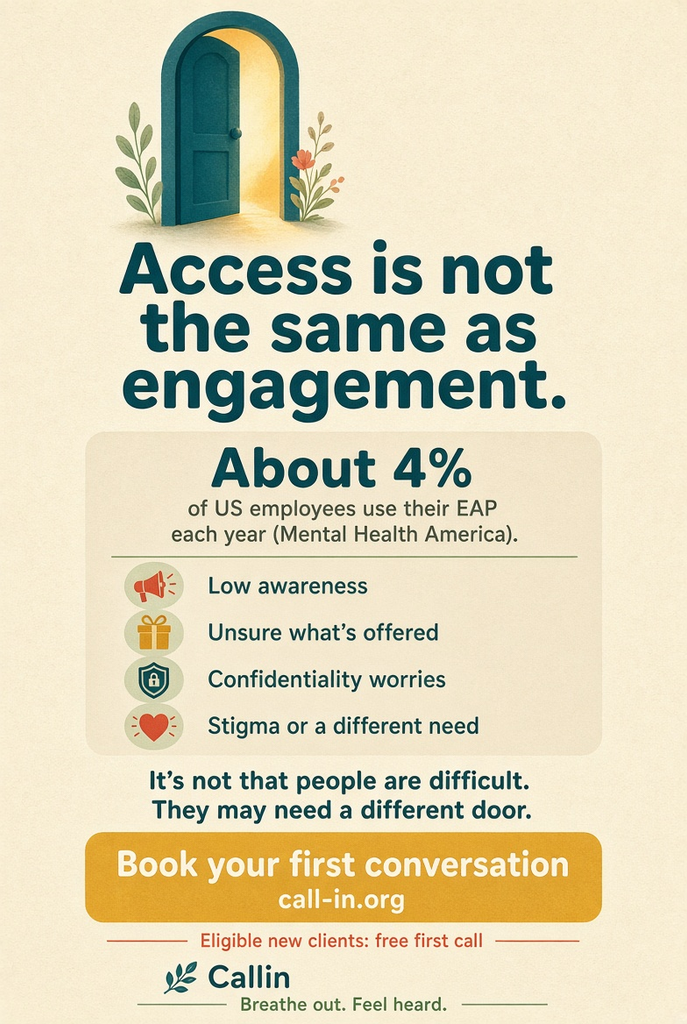
Access alone, though, is not the same as engagement. Across regions, many people still want workplace emotional support and employee mental health support that feels human, ongoing and clearly non-clinical. This article explores how Callin can sit beside an EAP as a complementary layer, not a replacement.
Callin provides confidential, one-to-one, non-clinical human support by voice call, video call or private chat. It is not therapy, counselling, diagnosis, medical or psychiatric care, or crisis or emergency support. Everyone you speak to is a real person, not an AI.
If you are in danger right now, or think you might act on thoughts of harming yourself or someone else, please contact your local emergency services or a crisis line. You can find a free, confidential line in your country at findahelpline.com.
Key takeaways
- An Employee Assistance Programme often offers confidential advice, counselling access, referrals and support with work or personal challenges.
- Having an EAP available does not automatically mean employees will use it.
- Employees sit on a continuum of need, from everyday listening to clinical care.
- Callin is designed as non-clinical emotional support that can complement, not replace, EAP and clinical pathways.
- Human Continuity™ means people can usually return to the same trained listener over time.
- Employers everywhere should ask clear questions about needs, confidentiality, duty of care and responsible integration before adding any complementary layer.
- The future of workplace wellbeing looks more like an ecosystem than a single benefit.
What is an Employee Assistance Programme (EAP) for employee mental health support?
An Employee Assistance Programme is an employer-sponsored support service that gives staff a route to confidential help. Names and designs vary by country, sector, provider and contract. Many EAPs include short-term counselling, advice lines, signposting and support with work stress or personal and family challenges.
Around the world, employers are paying more attention to employee mental health support. The World Health Organization notes that an estimated 15% of working-age adults have a mental disorder at any point in time, and that depression and anxiety cost the global economy about US$1 trillion each year in lost productivity. WHO and the International Labour Organization urge prevention of psychosocial risks, protection of mental health at work, and support for workers who need it.
Country evidence shows EAPs are already a familiar tool in some markets. In the UK, the CIPD’s Health and wellbeing at work 2025 survey found that offering an EAP was among the most common employer actions for mental health, cited by 41% of organisations surveyed. That is a UK snapshot, not a worldwide average.
EAPs are not identical products. Some focus on counselling sessions. Others add legal or financial advice, manager guidance, family support or digital tools. Quality, scope, language access and delivery differ, so the label “EAP” alone does not tell you what an employee will actually experience.
For a clear primer on how EAPs work, see Callin’s guide What Is an Employee Assistance Program (EAP) and How Does It Work?. This article does not repeat that map. It asks a different question: what sits around the EAP once it exists?
Why does EAP employee wellbeing still leave an engagement gap?
EAP employee wellbeing can stall when access exists on paper and hesitation exists in real life. Availability is not the same as uptake. That gap appears in more than one country, and it does not mean every EAP fails.
In the United States, Mental Health America notes that while most mid to large companies offer EAPs, only about 4% of employees use them each year. A 2024 international review in the Human Resource Management Journal by Long discusses under-utilisation as a persistent industry problem, citing figures such as a 5.5% US uptake example from SHRM reporting. Treat those numbers as US evidence examples, not a single global rate.
What stops people using the EAP they already have?
Common barriers include low awareness, uncertainty about what the EAP offers, confidentiality worries, stigma, and a preference for a different kind of support. Some people also struggle to recognise when a quieter form of help would be useful. How strongly each barrier bites can depend on local culture, language, hierarchy and family or community norms.
Trust matters everywhere. If someone fears that using support will follow them at work, they may stay silent even when the service itself is confidential. Clear communication about privacy helps. So does naming that “I just need to talk” is a valid reason to reach out.
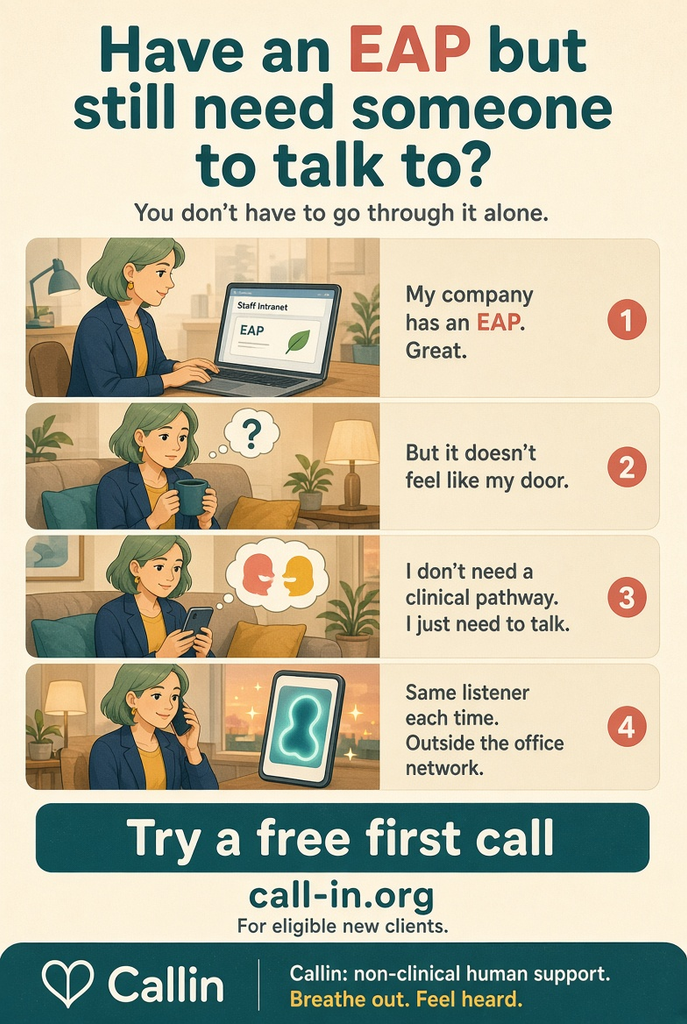
If you are an employee reading this and thinking “I have an EAP, but it does not feel like my door,” you are not being difficult. You may simply need a different room in the same building of support. Callin’s employee-facing page Workplace Mental Health Support for Employees explores those layers without pretending one tool fixes everything.
What kinds of workplace emotional support do employees actually want?
Workplace emotional support sits on a continuum. Not every hard week needs clinical intervention. Some people want a dedicated person to talk to, a space outside workplace relationships, support through a life transition, non-judgemental listening, regular human connection, or continuity with someone who remembers their story.
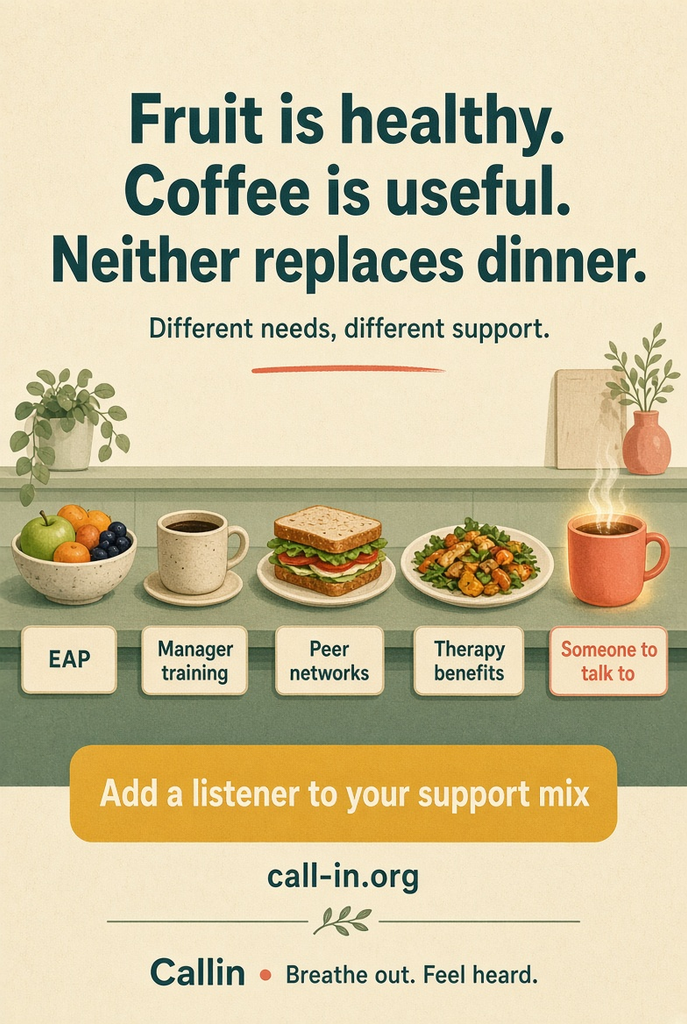
Think of it like office snacks. Fruit is healthy. Coffee is useful. Neither replaces dinner.
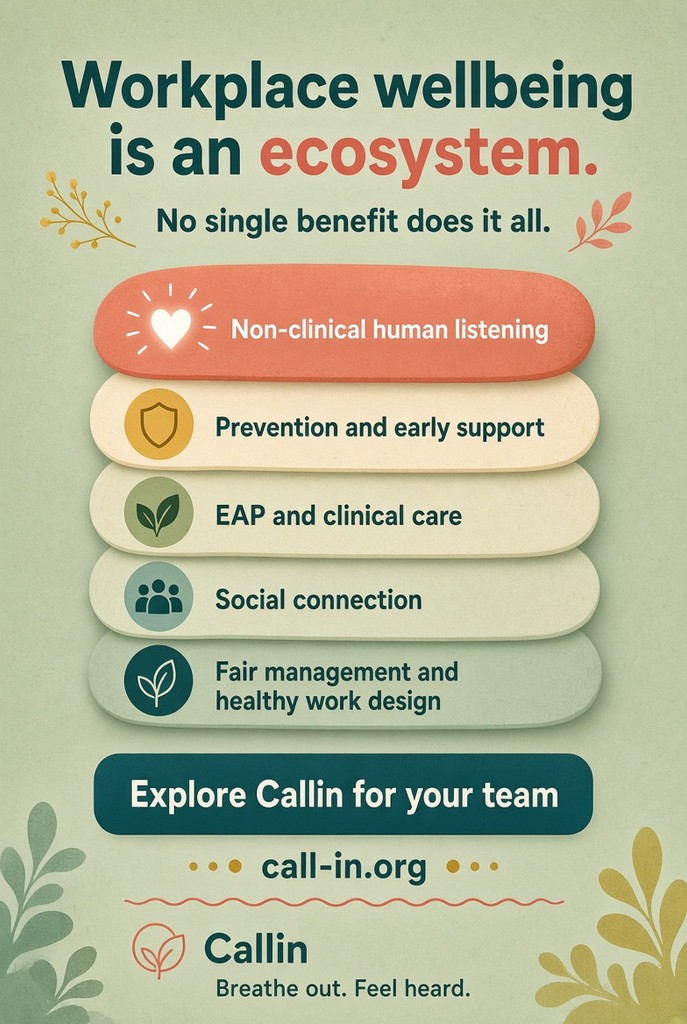
EAPs, therapy benefits, manager training, peer networks and non-clinical listening each feed a different hunger. Mixing them is ordinary good sense, not duplication for its own sake.
Employees often want emotional room that does not require them to frame their life as a clinical case. In some cultures, talking outside the family or outside a clinical setting carries different meaning, so choice of doorway matters. That wish can sit beside respect for counselling and therapy.
Callin’s articles What Is Non-Clinical Mental Health Support? The Missing Middle Between Friends and Therapy and What Kind of Support Do I Need: Therapy, Coaching or Emotional Support? help people sort those needs without shame.
How can Callin complement an Employee Assistance Programme?
Callin can complement an Employee Assistance Programme by offering dedicated one-to-one non-clinical listening alongside whatever clinical or advisory pathways the EAP already provides. The idea is an extra layer for human connection and ongoing emotional support. It is not a rival tile on a benefits list.
Callin’s FAQ states that Callin is open to conversations with employers, universities and other partners that want to add affordable non-clinical emotional support to what they already provide. It also states that Callin can complement an EAP, and that it does not replace an organisation’s safeguarding, occupational health, counselling or emergency responsibilities, whatever those local systems are called.
What is the difference between EAP access and dedicated ongoing support?
EAP access usually means a route into confidential help when someone reaches out. Clinical or therapeutic support focuses on assessment and treatment within a professional clinical frame. One-off listening can help in a single difficult moment. Dedicated ongoing emotional support adds familiarity over time with a listener who already knows the context.
Those are different jobs. A complementary model respects each job. Callin focuses on scheduled non-clinical conversations with trained listeners.
Listeners complete Psychological First Aid training and follow Callin protocols on boundaries, safeguarding and signposting, as explained in the FAQ. That training does not make them clinicians.
For how listening works in practice, see What Is a Listening Service? How Human Emotional Support Works and How Active Listening Makes You Feel Truly Heard Without Judgment. Side-by-side benefit comparisons live in EAP vs Mental Health App vs Online Therapy vs Emotional Support, which this piece deliberately does not rebuild.
Why does continuity matter for workplace emotional support?
Continuity matters because workplace stress rarely resolves in a single midweek phone call. Familiarity builds trust. People spend less energy re-explaining their manager, their shift pattern, or their caring responsibilities. Regular emotional expression becomes easier when someone already knows the plot.
Callin’s Human Continuity™ approach prioritises returning you to the same trained listener wherever possible. In a workplace context, that can mean a steady place outside the office network. It is not a promise of clinical outcomes or productivity gains.
You can read the continuity idea in Where Can I Find Ongoing Online Emotional Support From the Same Person? and Benefits of Consistent Emotional Support. For prevention before everything snaps, see What Is Preventive Emotional Care? Why Waiting Until You Break Is Risky.
Where might complementary non-clinical support help employers?
Complementary non-clinical support might help small and medium-sized businesses, larger employers, multinationals, distributed and remote workforces, organisations with high emotional demands, broader employee wellbeing programmes, and EAP providers exploring adjacent services. These are potential applications, not confirmed partnerships or guaranteed results.
Remote and hybrid teams often lose the soft hallway moments that once carried everyday support. Loneliness can rise even when calendars look full. Callin’s Remote Work Loneliness: Why It Happens and How to Cope explores that texture.
Employers already comparing EAP models for smaller teams can use existing Callin guides such as Best EAP for Startups and Small Businesses, How to Set Up Mental Health Support for Employees in a Small Company and How Much Does an EAP Cost Per Employee?. Those pages include illustrative buying and budgeting detail that may not match every country’s market. This article stays at the ecosystem level.
Organisation-facing overviews also sit at Workplace Wellbeing Support for Organisations and Workplace Wellbeing and UN SDGs.
What questions should employers ask before adding complementary EAP services?
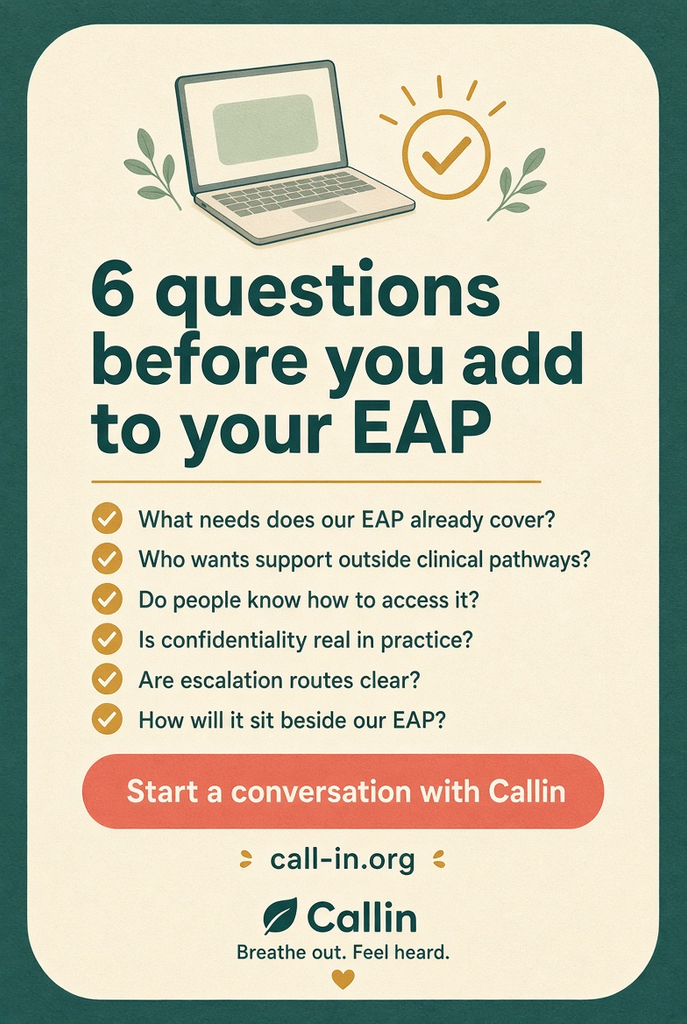
Employers should ask what needs their current provision already covers, and which needs still fall through the gaps. Good questions beat glossy promises every time.
Useful prompts include:
- What types of employee needs does our existing provision address well?
- Are there employees who want support outside clinical pathways?
- Do people understand what support is available and how to access it?
- How do we protect confidentiality in practice, not only in policy?
- How do we ensure appropriate safeguarding or duty-of-care processes and clear escalation routes under local law?
- How can complementary support be integrated responsibly beside the EAP, occupational health or equivalent services, and local crisis pathways?
Callin’s FAQ explains that sessions are private, that Callin does not create clinical notes, and that confidentiality still has safeguarding and legal limits. Details live in the Callin Privacy Policy and Community Standards. Listeners may signpost onwards when something sits beyond Callin’s non-clinical scope.
Culture still matters more than any portal tile. Why Workplace Stress Needs More Than Wellness Programmes makes that point without blaming individuals for structural pressure.
I have an EAP. Can I still look for employee mental health support myself?
Yes. Having an EAP does not lock you into one doorway. You can use your EAP, speak to a clinician, talk to a trusted person, or seek non-clinical listening, depending on what you need right now. Many people combine supports over time.
If you want counselling through your EAP, that may be exactly right. If you want someone to talk to about work stress without framing it as therapy, that can be valid too. See Who can I talk to about work burnout if I’m not looking for therapy? and Someone to Talk To for Work Stress and Burnout.
If a conversation feels welcome, eligible new clients can start with a free first call session with no obligation to continue. You can explore that via Callin’s non-clinical emotional support page or read What Happens in a Callin First Session? What to Expect.
What does the future of workplace wellbeing look like?
The future of workplace wellbeing looks less like one hero benefit and more like an ecosystem. That matches the direction of WHO and ILO guidance: prevent risks in how work is organised, protect mental health, and support people who need help. Clinical care, EAPs, social connection, fair management practices, prevention and non-clinical human support each play different roles.
No single service owns the whole story. Callin aims to be a potential contributor in the non-clinical listening part of that ecosystem. Interest from employers is welcome. Claims should stay honest: complementary, not miraculous.
About Us explains why Callin was built for the space between friendship and therapy. That same space appears at work, between “I’m fine” in the chat tools and “I need a clinical pathway.”
Frequently asked questions
Does Callin replace an Employee Assistance Programme?
No. Callin does not replace an EAP, occupational health or equivalent workplace health services, counselling or emergency responsibilities. It can sit beside those services as non-clinical emotional support.
What is the difference between an EAP and workplace emotional support from Callin?
An EAP is usually a broad employer-sponsored programme that may include counselling, advice and referrals. Callin focuses on scheduled one-to-one non-clinical listening with a real person. Many organisations may use both for different needs.
Why might employees want support outside their EAP?
Employees may want a different tone, more continuity, less clinical framing, or a space that feels separate from workplace systems. Preference is not rejection of the EAP. It is information about unmet need.
Is complementary employee mental health support confidential?
Callin treats confidentiality as foundational and does not create clinical session notes. Confidentiality still has legal and safeguarding limits, which are explained in Callin’s privacy and community materials.
Can employers offer Callin alongside an existing EAP?
Callin’s FAQ says Callin is open to conversations with employers and partners that want to add non-clinical emotional support to what they already provide. Any arrangement should keep safeguarding and clinical pathways clear.
Where can HR learn more about EAP design and cost?
Start with Callin’s existing guides on what an EAP is, EAP pricing and choosing an EAP for startups. Then return here for the complementary-layer conversation.
What should I do if I need urgent help at work?
If you are in immediate danger or cannot keep yourself safe, contact local emergency services or find a free confidential line at findahelpline.com. Callin is not a crisis service.
What is a practical next step for HR and for employees?
A practical next step for HR is to map what your EAP already covers, then notice which employee needs still have no clear home. A practical next step for an employee is to choose the door that fits today’s need, whether that is the EAP, a clinician, a friend or a non-clinical listener.
If Callin feels relevant as a complementary option, you can explore non-clinical emotional support or begin a partnership conversation through the routes described on Callin’s FAQ and organisation wellbeing page.
Support works best when people have more than one honest place to turn.
Most relevant UN Sustainable Development Goal
SDG 3: Good Health and Well-Being, especially Target 3.4 on promoting mental health and well-being. Across countries, workplace ecosystems that combine clinical care, EAPs and non-clinical human support can widen safe routes to help.
Sources and further reading
- World Health Organization. Mental health at work fact sheet.
- World Health Organization (2022). Guidelines on mental health at work.
- World Health Organization and International Labour Organization. Mental health at work: policy brief.
- CIPD (2025). Health and wellbeing at work 2025. UK survey evidence example.
- Mental Health America. How can we promote our EAP to increase its usage?. US evidence example.
- Long, T. (2024). Why are employee assistance programmes under-utilised and marginalised and how to address it? A critical review and a labour process analysis. Human Resource Management Journal, 34(4), 1134 to 1153.
- World Health Organization, War Trauma Foundation and World Vision International (2011). Psychological first aid: Guide for field workers.
- Find A Helpline. findahelpline.com.
- United Nations. Sustainable Development Goal 3.
- Callin Support Ltd. FAQ, About Us, Privacy Policy and Community Standards.