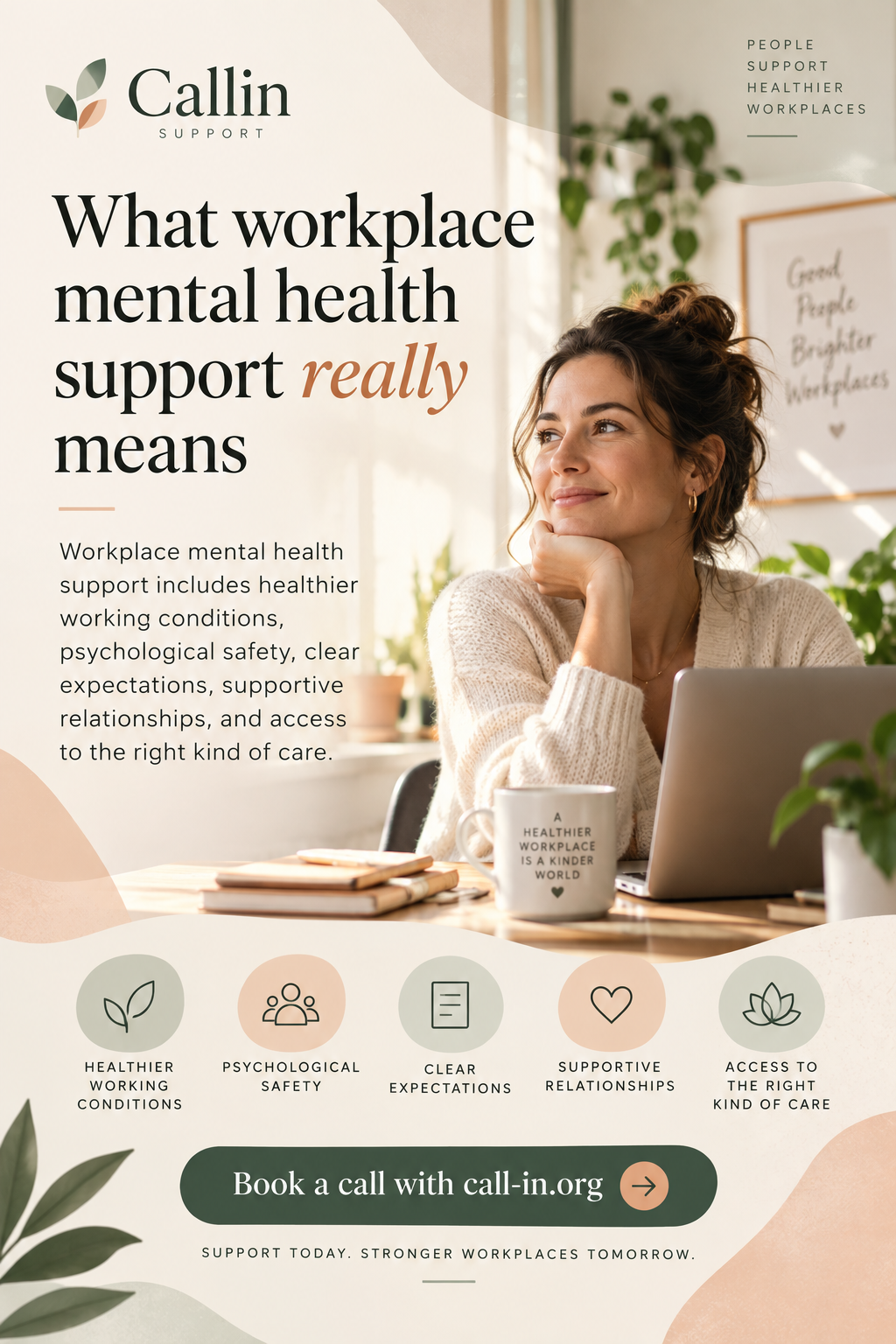
Workplace mental health support combines healthier working conditions, psychological safety at work, clear expectations, supportive relationships, and access to the right kind of care.
It can help employees process stress, loneliness, conflict, burnout, and emotional overload, but it cannot repair an unsafe workload or replace therapy, medical care, formal workplace action, or crisis support.
The most useful support meets the person and the problem at the same time.
The first important point is that workplace distress is not always an individual resilience problem. Workload, role ambiguity, understaffing, constant availability, difficult management, discrimination, harassment, and emotional labor can accumulate until ordinary tasks feel unusually heavy.
Asking employees to meditate through those conditions may create the impression that the person is the problem.
Key takeaways
•Effective workplace mental health support addresses working conditions as well as individual coping.
•A wellness app or one supportive conversation cannot substitute for fair workloads, psychological safety, accommodations, or formal action.
•Emotional support, peer listening, therapy, employee assistance, and crisis care serve different purposes.
•Helpful conversations are voluntary, bounded, privacy-aware, and clear about whether the person wants listening, perspective, or problem-solving.
•Persistent impairment, severe symptoms, or immediate safety concerns call for professional, crisis, or emergency support as appropriate.
Start with the job, not just the employee
A prevention-first approach begins by asking what the work is asking of people. The World Health Organization’s guidelines on mental health at work cover organizational interventions, manager training, worker training, individual support, return-to-work guidance, and employment access.
That range matters because mental health at work is shaped by systems, relationships, and personal circumstances together.
The CDC’s Total Worker Health approach also connects worker safety, health, and well-being with the conditions in which work is designed and performed.
In practical terms, an employer might review staffing, deadlines, decision-making authority, after-hours communication, physical safety, harassment procedures, and how managers respond when people raise concerns.
Not every difficult day is caused by the organization. People also bring grief, health conditions, caring responsibilities, and financial pressure into work. Still, a support program should not hide problems that require leadership, policy, resources, accommodations, or legal remedies.
Workplace support has an access problem, not only a caring problem. Employees can have kind coworkers and still lack a safe, private, low-consequence way to say that work is becoming unsustainable.
The layers of workplace mental health support
No single solution meets every employee’s needs. Strong support works as connected layers with clear boundaries.
1. Organizational prevention and repair
This layer includes manageable workloads, adequate staffing, fair treatment, psychological safety, anti-harassment processes, reasonable flexibility, and clear role expectations. It also includes listening to employees before a problem becomes a leave request or resignation.
The U.S. Surgeon General’s Framework for Workplace Mental Health and Well-Being places worker voice and equity at the center of five essentials: protection from harm, connection and community, work-life harmony, mattering at work, and opportunity for growth.
2. Manager support
A manager may be the first person to notice a change in an employee’s energy, participation, or workload. A useful conversation does not require the manager to diagnose anything. It can focus on observable work facts: what is getting in the way, what priorities are competing, what support would make the work more manageable, and whether the employee needs information about available resources.
Managers should not demand a diagnosis or pressure someone to disclose private health information. Employees should understand how any disclosure will be handled, what confidentiality limits apply, and whether accommodations or formal processes are available. Rules differ by country and situation, so workplace policies and qualified local advice matter.
3. Social connection and peer support
Colleagues, mentors, employee resource groups, professional communities, and trusted friends can reduce the sense that a person is carrying a difficult experience alone.
For remote employees, the loss may not be a lack of meaningful relationships. It may be the loss of low-effort contact: the brief check-in before a meeting, the informal question in a hallway, or the chance to notice that someone else is having a difficult week.
Peer support can include sharing resources, building community, mentoring, and helping someone identify their own goals. SAMHSA describes peer support workers as people who use shared understanding, respect, and mutual empowerment to support others.
Workplace peer support should remain voluntary and appropriately trained, and it should not turn coworkers into unpaid therapists or informal investigators.
4. Emotional support and active listening
Sometimes an employee does not need an immediate solution. They need a private opportunity to describe what happened, understand why it affected them, and decide what they want to do next. Emotional support can be useful when it is clear about its purpose and does not promise clinical treatment.
Active listening is more than staying quiet while waiting to respond. It involves paying attention, reflecting what was heard, acknowledging the person’s experience, and checking whether the understanding is accurate. Validation does not mean agreeing with every interpretation or approving harmful behavior. It means recognizing that the person’s feelings make sense from their point of view.
Before a difficult conversation, it can help to ask: “Do you want me to listen, help you think through options, or help with a practical next step?” That question protects the listener’s capacity and gives the speaker a better chance of receiving the kind of support they actually need.
5. Clinical, occupational, and crisis care
Therapy, counseling, primary care, occupational health, psychiatry, and employee assistance programs may be appropriate when symptoms persist, functioning is affected, or a person needs assessment and treatment. These services are not interchangeable with peer listening or a supportive conversation.
If someone is in immediate danger, thinking about suicide or self-harm, or cannot stay safe, they need urgent crisis or emergency support. In the United States, people can call or text 988 for the Suicide & Crisis Lifeline. The 988 Lifeline explains that counselors ask whether a person is safe, listen, and provide support and resources. Outside the United States, use the relevant local crisis or emergency service.
Why wellness programs are not enough on their own
Wellness practices can offer useful moments of recovery. A short break, movement, breathing, time away from screens, sleep, hobbies, or a supportive conversation may help someone pause and regain perspective.
But these options should be presented as choices, not as proof that an employee is responsible for solving a structural problem through better habits.
A breathing exercise cannot correct chronic understaffing. A mindfulness subscription cannot make harassment safe. A resilience seminar cannot replace an accommodation, a fair investigation, or a realistic workload.
The question is not whether wellness tools are useful. It is whether they are being offered alongside the organizational changes that employees need.
One useful distinction is this: wellness tools may help regulate a moment, while emotional support may help a person make sense of that moment. Neither one can fix an unsafe system.
Practical options that reduce support friction
Employees and employers can make support easier to use without turning it into another performance metric.
•Clarify the problem. Is the main pressure workload, conflict, uncertainty, isolation, grief, or a decision that has been postponed?
•Separate listening from action. A person may need to feel heard before they can plan. Another person may want practical options immediately.
•Create realistic communication boundaries. Teams can agree on response expectations, escalation routes, and when messages do not require an immediate reply.
•Build predictable connection. Regular one-to-one check-ins, mentoring, community spaces, and remote-friendly opportunities can be more usable than occasional high-energy events.
•Protect privacy. Do not share client information, trade secrets, identifiable coworker details, or sensitive investigations in uncontrolled channels.
•Keep formal routes visible. Employees should know how to raise concerns about harassment, discrimination, safety, workload, accommodations, and other workplace conditions.
•Use support before the breaking point. Reaching out when a problem is still manageable may feel more possible than waiting until every option feels urgent.
Recovery can become another burden when it is treated as an employee performance project. Sustainable support makes room for workload change, rest, connection, and professional care without turning any one of them into a new productivity target.
Burnout is not a diagnosis
The WHO defines burn-out in ICD-11 as “a syndrome conceptualized as resulting from chronic workplace stress that has not been successfully managed.” It describes three dimensions: energy depletion or exhaustion, increased mental distance or cynicism toward the job, and reduced professional efficacy. WHO also states that burn-out is an occupational phenomenon, not a medical condition, and that the term should not be applied to experiences in other areas of life. Read more about professional burnout without treating an online checklist as a diagnosis.
A person who feels exhausted or cynical may need changes at work, clinical assessment, time away, or several forms of support. Persistent low mood, severe anxiety, trauma symptoms, substance-related coping, hopelessness, or significant functional impairment deserve attention from a qualified professional. Thoughts of self-harm require immediate crisis or emergency support.
This is also why employees should not be told to simply “manage stress better.” The appropriate response might include a workload conversation, an accommodation request, occupational-health input, therapy, a confidential support conversation, a formal complaint, or urgent help. The right path depends on the situation and the person’s safety.
Why this matters beyond the workplace
Workplace mental health support connects naturally with several United Nations Sustainable Development Goals. SDG 3, Good Health and Well-Being, supports informed, stigma-reducing pathways to emotional and clinical care. SDG 8, Decent Work and Economic Growth, is especially relevant because decent work includes dignity, safety, fair conditions, and the ability to work without treating suffering as a measure of commitment. SDG 10, Reduced Inequalities, matters when disability, caregiving, discrimination, geography, shift work, remote work, or access to privacy shape who can use support safely.
These goals do not turn a support program into proof of impact. They provide a useful test: does the approach protect dignity, listen to worker voice, reduce barriers, and address the conditions that create avoidable harm?
FAQs about workplace mental health support
What counts as workplace mental health support?
It includes organizational prevention, fair policies, manager support, worker voice, peer connection, emotional support, employee assistance, therapy, occupational health, and crisis pathways. The appropriate option depends on the problem. No single service should be expected to address unsafe working conditions, everyday stress, clinical symptoms, and immediate danger in the same way.
Is workplace burnout a medical diagnosis?
No. WHO classifies burn-out as an occupational phenomenon in ICD-11, not a medical condition. It describes work-related exhaustion, mental distance or cynicism, and reduced professional efficacy. A clinician can assess other conditions that may overlap with or contribute to these experiences.
Should I tell my manager that I am struggling?
You may choose to share only what feels necessary and safe. A conversation can focus on workload, priorities, deadlines, flexibility, or practical support rather than a diagnosis. Before disclosing personal health information, check your workplace policy, privacy expectations, accommodation process, and the protections that apply where you live.
Are wellness programs enough to support employees?
Usually not on their own. Wellness tools can complement healthier work design, but they cannot replace adequate staffing, manageable workloads, protection from harm, fair treatment, accommodations, or formal action. A good program asks employees what conditions need to change instead of placing the entire burden on individual habits.
What is the difference between peer support, therapy, and a crisis line?
Peer support is generally based on shared understanding, connection, encouragement, resources, and mutual empowerment. Therapy and counseling involve clinical assessment or treatment from qualified professionals. Crisis lines and emergency services respond to urgent safety concerns. These forms of support can complement one another, but they are not interchangeable.
What should I do if I am not safe?
If you may harm yourself or someone else, are in immediate danger, or cannot stay safe, contact local emergency services or an appropriate crisis service now. In the United States, call or text 988. Do not rely on a workplace wellness program, ordinary peer support, or a non-clinical listening service for emergency intervention.
A place to talk through work pressure
Some people benefit from an objective, confidential, non-clinical space where they can process everyday work pressure without worrying about burdening a coworker, friend, partner, or family member; Callin offers that kind of human listening and does not replace therapy, medical care, formal workplace remedies, crisis support, or emergency help. If that kind of support feels appropriate, you can book a Callin conversation and decide what you want to talk through.
The goal is not to make employees better at tolerating harmful work. It is to make support easier to access while organizations create work with dignity, safety, connection, and room to be human.
Sources and further reading
•World Health Organization: Burn-out as an occupational phenomenon
•World Health Organization: Guidelines on mental health at work
•U.S. Surgeon General: Framework for Workplace Mental Health and Well-Being