
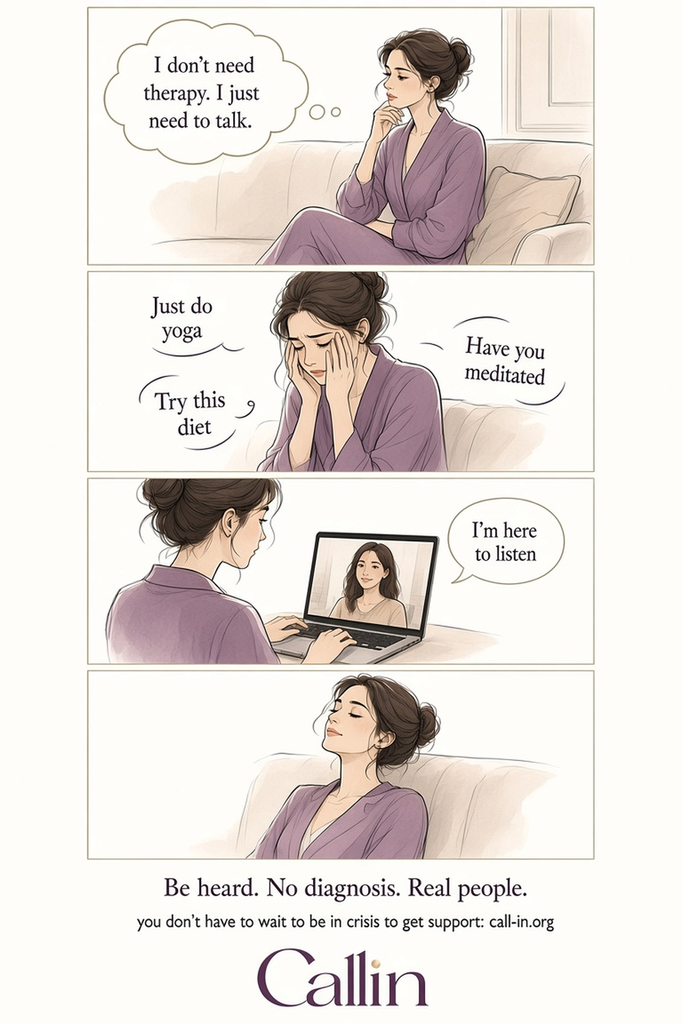
If you are wondering who to talk to when you don’t need therapy, you have real options. A non-clinical listening service such as Callin, a community warmline or a peer support network can give you a confidential place to vent. You do not need a diagnosis, a referral or a crisis to deserve someone who listens.
Callin provides confidential, one-to-one, non-clinical human support by voice call, video call or private chat. It is not therapy, counselling, diagnosis, medical or psychiatric care, or crisis or emergency support. Everyone you speak to is a real person, not an AI.
If you are in danger right now, or think you might act on thoughts of harming yourself or someone else, please contact your local emergency services. You can also find a free crisis line in your country at findahelpline.com.
Key takeaways
- You can get emotional support without therapy: non-clinical listening services, warmlines and peer support networks offer a confidential space to talk without a diagnosis.
- Feeling stressed, lonely or weighed down does not automatically mean you have a mental health condition; the World Health Organization describes mental health as a continuum that each person experiences differently.
- Many people delay seeking help because of worries about stigma, labels and confidentiality, and a large systematic review found stigma had a small to moderate negative effect on help-seeking.
- Non-clinical support focuses on listening and presence, while therapy can offer clinical assessment and treatment; they are different kinds of support, and neither is a lesser version of the other.
- Warmlines are listening lines for people who are not in immediate danger, while crisis lines respond to emergencies; local emergency services and findahelpline.com are the right route in a crisis.
- Venting can bring relief and connection, and talking things through with a good listener can also help you notice what sits underneath the pressure, such as routines, relationships, boundaries or life changes.
- Callin offers non-clinical support from listeners trained in active listening and Psychological First Aid, and through Human Continuity™ you can usually keep talking to the same person so you do not have to repeat your story.
Who to talk to when you don’t need therapy: what are my options?
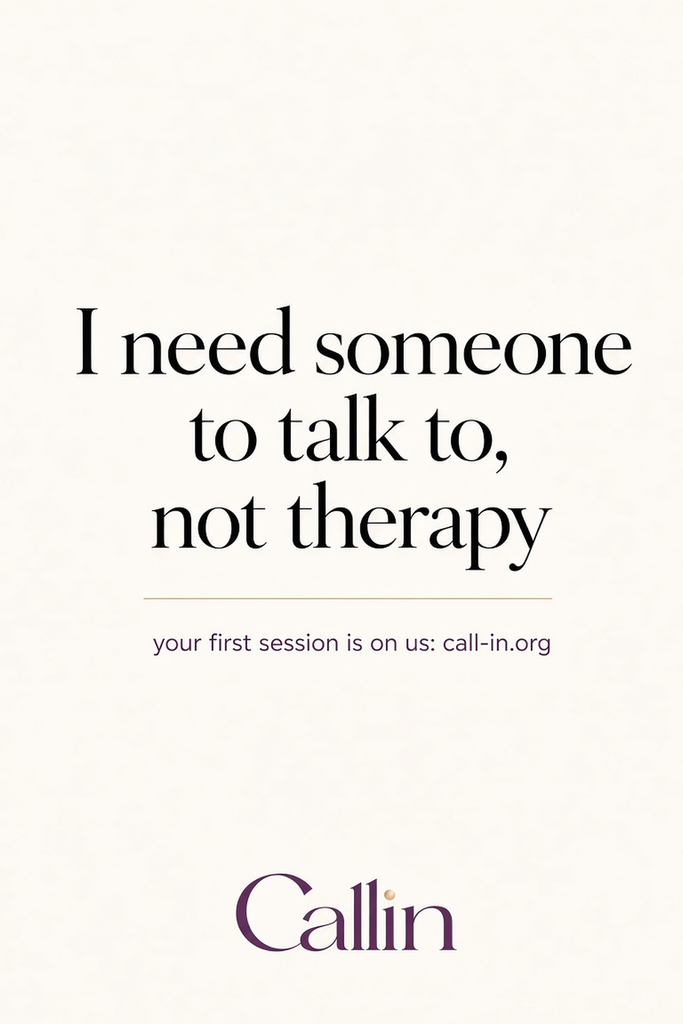
When you don’t need therapy but need to vent, you can talk to a non-clinical listening service, a warmline, a peer support network or a trusted person in your life. Each one offers listening without a clinical assessment. The best fit depends on how private you want the conversation to be, how often you want to talk and if you would like the same person each time.
A non-clinical listening service. This is a service built for conversation, not treatment. You talk to a trained listener who focuses on understanding you, not on diagnosing or fixing you. Callin is one example. Callin listeners are trained in active listening and Psychological First Aid, and you can speak by voice call, video call or private chat.
A warmline. A warmline is a phone, text or chat line for people who want to talk but are not in immediate danger. Many are run by peers with lived experience. Availability varies a lot by country and region.
Peer support networks and groups. These connect you with people who have been through similar experiences. They can feel less formal, and the shared experience is often the point.
Friends, family or someone in your community. These relationships matter. You do not need to replace them. Sometimes, though, you want a space where the person listening is not also part of the situation you are trying to talk about.
You can try one option and change your mind. If you are not sure what a listening service involves, Callin’s guide to therapy vs. a listening service sets out the difference.
How do I know if I need therapy or just someone to talk to?
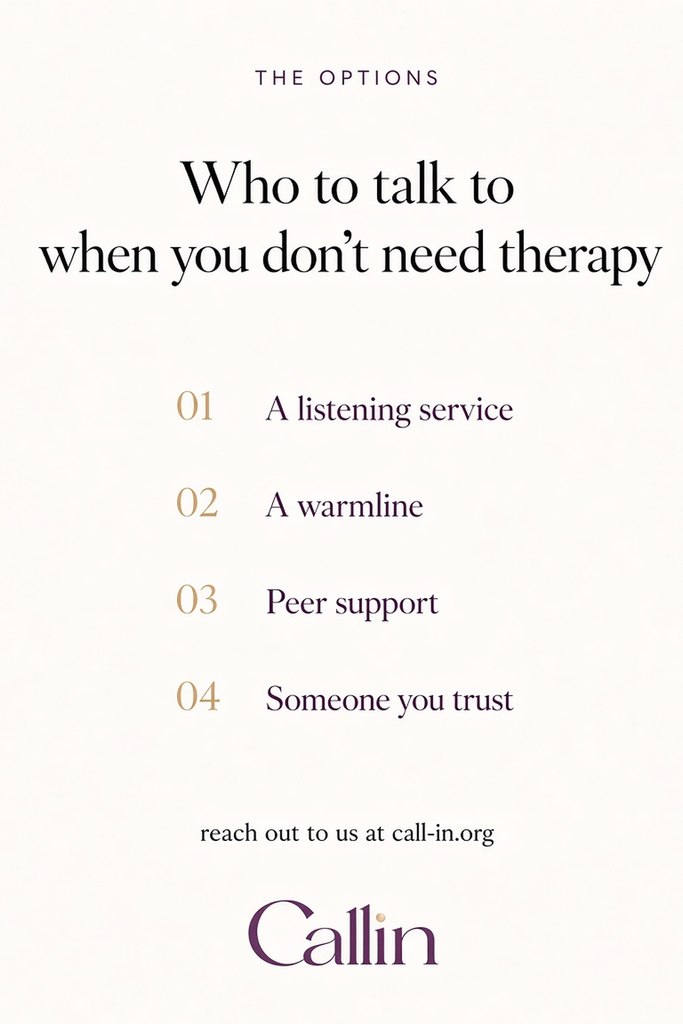
You might simply need someone to talk to if your main wish is to be heard, to offload or to untangle your thoughts out loud. Therapy may be the better fit if you want clinical assessment, treatment for a mental health condition, or structured work with a qualified professional. Both are valid choices, and some people use both.
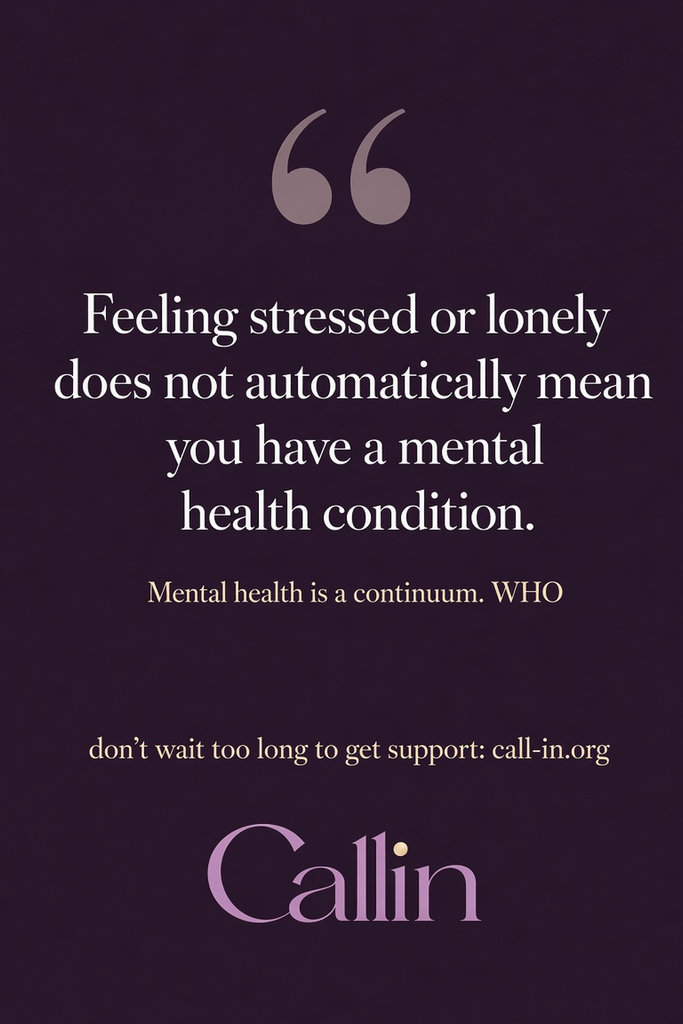
A difficult patch in a relationship, exhaustion at work, a move or loneliness can weigh on anyone. None of these automatically means something is clinically wrong with you.
The World Health Organization describes mental health as existing “on a complex continuum, which is experienced differently from one person to the next”. The WHO also says individual, family, community and structural factors can combine to protect or undermine mental health. In ordinary language: how you feel is shaped by your life, not only by what is happening inside you.
What are the signs a vent space might be enough for me right now?
A vent space may be what you are looking for if you mostly want to be heard rather than assessed. You might recognise yourself in some of these:
- You want to say things out loud without being told what to do.
- You feel tired of being the one who holds everyone else up.
- You do not want to worry the people close to you.
- You are not sure what is wrong, only that things feel heavy.
- You want support now, not after a long wait or an intake process.
When might therapy or medical care be the better fit?
Therapy, counselling or medical care may be more suitable if you want a diagnosis or an assessment, if difficult feelings are making daily life very hard over a long period, or if you want treatment for a mental health condition.
A doctor or qualified mental health professional can help you work out what fits. If you already have a therapist, take medication or see a doctor, please keep going with the care that is helping you. For a longer self-check, Callin’s article How Do I Know If I Need Emotional Support Instead of Therapy? walks through the question gently.
Why might therapy not feel right for me at the moment?
Therapy might not feel right at the moment because you do not want a clinical label, you are not ready for a formal process, or what you need is simply to be heard. That is a reasonable position, and therapy is still there if you want it later.
Depending on where you live, clinical care can involve assessments, intake forms, clinical notes, waiting lists or costs. These exist for good reasons, because they help clinicians treat people safely. They can still feel like a lot when you only want to talk.
Concerns about stigma and records are common. A systematic review by Clement and colleagues, published in Psychological Medicine, looked at 144 studies with 90,189 participants. It found that stigma had a small to moderate negative effect on help-seeking. Concerns about disclosure and confidentiality were among the most commonly reported stigma-related barriers.
Can I talk to someone without getting a diagnosis?
Yes, you can talk to someone without getting a diagnosis. Non-clinical listening services, warmlines and peer support do not ask you to be assessed or labelled before you speak. They focus on presence and empathy rather than diagnosis or fixing.
You do not need to prove that things are bad enough. Callin explores this in It’s Okay To Ask for Help Without a Mental Health Diagnosis and Why Modern Life Turns Simple Feelings Into Diagnosis.
What is non-clinical emotional support, and how is it different from therapy?
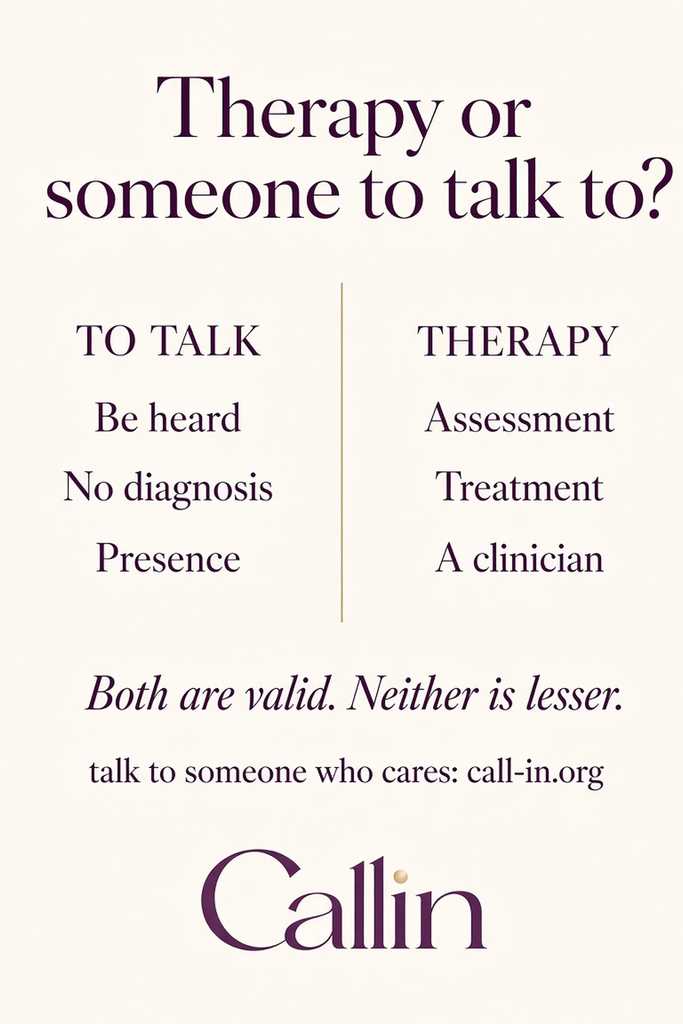
Non-clinical emotional support is confidential, human listening that does not involve diagnosis, clinical assessment or treatment. A non-clinical listener gives you space to talk, reflects back what they hear and helps you feel less alone with it.
Therapy, by contrast, is clinical or psychotherapeutic work with a qualified professional, and it can include assessment and treatment.
The aim of non-clinical support is conversational relief and understanding, not clinical progress notes. Callin’s explainer What Is Non-Clinical Mental Health Support? The Missing Middle Between Friends and Therapy covers this in more depth.
What does active listening actually mean?
Active listening means paying full attention, checking understanding and responding in a way that shows the listener has actually heard you. It is not waiting for a turn to speak. It is not jumping to advice.
What is Psychological First Aid?
Psychological First Aid is a framework for supporting people in distress with humane, practical care. The WHO guide to Psychological First Aid describes it as “a humane, supportive response to a fellow human being who is suffering and who may need support”.
The guide is clear that it is not professional counselling, and one of its themes is “listening to people, but not pressuring them to talk”. You set the pace, and you choose what to share.
What does non-clinical support not do?
Non-clinical support does not diagnose you, assess symptoms, label conditions, prescribe or provide treatment. It is not a crisis service. A good non-clinical service will be open about these limits, because knowing them helps you choose well.
What is the difference between a warmline, a crisis line and therapy?
A warmline is for talking when you are not in immediate danger. A crisis line is for urgent situations where someone may be at risk. Therapy is ongoing clinical or psychotherapeutic work with a qualified professional. They meet different needs, so the right one depends on what is happening for you today.
What is a warmline?
A warmline is a listening line, often staffed by trained peers, for people who want to talk but are not in crisis. In the United States, the Substance Abuse and Mental Health Services Administration (SAMHSA) describes peer-operated warmlines as phone, chat or text lines offering “empathetic listening and peer support” to people who may be experiencing distress or loneliness. SAMHSA describes their role as complementary to crisis lines rather than a replacement for them.
There is some research behind warmlines. A study by Dalgin and colleagues in the Psychiatric Rehabilitation Journal surveyed 480 callers to a peer-run warmline over four years. Callers reported less isolation and less use of crisis services. This study involved people living with mental health conditions, so it tells us about that group, not about everyone.
You can read more in Callin’s guides I Need Someone to Talk To, But I’m Not in Crisis: What Is a Warm Line? and What Is a Warmline? 5 Differences between Peer Support & Crisis Line.
When should I use a crisis line instead?
You should use a crisis line, or local emergency services, when you or someone else may be in danger or the distress feels overwhelming right now. findahelpline.com lists free, confidential crisis lines in many countries. Local emergency services are the right call if anyone is in immediate danger.
Where does a listening service like Callin fit?
A non-clinical listening service such as Callin sits alongside warmlines, not alongside crisis lines. Callin offers ongoing conversations, wherever possible with the same listener, for people who are not in crisis and want a private place to talk. Therapy remains the right room for clinical assessment and treatment.
Is Callin therapy, and who is it for?
No, Callin is not therapy. Callin is for people who want confidential, non-clinical support from a real person, somewhere between carrying everything alone (or leaning only on friends and family) and entering clinical care. You do not need a diagnosis, a referral or a crisis to use it.
You do not need a polished explanation of what is wrong. You can arrive with half a sentence and speak at your own pace. Callin also offers career coaching and student academic accountability for people whose main need is practical progress.
Can I talk to the same person every time?
Wherever possible, yes. Callin’s Human Continuity™ means you can keep talking to the same dedicated listener, so you do not have to repeat your story every time. They already know the outline of your life, and you can pick up where you left off. Continuity is a comfort for many people, not a promise of a particular outcome. You can read more about ongoing online emotional support from the same person.
What can Callin not help with?
Callin cannot provide therapy, counselling, diagnosis, medical or psychiatric care, or crisis or emergency support. Callin does not treat or manage mental health conditions. If you need any of those things, a qualified professional or your local emergency services are the right place, and you can find a free local crisis line at findahelpline.com.
What might be underneath my need to vent?
Underneath the need to vent, there is often a build-up of ordinary pressures: your context, your relationships, your routines, your boundaries and the changes you are living through. Talking with a calm listener can help you notice these contributing factors in your own words. This is reflection, not diagnosis.
Sometimes the thing you want to vent about is the surface. The argument. The email from your manager. The quiet weekend that felt too quiet. Underneath, there may be something wider, and it often becomes clearer only once you start talking.
Here are some of the everyday things people find underneath, as they understand them:
- Pressure that has piled up. Several small demands at once can feel heavier than one big one.
- Relationships. Strain, distance or a role you have taken on without choosing it, such as always being the reliable one.
- Boundaries. Saying yes when you meant no, or feeling you cannot switch off.
- Routines. Sleep, work patterns, screen time or meals that have quietly slipped.
- Values. Living or working in a way that does not fit what matters to you.
- Life changes. A move, a new job, a loss, a breakup, a child leaving home, or a new country.
- Connection. Feeling unseen even when you are surrounded by people.
That last one is common. The WHO Commission on Social Connection reported in 2025 that about 1 in 6 people worldwide experience loneliness. Wanting someone to talk to is not a weakness. It is a human need. If loneliness is what you are carrying, Callin’s article I Am So Lonely and Have Nobody to Talk To: Where Can I Get Support? may help.
A good listener will not tell you what your underlying cause is. They might ask a gentle question or reflect a pattern you have mentioned twice. You stay in charge of what it means.
Is it healthy to just vent, or do I need advice?
Venting can be healthy, and it often helps you feel less alone. You do not need advice for a conversation to be useful. Research suggests that the way a listener responds shapes what you get from it.
A study by Nils and Rimé, published in the European Journal of Social Psychology in 2012, tested different listener responses after people shared an emotional experience. Empathic, supportive responses were linked to feeling closer to the listener, feeling less lonely and an impression of feeling better. Responses that helped people reframe and make sense of the experience were linked to longer-lasting emotional recovery.
This was one laboratory study, so it is a clue rather than a final word. It suggests venting may help most with a listener who stays with you and, when you are ready, helps you see things from a slightly different angle.
You do not need to choose between offloading and reflecting. A conversation can hold both. Callin’s articles Emotional Venting: Why It Helps You Feel Less Alone and Trauma Dumping vs. Venting: The Real Difference Explained explore this further.
Why is it easier to talk to a stranger than to friends or family?
It can be easier to talk to someone outside your life because they are not part of the situation. You do not have to protect their feelings, manage their reaction or worry about how the conversation will change the relationship. That separation can make honesty feel safer.
Friends and family can be wonderful sources of support. Still, they bring their own history and hopes for you, and they may jump in with advice because they care. Callin looks at this in Why People Give Advice When You Just Want to Vent and Someone To Talk To When I Don’t Want to Burden My Friends.
A confidential listener gives you a different kind of room. Nobody at home or at work has to know. You can say the thing you have been holding, and it stays between you and the person you chose to tell.
How do I find someone to vent to online who feels right for me?
You can find the right person to vent to online by deciding what matters most to you: privacy, cost, availability, peers with lived experience, and talking to the same person each time. Then check how each option describes its limits. A clear, honest service is usually a good sign.
Some questions you can ask yourself:
- Do I want to talk once, or have somewhere to return to?
- Would I rather speak, see someone on video, or type?
- Does it matter that the person shares my experience?
- How important is it to talk to the same listener?
Some questions you can ask a service:
- Who will I be speaking to, and what training do they have?
- How is my privacy protected?
- Will I speak to the same person next time?
- What happens if my needs go beyond what you offer?
There is no wrong answer. If typing feels easier than speaking, see Can You Text Someone to Just Vent? Private Chat Lines Explained. For more routes, Callin’s guide Not Ready for Therapy? Alternatives for Emotional Support covers other options.
Frequently asked questions
Who can I talk to if I don’t need therapy but need to vent?
You can talk to a non-clinical listening service, a warmline, a peer support network or a trusted person in your life. These options offer listening without diagnosis or treatment. Callin is one non-clinical option, offering confidential one-to-one support by voice call, video call or private chat with a real person.
Can I get emotional support without a diagnosis?
Yes, you can get emotional support without a diagnosis. Non-clinical services, warmlines and peer support do not require a diagnosis, a referral or a clinical assessment. They focus on listening and connection rather than labels or treatment.
What is the difference between a warmline and a crisis line?
A warmline is for people who want to talk but are not in immediate danger, while a crisis line responds to urgent situations. Warmlines are often staffed by trained peers. If you are in crisis, contact your local emergency services or find a free line at findahelpline.com.
Is non-clinical support a replacement for therapy?
No, non-clinical support is not a replacement for therapy. Therapy can offer clinical assessment and treatment from a qualified professional, while non-clinical support offers listening and presence. They are different kinds of support, and some people find value in using both.
Is Callin a crisis service?
No, Callin is not a crisis or emergency service. Callin provides non-clinical emotional support for people who are not in immediate danger. If you are in crisis, please contact your local emergency services or use findahelpline.com to find a free crisis line in your country.
Will I talk to the same person each time at Callin?
Wherever possible, yes. Callin’s Human Continuity™ approach means you can usually keep speaking with the same dedicated listener, so you do not have to repeat your story every time. This is about comfort and familiarity, not a promise of a particular outcome.
Is it normal to want to vent without getting advice?
Yes, it is completely normal to want to vent without advice. Many people simply want to be heard before they think about solutions. A good listener will follow your lead and only explore ideas with you when you are ready.
What is a gentle next step if I want to talk?
A gentle next step is simply to choose one option and try a single conversation. You do not need to have the right words. You do not need to be at breaking point.
If Callin sounds like it might fit, eligible new clients can start with a free first call session, with no obligation to continue. You can find out more about Callin’s non-clinical emotional support whenever you are ready. If you would like to know what that first conversation looks like, you can read What Happens in a Callin First Session? What to Expect.
It is your choice, at your pace.
Most relevant UN Sustainable Development Goal
SDG 3: Good Health and Well-Being, in particular Target 3.4, which includes promoting mental health and well-being. Accessible, non-clinical listening can sit alongside healthcare, therapy and community support as one part of a wider picture of well-being. The topic also connects with the WHO’s work on social connection and loneliness.
Sources and further reading
- World Health Organization. Mental health: fact sheet. Definition of mental health and the mental health continuum.
- World Health Organization, War Trauma Foundation and World Vision International (2011). Psychological first aid: Guide for field workers. WHO, Geneva.
- World Health Organization (2025). From loneliness to social connection: Report of the WHO Commission on Social Connection.
- World Health Organization (30 June 2025). Social connection linked to improved health and reduced risk of early death. News release.
- Clement, S. et al. (2015). What is the impact of mental health-related stigma on help-seeking? A systematic review of quantitative and qualitative studies. Psychological Medicine, 45(1), 11 to 27.
- Substance Abuse and Mental Health Services Administration (2025). National Guidelines for a Behavioral Health Coordinated System of Crisis Care. Section on peer-operated warmlines.
- Dalgin, R. S., Maline, S. and Driscoll, P. (2011). Sustaining recovery through the night: Impact of a peer-run warm line. Psychiatric Rehabilitation Journal, 35(1), 65 to 68.
- Nils, F. and Rimé, B. (2012). Beyond the myth of venting: Social sharing modes determine the benefits of emotional disclosure. European Journal of Social Psychology, 42(6), 672 to 681.
- Find A Helpline. findahelpline.com. Free, confidential crisis lines by country.
- United Nations. Sustainable Development Goal 3: Good Health and Well-Being.

Leave a Reply