
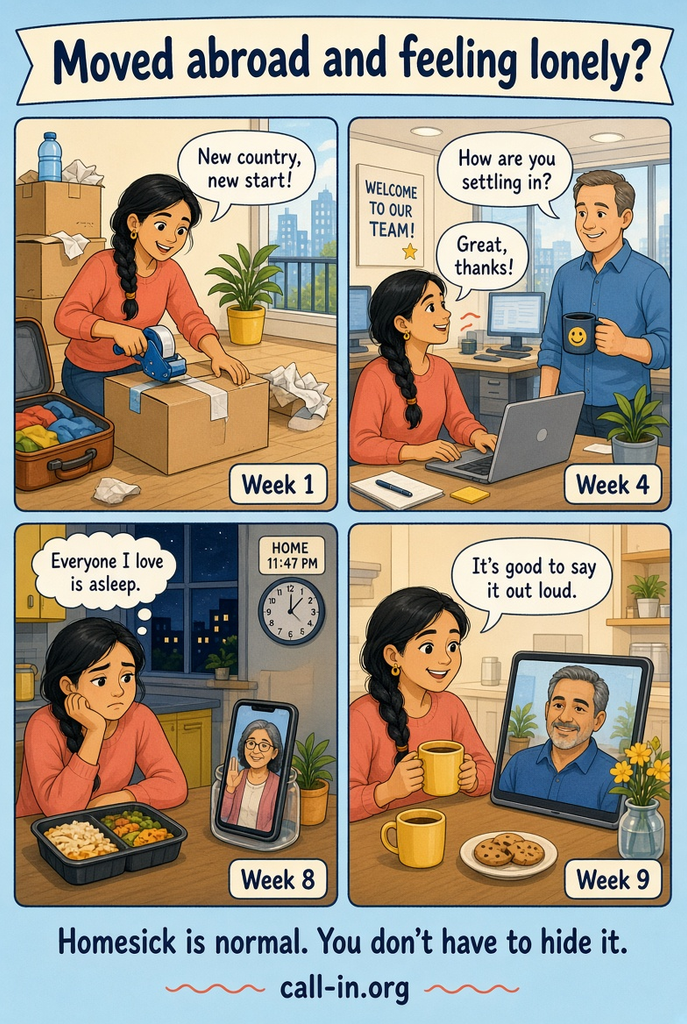
Moving abroad for work can be exciting, career-defining and genuinely lonely, sometimes all in the same week. Your expatriate employees leave behind friends, family, familiar systems and often their own language, while being expected to perform well from day one.
This guide is for HR and global mobility teams who want to give expatriate employees, and the people who move with them, emotional support that actually works across borders.
The short answer: HR can support expatriate employees by planning emotional support for the whole assignment, from before the move to after repatriation.
Combine practical relocation help, cultural and language preparation, regular check-ins, peer networks and clear routes to your EAP and clinical services with a confidential, non-clinical place to talk that works across time zones and stays the same when people move.
Include accompanying partners where you can, and treat any local rules as examples to check country by country.
Key definitions
- Expatriate employee: Someone who moves to another country to work, either on an assignment from their employer or after being hired locally abroad.
- Global mobility team: The people, often within HR, who manage international assignments, relocation, immigration and related policies.
- Accompanying partner: A spouse or partner who moves abroad with an expatriate employee, often leaving their own job and networks behind.
- Culture shock: The disorientation and stress that can come from adjusting to an unfamiliar culture, language and way of life.
- Repatriation: Returning to the home country, and often the home organisation, at the end of an assignment.
- Non-clinical emotional support: Confidential, human conversation with a trained listener that does not diagnose, treat, assess or replace therapy, occupational health or medical care.
A quick word on boundaries before we begin. Callin offers non-clinical emotional support, not therapy, counselling, occupational health, medical care, relocation services or crisis support, and nothing in this article is clinical, legal, immigration or employment advice.
If you, an employee or anyone you are supporting may be in immediate danger or crisis, please contact local emergency services or find a free, confidential helpline in the country where they are at findahelpline.com.
Key takeaways
- Moving abroad for work removes many of the everyday relationships that help people cope, so emotional support needs to be planned, not left to chance.
- WHO’s 2025 Commission on Social Connection reports that 1 in 6 people worldwide is affected by loneliness, and notes that people who have moved country may face additional barriers to connection.
- The emotional journey has stages, from preparing to move and arriving to settling in and coming home, and each stage needs something slightly different.
- Accompanying partners and families matter: one study of expatriate partners describes their unhappiness or difficulty adjusting as one of the leading causes of failed assignments.
- Support for expatriates must work across time zones and languages, stay confidential from host-country management, and ideally continue when people move.
- A confidential, non-clinical place to talk sits alongside your EAP, relocation provider and clinical services, and does not replace any of them.
- A defined three-month pilot for an expatriate cohort, with privacy-safe measures and a review point, is a low-risk way to test a new layer of support.
Why do expatriate employees need emotional support?
Because relocation strips away the support people usually rely on without noticing. The friend who would have met them for coffee, the family member down the road, the doctor they trust and the language they think in may all be far away.
Loneliness is a global concern in its own right. WHO’s Commission on Social Connection reported in June 2025 that “1 in 6 people worldwide is affected by loneliness,” and that lonely people are “twice as likely to get depressed.” The Commission notes that some groups, including refugees and migrants, may face discrimination or additional barriers that make social connection harder.
Expatriate employees are often highly capable and well supported practically, which can make their emotional needs easy to overlook. A study of expatriates in Acta Psychiatrica Scandinavica linked adjustment difficulties with stressors including “occupational anxiety, home country anxieties, acculturation and physical ill-health.” The study is older and drew on people examined during overseas service, but those pressures will sound familiar to many global mobility teams.
Our article on why moving to a new city feels so emotionally draining explains the individual experience, and may be useful to share with employees preparing to move.
How does the emotional experience change across an assignment?
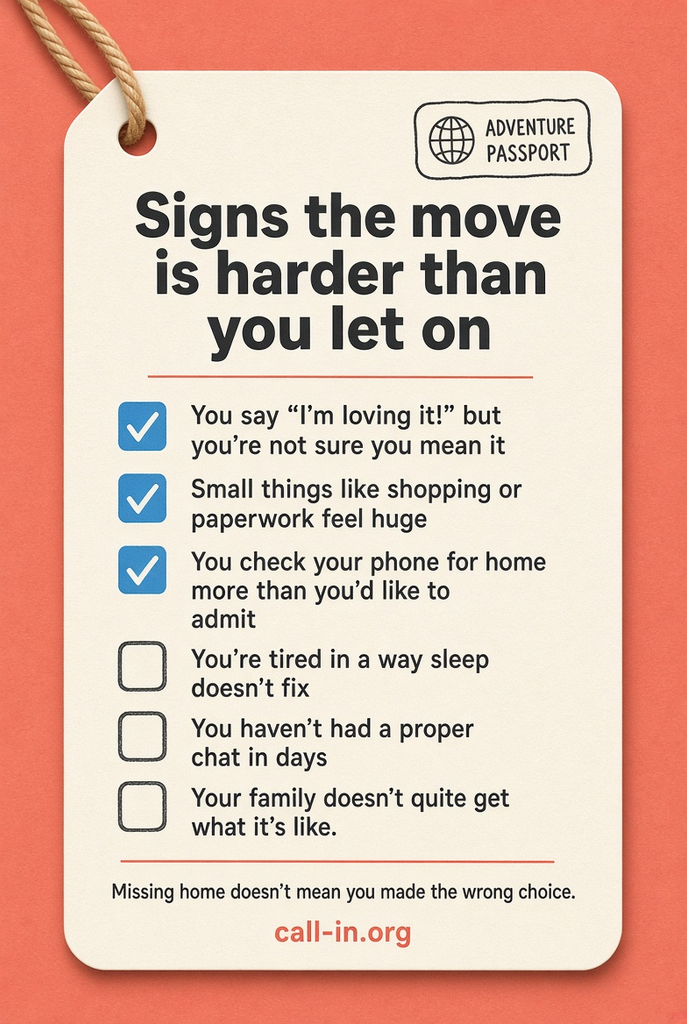
It tends to move in stages, though everyone’s path is different. Knowing the stages helps you offer the right support at the right time, rather than one welcome pack on arrival.
- Before the move: excitement mixed with worry about housing, schools, a partner’s career, ageing parents left behind and saying goodbye.
- Arrival: a rush of practical tasks, new colleagues and unfamiliar systems, often with little time to process anything.
- Settling in: once the novelty fades, loneliness, homesickness and frustration with small daily differences can grow.
- Mid-assignment: life may feel more stable, but events at home, such as illness, bereavement or a family crisis, can feel very hard from a distance.
- Repatriation: coming home can be surprisingly difficult, as people find that both they and home have changed.
Our article on rebuilding a support system after moving is written for the individual, and suits employees at the settling-in stage. For anyone feeling isolated, our guide to what to do when you feel lonely and have no one to talk to may help, and employees based in the Gulf may find our page on someone to talk to in the Middle East useful.
What about accompanying partners and families?
They deserve support in their own right, because their experience can be the hardest of all. Accompanying partners have often given up a job, a professional identity and their own networks, without the built-in structure that work provides.
Research reflects this. A study in Frontiers in Psychology on accompanying expatriate partners states that “one of the leading causes for failing at expatriate assignments is the accompanying expatriate partners’ (AEPs) unhappiness with life abroad or inability to adjust to the challenges of the host country.” The study is small and drawn from South African expatriates, so treat it as an insight rather than a universal rule.
Practical ways to include partners:
- Involve them early: invite partners to pre-move briefings and cultural preparation.
- Check eligibility: make sure your EAP and any emotional support you offer cover adult partners where possible.
- Support their goals: consider career, language or networking support for partners who want to work or study.
- Remember older children and dependants: many services, including Callin, are for adults aged 18 and over, so check age-appropriate options for younger family members.
If your organisation also hosts international interns or students, our article on feeling lonely and homesick after moving abroad to study is written for students and can sit alongside your own student support.
What support should be in place before, during and after an assignment?
A layered approach works best, with practical, social and emotional support joined up across the whole assignment. Most organisations already have some of these layers, and the aim is to close the gaps between them.
- Before: realistic previews of life in the host country, cultural and language preparation, and a conversation about family needs.
- Practical relocation help: housing, schooling, registration, banking and healthcare access in the host country.
- A named contact: someone in HR or global mobility the employee can reach easily, in addition to their line manager.
- Peer networks: connections with other expatriates in your organisation or local professional networks.
- Regular check-ins: short, predictable conversations at key points, not only when something goes wrong.
- EAP and clinical access: clear information on what your EAP covers abroad, and how to access local medical and mental health care.
- Confidential, non-clinical support: somewhere to talk honestly that is independent of host-country management.
- Repatriation support: planning for the return, recognising new skills, and space to talk about the adjustment home.
Some employees also want to think through what an assignment means for their career. Callin offers separate career coaching for professionals where that is the right fit.

How do you choose emotional support that works across borders?
Look for support that is reachable, confidential, culturally aware and continuous. Services that work well at home can be hard to use abroad, especially in a different time zone or language.
Questions to ask any provider:
- Hours and time zones: can employees actually reach support at a time that suits them, wherever they are?
- Language: which languages are available, and is that enough for your workforce?
- Independence: is it separate from host-country management, so people feel safe being honest?
- Confidentiality and data: how is personal data handled across borders, for example under the GDPR for people in the EU?
- Continuity: can someone keep talking to the same person if they move again or return home?
- Boundaries and signposting: does the provider make clear what it is and is not, and how it handles urgent risks?
- Eligibility: does it cover partners and adult family members?
Our guides to EAP vs therapy vs emotional support and how Callin complements EAPs explain how the layers differ.
How can HR recommend support without making it feel like a performance issue?
Offer it to everyone, routinely, as part of the assignment. When emotional support is presented as a normal part of moving abroad, rather than something for people who are “not coping,” employees are far more likely to use it.
Helpful approaches:
- Build it into the package: mention emotional support alongside housing and schooling in every relocation conversation.
- Normalise the ups and downs: explain that most people find some stages of an assignment hard.
- Separate support from assessment: make clear that using confidential support has no bearing on performance reviews.
- Respect cultural differences: people from different backgrounds express emotion differently, and some prefer not to talk at work at all.
- Repeat the message: remind people at each stage, because needs change over time.
Our article on why emotional expression differs across cultures offers useful context, and our piece on finding someone to talk to when family do not understand speaks to a common expatriate experience.
What about duty of care and local rules?
Your obligations depend on the countries involved, so check them for each assignment. Employment law, health and safety duties, data protection and healthcare access differ widely between home and host countries.
- Psychosocial risks: the WHO mental health at work fact sheet lists risks such as “excessive workloads,” “long, unsocial or inflexible hours” and “conflicting home/work demands,” all of which can be heightened on assignment.
- Travel risk management example: the international standard ISO 31030:2021 “gives guidance to organizations on how to manage the risk(s), to the organization and its travellers, as a result of undertaking travel.” It is guidance, not law, and some organisations use it alongside their mobility policies.
- Local examples: health and safety duties, works council consultation and data transfer rules vary by country, so take local advice rather than assuming home-country rules apply.
The WHO guidelines on mental health at work also recommend manager training, which can help managers of international teams spot and respond to distress.
Where does Callin fit alongside your global mobility support?
Callin offers non-clinical emotional support: a confidential, human place to talk, alongside your relocation provider, EAP, occupational health and local clinical services. It is not therapy, occupational health, relocation support or a crisis service, and it does not replace any of them.
Callin has offered this kind of support since June 2023. Callin Support Ltd is UK-registered and supports adults aged 18 and over worldwide through one-to-one online sessions in English. Callin is available 24/7, with sessions booked in advance at a time that suits each person, at any hour, which can help expatriates in time zones far from head office. Listeners complete Johns Hopkins University Psychological First Aid training and use active listening, with clear safeguarding and signposting procedures.
Through Human Continuity™, Callin prioritises the same listener for ongoing support wherever operationally possible. Because sessions are online, that continuity can travel with an employee through a move, mid-assignment and repatriation. Callin does not create clinical records, and the content of an employee’s conversations is not shared with their employer. You can read more in our FAQ and privacy policy.
Sessions are currently in English, so Callin suits expatriates who are comfortable talking in English, and you may need other options for people who prefer another language. For a wider view of the layers, see our guide to workplace mental health support for employees. We do not publish outcome or savings figures for Callin, and we would encourage you to measure impact in your own organisation.
What would a three-month pilot for expatriate employees look like?
A three-month pilot tests a new layer of support with a defined group, clear measures and a decision point at the end. Callin offers a defined three-month pilot for organisations through our workplace wellbeing support for organisations page.
A practical pilot plan might include:
- Before launch: choose a group, such as employees starting or partway through assignments in a given period, agree who is eligible, including adult partners if in scope, and agree privacy-safe reporting.
- Month 1, awareness and trust: check through a short anonymous pulse whether expatriate employees know the support exists and believe it is confidential.
- Month 2, access and reach: look at aggregate uptake across time zones, with small numbers suppressed so no individual can be identified.
- Month 3, early signals: gather anonymous feedback on whether people felt heard and whether support was easy to reach from where they live.
- Review: decide with your mobility team and employees whether to stop, adjust or continue, and keep watching assignment completion and retention over a longer period.
Pair the pilot with honest attention to workload and assignment design. Our guide to preventive emotional care shows the value of reaching people before they reach breaking point.
Ready to give your expatriate employees someone to talk to, wherever they are?
Supporting expatriate employees starts with good preparation, practical help and a culture where asking for support is normal, and it is strengthened by a confidential, human place to talk that travels with them. If you would like to understand what that feels like first, explore non-clinical mental health support with Callin or read what happens in a Callin first session.
When you are ready to talk about your global workforce, enquire about a three-month pilot for your expatriate employees and agree the measures that matter to you and your people from day one.
Frequently asked questions
What emotional support can HR offer expatriate employees?
HR can offer cultural and language preparation, practical relocation help, a named contact, peer networks, regular check-ins, clear access to an EAP and clinical services, a confidential non-clinical place to talk and repatriation support. The best approach covers the whole assignment, not just arrival.
How can we support accompanying partners?
Involve partners early, check that your EAP and other support cover adult partners, and consider career, language or networking help. Partners often lose their job and networks when they move, so their wellbeing deserves attention in its own right.
Does an EAP cover expatriate employees?
It depends on the provider and contract. Check whether your EAP works in the host country, in which languages, at what hours and whether it covers partners. Many organisations add other layers of support alongside their EAP for international staff.
How can we support employees returning from an international assignment?
Plan the return in advance, recognise the skills people gained abroad, discuss their next role early and give them space to talk about the adjustment. Coming home can be as unsettling as leaving, so keep support in place for the first few months back.
Can expatriate employees use Callin from any country?
Callin supports adults aged 18 and over worldwide through online sessions in English. Callin is available 24/7, and sessions are booked in advance at a time that suits each person, at any hour, which helps people living far from head office.
Does Callin replace our EAP or local clinical services?
No. Callin works alongside EAPs, relocation providers, occupational health and local clinical care, and signposts to them when needed. It is not therapy, occupational health or a crisis service.
Will our organisation see what expatriate employees talk about?
No. The content of an employee’s conversations is not shared with their employer, and Callin does not create clinical records. Callin follows safeguarding and signposting procedures where urgent safety concerns arise.
UN Sustainable Development Goals alignment
At Callin, we are aligning ourselves with the UN SDGs, and this article connects with three of them. This describes alignment only, not United Nations affiliation or endorsement; read more in our guide to mental health and the SDGs and our workplace wellbeing and the UN SDGs page.
- SDG 3: Good Health and Well-being. Supporting the emotional wellbeing of people living and working far from home is part of good health.
- SDG 8: Decent Work and Economic Growth. Humane, well-supported international assignments are part of decent work.
- SDG 10: Reduced Inequalities. Support that reaches people across borders, time zones and cultures helps no one miss out because of where they live.
Sources and further reading
- World Health Organization (30 June 2025). Social connection linked to improved health and reduced risk of early death, news release on the WHO Commission on Social Connection report. Global.
- World Health Organization. Commission on Social Connection. Global.
- World Health Organization (updated 15 September 2026). Mental health at work, fact sheet. Global.
- World Health Organization (2022). WHO guidelines on mental health at work. Global guidance.
- Foyle, M. F., Beer, M. D. and Watson, J. P. (1998). Expatriate mental health, Acta Psychiatrica Scandinavica, 97(4), 278 to 283. Peer-reviewed; older study of expatriates examined during overseas service.
- Botha, T., Potgieter, J. C. and Botha, K. F. H. (2022). Flourishing beyond borders: facilitating the well-being of accompanying expatriate partners, Frontiers in Psychology, 13, 795845. Peer-reviewed; South African expatriate context.
- International Organization for Standardization (2021). ISO 31030:2021 Travel risk management: guidance for organizations. International standard, example framework.
- Find A Helpline. findahelpline.com. International helpline directory.
- United Nations. SDG 3, SDG 8 and SDG 10.

Leave a Reply