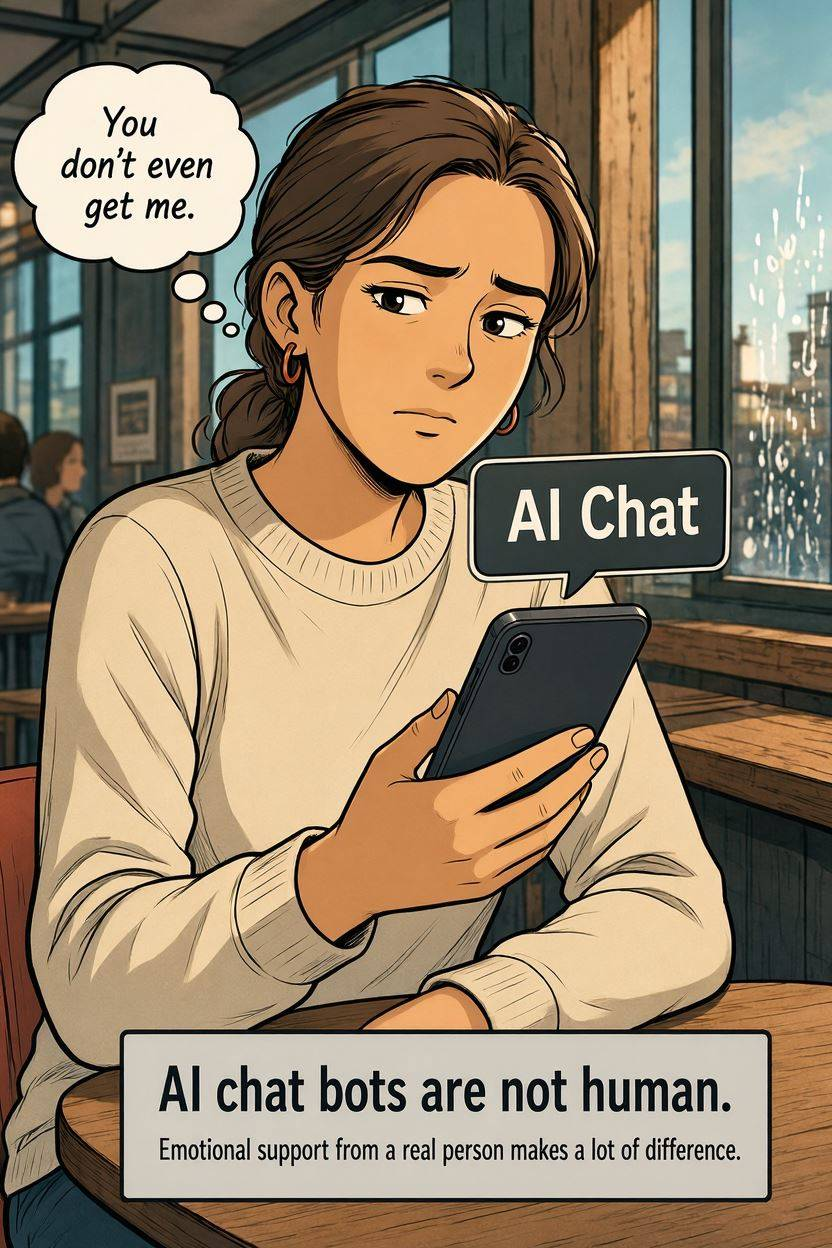
AI chat can respond instantly, at any hour, without judgment. Human emotional support responds more slowly, but it responds with something AI cannot generate: real understanding, shaped by lived experience, memory, and genuine care.
When you’re deciding between the two, the real question isn’t which is more convenient. It’s which one actually meets the need you have.
That question matters more than it might seem, because the two are not really substitutes for each other. They solve different problems.
Table of Contents
- Why People Compare AI Chat to Human Emotional Support
- How AI Emotional Support Works
- Where Human Connection Makes the Difference
- Which Option May Fit Different People
- Who AI Chat May Work Well For
- Why Some People Need More Than AI Can Offer
- Real-Life Scenarios
- Frequently Asked Questions
Why People Compare AI Chat to Human Emotional Support
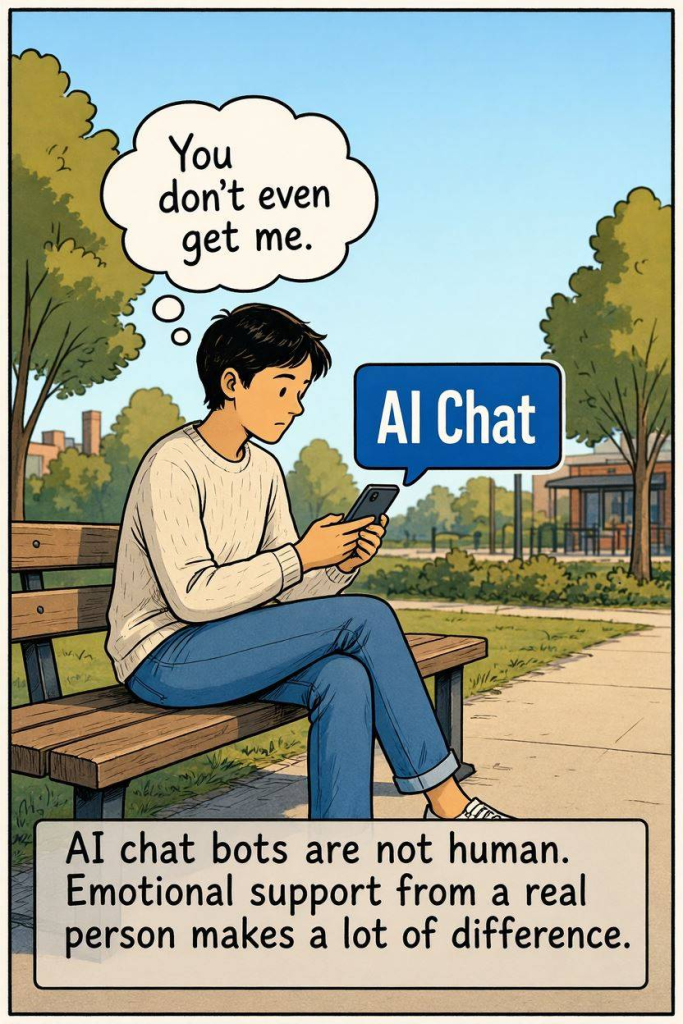
AI chat has become a common first stop for people who feel overwhelmed, lonely, or unsure who to talk to. It makes sense why. It’s available at 2am, it never seems tired of listening, and there’s no risk of being judged by someone you’ll see again tomorrow.
But a lot of people who start with AI chat eventually notice something missing. The responses are fluent, sometimes even comforting, but they don’t feel like they’re coming from somewhere. Can AI replace human connection is one of the most common questions people end up asking once that feeling sets in, and it’s a fair one. There’s a difference between a well-formed sentence and a sentence someone actually means.
Others notice that after a while, talking to an AI starts to feel like talking into a void that talks back. AI emotional support is not enough puts language to that exact experience, the strange loneliness of being “heard” by something that isn’t actually present with you.
How AI Emotional Support Works
AI chat tools generate responses by predicting likely patterns of language based on enormous amounts of text. When you share how you’re feeling, the system produces a reply that statistically resembles what a supportive response looks like. Some tools retain a record of previous conversations to make responses feel more personalised. Many are available instantly, at no cost, with no waiting and no scheduling.
That design has real strengths. It’s genuinely useful for low-stakes venting, journaling prompts, or simply having somewhere to put your thoughts when it’s the middle of the night and no one else is awake.
But it’s worth being precise about what’s actually happening. The AI is not feeling concern for you. It has not lived anything. It cannot be moved by what you share, because there is no one there to be moved. The response can sound caring without any care actually existing behind it. That distinction is easy to overlook in the moment, but it matters over time.
Where Human Connection Makes the Difference
This is where human emotional support does something an AI simply cannot replicate: it involves another person who is actually, genuinely present with you.
When a real person listens to you, something is actually happening between two people. They bring their own history, their own attention, their own care into the room.
They can sit with the weight of what you’re saying because they understand, on some level, what weight feels like. That is not something that can be generated. It has to be lived.
This is also where continuity becomes so important, and so different from what AI chat offers. Callin is built around ongoing, human conversation with the same person over time, someone who genuinely comes to know your story rather than pattern-matching against it. That relationship, built session by session, is not something a script can imitate, no matter how well it’s written.
There’s a deeper point here too, about what we actually mean by intelligence and understanding. Holistic intelligence, we need a new definition of intelligence in the modern world explores this idea directly: that real understanding involves emotional depth, memory, and lived context, not just the ability to produce a fluent, well-structured sentence.
A person who has actually felt loneliness understands loneliness in a way no amount of processed text can replicate. That difference is not a small one. It’s the entire difference between being answered and being understood.
Human connection is, in a very real sense, priceless. Not because it’s expensive or rare, but because it cannot be manufactured, only offered, person to person.
Callin provides non-clinical emotional support and is not therapy, counselling, diagnosis, or crisis intervention. If you are experiencing a mental health crisis, contact appropriate crisis support services such as Samaritans (UK: 116 123), 988 Suicide & Crisis Lifeline (US), or Lifeline (Australia: 13 11 14).
Which Option May Fit Different People
There are moments where AI chat can be a reasonable stopgap. If you need to organise your thoughts at an hour when no one else is reachable, or you want a low-pressure space to journal without any social component at all, AI chat can serve that narrow purpose.
But if what you actually need is to feel heard, understood, and less alone, human support offers something AI structurally cannot.
A real conversation involves someone who can genuinely relate to what you’re going through, who remembers you as a person rather than a chat log, and whose care for you is real rather than simulated.
If your priority is depth, being known over time by someone who actually holds your story, human emotional support is the option built for that. If you crave connection but have noticed yourself withdrawing from people, that’s usually a sign AI chat is filling a gap it was never designed to fill. Why you crave connection but withdraw from people is worth reading if that pattern feels familiar.
Who AI Chat May Work Well For
To be fair, AI chat isn’t without any use. It can work reasonably well for quick, structured tasks, like organising thoughts before a difficult conversation, or getting a short, immediate response when literally no other option is available in the moment.
Some people find it useful as a bridge, something to lean on for a few minutes before reaching out to an actual person.
Where it consistently falls short is anywhere real emotional depth is needed: processing grief, working through loneliness, feeling genuinely understood, or simply wanting to matter to someone. Those are human needs, and they call for a human response.
Why Some People Need More Than AI Can Offer
Most people who search for AI chat alternatives are describing this exact gap in their own words, even if they don’t use these terms.
They want someone real to talk to, without it costing them a friendship or feeling like a burden, and they’ve discovered that an AI, however articulate, doesn’t fill that particular hole. Someone to talk to when I don’t want to burden my friends speaks to that need for a real person who can hold space without it costing a friendship.
Others notice that AI chat, especially through constant notifications and always-on availability, can end up adding to their sense of overwhelm rather than easing it. Why notifications are emotionally draining touches on how “always available” technology can quietly wear a person down instead of genuinely supporting them.
And some people realise, often after weeks of AI chat, that they don’t actually want a tool. They want someone. What to do when you need to vent, but not therapy is a useful next step for anyone standing at that exact realisation.
Real-Life Scenarios
Someone has been talking to an AI chatbot every night for weeks, and while it never says anything unkind, they still feel completely alone by the time they close the app. Nothing about their situation actually changed, because nobody actually knows.
Someone tried an AI companion app after a breakup, hoping it would help them process what happened, and found that while it responded quickly, it never once said anything that felt like it came from real understanding. Going through a breakup reflects what that kind of loss actually needs, which is usually a real person who has felt something similar.
Someone works remotely and has noticed their main daily “conversations” have quietly become exchanges with a chatbot, not because they chose that, but because it was simply there and nothing else was. Remote worker loneliness describes exactly how that slow substitution happens.
These are illustrations of common patterns, not testimonials, and they are not presented as real Callin users.
Frequently Asked Questions
Is AI chat as effective as talking to a real person? AI chat can be useful for quick, low-stakes venting or organising your thoughts, but it cannot replicate genuine human understanding, memory, or care. For anything involving real emotional depth, loneliness, or feeling truly heard, human connection offers something AI is not built to provide.
Can an AI chatbot understand my emotions? An AI chatbot can generate language that resembles empathy, but it does not actually feel concern or understanding, because there is no lived experience behind the response. A real person listening to you brings genuine care, memory, and context that a generated response cannot replicate.
Why does talking to a human feel different from talking to an AI? Talking to a real person involves an actual relationship: someone who remembers you, has their own history, and genuinely cares how you’re doing. That presence is what makes human connection feel meaningful in a way generated responses, however fluent, do not.
Is it unhealthy to rely on AI for emotional support? Occasional use for low-stakes venting isn’t inherently harmful, but relying on AI chat as a primary source of emotional support can leave deeper needs, like feeling truly known and understood, unmet. If you notice yourself withdrawing from real people in favour of a chatbot, that’s often a sign it’s time for actual human connection.
What’s a good alternative to AI chat for emotional support? Callin offers non-clinical, ongoing conversations with real people, built around continuity and genuine human connection rather than generated responses. It gives you somewhere to talk that involves an actual person who remembers your story over time.
A Space to Start the Conversation
If you’ve noticed that AI chat leaves you feeling a little more alone than before you opened it, that’s worth listening to. Callin offers something an algorithm never can: a real person, genuinely listening. It begins with a free 20-minute session, no pressure, no commitment, just a real conversation with someone who’s actually there.