
If repeating your story on helplines leaves you more drained than when you dialled, you are not being ungrateful. Most volunteer helplines are built for fast, high-volume crisis response, so each call usually reaches whoever is free. That protects availability, but it means starting again each time. If you are not in crisis, a service with the same listener, like Callin, may suit you better.
Callin provides confidential, one-to-one, non-clinical human support by voice call, video call or private chat. It is not therapy, counselling, diagnosis, medical or psychiatric care, or crisis or emergency support. Everyone you speak to is a real person, not an AI.
If you are in danger right now, or think you might act on thoughts of harming yourself or someone else, please contact your local emergency services or a crisis helpline. You can find a free, confidential line in your country at findahelpline.com. Crisis helplines are exactly the right place in that moment.
Key takeaways
- Volunteer crisis helplines usually connect you to a different person each time because they are designed to answer as many callers as quickly as possible, not to build ongoing relationships.
- Samaritans, for example, says callers are connected to “the first available volunteer regardless of location”, and that it responds to a call for help every 10 seconds.
- Repeating your story to someone new each time can be emotionally tiring, because you have to rebuild context, decide again how much to share and manage a new person’s reaction.
- Without shared history, conversations can stay on the surface, and the style of each new volunteer can feel unpredictable.
- Crisis helplines remain vital for emergencies, and anyone in danger should contact local emergency services or a line listed on findahelpline.com.
- Research in healthcare links relational continuity with better outcomes in some settings, although the evidence is mostly observational and does not prove that continuity alone causes the benefit.
- Callin’s Human Continuity™ means that, wherever possible, you keep the same trained listener across sessions, so you can skip the preamble and pick up where you left off.
Why do helplines connect you to a different person every time?
Helplines connect you to a different person every time because they are designed for rapid, high-volume response. When someone calls, the system usually routes them to whoever is free first. That structure prioritises availability over continuity, which is the right trade-off when someone may be in danger.
Samaritans in the UK and Ireland is one well-known example. In a public statement about its future plans, the charity explains that callers “are connected to the first available volunteer regardless of location”. It also says it responds to a call for help every 10 seconds, and that it aims for no one to wait longer than five minutes.
The scale is real across many countries. A study of Lifeline, Australia’s largest crisis helpline, by Spittal and colleagues analysed 411,725 calls from 98,174 people over 18 months. When demand is that high, matching each caller with a particular volunteer would mean longer waits for everyone.
Some helplines can offer limited follow-up. Samaritans’ privacy statement notes that in some circumstances it may arrange a follow-up call or an agreed support plan. Even so, the core model is built around the next available person.
None of this is a flaw. It is a design choice that saves lives in emergencies. It simply means a crisis line may not be the best fit for ongoing, everyday emotional support.
Why is repeating your story on helplines so exhausting?
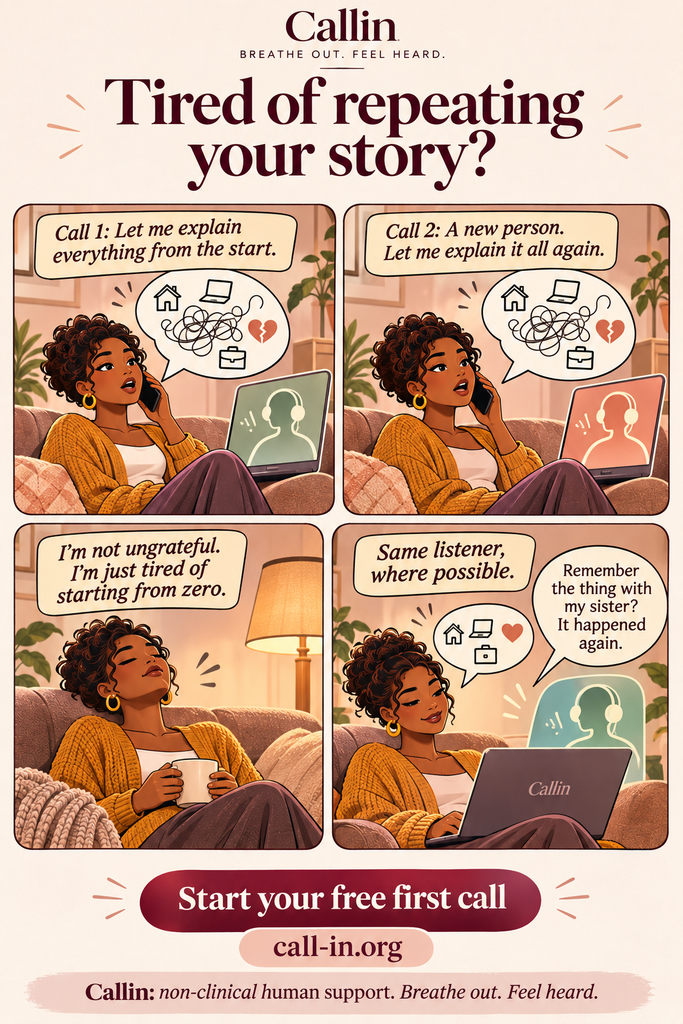
Repeating your story on helplines is exhausting because each new conversation asks you to rebuild everything from the beginning. You explain who people are, what happened, why it matters and how you feel, often before you reach the part you actually wanted to talk about. Doing that again and again takes real emotional energy.
It might look like this:
- You spend the first ten minutes explaining your family, your job or your relationship.
- You summarise years of history into a few sentences, and it never feels quite right.
- You reach the painful part just as the call is winding down.
- You hang up feeling heard for a moment, but not known.
You may also find yourself performing a little. You choose words to sound reasonable. You check how the new person is reacting. You soften the story so it does not sound too much.
That is a lot of work when you are already tired.
Why do helpline conversations sometimes stay on the surface?
Helpline conversations can stay on the surface because there is no shared history to build on. Each call starts from zero, so much of the time goes on context rather than depth. The listener cannot notice patterns across weeks, because they were not there for the earlier weeks.
Depth in conversation often grows from being known over time. Research on how closeness develops supports this idea. In two diary studies, Laurenceau, Barrett and Pietromonaco found that people felt closer in conversations when they disclosed something and felt the other person was responsive. Emotional disclosures mattered more than factual ones.
When most of a call is spent on facts and background, there may be less room for the emotional part. Callin’s article The Dangers of “I’m Fine”: The Cost of Surface-Level Interactions explores why staying on the surface can feel so lonely.
Why does talking to a new volunteer every time feel like a lottery?
Talking to a new volunteer every time can feel like a lottery because each person brings their own style, warmth and way of responding. Some calls feel deeply supportive. Others may feel rushed, formal or not quite right for you. You cannot predict which one you will get.
Research suggests helper style really does vary. In a study of crisis lines in the United States, Mishara and colleagues silently monitored 2,611 calls to 14 helplines. They found that empathy, respect and a supportive approach were linked to better short-term outcomes. Callers hung up on helpers rated low in empathy in 12.5% of calls, compared with 2.4% for helpers rated high in empathy.
That study was about crisis calls, and it does not tell us how any particular helpline performs today. It does show that who answers can shape how a call feels.
What might sit underneath the tiredness of retelling your story?
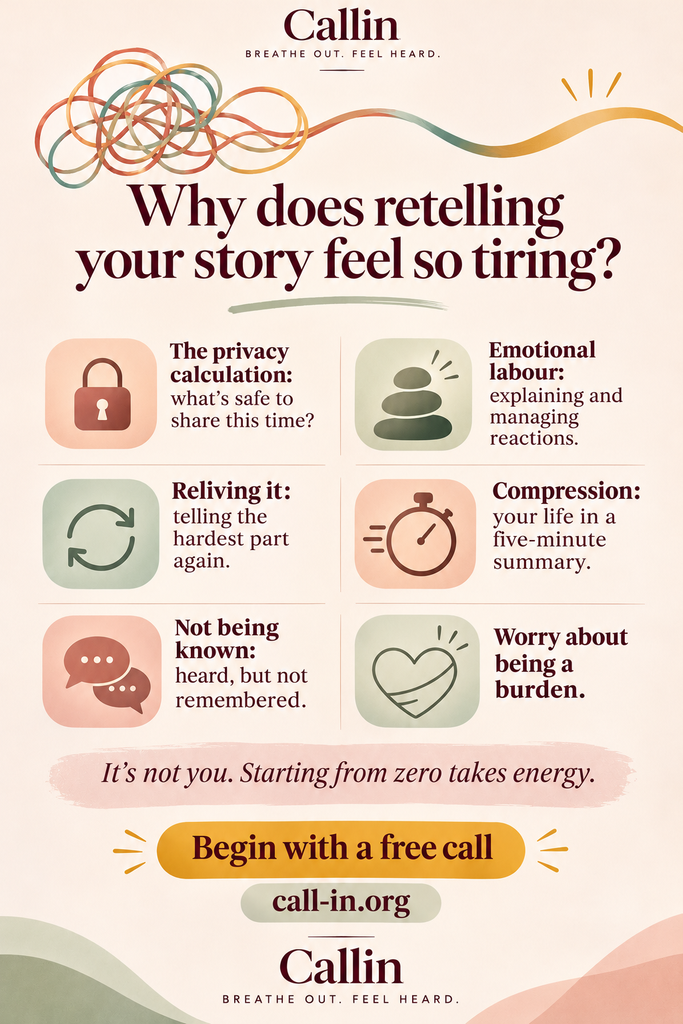
Underneath the tiredness of retelling your story there are usually several ordinary pressures: deciding again how much to reveal, doing the emotional work of explaining, reliving painful moments and not feeling known. Naming these in your own words can help you understand why helplines feel draining, even when the people on them are kind. This is reflection, not diagnosis.
Here are some things people often find underneath, as they understand them:
- The privacy calculation. Every new listener means deciding again what is safe to share and what to keep back.
- Emotional labour. Explaining, summarising and managing someone else’s reaction is work, especially when you are already worn out.
- Reliving it. Telling the hardest part again can bring the feelings back up, every single time.
- Compression. A complicated life does not fit neatly into a five-minute summary, so something always feels missing.
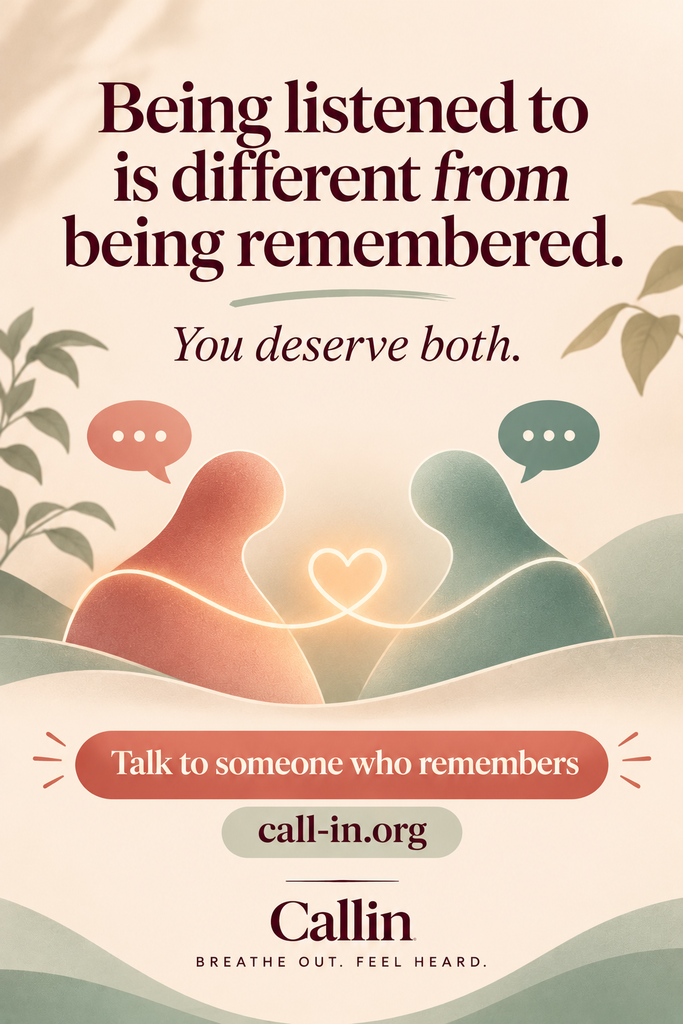
- Not being known. Being listened to is different from being remembered. Many people want both.
- Worry about being a burden. Calling again and again can make you feel you are taking too much, even when you are not.
If you are someone who usually listens to everyone else, opening up to strangers can feel even harder. Callin’s article Why Can’t I Open Up Even Though I Listen to Everyone Else? looks at this pattern.
Are crisis helplines still the right choice in an emergency?
Yes, crisis helplines are still the right choice in an emergency. They are free in many countries, often open around the clock and staffed by trained people who are ready for urgent situations. If you are in danger, please contact your local emergency services or find a crisis line at findahelpline.com.
The point of this article is not that helplines are bad. It is that different kinds of support are built for different moments.
A crisis line is built to be there fast for anyone, at any time. Ongoing emotional support is built to be there steadily for one person, over time. You might need one, the other or both at different points in your life.
What is the difference between a crisis helpline, a warmline and ongoing emotional support?
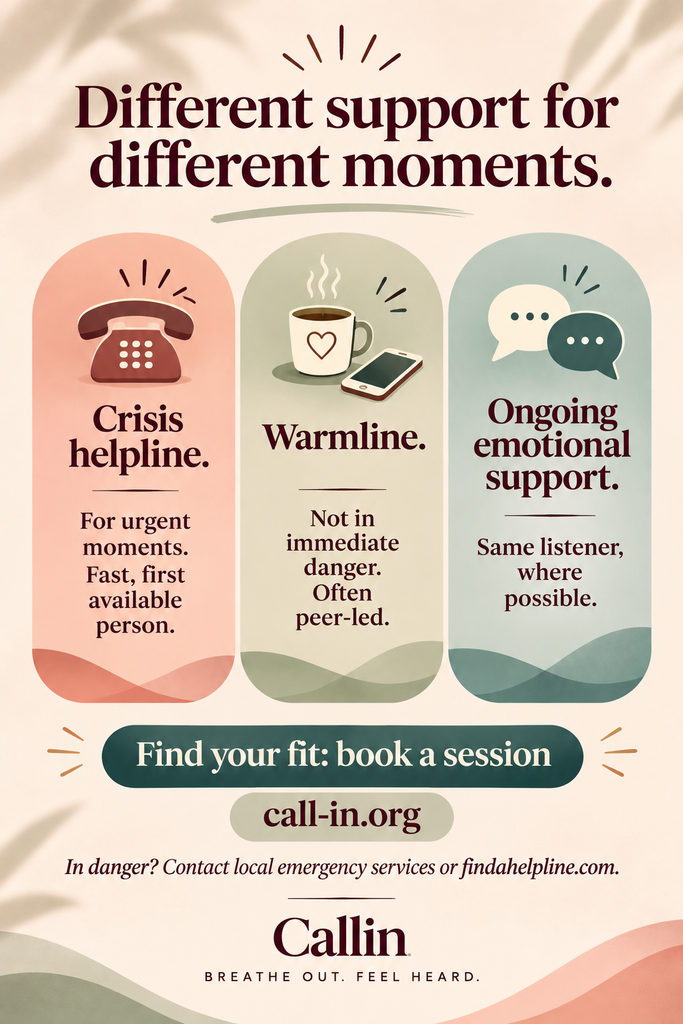
A crisis helpline responds to urgent situations where someone may be at risk. A warmline is a listening line for people who want to talk but are not in immediate danger, and it is often staffed by peers. Ongoing emotional support, such as Callin, offers regular conversations, wherever possible with the same listener, for people who are not in crisis.
Warmlines can be a gentler fit than crisis lines for everyday distress, although many still connect you to whoever is available. Callin’s guides I Need Someone to Talk To, But I’m Not in Crisis: What Is a Warm Line? and What is a Warmline? 5 Key Differences Between Crisis Lines and Peer Support explain these options in more detail.
Therapy is a different room again. A therapist or counsellor is a qualified professional who can offer clinical assessment and treatment. Therapy usually includes a lot of continuity, and it is the right place for many people. Callin’s article Therapy vs. a Listening Service: Do You Need Therapy or Someone to Talk To? sets out the differences.
Does talking to the same person actually make a difference?
Talking to the same person can make a real difference to how support feels, although research has not proved that continuity alone causes better outcomes. In healthcare, continuity with the same professional has been linked with benefits in several studies. Most of that evidence is observational, so it shows associations rather than certainty.
Here is what the research suggests, with its limits:
In medicine. A systematic review in BMJ Open by Pereira Gray and colleagues looked at 22 studies from nine countries. In 18 of them, seeing the same doctor over time was linked with lower death rates. The authors note that all the evidence was observational.
In mental health care. A 2023 systematic review in BMC Psychiatry by Engström and colleagues looked at relational continuity for people with serious mental illness. It found some links with better outcomes, but rated the certainty of the evidence as low or very low.
Both reviews are about clinical care, not non-clinical listening. They cannot tell us exactly what continuity does in a service like Callin. They do support a simple human idea: being known by the person helping you can matter.
How does Human Continuity™ work at Callin?
Callin’s Human Continuity™ means that, wherever possible, you keep talking with the same trained listener across sessions. Your listener already knows the outline of your life, so you do not have to start from the beginning. You can skip the preamble and go straight to what matters today.
In practice, that might sound like:
- “Remember the thing with my sister? It happened again.”
- “The interview I was nervous about was yesterday.”
- “I’m doing a bit better than last week.”
Your listener knows who your sister is. They remember the interview. They noticed last week was hard. That shared history can make it easier to go deeper, notice patterns and feel remembered rather than processed.
Callin listeners are trained in active listening and Psychological First Aid. The World Health Organization’s guide to Psychological First Aid describes it as “a humane, supportive response to a fellow human being who is suffering and who may need support”. The guide is clear that it is not professional counselling.
Continuity is a comfort for many people, not a promise of any particular outcome. You can read more in Where Can I Find Ongoing Online Emotional Support From the Same Person?.
Can talking to the same listener help me trust them more?
Talking to the same listener can help trust grow, because trust usually builds when someone shows, over time, that they listen and remember. You do not have to test a new person each call. You can share a little, see how it lands and share more when you are ready.
You stay in control throughout. You choose what to talk about, how much to share and how often you want to speak.
Can I use Callin by chat instead of calling?
Yes, you can use Callin by private chat as well as by voice or video call. Some people find typing easier, especially at first. Callin’s guide Can You Text Someone to Just Vent? Private Chat Lines Explained explains how chat-based support works.
Is Callin a replacement for a crisis helpline?
No, Callin is not a replacement for a crisis helpline. Callin provides non-clinical emotional support for people who are not in immediate danger. It does not diagnose, assess or treat mental health conditions, and it is not an emergency service.
If you are in crisis, please contact your local emergency services or a crisis line through findahelpline.com. If you need clinical care, a doctor, therapist or counsellor is the right place. If you already use a helpline, therapy or medication that is helping you, please keep going with it.
What Callin offers is something different: a steady, confidential place to talk about everyday emotional weight with someone who remembers you. If you are in the UK and comparing options, Callin’s article Who Can I Reach Out to Instead of Samaritans in the UK? explains the differences, and is clear that Callin does not replace crisis support. For a broader look at non-clinical options, see Who to Talk to When You Don’t Need Therapy But Need a Safe Space to Vent.
How do I find emotional support with the same listener every time?
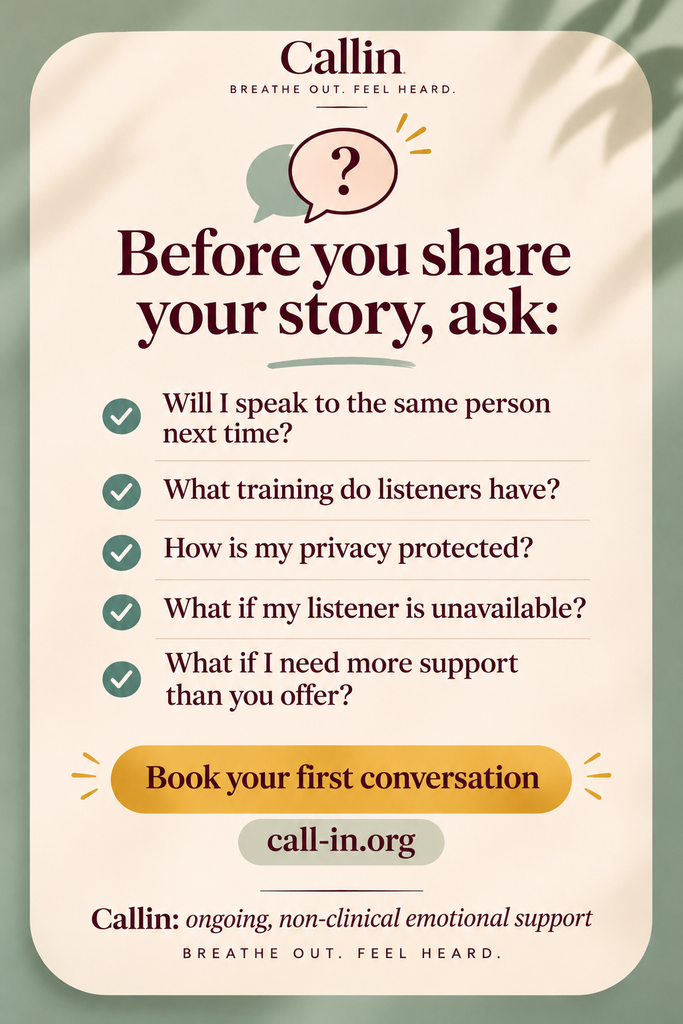
You can find emotional support with the same listener by asking each service directly if you will speak to the same person next time. Many services rotate listeners, so it is worth checking before you invest your story. Look for a clear answer, a clear explanation of limits and clear privacy information.
Some questions you can ask a service:
- Will I speak to the same person each time, wherever possible?
- What training do your listeners have?
- How is my privacy protected?
- What happens if my listener is unavailable?
- What happens if I need more support than you offer?
Some questions you can ask yourself:
- Do I need urgent help right now, or somewhere steady to return to?
- Would I rather speak, see someone on video, or type?
- How often would I like to talk?
There is no wrong answer. You can try something, notice how it feels and change your mind. Callin’s explainer What Is a Listening Service? How Human Emotional Support Works may also help you decide.
Frequently asked questions
Why do I get a different person every time I call a helpline?
You usually get a different person because volunteer helplines route each call to the first available listener. This keeps waiting times as short as possible for everyone, which matters in emergencies. Some helplines can arrange limited follow-up in certain circumstances, but continuity is not their main design.
Is it normal to find helplines draining?
Yes, it is normal to find helplines draining when you have to retell your story each time. Rebuilding context, deciding again what to share and reliving painful moments all take energy. Feeling this way does not mean helplines are bad or that you are ungrateful.
Can I talk to the same person every time for emotional support?
Yes, some services offer emotional support with the same person over time. Therapy usually does, and some non-clinical services do too. Callin’s Human Continuity™ means that, wherever possible, you keep the same dedicated listener across sessions.
Should I stop using crisis helplines?
No, you should not stop using crisis helplines if you need them. They are the right place in an emergency or when you may be at risk. Ongoing emotional support can sit alongside crisis lines for everyday weight, rather than replacing them.
Is Callin a crisis line?
No, Callin is not a crisis or emergency service. Callin provides non-clinical emotional support for people who are not in immediate danger. If you are in crisis, please contact your local emergency services or find a free line at findahelpline.com.
Does talking to the same listener guarantee better results?
No, talking to the same listener does not guarantee any particular result. Research in healthcare links continuity with some benefits, but the evidence is mostly observational. Many people simply find it more comfortable and less tiring to be remembered.
What happens in a first session at Callin?
In a first session, you can talk about whatever is on your mind at your own pace, with no pressure to continue. Eligible new clients can start with a free first call session, with no obligation to continue. Callin’s guide to the first session explains what to expect.
What is a gentle next step if I am tired of starting again?
A gentle next step is to choose one place where your story can be held over time, so you are not starting from zero every time things feel heavy. You do not need the perfect words. You can start with “I’m tired of explaining everything again”.
If Callin sounds like it might fit, eligible new clients can start with a free first call session, with no obligation to continue. You can find out more about Callin’s non-clinical emotional support whenever you are ready. To see what that first conversation looks like, read What Happens in a Callin First Session? What to Expect.
You deserve to be heard. You also deserve to be remembered.
Most relevant UN Sustainable Development Goal
SDG 3: Good Health and Well-Being, in particular Target 3.4, which includes promoting mental health and well-being. Crisis helplines, healthcare, therapy and ongoing non-clinical listening each play different parts in a wider system of support, and continuity can make everyday support feel more humane and accessible.
Sources and further reading
- Samaritans. Samaritans unveils plan to future proof the life-saving charity and answer more calls from those in crisis. News release.
- Samaritans. Privacy Statement.
- Spittal, M. J. et al. (2015). Frequent callers to crisis helplines: Who are they and why do they call? Australian and New Zealand Journal of Psychiatry, 49(1), 54 to 64.
- Mishara, B. L. et al. (2007). Which helper behaviors and intervention styles are related to better short-term outcomes in telephone crisis intervention? Results from a silent monitoring study of calls to the U.S. 1-800-SUICIDE network. Suicide and Life-Threatening Behavior, 37(3), 308 to 321.
- Laurenceau, J.-P., Barrett, L. F. and Pietromonaco, P. R. (1998). Intimacy as an interpersonal process: The importance of self-disclosure, partner disclosure, and perceived partner responsiveness in interpersonal exchanges. Journal of Personality and Social Psychology, 74(5), 1238 to 1251.
- Pereira Gray, D. J., Sidaway-Lee, K., White, E., Thorne, A. and Evans, P. H. (2018). Continuity of care with doctors: a matter of life and death? A systematic review of continuity of care and mortality. BMJ Open, 8(6), e021161.
- Engström, I. et al. (2023). Relational continuity may give better clinical outcomes in patients with serious mental illness: a systematic review. BMC Psychiatry, 23, 952.
- World Health Organization, War Trauma Foundation and World Vision International (2011). Psychological first aid: Guide for field workers. WHO, Geneva.
- Find A Helpline. findahelpline.com. Free, confidential crisis lines by country.
- United Nations. Sustainable Development Goal 3: Good Health and Well-Being.

Leave a Reply