
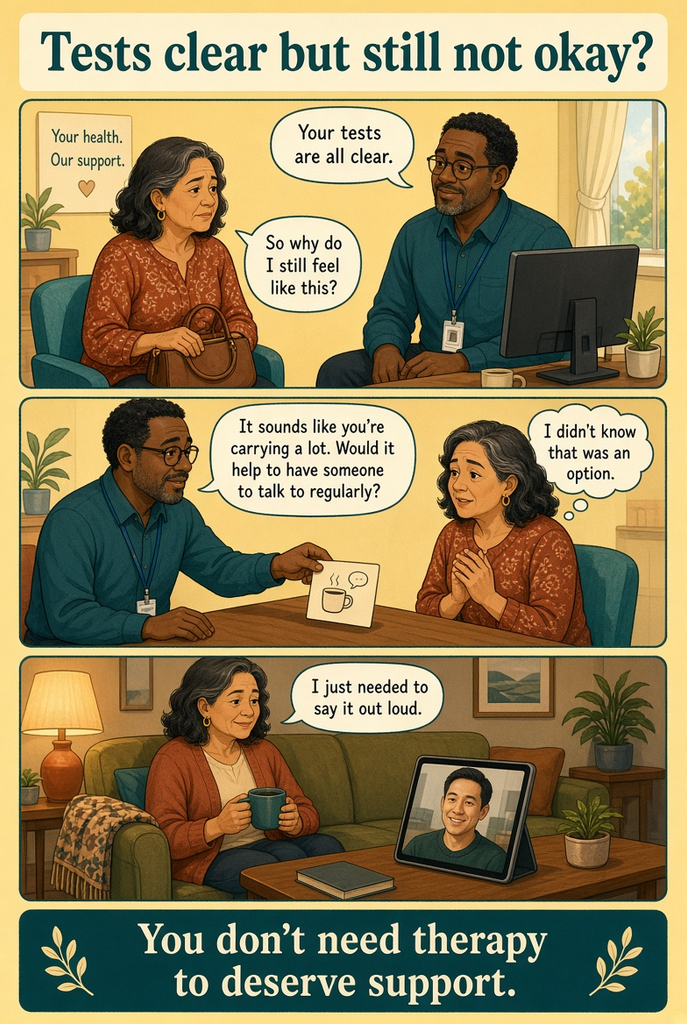
You know the appointment. The tests are clear, the prescription is not the answer, and the person in front of you mostly needs someone to listen for longer than a consultation allows.
This guide is for GPs, practice nurses, practice managers and other medical professionals who want a clear, honest set of non-therapy options to signpost patients to, alongside the medical care you provide.
The short answer: You can recommend a range of non-therapy emotional support, including social prescribing and link workers, community and peer groups, warmlines, issue-specific helplines and non-clinical one-to-one emotional support.
These options work alongside medical care, not instead of it, and they suit patients who want to talk, feel less alone or get through a hard patch. Check each provider’s boundaries, safeguarding and privacy before you recommend it, and keep clinical and crisis routes clearly in view.
Key definitions
- Signposting: Giving a patient information about a service they can contact themselves, without making a formal clinical referral.
- Social prescribing: Described by WHO as “a means of connecting patients to a range of non-clinical services in the community to improve their health and well-being.”
- Link worker: A professional, sometimes called a community connector or care navigator, who helps patients find community activities, groups and services.
- Warmline: A non-crisis listening line for people who want to talk before things reach a crisis point.
- Non-clinical emotional support: Confidential, human conversation with a trained listener that does not diagnose, treat, assess or replace therapy, counselling or medical care.
- Therapy: Structured psychological treatment delivered by a qualified, regulated clinician, usually after an assessment.
A quick word on boundaries before we begin. Callin offers non-clinical emotional support, not therapy, counselling, medical or psychiatric care, diagnosis, treatment or crisis support, and nothing in this article is clinical, legal or medical advice. If a patient, a colleague or anyone you are supporting may be in immediate danger or crisis, please follow your clinical and safeguarding procedures, contact local emergency services, or find a free, confidential helpline in their country at findahelpline.com.
Key takeaways
- Many patients come to primary care with life pressures, loneliness or low-level distress, and some mainly need time and human connection rather than treatment.
- WHO’s 2025 Commission on Social Connection reports that 1 in 6 people worldwide is affected by loneliness, and that lonely people are twice as likely to get depressed.
- Non-therapy options include social prescribing, community and peer groups, warmlines, issue-specific helplines and non-clinical one-to-one emotional support.
- These options sit alongside medical care, never instead of it, and are not the right sole support for anyone who needs assessment, medication, clinical management or crisis care.
- Social prescribing schemes exist in many countries, but evidence on outcomes is still developing, so recommend services for the support they offer rather than promised results.
- Before recommending any provider, check its boundaries, training, safeguarding, privacy, eligibility, language and availability.
- Practice managers can make signposting easier for the whole team with a short, reviewed signposting list, and practices can also enquire about a three-month pilot of support for their own staff.
Why do so many patients need someone to talk to rather than treatment?
Because a lot of what brings people through the door is life, not illness. Bereavement, loneliness, relationship strain, caring responsibilities, work stress and big transitions all affect how people feel, and many patients simply have nobody they can talk to honestly.
The scale of disconnection is significant. WHO’s Commission on Social Connection reported in June 2025 that “1 in 6 people worldwide is affected by loneliness,” and that loneliness is “linked to an estimated 100 deaths every hour.” It adds that people who are lonely are “twice as likely to get depressed.”
At the same time, WHO’s mental disorders fact sheet notes that “most people with mental disorders do not have access to effective care.” Non-therapy support does not fill that clinical gap, and it should never be presented as if it does. What it can do is give people who are struggling with everyday life somewhere human to turn.
Our article on why it is okay to ask for help without a diagnosis explains this from the patient’s side, and may be helpful to share.
What non-therapy emotional support can you recommend?
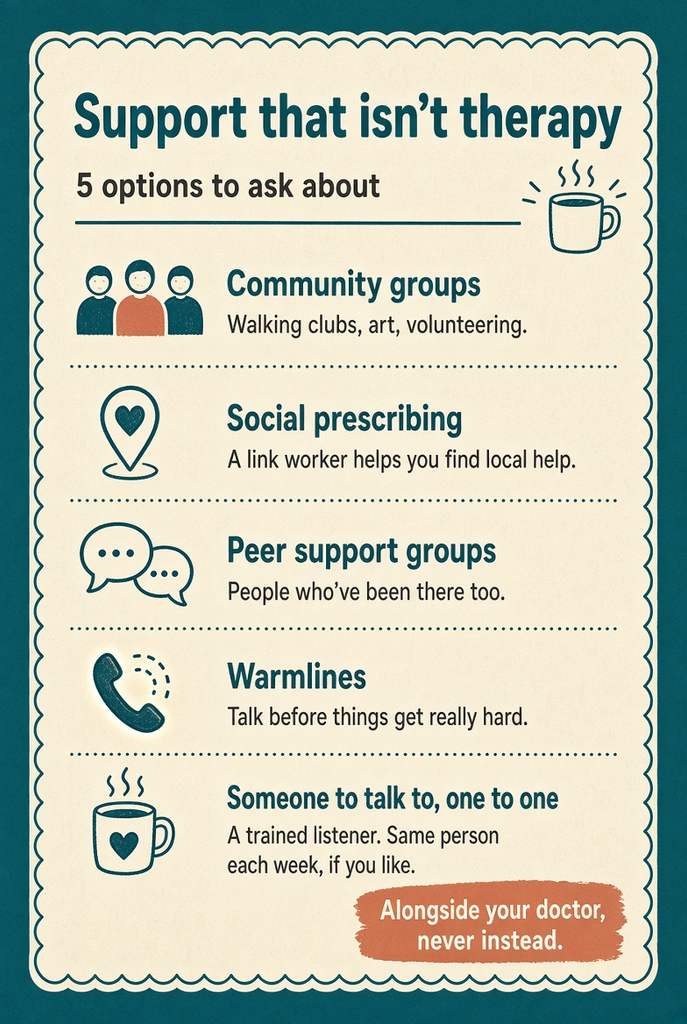
There are several kinds, each with a different job. The right one depends on what the patient wants, what is available locally and whether they prefer groups, one-to-one conversation, practical help or a mix.
Common options include:
- Social prescribing and link workers: help with connecting to community activities, groups and practical services, where your health system offers it.
- Community and interest groups: walking groups, arts, volunteering, faith or cultural communities and local clubs.
- Peer support groups: people with shared experiences, such as new parents, carers, bereaved people or people living with a long-term condition.
- Warmlines: non-crisis listening lines for people who want to talk before things get worse.
- Issue-specific helplines and charities: for example, bereavement, carers, debt or relationship organisations in your area.
- Non-clinical one-to-one emotional support: a confidential conversation with a trained listener, often online, sometimes with the option of talking to the same person over time.
- Self-help resources: workbooks, reputable websites and apps, which suit some people but not those who want a human conversation.
Our explainers on what a warmline is and warmlines, crisis lines and peer support set out the differences. Our guide to what a listening service is explains one-to-one listening for patients in plain language.
How is social prescribing different from non-clinical emotional support?
Social prescribing connects people to community activities and services; non-clinical emotional support gives them a confidential conversation. They are complementary, and many patients benefit from knowing about both.
Social prescribing is now established in several health systems, with local differences. These are examples only:
- England example: NHS England describes social prescribing as an approach that “connects people to activities, groups, and services in their community to meet the practical, social and emotional needs that affect their health and wellbeing,” with link workers based in primary care networks.
- Netherlands example: Welzijn op Recept (Wellbeing on Prescription) helps people who come to primary care with psychosocial complaints move towards sources of wellbeing and social connection in daily life, often following a GP referral.
- Canada example: the Canadian Institute for Social Prescribing explains that social prescribing “enables healthcare providers to refer people to local, non-clinical services, including community and social services.”
Be honest about the evidence. A systematic review in BMJ Open, covering UK schemes, concluded that “current evidence fails to provide sufficient detail to judge either success or value for money.” That is a reason to recommend services for what they offer, not for promised results.
When is non-therapy support a good fit, and when is it not?
It is a good fit when a patient wants someone to talk to, feels lonely or overwhelmed by life, or wants extra human support alongside their medical care. It is not the right sole support when someone needs assessment, diagnosis, medication, psychiatric treatment, trauma treatment or clinical management, or when there is an immediate safety concern.
Situations where patients may welcome non-therapy support include:
- Life events: bereavement, separation, retirement, moving country or becoming a parent.
- Loneliness and isolation: living alone, caring for someone or losing a social network.
- Everyday stress: work pressure, money worries or feeling stretched thin.
- Alongside clinical care: some patients want someone to talk to while they wait for, or continue with, clinical treatment.
Clinical judgement always comes first. Non-therapy support should be offered as an addition that the patient chooses, with clear routes back to you and to crisis services. Our guide to non-clinical mental health support vs therapy and our page on how to tell what kind of support might help explain these differences for patients, so you do not have to.
How can you recommend non-therapy support without sounding dismissive?
Frame it as an addition, not a brush-off. Patients can hear “go and talk to someone else” as “you are not worth my time,” so be clear that you are adding support, not closing the door.
Helpful approaches:
- Name what you are hearing: “It sounds like you are carrying a lot, and it might help to have someone to talk to regularly.”
- Make it a choice: offer two or three options and let the patient decide what feels right.
- Keep the door open: make clear they can come back to you at any time, and when to seek urgent help.
- Be accurate: describe each option honestly, including that non-clinical support is not therapy.
- Follow up where you can: a brief question at the next appointment shows you meant it.
Some patients feel they “should” need therapy to deserve support, or that their problems are too small. Our articles on needing someone to talk to, not therapy and emotional support when you do not need therapy speak directly to that feeling.
What should you check before recommending a provider?
Check that the service is honest about what it is, safe in how it works and practical for your patients. You do not need to audit every provider in depth, but a short, consistent checklist protects patients and your practice.
Questions to ask:
- Boundaries: does it clearly say what it is and is not, and avoid clinical or outcome claims?
- Training: what training do listeners or volunteers receive?
- Safeguarding and signposting: what happens if someone discloses a risk to themselves or others?
- Privacy: how is personal data handled, and are clinical notes created or shared?
- Eligibility: age limits, location and any conditions of use.
- Language and access: which languages, formats and devices are supported?
- Availability: when can patients actually reach it, including evenings and weekends?
- Continuity: can patients talk to the same person over time if they want to?
If a provider makes claims about treating or curing conditions, or promises outcomes, treat that as a reason for caution.
How can practice managers make signposting easier for the whole team?
By giving everyone the same short, trusted list and keeping it up to date. When receptionists, care navigators, nurses and GPs all point to the same options, patients get consistent messages and staff save time.
Practical steps:
- Build a one-page list: group options by type (social prescribing, community groups, peer support, warmlines, helplines and one-to-one emotional support), with clear notes on what each is and is not.
- Include crisis routes at the top: local emergency numbers, urgent care routes and findahelpline.com for patients from other countries.
- Review regularly: check links, eligibility and availability at least every few months.
- Share in several formats: printed sheets, text messages, your practice website and patient portal.
- Gather feedback: ask patients and staff which options people actually use and value.
National directories can help you find services. These differ by country, so check what exists where you practise.
How does this work across different health systems?
The principles travel well, but the routes do not. In some countries the GP is the main gateway to care; in others patients go directly to specialists, and primary care teams, community nurses or pharmacists may do more of the signposting.
- Check local schemes: social prescribing, link worker or community navigator programmes exist in some systems and not others.
- Think about language and culture: some patients may prefer to talk in a language other than the local one, or come from cultures where talking about feelings with a stranger is unfamiliar.
- Consider internationally mobile patients: people who have recently moved may have no local network at all.
- Respect privacy expectations: patients may worry about what goes on their medical record, so be clear that signposting to an independent service is different from a referral.
Our page on NHS alternatives for mental health support is a UK example written for patients, and our article on what to do when you feel lonely and have no one to talk to suits patients in any country.
Where does Callin fit alongside medical care?
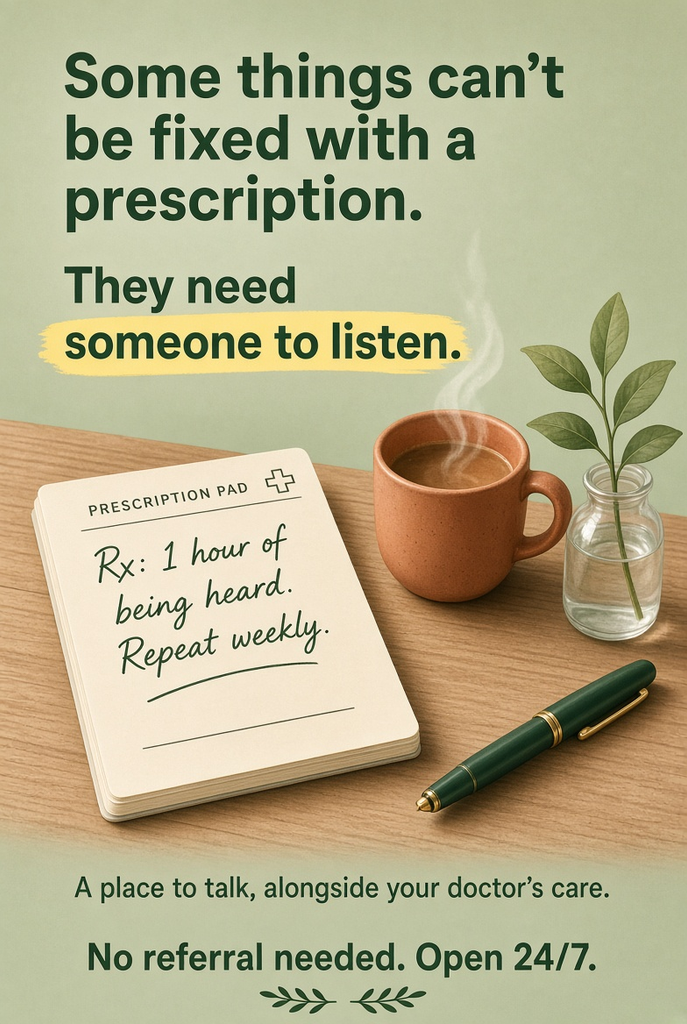
Callin is one non-clinical option you can mention to adult patients who want someone to talk to. It works alongside medical care, not instead of it, and it is not therapy, counselling, medical or psychiatric care, diagnosis, treatment or a crisis service.
Callin has offered this kind of support since June 2023. Callin Support Ltd is UK-registered and supports adults aged 18 and over worldwide through one-to-one online sessions in English, by video call. Patients book directly and do not need a diagnosis or a referral. Callin is available 24/7, with sessions booked in advance at a time that suits each person, at any hour, which can help patients who work shifts or care for others.
Listeners complete Johns Hopkins University Psychological First Aid training and use active listening, with clear safeguarding and signposting procedures. Through Human Continuity™, Callin prioritises the same listener for ongoing support wherever operationally possible, so patients do not have to repeat their story each time. No clinical notes are generated, and you can read more in our FAQ, our privacy policy and our page on who we support.
Callin is not suitable as the only source of support for someone who needs diagnosis, medication, psychiatric treatment, trauma treatment, emergency intervention or clinical management of a mental health condition. We do not publish outcome figures for Callin, and we do not claim that it improves any health condition.
What could a practice enquiry or three-month pilot look like?
Start with a conversation. If you would like to understand how Callin works before adding it to your signposting list, or you want to support your own practice team, you can contact Callin about organisational support.
Two practical routes:
- For your signposting list: ask Callin about boundaries, safeguarding, privacy and availability, and decide as a team whether it belongs on your list alongside other options.
- For your own staff: primary care teams carry a heavy emotional load too, and Callin offers a defined three-month pilot for organisations, so your practice can test confidential, non-clinical support for its own people with privacy-safe measures and a review point.
Whatever you choose, keep the patient’s choice and clinical safety at the centre. Our guide to what non-clinical mental health support means is a helpful briefing to share with colleagues.
Ready to give patients more than a prescription?
You cannot give every patient an hour, but you can make sure they know where to find someone who will listen. If you would like to see what non-clinical support feels like first, explore non-clinical mental health support with Callin or read what happens in a Callin first session.
When you are ready, make a practice enquiry or ask about a three-month pilot for your team, and we will talk through boundaries, safeguarding and how Callin can sit alongside the care you already provide.
Frequently asked questions
What can a GP recommend for a patient who just needs someone to talk to?
Options include social prescribing or link worker services where available, community and peer support groups, warmlines, issue-specific helplines and non-clinical one-to-one emotional support. Offer a choice, describe each honestly and keep clinical and crisis routes clearly in view.
Is non-clinical emotional support the same as therapy?
No. Therapy is structured psychological treatment delivered by a qualified, regulated clinician. Non-clinical emotional support is a confidential conversation with a trained listener that does not assess, diagnose or treat, and it works alongside medical care rather than replacing it.
What is the difference between social prescribing and emotional support?
Social prescribing connects patients to community activities, groups and practical services, often through a link worker. Non-clinical emotional support offers a confidential one-to-one conversation. They complement each other, and some patients benefit from both.
When should non-therapy support not be the only option?
When a patient needs assessment, diagnosis, medication, psychiatric or trauma treatment, clinical management of a mental health condition, or is at immediate risk. In those situations, clinical and crisis care come first, and non-therapy support can only ever be an addition.
Do patients need a referral to use Callin?
No. Adult patients can book Callin directly, without a diagnosis or a referral. Signposting a patient to Callin is not a clinical referral, and Callin does not replace any part of their medical care.
Can patients use Callin outside surgery hours?
Yes. Callin is available 24/7, and sessions are booked in advance at a time that suits each person, at any hour. It is not a crisis service, so patients at risk should always use emergency or crisis routes.
How can a practice find out more?
Practice managers and clinicians can contact Callin through our organisations page to ask about boundaries, safeguarding, privacy and availability, or about a three-month pilot of support for the practice’s own staff.
UN Sustainable Development Goals alignment
At Callin, we are aligning ourselves with the UN SDGs, and this article connects with two of them. This describes alignment only, not United Nations affiliation or endorsement; read more in our guide to mental health and the SDGs.
- SDG 3: Good Health and Well-being. Helping patients find human connection alongside their medical care supports wellbeing as part of good health.
- SDG 10: Reduced Inequalities. Clear, accessible signposting helps more people, including those far from home or without a support network, find someone to talk to.
Sources and further reading
- World Health Organization, Regional Office for the Western Pacific (2022). A toolkit on how to implement social prescribing. Global guidance.
- World Health Organization (30 June 2025). Social connection linked to improved health and reduced risk of early death, news release on the WHO Commission on Social Connection report. Global.
- World Health Organization. Commission on Social Connection. Global.
- World Health Organization. Mental disorders, fact sheet. Global.
- Bickerdike, L. and colleagues (2017). Social prescribing: less rhetoric and more reality. A systematic review of the evidence, BMJ Open, 7(4), e013384. Peer-reviewed, UK studies.
- NHS England. Social prescribing. England example.
- Landelijk kennisnetwerk Welzijn op Recept. Welzijn op Recept, in Dutch. Netherlands example.
- Canadian Institute for Social Prescribing. Social prescribing in Canada. Canada example.
- Find A Helpline. findahelpline.com. International helpline directory.
- United Nations. SDG 3 and SDG 10.

Leave a Reply