

If you have ever searched for “What is an Employee Assistance Program?”, “How does an EAP work?”, “Is EAP counselling confidential?”, or “Can an EAP help with burnout?”, you are probably trying to understand one thing: what support is actually available when an employee is struggling. Callin exists to provide support for prevention and if you’re experiencing burnout already, Callin also caters to your needs.
An Employee Assistance Program (EAP) is an employer-funded workplace benefit that can give employees confidential access to short-term counselling, practical advice, and other forms of support for personal or work-related problems.
An EAP can be valuable. But it is not the same thing as therapy, health insurance, occupational health, crisis intervention, or ongoing non-clinical emotional support.
That distinction matters.
A strong workplace mental health strategy is not simply about buying one service and calling the job done. It is about understanding what different forms of support are designed to do, where their limits are, and what employees can access when they need help.
This guide explains what an EAP is, how it works, what it usually includes, how confidentiality works, what EAPs can and cannot address, and where additional human support can sit alongside an EAP.
Key takeaways
- An Employee Assistance Program (EAP) is an employer-funded workplace support service for personal and work-related issues that may affect wellbeing or work.
- EAPs commonly provide short-term counselling, helplines, practical advice, referrals, and sometimes manager or critical-incident support.
- EAP counselling is generally designed to be confidential, although the exact privacy arrangements and exceptions depend on the provider and service.
- Many EAPs focus on brief, targeted support, rather than long-term therapy.
- Employees can often self-refer without asking their manager for permission.
- An EAP can help someone cope with stress or burnout, but it cannot by itself fix an unsustainable workload, poor management, unclear roles, bullying, or other organisational problems.
- An EAP is one layer of workplace support. Employers may also need manager training, healthy work design, psychological safety, clinical pathways, crisis procedures, and accessible human support.
- Callin can complement an EAP by providing confidential, non-clinical human support for people who want somewhere to talk before stress reaches breaking point.
What is an Employee Assistance Program (EAP)?
An Employee Assistance Program, also called an Employee Assistance Programme in UK English, is an employer-sponsored service designed to help employees deal with personal and work-related problems that may affect their wellbeing, attendance, relationships, or ability to work.
Depending on the provider and contract, an EAP may support issues such as:
- workplace stress
- anxiety and emotional difficulties
- relationship problems
- bereavement
- family concerns
- financial difficulties
- legal or practical questions
- substance-related concerns
- workplace conflict
- other personal problems that are affecting an employee
The central idea is early and accessible support. Rather than waiting until a problem becomes significantly more disruptive, an employee can access a service that helps them understand the situation, cope with it, and identify appropriate next steps.
An EAP may include counselling, but an EAP is not automatically the same thing as long-term therapy. It is also different from private health insurance, occupational health, and emergency or crisis services.
The exact definition and scope of an EAP can vary between providers, so employers should always read the terms of the specific programme they are considering.
How does an EAP work?
Most EAPs are provided by a specialist third-party organisation contracted by an employer.
An employee may access the service through a telephone helpline, online portal, app, email, or another access route provided by the organisation.
A typical EAP process may look like this:
- The employee makes contact. Self-referral is common, although some programmes also support manager referrals with the employee’s knowledge.
- The employee explains what is happening. An intake professional or counsellor assesses what kind of support may be appropriate.
- The employee receives short-term support or practical advice. This may include counselling by telephone, video, or in person, depending on the programme.
- Further support may be recommended. If the employee needs longer-term or specialist care, the EAP may signpost or refer them to appropriate services.
- Additional workplace support may be available. Some EAPs provide manager consultations, critical-incident support, return-to-work guidance, or online resources.
The employee usually does not pay at the point of use because the employer funds the service. Commercial arrangements vary and may be based on the number of employees, utilisation, or another contract structure.
What services does an EAP usually include?
There is no single EAP package that every provider offers. Employers should check exactly what is included before choosing a programme.
Common EAP services can include:
- confidential telephone helplines
- short-term counselling
- support for stress, anxiety, bereavement, relationships, and work problems
- financial or debt guidance
- basic legal information
- family and caring support
- manager guidance
- critical-incident or trauma response
- referrals to longer-term or specialist services
- online wellbeing resources or self-help materials
Some programmes are particularly counselling-focused. Others place more emphasis on practical advice, referrals, employee resources, or organisational support.
That is why the phrase “we have an EAP” does not tell an employee everything they need to know. The actual service, access route, session limits, confidentiality arrangements, eligibility, and referral pathways matter.
Does an EAP cover therapy or counselling?
Many EAPs include short-term counselling, but this does not necessarily mean that an EAP provides unlimited or ongoing therapy.
EAP counselling is often designed to be brief and focused. The aim may be to help an employee work through a specific difficulty, understand what is happening, identify coping strategies, and decide what support they need next.
If someone needs longer-term psychotherapy, psychiatric care, specialist treatment, or another form of clinical care, an EAP may instead help them access an appropriate service.
This distinction is important for both employers and employees.
An EAP can be an important route into support. It does not have to provide every form of mental health care itself.
How many counselling sessions does an EAP usually provide?
There is no universal number of EAP counselling sessions.
Session limits depend on the provider and the employer’s contract. Some programmes offer a small number of sessions per issue or per year, while other arrangements may provide different levels of access.
The important question is therefore not simply “How many sessions does an EAP provide?” but:
“What happens if an employee needs more support than the EAP provides?”
Before selecting an EAP, employers should understand the session limits, eligibility rules, referral process, and options for longer-term or specialist care.
Employees should also check their specific employer benefit information rather than assuming every EAP works in the same way.
Can employees use an EAP for work stress and burnout?

Yes. Work-related stress and burnout are common reasons people seek workplace support.
An EAP can give an employee somewhere to talk about workload pressure, difficult workplace relationships, emotional exhaustion, or the personal impact of work-related stress. It can also help someone identify practical next steps or access further support.
But there is an important boundary here.
An EAP can support the person experiencing workplace stress. It cannot, by itself, fix the workplace conditions causing that stress.
If an employee is carrying an impossible workload, dealing with poor management, working with unclear responsibilities, experiencing bullying, or operating in a psychologically unsafe environment, giving that employee a counselling number does not solve the underlying organisational problem.
A credible workplace mental health strategy has to ask two questions at the same time:
What support do people have when they are struggling?
And:
What are we changing so fewer people are pushed into that level of distress in the first place?
That is where prevention matters.
What are the signs of burnout at work?
Burnout can look different from person to person, but common signs can include persistent exhaustion, emotional distance from work, reduced capacity, cynicism, difficulty concentrating, irritability, and feeling unable to recover from work demands.
Someone can also be burned out while continuing to perform well on the surface.
That is one reason workplace support should not depend only on visible performance problems. A person may still be meeting deadlines while privately struggling with exhaustion, anxiety, loneliness, or the feeling that they cannot keep doing this indefinitely.
Support can help the individual cope. Organisations still need to examine workload, role clarity, management behaviour, staffing, boundaries, and other working conditions that contribute to sustained stress.
Is EAP counselling confidential?
EAP counselling is generally designed to be confidential, but employees should always check the specific provider’s privacy information and their employer’s documentation.
In standard arrangements, employers typically receive limited, aggregated information rather than the content of an individual counselling conversation. Depending on the contract, this may include overall utilisation levels, broad categories of issues, or high-level service feedback.
Confidentiality is not absolute in any responsible support service. There can be legal or safeguarding exceptions, particularly where there is an immediate and serious risk of harm or another legal duty to disclose information.
A good EAP should explain these limits clearly to employees before or when they access the service.
What can an employer see when an employee uses an EAP?
In a normal self-referral arrangement, an employer will generally not be given the content of an employee’s counselling conversations.
However, the exact information an employer receives depends on the provider, contract, service, and circumstances.
Employers may receive aggregated information such as overall usage levels or broad themes. In specific assessment or referral arrangements, different information may be shared where the employee has been informed and the appropriate consent or legal basis exists.
Employees who are concerned about privacy should ask:
- Will my name be shared with my employer?
- Will my manager know that I contacted the service?
- Will my employer receive session notes?
- What usage data does the employer receive?
- What are the safeguarding exceptions?
- What does the provider’s privacy notice say?
People will not reliably use support they do not trust. Confidentiality therefore is not a minor feature of workplace mental health support. It is part of whether the support is usable at all.
Can family members use an employee’s EAP?
Many EAP contracts extend some form of access to an employee’s immediate family or household dependants, but this is not universal.
Eligibility, age limits, household definitions, session allowances, and access routes vary between providers.
Employees should check the specific EAP terms rather than assuming family access is included.
What is the difference between an EAP and health insurance?
Health insurance and EAPs can complement each other, but they are designed for different purposes.
Health insurance may cover clinical treatment, specialist appointments, hospital care, medication, or other healthcare services depending on the policy.
An EAP is generally a workplace-focused support service that provides short-term counselling, practical advice, and signposting.
An EAP may help someone identify that they need clinical care and may assist with navigating appropriate services. It does not automatically replace health insurance or public healthcare for ongoing treatment.
What is the difference between an EAP and therapy?
An EAP is a workplace benefit. Therapy is a form of clinical or psychological treatment that can be ongoing and may address a broad range of emotional, psychological, or behavioural difficulties.
An EAP may provide short-term counselling as one of its services, but the two concepts should not be treated as interchangeable.
A person may use an EAP for a specific problem and later be referred to longer-term therapy. Another person may already have access to therapy through their healthcare arrangements and use an EAP for a separate workplace or practical issue.
The right question is not always “Which one is better?”
It is:
“What kind of support does this person need right now?”
What is the difference between an EAP and emotional support?
This distinction is particularly important because people often use the words support, counselling, and therapy interchangeably when they are actually describing different needs.
An EAP is a structured, employer-funded programme that may include counselling, practical advice, referrals, manager support, and other services within defined terms.
Non-clinical emotional support is different. It gives someone a confidential space to talk to a trained human listener without framing the conversation around diagnosis or clinical treatment.
Someone may need therapy.
Someone else may need practical advice.
Someone may need crisis intervention.
And someone may simply be thinking:
“I have a lot going on and I need somewhere safe to talk it through.”
Those needs can coexist.
Non-clinical emotional support does not replace clinical care when clinical care is needed. It can, however, provide an accessible layer of human support for people who are struggling with everyday emotional pressure, work stress, loneliness, overthinking, relationship difficulties, career uncertainty, or a difficult period of life.
Why do employees underuse EAPs?
Having an EAP and having employees actually use an EAP are two different things.
An employee may not use the service because:
- they do not know the benefit exists
- they do not understand what it covers
- they worry about confidentiality
- they assume their problem is not serious enough
- they do not want therapy or counselling
- they do not know how to access it
- they have had a poor experience with support in the past
- they want more continuity than the service provides
- they have already reached their session limit
- they are concerned about being judged at work
This is why simply announcing “We have an EAP” is not a complete wellbeing strategy.
Employees need to understand what the service is, how to access it, what remains confidential, and what other forms of support are available when an EAP is not the right fit.
What are the limitations of an Employee Assistance Program?
EAPs can be valuable, but they have limitations.
Depending on the provider and contract, these may include:
- limited counselling sessions
- variable availability or waiting times
- differences in provider quality
- low employee awareness or utilisation
- concerns about confidentiality
- limited continuity between sessions or providers
- limited ability to address structural workplace problems
- a focus on helping individuals cope rather than changing organisational conditions
The last point is particularly important.
An organisation cannot outsource workplace wellbeing entirely to an EAP.
If the underlying problem is excessive workload, poor management, unclear roles, inadequate staffing, bullying, or a lack of psychological safety, the organisation has work to do.
The support service can help the person. Leadership still has to address the system.
What can employers add alongside an EAP?
A strong workplace mental health strategy can have several layers.
First, employers need healthy work design: realistic workloads, reasonable expectations, adequate resources, clear responsibilities, and meaningful boundaries.
Second, managers need the skills to recognise when someone may be struggling and to have appropriate conversations without attempting to become therapists themselves.
Third, employees need clear policies, psychological safety, and practical routes to support.
Fourth, organisations need appropriate clinical and crisis pathways for situations that require specialist intervention.
And between everyday workplace pressure and formal clinical care, there can be another useful layer:
confidential human support.
This can be particularly valuable for people who are not looking for therapy, do not feel ready for therapy, or simply want somewhere to talk before their situation becomes overwhelming.
What is the best EAP complement for a small business or startup?
There is no single best EAP complement for every organisation.
The right choice depends on the size of the team, the locations of employees, the type of work, existing healthcare benefits, budget, risk profile, and the kind of support employees are actually asking for.
For a small business or startup, useful questions include:
- Can employees access support quickly?
- Is the service genuinely confidential?
- Does it support remote employees?
- Can employees speak to a real person?
- Is support available before a problem becomes severe?
- Is there continuity between conversations?
- What happens when someone needs clinical care?
- Can the service complement an existing EAP or health benefit?
- Is the benefit simple enough for a small HR team to administer?
The goal should not be to collect the largest possible list of wellbeing benefits.
It should be to give people useful support they will actually trust and use.
Where does Callin fit alongside an EAP?
Callin provides a different layer of support.
Callin is a global online service offering confidential, one-to-one, non-clinical emotional support with trained human listeners. It also offers career coaching and student academic accountability.
Callin is not therapy, counselling, diagnosis, crisis intervention, or medical care.
Its workplace role is straightforward:
Callin can complement an Employee Assistance Program or wider workplace wellbeing strategy by giving employees, founders, and professionals somewhere human to talk before stress reaches breaking point.
Callin uses a Human Continuity approach, aiming to keep a person with the same listener wherever operationally possible. Support can be provided through voice or video calls, with private chat also available.
For eligible new clients, the first introductory session is free.
The point is not to replace an EAP.
The point is to add another accessible layer of support for people who may be carrying stress, loneliness, overthinking, work pressure, career uncertainty, relationship difficulties, or other everyday emotional burdens.
Sometimes people need clinical care.
Sometimes they need workplace intervention.
Sometimes they need a manager who will actually listen.
And sometimes they need somewhere outside all of that to say:
“This is what is happening in my head. Can I talk it through with someone?”
That is the space Callin is designed to provide.
Can Callin replace an Employee Assistance Program?
No.
Callin should not be presented as a replacement for an EAP, therapy, occupational health, emergency services, or other specialist care.
An EAP may provide counselling, practical advice, referrals, manager support, and crisis or critical-incident resources that Callin does not provide.
Callin is better understood as a preventive human-support layer that can sit alongside an EAP or serve as an accessible support option for organisations that do not have a formal EAP.
The question is not whether one service should replace every other service.
The better question is whether employees have somewhere appropriate to turn at each stage of difficulty.
Frequently asked questions about Employee Assistance Programs
Is an EAP the same as occupational health?
No. Occupational health focuses on health in relation to work, including fitness for work, workplace adjustments, and health-related assessments. An EAP generally focuses on confidential personal and emotional support, practical advice, and counselling.
Do I have to tell my manager that I am using the EAP?
Self-referral is common and normally does not require managerial approval. However, access arrangements vary, so employees should check their specific programme information.
Can an EAP help with financial or legal problems?
Many EAPs provide practical advice or signposting for financial and legal concerns. The scope varies, and an EAP does not normally provide full legal representation or specialist financial services.
What happens if I need longer-term therapy after using my EAP?
Depending on the programme, the EAP may assess your needs and signpost or refer you to appropriate clinical services, insurance pathways, or public healthcare. The EAP itself may be designed for short-term support.
Is Callin confidential?
Callin provides confidential, non-clinical conversations. As with any responsible support service, safeguarding and legal exceptions can apply in situations involving immediate serious risk. Employees and clients should review the current privacy information provided by Callin.
Can a small company with only a few employees get an EAP?
Some EAP providers have minimum headcount requirements, while others are more flexible. Small companies can also consider complementary services such as non-clinical human support, depending on what their employees need.
Does using an EAP go on my employment record?
Under standard arrangements, an employee’s use of an EAP is generally treated as confidential and is not placed on their normal personnel record. The exact arrangements depend on the provider, service, and circumstances, so employees should check the relevant privacy information.
What should employers look for in an EAP?
Before choosing an Employee Assistance Program, employers should look beyond the number of services listed in the sales brochure.
Ask:
Can employees access it easily?
A benefit that is difficult to find or use will not help much.
Do employees trust the confidentiality arrangements?
Privacy concerns can stop people from using support altogether.
What happens after the initial support?
Understand referral routes, clinical escalation, session limits, and specialist pathways.
Does it work for your workforce?
Remote, hybrid, international, shift-based, and office-based teams may have different access requirements.
Does it support managers as well as employees?
Managers often need guidance on how to respond appropriately when someone is struggling.
What problems can it actually solve?
Do not buy a benefit simply because it has a long list of features. Start with the problems your employees are experiencing.
And ask one final question:
What support exists between “I am fine” and “I need clinical treatment”?
That gap matters.
A workplace mental health strategy should support people and improve the workplace
The strongest workplace mental health strategy is not the one with the longest list of benefits.
It is the one that recognises that employee wellbeing has more than one layer.
People need healthy working conditions.
They need managers who can have appropriate conversations.
They need psychological safety.
They need access to clinical care when clinical care is appropriate.
They need clear crisis pathways when a situation becomes urgent.
And they may also need somewhere human to talk about the ordinary pressures of being a person at work before those pressures become overwhelming.
An EAP can be an important part of that system.
It does not have to be the whole system.
Support the person. Fix the system.
That is the distinction worth keeping in mind whenever an organisation talks about workplace mental health.
And ultimately, the question is not simply:
“Do we have an EAP?”
It is:
“Do our people have somewhere appropriate to turn when they are struggling?”
Explore Callin for workplace emotional support
If you are looking for confidential, non-clinical human support that can sit alongside an existing EAP or provide an accessible support layer for a small team, explore Callin.
Callin provides one-to-one human emotional support for employees, founders, and professionals, with career coaching available separately.
Happy team, successful company.
And if you can get a gym membership for your body, you can get a Callin membership for your mind.
Visit call-in.org to learn more or start an introductory conversation.
Sources and further reading
- Employee Assistance Professionals Association (EAPA) definitions and standards
- UK Health and Safety Executive guidance on work-related stress
- World Health Organization materials on burnout as an occupational phenomenon
- ACAS guidance on mental health at work
- Individual EAP provider terms and privacy notices
- UK data protection and confidentiality principles
- Callin source-of-truth materials on non-clinical human support
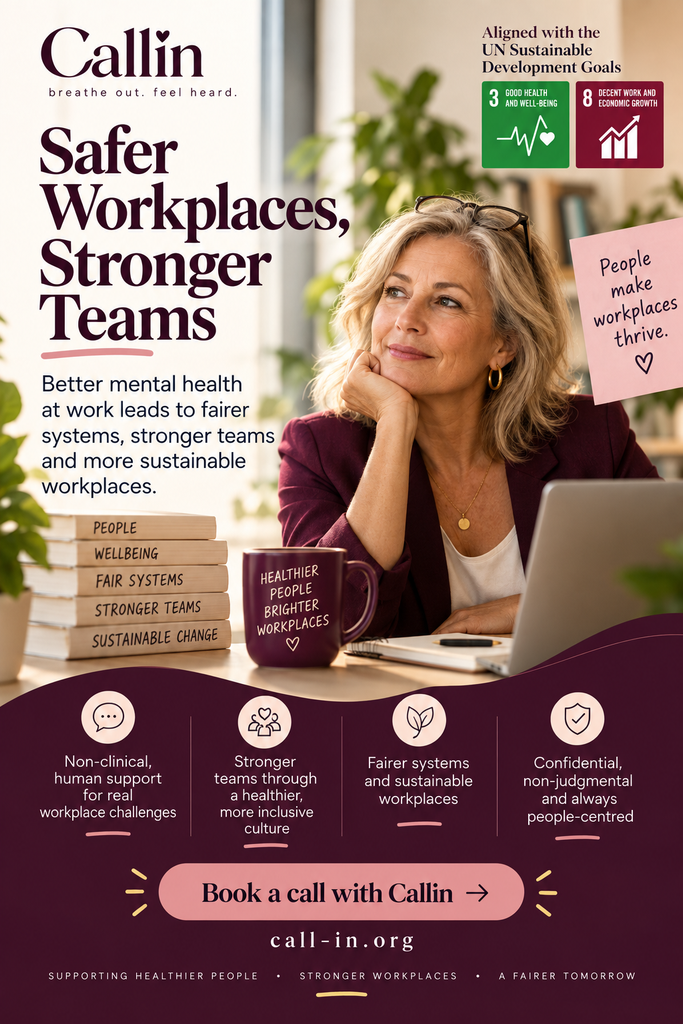
Relevant UN Sustainable Development Goals: SDG 3, Good Health and Well-Being, and SDG 8, Decent Work and Economic Growth.
Leave a Reply