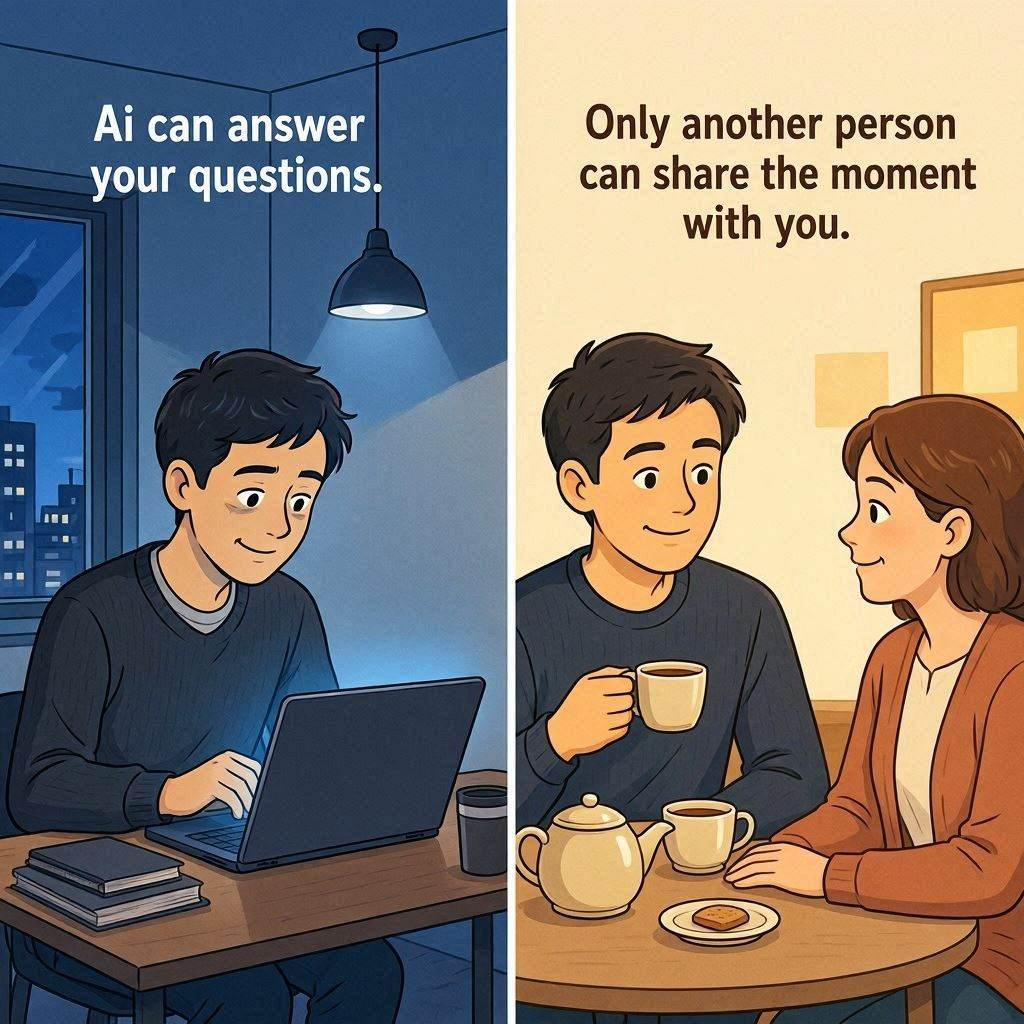
Can AI replace human connection? Not really, and not because artificial intelligence isn’t impressive. It can write, diagnose, and even sound remarkably empathetic. But real human connection depends on something no model can generate: one nervous system responding to another, in real time, with real stakes. That instinct is not a flaw in your wiring. It is the whole point.
Key Takeaways
- AI can imitate the words of empathy, but not the nervous-system-level resonance that happens when two real people connect.
- Human support carries real risk. When someone shows up for you, they are spending real time and a bit of their own emotional safety.
- No AI has lived your specific life, which is why human advice can hold a kind of wisdom a statistical average never will.
- The most healing thing a person can offer is often not a solution, but unhurried presence, something optimization-built systems were never designed to give.
- Wanting a real human to talk to is not a weakness. It is one of the most well-documented human needs we have.
Why This Question Refuses to Go Away
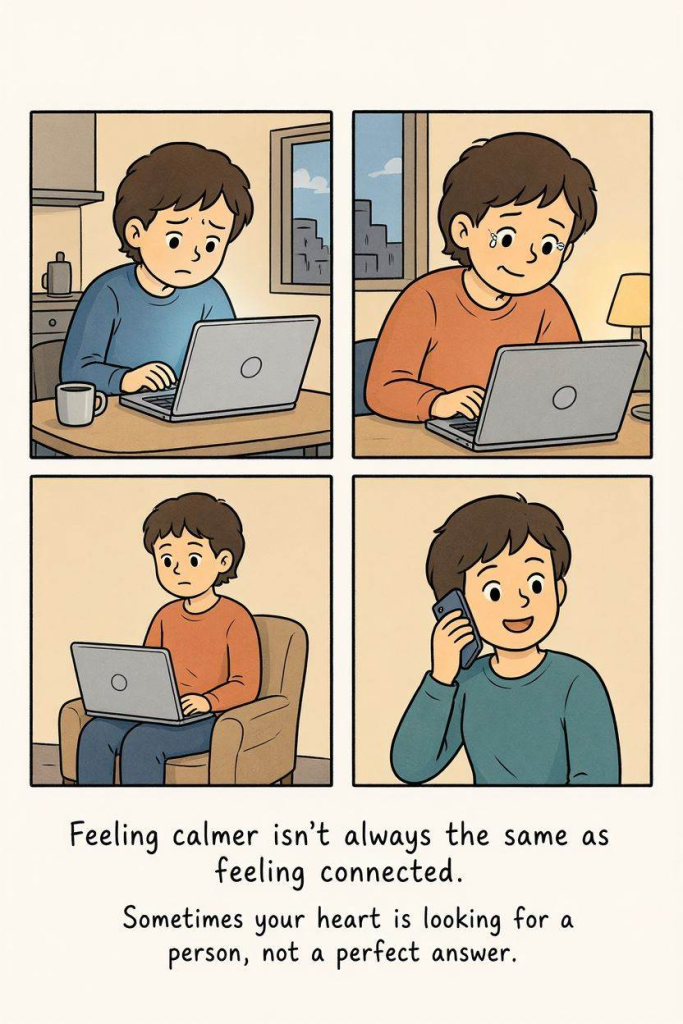
Every year, AI gets better at sounding like it cares. It can draft a eulogy, help you steady your breathing during a panic wave, and generate a sympathy card message faster than you can find a pen that actually works. Yet once the impressive demo ends, plenty of people still close the chat window and call a friend instead.
Researchers have been tracking a quieter story running alongside all this progress. Institutions from Harvard to the CDC have spent years documenting how loneliness affects health, even as our devices have become smarter and more available than ever. That gap between capability and comfort is not nostalgia. It is worth taking seriously instead of explaining away.
Your Nervous System Knows the Difference
Long before language, humans read each other through the body. A shift in someone’s breathing, a flicker at the corner of their eyes, the exact pitch that makes a sentence sound safe rather than sarcastic, all of it gets processed almost instantly and mostly without effort.
Scientists sometimes call this limbic resonance, the way two nervous systems sync up when people are genuinely present with one another. It is part of why a phone call from someone who loves you can slow your heart rate in a way a perfectly worded paragraph cannot.
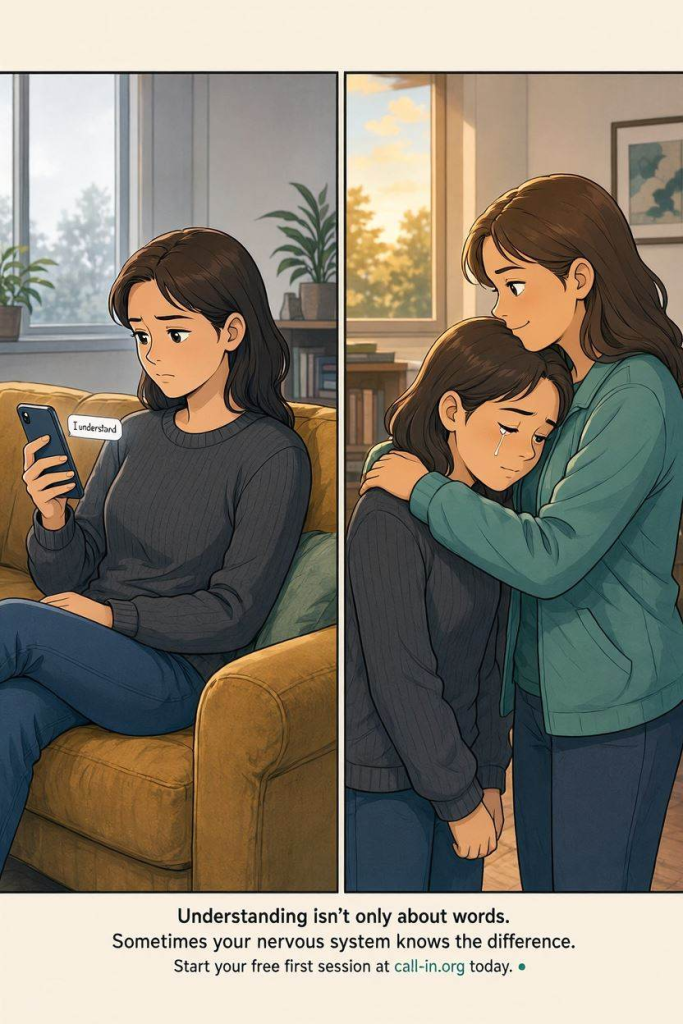
This is also why texting can feel strangely hollow even when the words are exactly right. You can read “I understand” a hundred times and still feel unseen, because understanding was never just about the words.
If a text thread has ever left you flatter than a five-minute phone call, you are not imagining it, and it says a lot about why texting can’t fully replace real conversation. AI can write a flawless sentence of comfort, but it has no breath to catch and no body listening on the other end.
Humans Have “Skin” in the Game

When a friend sits with you through a hard week, they are not running a background process. They are spending hours they will never get back, and taking a small emotional risk by staying close to your pain.
If they share their own failure to make you feel less alone, they are handing you something they cannot take back. AI, on the other hand, can generate a heartfelt response for a million people at once without losing a second of its own existence, which sounds efficient until you remember efficiency was never really the point of comfort.
There is something almost funny about asking a system with zero stakes to reassure you about a situation that has very high stakes for you. It is a bit like asking someone who never gets tired to explain exhaustion.
That mismatch is part of why ongoing, consistent emotional support from an actual person tends to matter more over time than any single well-written reply, however comforting it feels in the moment.
Nobody Else Has Lived Your Exact Life
AI is trained on an enormous archive of human writing, which makes it excellent at telling you what people in general tend to do. It is, in a sense, trained on humanity’s collective group chat.
But your life was never general. It was shaped by a specific childhood and choices nobody else would have made in your exact position.
That specificity is exactly why another person can sometimes say something an algorithm never would, not because they are smarter, but because they have stumbled through something similar and found their own strange way out.
Some researchers argue we need a broader definition of intelligence altogether, one that accounts for this kind of lived, embodied wisdom rather than pattern recognition alone.
A good peer listener is not reciting the statistical average of human advice. They are offering the specific, occasionally messy wisdom of someone who has actually been somewhere dark and made it back.
Presence Beats Productivity
AI is built to optimize, which is wonderful when you need directions or a spreadsheet fixed, and less wonderful when you are grieving. Grief, burnout, and identity crises rarely respond well to five bullet-pointed action steps. Sometimes what a person actually needs is for someone to sit with the mess without rushing to tidy it up.
This becomes especially clear for anyone whose sense of worth has quietly become tied to how much they produce in a day, a pattern worth examining on its own.
Constant pings do not help either, since a phone that never stops buzzing keeps the nervous system slightly on edge, which is worth understanding on its own terms, notifications included.
A human companion willing to sit in unhurried silence with you is doing something a productivity-obsessed system was never built to value: nothing, on purpose, entirely for your benefit.
Where This Leaves You
None of this means AI is useless, or that reaching for a chatbot at one in the morning makes you a bad or broken person. It simply means AI and human connection solve different problems, and mixing the two up is often where people end up feeling more isolated, not less.
If AI emotional support leaves you briefly calmer but not actually less alone, that is a well-documented pattern, not a personal failing.
A lot of people want an outlet that sits somewhere between calling a therapist and calling their already-exhausted best friend, a place to say the unfiltered version of things without worrying about being a burden.
That is the space Callin was built for: a confidential, non-clinical place to talk things through with a trained peer listener, at your own pace, with no diagnosis or therapy appointment required. It will not replace therapy, and it is not trying to. It is simply a real person on the other end, willing to listen.
Frequently Asked Questions
Can AI actually understand what I’m feeling?
AI can recognize patterns in language associated with emotions and respond in ways that sound understanding. It has no subjective experience, nervous system, or body, so what looks like understanding is closer to sophisticated pattern matching than genuinely feeling something alongside you.
Is it bad to talk to an AI chatbot when I’m upset?
Not inherently. Many people find it useful for organizing their thoughts or getting through a rough moment late at night. Problems tend to show up when AI becomes a full substitute for human contact rather than an occasional bridge toward it.
What’s the real difference between AI support and talking to a person?
A person brings a body that physically responds to yours, genuine vulnerability, and a life shaped by hardship similar to your own. AI brings speed, availability, and consistency, which are useful, just entirely different qualities.
Can AI ever fully replace therapy or peer support?
Most researchers and clinicians view AI as a supplement rather than a replacement. Therapy and peer support rely on relational trust and human judgment that current AI systems are not built to provide.
Why do I still feel lonely after talking to an AI for hours?
This is common, and it reflects the gap between feeling heard and feeling known. AI can respond accurately without ever actually knowing you, and that gap tends to surface once the conversation ends and the quiet sets back in.
Is wanting a real human to talk to a sign something is wrong with me?
No. Wanting genuine connection is one of the most consistently documented human needs in psychology research. Noticing you want more than an algorithm can offer is a sign of self-awareness, not weakness.

Leave a Reply