
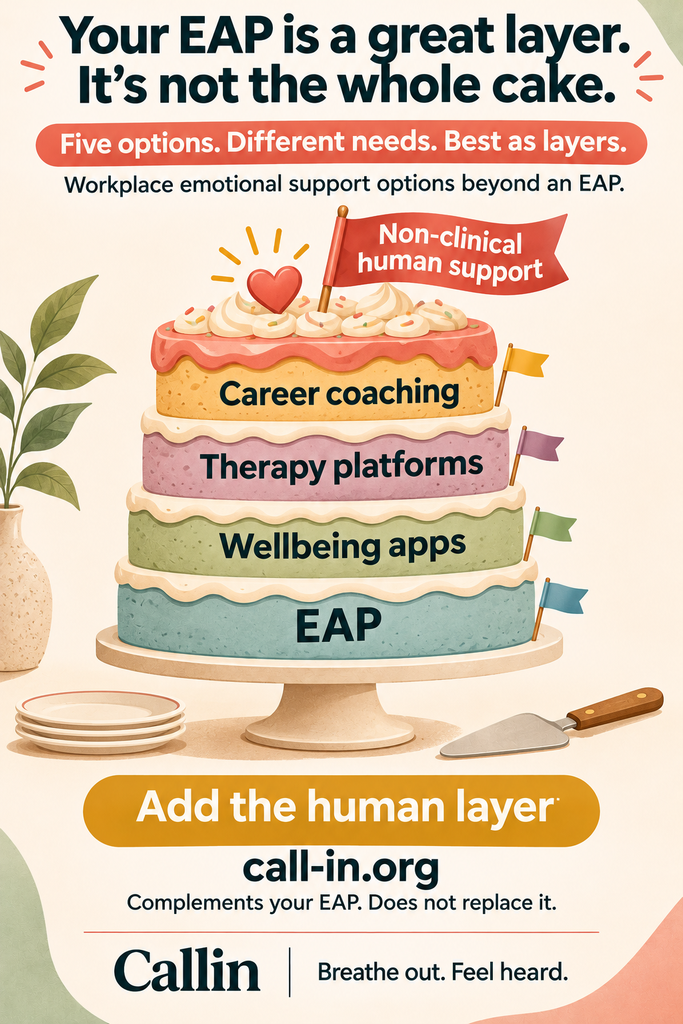
Beyond an Employee Assistance Programme (EAP), employers can usually choose from four other broad options: meditation and wellbeing apps, therapy platforms, non-clinical human support, and career coaching.
Each serves a different need, from self-guided resources to professional therapy, confidential listening and career direction. Many organisations find these work best as complementary layers, chosen around their people’s needs, rather than as one single benefit.
Definition: Workplace emotional support options are the services an employer can fund or signpost so that employees have somewhere appropriate to turn when work or life feels heavy.
Definition: An Employee Assistance Programme (EAP), spelled Employee Assistance Program in the US, is an employer-funded service providing employee assistance, often including counselling and other support.
A quick boundary before we begin. Callin is a non-clinical emotional support service. It is not therapy, counselling, diagnosis, medical care, or crisis or emergency support. If anyone is in immediate danger, they should contact local emergency services, or find a free crisis line in their country at findahelpline.com.
Key takeaways
- An EAP is one important layer of workplace support, and it is rarely the only option available to employers.
- Five broad option types exist: EAPs, meditation and wellbeing apps, therapy platforms, non-clinical human support, and career coaching.
- Each option answers a different need, so comparing them on price or features alone can miss the point.
- The options can work together as an ecosystem, with clear routes between self-guided, human, clinical and developmental support.
- Confidentiality, data handling, safeguarding and clinical pathways deserve as much scrutiny as session counts.
- Measurement works best when it respects privacy, using aggregate, anonymised indicators rather than individual tracking.
- Callin’s distinguishing feature is Human Continuity™, which prioritises keeping people with the same trained listener or coach wherever possible.
At a glance: the five workplace support options
- Employee Assistance Programme (EAP): employee assistance, often including counselling and other support.
- Meditation and wellbeing apps: self-guided resources and programmes.
- Therapy platforms: access to professional therapeutic services.
- Non-clinical human support: confidential conversations, listening, ongoing emotional support.
- Career coaching: professional development, career direction, accountability.
Why are employers looking beyond the Employee Assistance Programme?
Many employers and managers are looking beyond the EAP because their people’s needs are broad, and no single service is designed to cover all of them. This is not a judgement on EAPs. It reflects a wider recognition that workplace mental health is shaped by work design, management, life events and career pressure, not only by access to counselling.
The World Health Organization’s fact sheet on mental health at work estimates that 12 billion working days are lost globally every year to depression and anxiety, at a cost of US$1 trillion per year in lost productivity. The same fact sheet notes that decent work is good for mental health, while poor working environments pose a risk to it.
The WHO guidelines on mental health at work cover organisational interventions, manager training, worker training, individual interventions, return to work and gaining employment. The joint WHO and ILO Mental health at work: policy brief offers a practical framework for putting those recommendations into action. Read together, they suggest that support for individuals is one part of a wider strategy, not a substitute for it.
In the UK, the CIPD Health and wellbeing at work survey reports that 64% of organisations are taking steps to identify or reduce workplace stress, but only 50% believe their efforts are effective. That gap is one reason buyers are asking what else might sit alongside the services they already fund.
If you want a primer on how EAPs themselves work, our guide What Is an Employee Assistance Program (EAP) and How Does It Work? covers the basics. This article focuses instead on the wider landscape from a buyer’s perspective.
What are the main workplace emotional support options?
The five main options are EAPs, meditation and wellbeing apps, therapy platforms, non-clinical human support, and career coaching. Each is described below using the same four headings, so you can scan and compare them side by side without a table.
Provider offerings vary widely within each category. Treat these descriptions as a starting map, and confirm the detail with any provider you speak to.
Employee Assistance Programme (EAP)
What it is: Employee assistance, often including counselling and other support.
Often includes: Depending on the provider and contract, this may include short-term counselling, telephone advice lines, practical information on topics such as money or legal matters, manager consultations and critical incident support. In the UK, EAPA UK describes itself as the UK voice of the employee assistance field and promotes standards of practice for EAP provision.
May suit: Organisations wanting a broad, established framework of support that covers many types of issue, often with clinical and advisory elements under one contract.
Questions to ask a provider: What is included as standard and what costs extra? How are counselling sessions allocated, and what happens after they are used? What usage reporting do we receive, and how is it anonymised? How do employees in different countries and time zones access it?
Meditation and wellbeing apps
What it is: Self-guided resources and programmes.
Often includes: Guided meditations, breathing exercises, sleep content, courses, mood tracking, educational articles and sometimes group sessions or digital coaching features, depending on the product.
May suit: Workforces that value flexibility and privacy, people who prefer to work through things independently, and organisations wanting a scalable, always available resource for everyday wellbeing habits.
Questions to ask a provider: What content is included, and how often is it updated? Is the evidence behind the programmes published? What personal data does the app collect, and where is it stored? Does it signpost clearly to human or clinical support when someone needs more?
Therapy platforms
What it is: Access to professional therapeutic services.
Often includes: Sessions with qualified therapists or counsellors by video, phone or messaging, matching processes, structured therapeutic approaches and, on some platforms, assessment or referral routes.
May suit: Employees who need psychological treatment or structured therapeutic work from an appropriately qualified professional, and employers wanting a dedicated clinical layer with clear professional standards.
Questions to ask a provider: How are clinicians qualified, registered and supervised in each country we operate in? How quickly can employees typically be seen? How are clinical records held, and who can access them? How does the platform handle risk and escalation?
Non-clinical human support
What it is: Confidential conversations, listening, ongoing emotional support.
Often includes: One-to-one conversations with trained listeners by voice, video or chat, with a focus on being heard rather than being diagnosed or treated. Good services in this category have clear boundaries, safeguarding protocols and signposting to clinical or crisis help when needed. Our explainers on non-clinical mental health support and what a listening service is go into more depth.
May suit: Employees carrying everyday pressure, loneliness, change or overthinking who want to talk to a real person without entering a clinical relationship. It can also suit people who are not sure what kind of help they need yet.
Questions to ask a provider: How are listeners selected and trained? What are the boundaries of the service, and how are they explained to users? What safeguarding and signposting procedures are in place? Can employees speak with the same person over time?
Career coaching
What it is: Professional development, career direction, accountability.
Often includes: One-to-one coaching on goals, transitions, confidence at work, decision making and progress tracking. Some services also offer accountability support for study or professional development.
May suit: Employees facing promotion, role change, return to work, career uncertainty or a stalled sense of direction, where the pressure is as much about the future as about feelings in the moment.
Questions to ask a provider: How are coaches trained and supervised? How is the coaching scope kept distinct from therapy? Is the content of sessions kept confidential from the employer? How are goals agreed without turning coaching into performance management?
How do these options work together as an ecosystem?
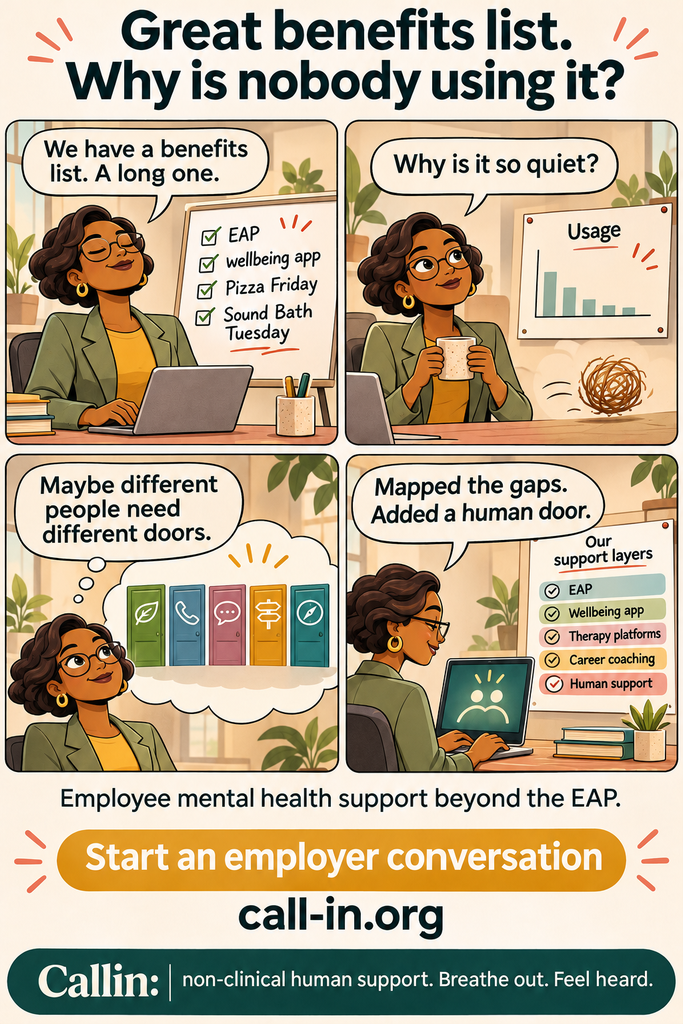
These options tend to work best as layers that point to one another, rather than as rivals on a benefits list. A wellbeing app can support daily habits, a listening service can offer a human conversation, career coaching can address direction, an EAP can provide broad assistance, and a therapy platform can provide clinical care.
The most important design question is often the space between layers. If an app user needs a person, where do they go? If a listener notices that someone may need clinical help, how is that signposted? If a coaching conversation surfaces something emotional, what route exists?
Our article on therapy, coaching or emotional support explains these differences from an individual’s point of view. For employers, the aim is similar: a clear map, so people can find the right door without needing to understand the whole system first.
None of these layers replaces the organisational work the WHO guidelines describe, such as manager training and healthier work design. Our piece on why workplace stress needs more than wellness programmes explores this further.
How should you choose or combine workplace support options?
Start with your people’s needs, then test each option against engagement, confidentiality, data, safeguarding, clinical pathways and measurement. The right mix is likely to differ between a ten-person startup, a global remote team and a large regulated employer.
Needs
Look at what your people are actually carrying. Anonymous pulse surveys, exit interview themes, absence patterns and conversations with employee networks can all help. Needs might range from everyday stress and isolation to career uncertainty or diagnosed conditions, and each points to a different layer.
Engagement
A benefit only helps if people feel able to use it. Consider format (voice, video, chat or self-guided), time zones, how easy the first step is, and whether employees trust that it is genuinely separate from management. Communication matters too, including reminders that come from leaders who talk openly about using support.
Confidentiality
Ask every provider exactly what the employer can and cannot see. Employees may hesitate if they suspect that their manager, HR or a future employer could learn what they discussed. Clear, plain-language confidentiality statements tend to help more than long legal documents.
Data
Check where data is stored, which privacy laws apply, whether records are created, how long anything is retained and whether data is shared with third parties. For distributed teams, ask how the provider handles different jurisdictions.
Safeguarding
Every option should have a clear answer to the question: what happens if someone is at risk? Non-clinical services should be explicit that they are not crisis services and should signpost promptly. Apps and coaching services need clear routes to urgent help too.
Clinical pathways
Map how someone moves from a non-clinical or self-guided layer into clinical care if they need it. That might be through the EAP, occupational health, a therapy platform or public health services, depending on your country. In the UK, the CIPD survey reports that occupational health services are offered by 69% of employers, rising to 86% in organisations with 250 or more employees.
Measurement
Agree in advance how success will be judged, and keep it privacy-respecting. Aggregate, anonymised indicators such as uptake, return visits, satisfaction and themes are usually more appropriate than anything identifying individuals. Be cautious of any provider promising specific outcomes or savings, since results depend on many factors outside any one service.
What questions should you ask any workplace support provider?
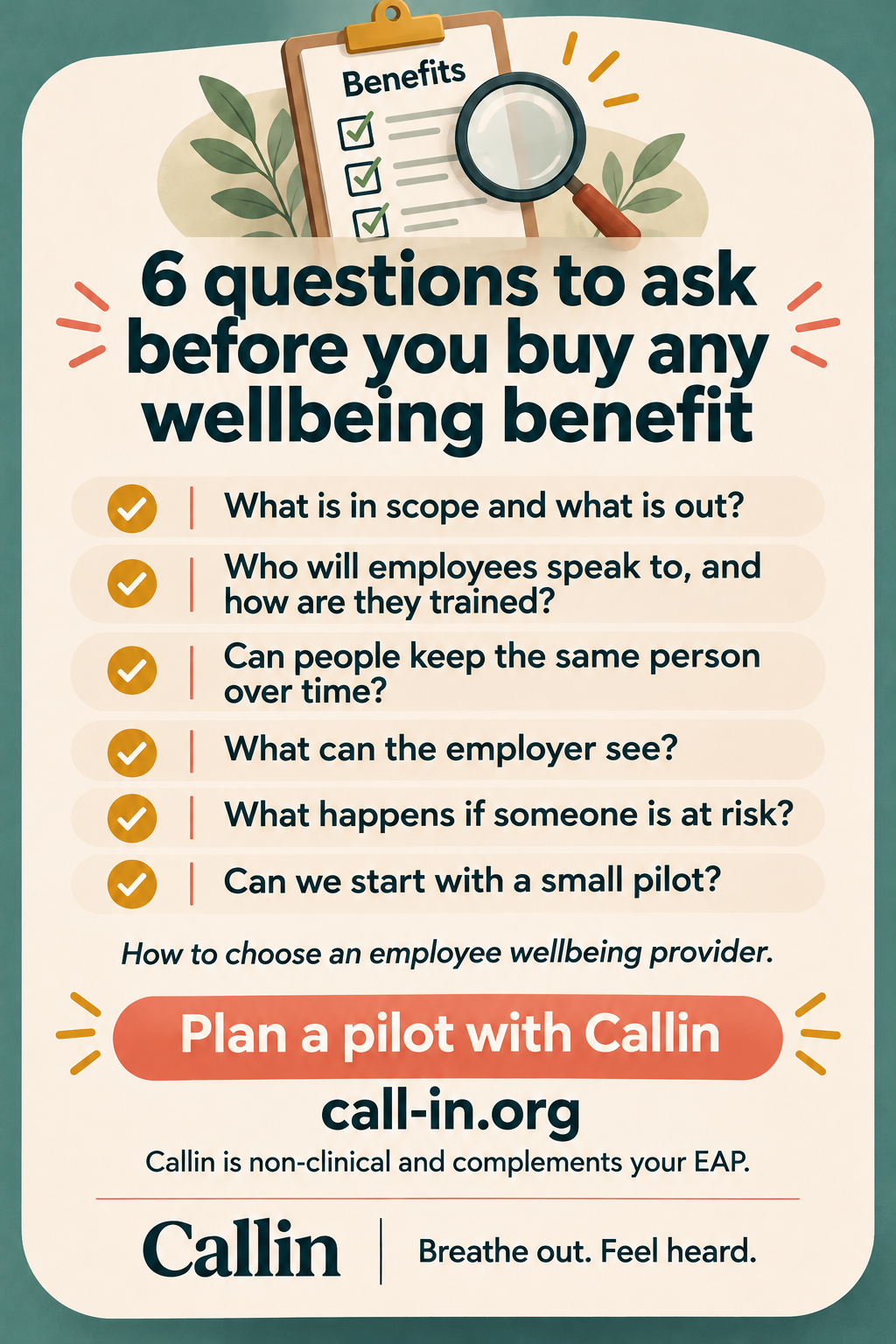
Whatever the category, a short set of shared questions can make comparisons fairer. These sit alongside the option-specific questions above.
- What exactly is in scope, and what is explicitly out of scope?
- Who will employees speak to, how are they trained and how are they supervised?
- Can employees continue with the same person over time, or are they matched afresh each time?
- What can the employer see, and in what form?
- What personal data is collected, where is it stored and is it shared?
- What happens if someone discloses risk, or needs clinical or emergency help?
- How does the service fit alongside our EAP, occupational health and HR processes?
- What reporting will we receive, and how is individual privacy protected?
- Can we start with a defined pilot before committing to a longer arrangement?
For smaller organisations, our guides on setting up mental health support in a small company, choosing an EAP for a startup or small business and EAP cost per employee cover budget and sizing questions in more detail.
Where does Callin fit in this landscape?
Callin sits in the non-clinical human support and career coaching layers. We provide confidential, one-to-one online support with trained human listeners by voice, video or private chat, alongside career coaching and student or accountability coaching, for adults aged 18 and over worldwide.
What distinguishes Callin is Human Continuity™. Callin prioritises keeping people with the same trained listener or coach wherever possible, so they do not have to restart their story each time. For some people, being remembered can make it easier to keep talking, and our article on the benefits of consistent emotional support explores why.
According to our About page, all Callin listeners complete Johns Hopkins University Psychological First Aid training and follow Callin’s active listening workbook and internal protocols on boundaries, safeguarding and signposting. Callin does not create clinical records, as explained in our FAQ and privacy policy.
Callin is designed to complement, not replace, an organisation’s EAP, occupational health, counselling or emergency responsibilities. Eligible new clients can try a free first session, and you can read what happens in a Callin first session before suggesting it to your team. Details for employees are on our workplace mental health support for employees page, and our career coaching for professionals page covers the coaching layer.
Does a human or a digital layer matter more?
Neither matters more in general. Digital tools offer scale, flexibility and privacy, while human support offers conversation, nuance and a sense of being heard. Many people use both at different times.
Our article on AI vs human emotional support looks at where each can help. For buyers, the practical question is whether your mix gives people a route to a real person when a self-guided tool is not enough.
How does early support fit with prevention?
Support offered before pressure builds can sit naturally within a preventive approach. The WHO guidelines include individual interventions alongside organisational ones, which suggests both have a role.
Our explainer on preventive emotional care describes why talking things through early may help some people, while recognising that it cannot fix workload or management problems. Those still need organisational action.
How does this article differ from our other EAP guides?
This guide is a buyer’s map of five option types and how to combine them. Our EAP vs mental health app vs online therapy vs emotional support article helps decide which type suits employees, and our EAP explainer covers how EAPs work. Together they form a fuller picture.
What is a sensible next step for decision-makers?
A sensible next step is to map what you already offer against the five layers, note any gaps, and talk to providers with the shared questions in hand. You do not need to change everything at once.
If non-clinical human support or career coaching looks like a gap, you are welcome to start an employer conversation or discuss a pilot with Callin. There is no pressure to commit, and we are happy to talk about whether Callin is a good fit for your organisation at all.
Frequently asked questions
What are the alternatives to an Employee Assistance Programme?
The main options beyond an Employee Assistance Programme are meditation and wellbeing apps, therapy platforms, non-clinical human support and career coaching. Many employers use them alongside an EAP rather than instead of one, because each serves a different need.
Is an Employee Assistance Program the same as an Employee Assistance Programme?
Yes. Employee Assistance Program is the US spelling and Employee Assistance Programme is the British spelling. Both describe employee assistance, often including counselling and other support.
Can a small business offer workplace emotional support without an EAP?
Yes. Smaller organisations can choose from wellbeing apps, therapy platforms, non-clinical human support or career coaching depending on needs and budget. Whatever they choose, clear routes to clinical and emergency help remain important.
What is non-clinical human support at work?
Non-clinical human support offers confidential conversations, listening and ongoing emotional support with trained people. It does not diagnose or treat mental health conditions, and it should signpost to clinical or crisis services when needed.
How should employers measure a workplace wellbeing benefit?
Employers can agree aggregate, anonymised indicators such as uptake, return use and satisfaction before launch. Measurement should protect individual confidentiality and avoid expecting any single service to guarantee outcomes.
Is Callin a replacement for an EAP?
No. Callin is a non-clinical emotional support and coaching service that can complement an EAP, occupational health, counselling and emergency arrangements. It is not therapy, counselling, diagnosis, medical care or crisis support.
What should someone do in a mental health emergency?
They should contact local emergency services straight away or use a crisis line in their country, which can be found at findahelpline.com. Non-clinical services such as Callin are not designed for emergencies.
Most relevant UN Sustainable Development Goals
- SDG 8: Decent Work and Economic Growth. A thoughtful mix of workplace support options can be part of building decent, sustainable working environments. See UN SDG 8.
- SDG 3: Good Health and Well-being. Accessible emotional support and clear pathways to clinical care can contribute to wider wellbeing. See UN SDG 3.
Read more in Workplace Wellbeing and UN SDGs: Callin Support’s Guide for Employers.
Sources and further reading
All sources below returned HTTP 200 when checked on 10 November 2026.
- World Health Organization. Mental health at work, fact sheet. Source of the 12 billion working days and US$1 trillion estimates.
- World Health Organization. Guidelines on mental health at work (2022).
- World Health Organization and International Labour Organization. Mental health at work: policy brief (2022).
- CIPD (UK). Health and wellbeing at work survey. UK employer data on stress management and occupational health provision.
- EAPA UK. UK Employee Assistance Professionals Association.
- Find A Helpline, free international directory of crisis lines.
- United Nations. SDG 8 and SDG 3.
- Callin. Affordable therapy alternatives and support options and Non-Clinical Mental Health Support.
Leave a Reply