A small company can provide meaningful mental health support without having a large HR department, an expensive corporate wellness programme or a complicated benefits package.
The best place to start is with the people who actually work there.
Understand what is causing stress. Look at workload and management practices. Give employees clear ways to access support. Train managers to respond appropriately. Make confidentiality easy to understand. And create a workplace culture where asking for help is not treated as a failure.
Mental health support for employees should not simply help people cope with unhealthy workplaces. It should also help companies identify and address the conditions creating unnecessary stress in the first place.
This guide explains how small businesses and startups can build a practical employee mental health support programme, including EAPs, confidential emotional support, workplace wellbeing policies, manager training, burnout prevention and affordable mental health benefits.
Key Takeaways
- Start with the workplace, not the wellness product. Identify workload, management, communication and other sources of workplace stress before deciding what support to buy.
- Small companies can build support gradually. You do not need every possible mental health benefit on day one.
- An EAP is an option, not a requirement. Compare Employee Assistance Programmes with other forms of employee mental health support.
- Managers need practical training. They should know how to listen, respond appropriately and signpost employees without attempting to become therapists.
- Confidentiality determines trust. Employees need to understand who can see their information and what happens when they access support.
- Mental health support should include prevention. Look at workload, boundaries, psychological safety, management practices and workplace culture.
- Measure whether people can actually use the support. Awareness, accessibility, trust and employee experience matter just as much as usage numbers.
How Can a Small Company Support Employee Mental Health?
A small company can support employee mental health by combining healthier working practices with accessible, confidential support.
This can include:
- Employee Assistance Programmes
- confidential emotional support
- therapy or counselling benefits
- manager mental health training
- workplace wellbeing initiatives
- mental health policies
- burnout prevention
- flexible working arrangements
- peer support
- wellbeing resources
- clear routes to professional and emergency support
The right combination depends on the company.
A five-person startup does not necessarily need the same programme as a 500-person organisation.
The important question is:
What are our employees actually struggling with, and what would make getting support easier?
If employees are exhausted because deadlines are unrealistic, the answer is not another wellness app.
If employees are lonely because they work remotely, the solution may include meaningful human connection.
If managers do not know how to respond when an employee says they are struggling, manager training may be one of the most valuable interventions.
Start with the problem.
Then choose the support.
Where Should a Startup Begin With Employee Mental Health Support?
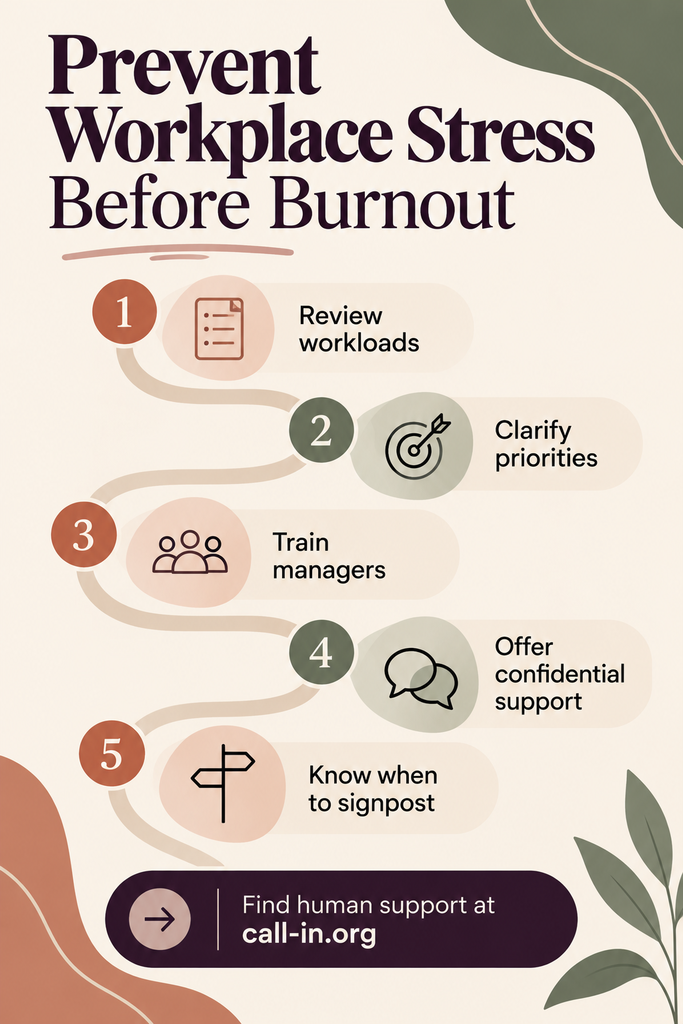
Start by understanding the experience of your employees.
Ask about:
- workload
- working hours
- role clarity
- management
- communication
- workplace relationships
- psychological safety
- remote working
- boundaries
- access to existing benefits
- barriers to asking for help
You can use anonymous surveys, employee listening sessions, one-to-one conversations or a combination of approaches.
Useful questions include:
What creates the most stress in your working week?
Do you feel comfortable telling your manager when you are struggling?
Do you know what mental health support is available to you?
Would you know where to go if you needed someone to talk to?
What would make accessing support easier?
What is one thing we could change to improve employee wellbeing?
Do not collect information you do not need, and do not promise anonymity unless your process genuinely provides it.
The purpose is not to investigate employees’ private lives.
It is to understand the workplace.
What Mental Health Benefits Should a Small Company Offer?
There is no universal list of benefits that every small company should provide.
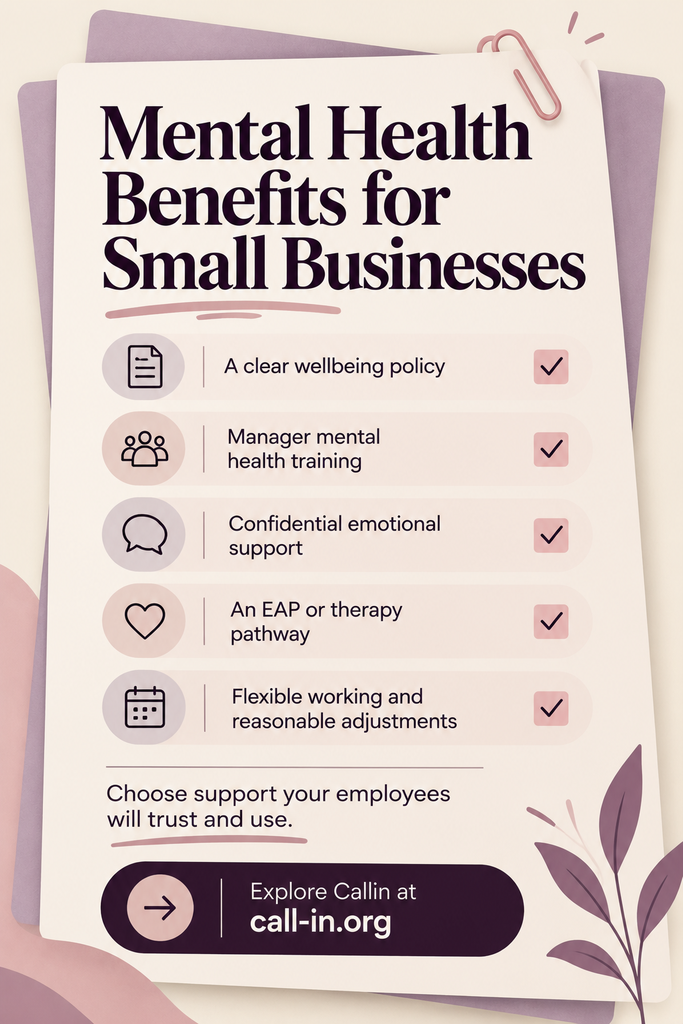
A practical employee mental health programme can include several layers.
Healthy work practices
Start with workload, working hours, responsibilities, communication and expectations.
Manager support
Give managers practical training so they can have appropriate conversations and signpost employees to support.
Confidential emotional support
Give employees somewhere they can talk privately about stress, burnout, loneliness, difficult relationships and other emotional challenges.
Clinical support
Where appropriate, provide routes to qualified therapists, counsellors, healthcare professionals or other specialist services.
Workplace policies
Create clear policies covering mental health, workplace stress, absence, flexible working, reasonable adjustments where applicable and returning to work.
Crisis procedures
Make sure managers know what to do if someone requires urgent or emergency support.
Social connection
Consider how employees build relationships and maintain connection, particularly in remote and hybrid teams.
You do not need to introduce everything simultaneously.
Build according to need.
What Is the Best Mental Health Support for a Small Business?
The best mental health support for a small business is the support that addresses the needs of its employees, fits the company’s resources and is actually accessible.
When comparing providers or programmes, consider:
- cost
- confidentiality
- accessibility
- availability
- employee eligibility
- type of support
- geographic coverage
- remote access
- provider qualifications
- escalation procedures
- data protection and privacy
- whether the service complements existing benefits
Do not choose a provider simply because it has the longest list of features.
A smaller, focused service that employees trust and actually use can be more valuable than an enormous benefits platform that nobody understands.
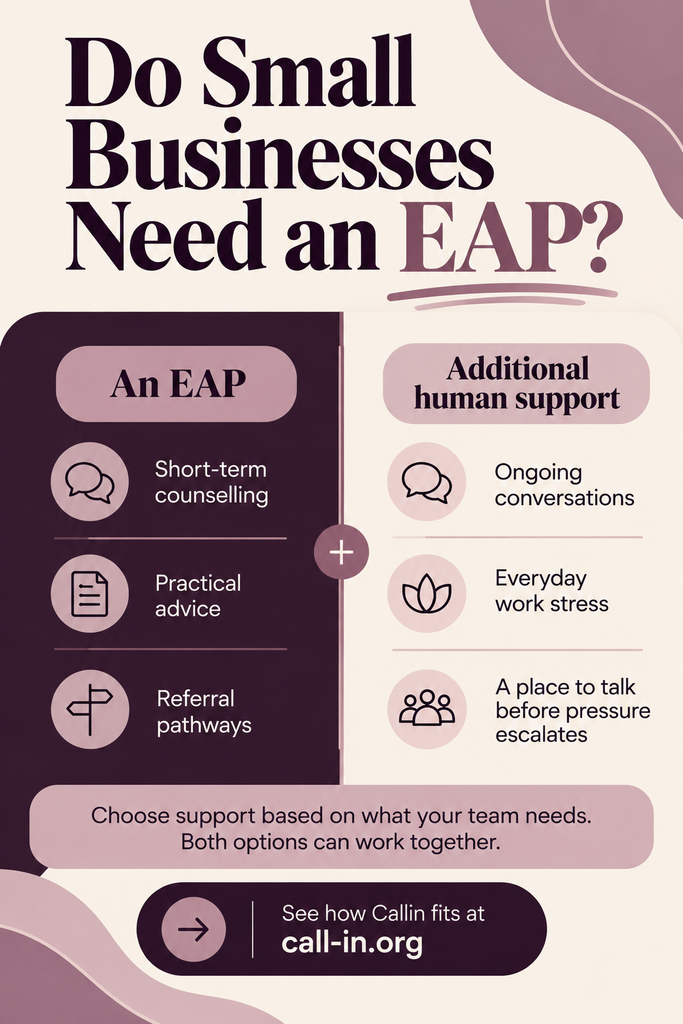
Does a Small Company Need an Employee Assistance Programme?
No.
An Employee Assistance Programme can be useful, but it is only one approach to workplace mental health support.
An EAP may provide services such as counselling, practical advice, referrals and other employee assistance services. What is included varies between providers and countries.
Before choosing one, ask:
What does the EAP actually provide?
How many employees can access it?
How quickly can someone receive support?
How many sessions are included?
Is support available remotely?
What information is shared with the employer?
What happens if someone needs longer-term or specialist care?
Can employees access support internationally if the company has a distributed workforce?
That final question is particularly important for global startups.
A company with employees across several countries may need to think about language, local healthcare systems, time zones, availability and country-specific requirements.
An EAP is a tool.
It is not the definition of workplace mental health support.
How Can Small Businesses Provide Mental Health Support on a Budget?
Start with the interventions that address the biggest problems.
You do not need to spend thousands of pounds, dollars or euros before you can begin improving workplace wellbeing.
A small business can:
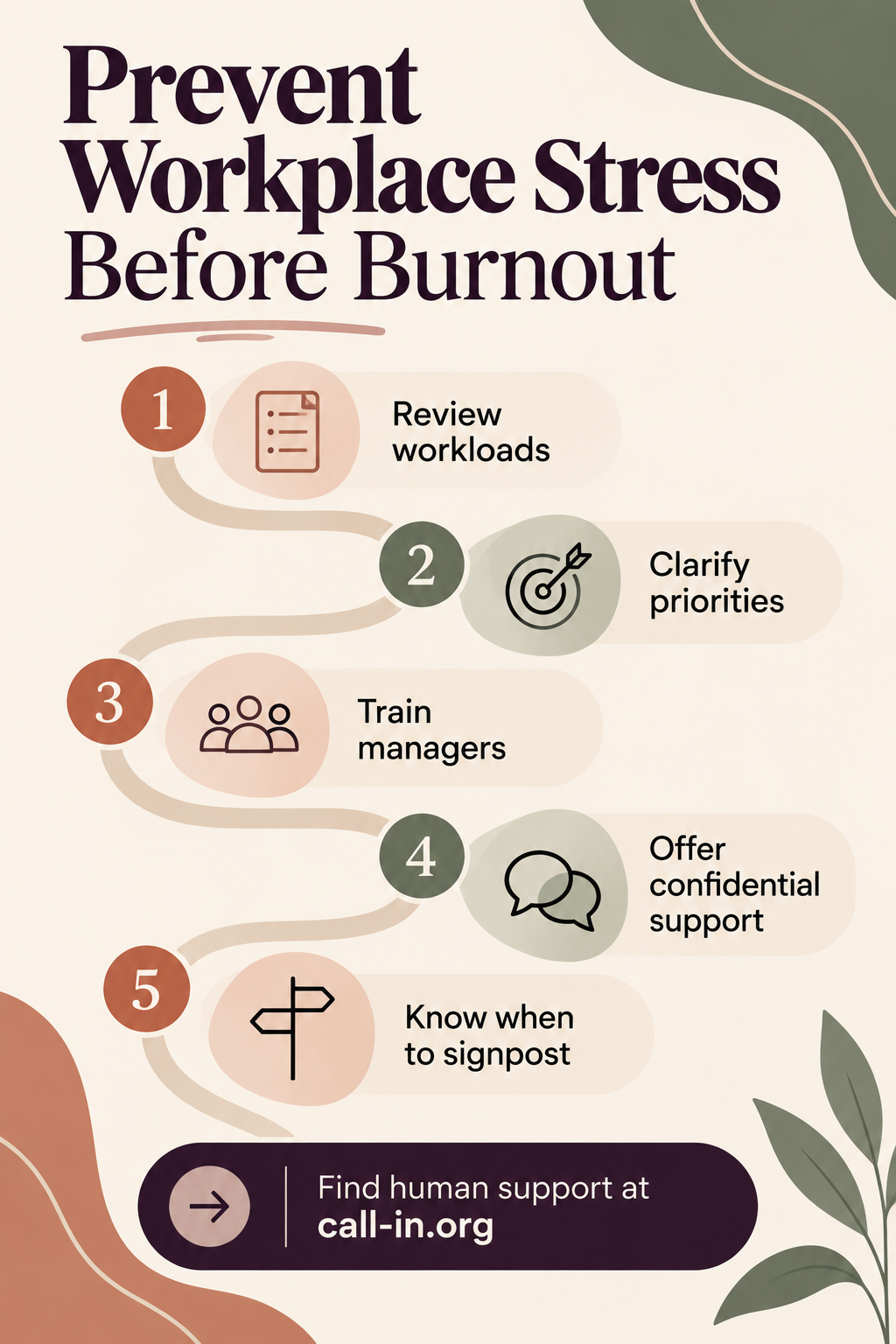
- Review workloads and unrealistic deadlines.
- Establish clearer boundaries around working hours.
- Train managers to have supportive conversations.
- Create a simple mental health policy.
- Make existing healthcare and support benefits easier to understand.
- Provide confidential support employees can access without going through their manager.
- Create clear signposting to professional and emergency services.
- Regularly ask employees what support they actually need.
This is particularly important for startups.
A company can have a tiny HR budget and still create a culture where employees know they are allowed to say:
“I’m struggling.”
That sentence can be more valuable than an expensive wellbeing platform if nobody feels safe enough to use the platform.
Should a Small Company Offer Mental Health Days?
Part of showing concern for your team includes giving benefits. Not just saying “we’re family.” Mental health days can form part of an employee wellbeing strategy, but they should not be used as a substitute for addressing unhealthy working conditions.
If your company introduces mental health days, explain:
- who is eligible
- how they are requested
- whether they are additional or part of existing leave
- how privacy is handled
- whether employees need to provide information
- how managers should respond
- how the policy interacts with applicable employment and leave requirements
Most importantly, look at why employees need the time off.
If everybody needs a mental health day every few weeks because the workload is unsustainable, the problem may not be a lack of leave.
It may be the workload.
What Is a Mental Health Stipend for Employees?
A mental health stipend is an employer-funded allowance that employees can use towards specified wellbeing or mental health-related expenses.
Depending on the company’s policy, this could include approved wellbeing services, subscriptions or other forms of support.
If you introduce one, clearly define:
- what expenses qualify
- the amount available
- how employees claim it
- whether receipts are required
- how frequently it can be used
- how the benefit is treated for tax and payroll purposes
Tax treatment varies by country, so companies with international employees should obtain appropriate local advice.
A stipend can provide flexibility, but it is not automatically the best solution.
One employee may want therapy.
Another may need coaching.
Another may simply want somewhere confidential to talk.
Another may need their workload changed.
Do not confuse giving someone money for wellbeing with creating a workplace where wellbeing is possible.
Should Managers Receive Mental Health Training?
Yes.
Managers should understand how to respond when an employee is experiencing stress, burnout or another mental health difficulty.
They do not need to become therapists.
They need to know how to:
- listen without judgement
- ask appropriate questions
- discuss workload
- recognise potential warning signs
- respect privacy
- avoid making diagnoses
- signpost employees to appropriate support
- understand workplace policies
- escalate serious concerns appropriately
For example:
“I’ve noticed you’ve seemed under a lot of pressure recently. How are things going, and is there anything about your workload or working arrangements we should talk about?”
is a much more useful starting point than:
“You seem stressed. You need to manage your time better.”
The manager’s job is not to solve someone’s entire life.
It is to create a safe, appropriate conversation and help the employee identify the next step.
How Do You Create a Mental Health Policy for a Small Company?
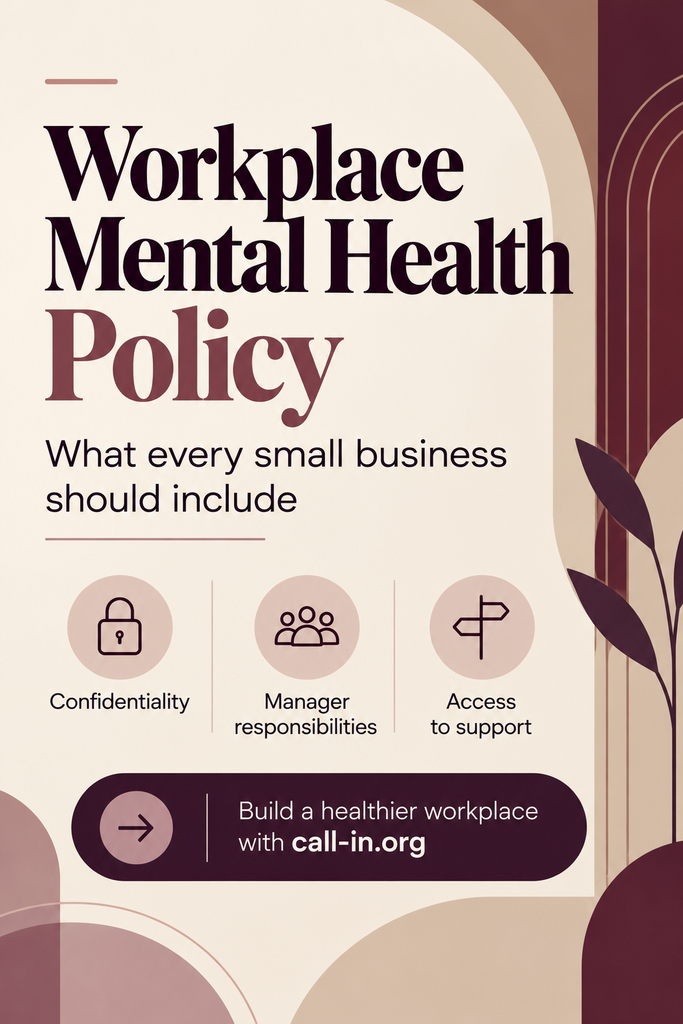
A workplace mental health policy should explain the company’s approach to employee mental health and how employees can access support.
It can cover:
- the company’s commitment to wellbeing
- how employees can raise concerns
- available mental health support
- manager responsibilities
- confidentiality
- workplace adjustments where applicable
- absence and return-to-work procedures
- bullying and harassment
- workplace stress
- professional support and referrals
- crisis procedures
- how the policy is reviewed
Keep it practical.
An employee who is already overwhelmed should not have to read 30 pages of corporate language to discover how to ask for help.
Make the policy easy to find.
Include it in onboarding.
Remind employees where it is.
Train managers on it.
And update it when the company’s support arrangements change.
What Should a Workplace Stress Policy Include?
A workplace stress policy should explain how the company identifies and addresses work-related stress.
Look at:
- demands
- control
- support
- workplace relationships
- role clarity
- organisational change
- working hours
- workload
- communication
- management practices
The exact legal requirements vary between countries, so international employers should follow the requirements applicable where their employees work.
The important principle is universal:
Do not treat workplace stress as solely an employee’s personal problem when workplace conditions are contributing to it.
If people are consistently working excessive hours, receiving conflicting instructions or operating under impossible deadlines, the organisation needs to examine those conditions.
How Do You Make Mental Health Support Confidential for Employees?
Employees need to know exactly what happens when they ask for help.
Before choosing a provider, ask:
- What information is collected?
- Who can access it?
- Can managers see individual usage?
- What information is reported to the employer?
- Is reporting aggregated?
- How is information stored?
- What privacy rights apply?
- What exceptions exist for safeguarding or emergencies?
Then communicate the answers to employees clearly.
Do not promise absolute confidentiality if the service has legitimate exceptions.
Trust is built through clarity.
An employee who thinks their manager will receive details of a private conversation may decide not to seek support at all.
How Can You Support Employees Who Do Not Want Therapy?
Not everybody who is struggling wants therapy.
And not every difficult emotional experience requires clinical treatment.
An employee might want to talk about:
- work stress
- burnout
- loneliness
- relationship problems
- career uncertainty
- difficult workplace dynamics
- low moods
- feeling overwhelmed
- personal challenges
- the pressure of constantly having to perform
Non-clinical emotional support can provide a confidential space to talk through these experiences without presenting itself as therapy or clinical treatment.
This is one area where Callin can fit naturally into a broader workplace wellbeing strategy.
Callin provides workplace mental health support for employees through confidential, one-to-one, non-clinical emotional support with trained human listeners.
Employees can talk about work stress, burnout, loneliness, low moods and difficult life experiences with a real person who listens without judgement.
Callin’s Human Continuity™ approach is designed around continuity, so employees can speak with the same listener where operationally possible rather than repeatedly explaining their situation to someone new.
Callin is a global brand and its online model is designed to support people beyond a single local workplace or country. Availability, pricing and service arrangements can vary by location.
Callin does not provide therapy, diagnosis, psychiatric care, medical treatment, crisis intervention or emergency services.
It can complement an EAP, therapy, healthcare or other appropriate professional support.
What Should You Do If an Employee Needs Therapy or Specialist Care?
If an employee needs clinical or specialist support, help them identify an appropriate route.
Depending on their location and circumstances, this may include:
- a primary healthcare provider
- a qualified therapist or counsellor
- occupational health
- a health insurance provider
- an EAP
- a relevant public healthcare service
- an appropriate specialist organisation
Managers should not diagnose employees or decide what treatment they need.
Their role is to listen, discuss relevant workplace support and signpost appropriately.
A non-clinical emotional support service should also be clear about its limits.
Good employee support includes knowing when a conversation needs to move beyond the service being offered.
What Should You Do in a Mental Health Crisis at Work?
Every company should have a clear procedure for responding to an immediate safety concern.
Managers should know:
- who to contact internally
- when to involve emergency services
- how to respond calmly
- how to protect the person’s immediate safety
- what information should be documented
- what follow-up process applies
The correct emergency and crisis response depends on the employee’s location.
For a global company, do not create a crisis procedure that assumes everyone is in the same country.
Maintain appropriate local emergency information and make sure managers know how to access it.
Non-clinical support should never be presented as emergency care.
If someone is in immediate danger, use the appropriate emergency service where they are located.
How Can You Introduce Mental Health Support Without Making Employees Uncomfortable?
Do not launch your programme with corporate language that makes mental health sound like another performance metric.
Employees do not need to hear that the company is introducing a “holistic human optimisation ecosystem.”
They need to know:
What is available?
Who is it for?
How do I access it?
Is it confidential?
What can I talk about?
What happens if I need more help?
Say that clearly.
For example:
“If work, life or something you’re dealing with is becoming difficult to carry alone, we want you to know that support is available. You can access confidential support through our employee wellbeing programme. You do not need to wait until you’re at breaking point to use it.”
Human language works.
Especially when the subject is human.
How Can You Measure Whether Your Employee Mental Health Programme Is Working?
Measure awareness, accessibility, trust and employee experience.
Do not rely on usage numbers alone.
Low usage could mean employees are doing well.
It could also mean they do not know the service exists.
Or they do not trust it.
Or accessing it is too complicated.
Useful measures include:
Awareness: Do employees know what support exists?
Accessibility: Can they access it easily?
Trust: Do they understand the confidentiality arrangements?
Experience: Do employees find the support useful?
Manager confidence: Do managers know how to respond appropriately?
Workplace conditions: Are the stressors identified by employees actually changing?
Follow-through: Does the company act on recurring problems?
Protect employee privacy when collecting and analysing this information, particularly in very small teams where individuals may be identifiable.
The goal is improvement, not surveillance.
What Is a Practical 30-Day Plan for Setting Up Employee Mental Health Support?
A small company can make a meaningful start within 30 days.
Week 1: Listen
Identify the main sources of workplace stress and the gaps in existing support.
Ask employees what they need.
Week 2: Plan
Decide what needs to change internally and what external support would be useful.
Compare EAPs, emotional support, therapy benefits, training and other options.
Week 3: Implement
Create or update the mental health policy.
Train managers.
Confirm confidentiality arrangements.
Establish crisis and escalation procedures.
Make support easy to find.
Week 4: Communicate
Tell employees what is available.
Explain how to access it.
Explain confidentiality.
Ask whether anything is unclear.
Then set a date to review the programme.
The first 30 days are not about solving every workplace wellbeing problem.
They are about moving from “we should probably do something about mental health” to “here is exactly what our employees can access, and here is what we are changing.”
How Does Callin Fit Into a Small Company’s Workplace Wellbeing Strategy?
Callin can provide a layer of confidential, non-clinical emotional support within a wider employee wellbeing strategy.
This can be particularly useful for employees who do not necessarily need therapy but would benefit from having someone outside their workplace to talk to.
Someone may be overwhelmed.
Someone may be struggling with burnout.
Someone may feel lonely.
Someone may be dealing with a difficult relationship.
Someone may simply need to say, “I don’t know what I’m doing anymore,” to another human being.
That conversation matters.
Callin provides online one-to-one emotional support with trained human listeners, with Human Continuity™ designed to help employees build continuity with the same listener where operationally possible.
Callin can sit alongside an EAP, healthcare, therapy, coaching or other employee wellbeing benefits rather than replacing them.
Explore workplace mental health support at Callin to see how confidential non-clinical emotional support can form part of an employee wellbeing strategy.
Frequently Asked Questions About Mental Health Support for Small Companies
Can a small company provide mental health support without an EAP?
Yes. An EAP is one option. Small companies can also provide confidential emotional support, therapy benefits, manager training, workplace wellbeing resources, mental health policies and appropriate professional referrals.
What is the best mental health benefit for a small business?
The best benefit depends on what employees need. Compare cost, accessibility, confidentiality, geographic coverage, service quality and the type of support provided rather than choosing based on brand recognition alone.
How much does employee mental health support cost?
Costs vary according to the provider, number of employees, location, service type and pricing model. Small businesses should compare per-employee, membership and session-based models and consider what employees are actually likely to use.
Should startups provide mental health support?
Yes. Startups can experience rapid growth, uncertainty, high workloads, funding pressure, long hours and blurred boundaries. Employee mental health support can form part of a broader strategy for sustainable growth and workplace wellbeing.
Is employee mental health support confidential?
It depends on the service. Companies should understand exactly what information a provider collects, who can access it, what is reported to the employer and what exceptions apply before introducing the benefit.
Can employees use non-clinical emotional support instead of therapy?
Non-clinical emotional support may be appropriate for people who want a confidential space to talk through everyday emotional difficulties, stress or life challenges. It should not replace therapy, medical care or specialist treatment when those are needed.
How often should a small company review its mental health policy?
Review it regularly and whenever there are significant changes to the organisation, support services, working arrangements or identified workplace risks. The policy should remain practical and relevant rather than becoming a document that nobody reads.
Key Takeaways for Small Businesses
Mental health support does not need to begin with a huge budget.
It begins with paying attention.
Pay attention to workload.
Pay attention to how managers speak to people.
Pay attention to whether employees feel safe raising concerns.
Pay attention to whether people actually understand the benefits available to them.
And pay attention to what happens when somebody finally says:
“I’m struggling.”
A good workplace wellbeing strategy does not simply teach employees how to cope with more.
It asks whether the workplace itself needs to change.
For small businesses and startups, that may be the most important mental health investment of all.
If you are looking for confidential, non-clinical emotional support for employees, explore Callin’s workplace mental health support.
Callin. Breathe out. Feel heard.
Leave a Reply