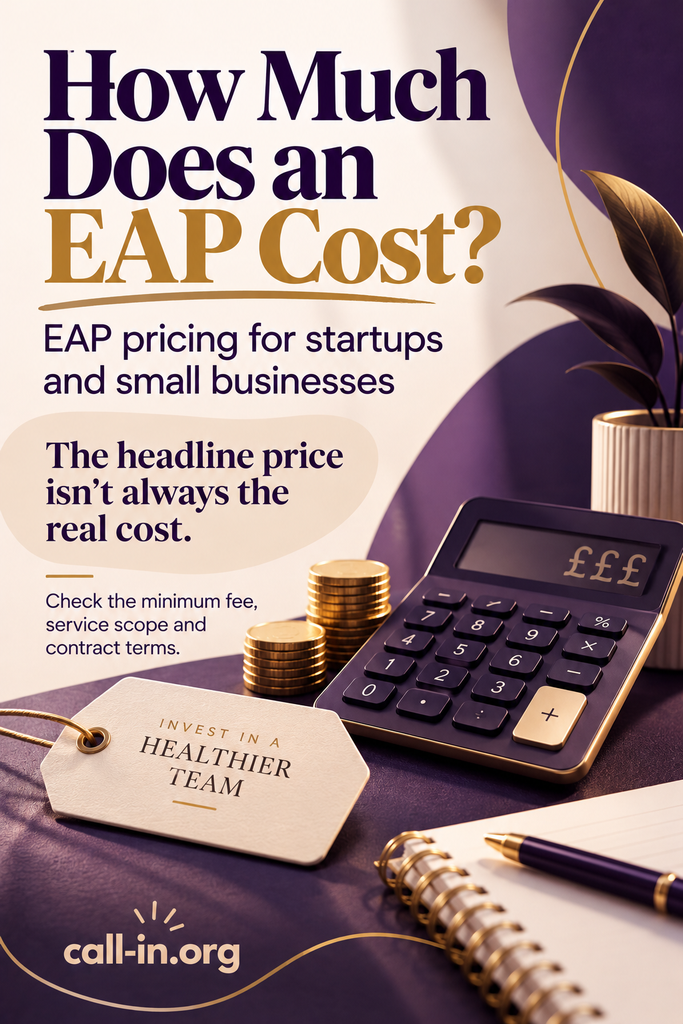
EAP pricing can be less than £1 per employee per month at some workforce sizes, but smaller businesses may face minimum annual fees that make the effective cost per employee higher. For example, AXA Health currently advertises an EAP rate of 50p per employee per month for 100 employees, while HR Service Centre lists pricing from £395 a year for businesses with fewer than 25 staff.
When comparing EAPs, look beyond the headline price and check the minimum spend, what’s included and the contract terms.
Employees experience different kinds of emotional difficulty. Not every difficult or heavy moment requires therapy or clinical care. Sometimes a person wants a safe, confidential space to talk things through with another human being.
That is why employers need more than one layer of workplace wellbeing support. Therapy and counselling can provide clinical or therapeutic care where needed. An EAP may provide counselling, practical advice and referrals.
Wellbeing programmes can address culture and working conditions. Non-clinical emotional support can give employees somewhere to talk through everyday pressure before it becomes more severe.
Callin provides confidential, non-clinical human support. It can complement existing workplace wellbeing provision, including an EAP, rather than replace therapy, counselling, occupational health, crisis services or specialist care.
What are the seven key takeaways about EAP pricing?
EAP pricing becomes easier to compare when you separate the cost of access from the support included. Keep these seven points in mind:
- Public prices are examples, not a universal market average. AXA Health and HealthHero attach workforce-size conditions to their advertised rates.axahealth.co
- A minimum annual fee can matter more than the per-person rate for a small team. HealthHero explicitly states that a minimum annual fee applies.
- EAPs can use prepaid subscriptions or a service fee plus usage charges. Fitzgerald HR publishes both approaches.
- Helpline access does not necessarily include a course of scheduled counselling. AXA Health reserves scheduled counselling for its EAP Premier option.axahealth.co
- Session limits need careful reading. A limit per referral is different from a limit per employee per year.
- Callin provides non-clinical human support, not a traditional full-service EAP or a replacement for necessary clinical care.
- Buying support does not remove the need to address harmful working conditions. HSE says employers must assess work-related stress risks and act on them.hse.gov
What is an Employee Assistance Programme (EAP)?
An Employee Assistance Programme, often called an EAP, is an employer-funded support service that may include counselling, practical advice, referrals and other resources, depending on the provider and contract. It is one form of workplace mental health support, not a single standardised product.axahealth.co
The exact scope varies. Some EAPs focus on a helpline and information. Others may include structured counselling, legal or financial guidance, manager support, critical incident support or routes to further care.
For a small business, the practical question is not whether an EAP is “worth it” in the abstract. It is whether the specific package meets the support needs your team is likely to have, at a total cost the business can sustain.
What is workplace emotional support?
Workplace emotional support is any confidential support that helps an employee talk through pressure, stress, loneliness, overwhelm, relationship difficulties, career uncertainty or other personal circumstances affecting work. It can be clinical or non-clinical, depending on the service and the person’s needs.
Not every employee who wants to talk needs therapy. A difficult week, a strained relationship, uncertainty about a career move or the pressure of carrying too much may benefit from a human conversation rather than a clinical treatment plan.
At the same time, emotional support is not a substitute for therapy, counselling, medical care or crisis support where those are needed. Different forms of support serve different needs.
What is the difference between therapy, an EAP and non-clinical emotional support?
Therapy and counselling are clinical or therapeutic support delivered by appropriately qualified professionals for people who need that level of care. An EAP is a broader employee support service that may include counselling, practical advice and referrals. Non-clinical emotional support is confidential human conversation for everyday emotional pressure that may not require clinical treatment.
These categories can overlap, but they are not interchangeable.
Therapy and counselling
Therapy, counselling and other clinical mental health care are provided by appropriately qualified professionals. They may be appropriate where someone needs assessment, treatment or ongoing clinical support.
A therapist can absolutely provide a supportive conversation. The question is whether every employee who could benefit from talking to someone wants, or needs, to enter a clinical relationship.
Employee Assistance Programmes
An EAP may include counselling, practical advice, referrals and other resources, but the exact package depends on the provider and contract. It is a workplace benefit rather than a single service with a universal definition.axahealth.co
Workplace wellbeing programmes
Workplace wellbeing programmes are broader initiatives designed to support employee wellbeing, culture, health and sustainable working. They can include education, manager development, policy work, benefits and practical changes to how work is organised.
A wellbeing programme is not automatically a substitute for individual support. Nor is individual support a substitute for fixing excessive workload, poor management, bullying, discrimination or other structural problems.
Non-clinical emotional support
Non-clinical emotional support gives someone a confidential place to talk through everyday emotional pressure. It is not therapy, counselling, diagnosis, psychiatric care, medical care, crisis intervention or emergency support.
Callin sits in this category. It provides one-to-one conversations with trained human listeners and can complement an EAP, therapy, occupational health or other appropriate care.
How much does an EAP cost per employee in the UK?
Published UK EAP prices include rates below £1 per employee per month, alongside fixed annual fees for smaller businesses. These figures apply to specific services and workforce sizes, so they should not be treated as interchangeable quotes.axahealth.co+1
Here are three public examples checked for this article.
AXA Health: workforce size changes the advertised rate
AXA Health advertises an EAP price from 50p per person per month for 100 employees, allowing for minimum spend. It also publishes a rate from 27p per person per month for 750 to 999 employees. The prices exclude VAT and are stated as valid until 31 December 2026.axahealth.co
The important qualification is the headcount. A founder with eight employees should not assume the company can buy the same service for eight times 50p a month.
AXA Health also distinguishes its service tiers. Scheduled counselling is available through EAP Premier, with five-, six- or eight-session models. The lowest advertised figure should not be read as a promise that every listed feature is included.axahealth.co
HealthHero: different packages have different prices
HealthHero publishes these starting monthly prices per person:
- Essentials, its self-serve digital option: £0.34.
- EAP Core: £0.60.
- EAP Advanced: £1.44.
- EAP 360°: £1.77.
These rates exclude VAT, assume 175 employees and a one-year term, and are subject to a minimum annual fee. HealthHero states that the rate varies with the number of employees covered.
The packages also differ in scope. For example, EAP Core adds a 24/7 in-the-moment counselling and trauma support phone line, plus legal and financial guidance, to the Essentials offering.
HR Service Centre: a small-business annual price
HR Service Centre publishes pricing from £395 per year for businesses with fewer than 25 staff. It separately advertises prices from £6 per employee per year for organisations with more than 50 staff, with no per-call or per-session charges.hrservicecentre.co
For a small employer, the annual starting price is more informative than a large-workforce headline rate. However, the final quote still needs to confirm eligibility, inclusions, VAT treatment and any additional charges.
These examples establish that relatively low-cost EAP access exists. They do not establish a reliable UK market average or tell you what your particular team will pay.
How are EAP providers usually priced?
EAP providers can charge a fixed subscription, a minimum annual fee, usage-based charges, or a combination. Public provider information shows both prepaid and service-fee-plus-usage models.hrservicecentre.co
Per employee per month or year
A provider may express its subscription as a monthly or annual amount for each covered employee. AXA Health publishes monthly per-person examples, while HR Service Centre publishes an annual per-employee starting rate for larger organisations.axahealth.co+1
This makes the quoted unit price easy to compare, but only after you check minimum charges and service differences.
Minimum annual fee
A minimum annual fee sets a floor beneath the contract price. HealthHero explicitly includes this condition in its published SME pricing.
Ask the provider to show the actual annual total for your headcount. Do not calculate your budget from an advertised per-person rate until the provider confirms that the rate applies.
Service fee plus pay-as-you-go support
Fitzgerald HR’s Value EAP combines a quarterly service charge with billing in arrears for counselling and advice sessions employees actually access. Its Standard EAP instead includes specified counselling and advice charges within a prepaid subscription.
The buying question is therefore not simply, “Which model is cheaper?” It is, “How much spending certainty do we need, and what happens when employees need more support than expected?”
Do EAPs charge per employee or per use?
Both arrangements exist. A prepaid EAP can charge for workforce coverage, while a usage-based arrangement charges for sessions accessed, sometimes alongside a fixed service fee. Fitzgerald HR’s published packages illustrate that distinction.
For a subscription quote, ask:
- Which employees must be included in the covered headcount?
- When are starters and leavers reflected in the bill?
- What support is included without further charges?
- Which services require additional payment?
For a usage-based quote, ask:
- What does each type of session cost?
- Is there an annual spending cap?
- Who authorises additional sessions?
- Can spending controls operate without revealing who is seeking support?
- What happens if the agreed budget runs out?
Avoid creating a benefit that is confidential in the brochure but requires an employee to explain a personal difficulty to the founder before using it.
Is there a minimum number of employees for an EAP?
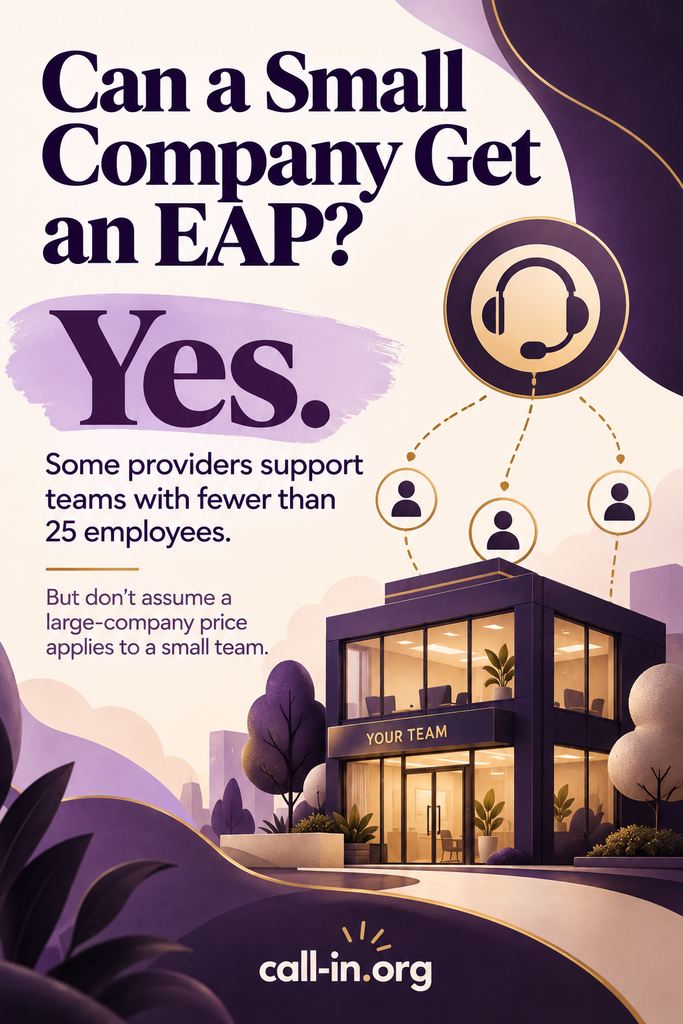
There is no single minimum across the examples reviewed. HR Service Centre expressly offers a small-business price for organisations with fewer than 25 staff, while HealthHero’s advertised per-person rates use a 175-employee example and carry a minimum annual fee.hrservicecentre.co
Separate two questions when requesting quotes:
- Is a company of our size eligible?
- What is the lowest total amount we would have to pay?
A provider accepting small companies does not necessarily mean a five-person business receives the same per-person price as a 500-person employer.
Also confirm whether founders, directors, contractors, overseas workers and dependants are eligible. Ask for the answer in the proposal rather than assuming that “your team” includes everyone working with the business.
How should a startup calculate its EAP budget?
A startup should calculate the total annual commitment first, then divide that figure by its covered headcount. Include compulsory charges and separately identify any usage-based spending.
For a fixed-price proposal:
Annual commitment = subscription or minimum annual fee + compulsory additional charges + applicable VAT.
Effective annual cost per employee = annual commitment ÷ covered employees.
An illustrative minimum-fee calculation
Suppose a provider quotes a minimum annual fee of £600:
- With 10 covered employees, the effective annual cost is £60 each.
- With 20 covered employees, it is £30 each.
- With 40 covered employees, it is £15 each.
This is a hypothetical calculation, not a provider quote or a market benchmark. It shows why the minimum fee can change the economics for a small company.
For a usage-based proposal, prepare more than one spending scenario. Estimate a lower-use year, a higher-use year and a year when several employees need support at the same time. Use the provider’s actual session prices, not an assumed utilisation percentage.
What affects the cost of an EAP?
Published provider information shows that workforce size, package scope, counselling provision and additional services can change the price. Contract conditions such as minimum annual fees also affect what a company ultimately pays.axahealth.co
Team size
AXA Health publishes different per-person prices at different workforce sizes. HealthHero also states that its rates vary by the number of employees covered.axahealth.co
Ask for a quote based on today’s headcount and a second calculation for your expected renewal headcount.
Counselling access and limits
AXA Health offers different scheduled counselling session models through EAP Premier. HealthHero states that structured counselling typically offers up to six or eight sessions per referral, limited to one referral per user in a rolling 12-month period.axahealth.co
These are different contract structures. Counting sessions without reading the eligibility and referral conditions can produce a misleading comparison.
Additional services
HealthHero lists extended counselling, psychological services, critical incident support and mental health training as additional-cost options.
Decide which services you need before comparing the proposals. A broader package is not automatically better value if the extra services do not address your team’s needs.
Contract commitment
Fitzgerald HR publishes a one-year initial term followed by rolling quarterly arrangements for its EAP packages.
Check the initial term, payment schedule, cancellation notice, automatic renewal and process for changing headcount. A monthly price is not necessarily a month-to-month contract.

Is therapy included in EAP pricing?
Some EAP packages include short-term counselling, but you should not assume every price includes scheduled sessions or open-ended therapy. The provider, package, assessment process and contractual limits determine the support available.axahealth.co
AXA Health, for example, places scheduled counselling within EAP Premier. Fitzgerald HR’s Standard package specifies up to six counselling sessions per employee per year within its prepaid subscription.axahealth.co
Before signing, ask:
- Is structured counselling included in this exact quote?
- Is access subject to an assessment?
- Is the limit per issue, referral or employee?
- When does the allowance reset?
- Which delivery methods are available?
- What happens when someone needs longer-term or specialist care?
A counselling allowance should be described accurately to employees. “Access to short-term counselling under the provider’s terms” is more useful than a vague promise of unlimited mental health support.
Does an EAP replace therapy?
No. An EAP does not automatically replace therapy, and therapy does not make an EAP unnecessary. They can serve different needs: an EAP may provide workplace-facing support, practical guidance and short-term counselling, while therapy provides clinical or therapeutic care delivered by appropriately qualified professionals.
Some employees may use an EAP and never need therapy. Others may use an EAP for practical support and separately need clinical care. Others may already have a therapist and simply want a different kind of space to talk through a difficult week.
The right answer depends on the person, the situation and the services available. Employers should make those boundaries clear rather than implying that one benefit covers every need.
What if employees already have access to a therapist?
If employees already have access to therapy and use it comfortably, the organisation may already have the right provision for that need. A new service is not automatically required.
But therapy is not the only useful form of support. Some people may not see themselves as needing therapy, yet still want a confidential person to talk to about a difficult week, work stress, loneliness, relationship problems, career uncertainty, feeling overwhelmed or personal circumstances affecting work.
That is where non-clinical emotional support can fit alongside existing provision. Callin can provide that option without positioning itself as a replacement for therapy or clinical care.
Can an EAP and non-clinical emotional support work together?
Yes. An EAP and non-clinical emotional support can complement each other because they address different levels of need. An EAP may provide counselling, practical advice and referrals, while non-clinical support gives employees a confidential place to talk through everyday emotional pressure.
This can be useful when an employee does not yet know whether they need counselling. They may simply want to talk about work stress, burnout risk, loneliness, a difficult relationship or career uncertainty.
Callin can sit within that wider support ecosystem as a non-clinical human-support layer. Its trained listeners provide active, compassionate listening. Callin is not therapy, counselling, diagnosis, medical care or crisis intervention, and it should not replace care someone clinically needs.
What kind of problems can employees discuss with a non-clinical listener?
An employee may want to talk about work stress, burnout risk, loneliness, overthinking, feeling overwhelmed, relationship difficulties, grief, life changes, career uncertainty or personal circumstances that are affecting work. These are everyday emotional difficulties, not necessarily clinical conditions.
A non-clinical listener does not diagnose, treat or assess mental health conditions. The purpose is to provide space to be heard, reflect and feel less alone.
If an employee needs clinical assessment, treatment, occupational health input or emergency support, those needs should go to appropriate services. A non-clinical service can help someone decide what kind of support to seek, but it should not be presented as a clinical pathway.
How can small businesses provide mental health support for employees?
Small businesses can provide employee mental health support by combining clear working conditions, manager capability, confidential individual support and appropriate routes to clinical or crisis care. There is no one universal answer for every team.
A small company may be deciding between:
- An EAP.
- A therapy benefit.
- A wellbeing programme.
- Coaching.
- Non-clinical employee emotional support.
- Other benefits or resources.
Start by identifying the gap. Is the problem that employees need practical advice, scheduled counselling, manager guidance, help with workload, or simply someone confidential to talk to?
An EAP may be useful where a company wants a defined employee benefit with counselling and practical resources. Our guide to the best EAP for startups and small businesses sets out what to compare before choosing a provider.
For wider organisational responsibility, workplace wellbeing should also consider how work itself is designed. Callin’s guide to workplace wellbeing and the UN Sustainable Development Goals explores that broader context.
How much should a startup budget for employee mental health support?
There is no verified universal budget that fits every startup. Build the budget around the support you need, the people eligible to use it and the full cost of delivery.
Separate the plan into three parts.
Core access
Obtain a firm quote for the support every eligible employee can access. Record the minimum annual commitment, service scope and contract term.
Additional support
Decide how you will handle needs beyond the core package. This could involve an agreed additional-session budget or access to a different service, subject to appropriate advice and provider terms.
Implementation and workplace improvements
Allow time for explaining the benefit, briefing managers and reviewing whether people can access it privately.
Keep a separate action plan for workplace causes of stress. HSE’s Management Standards cover demands, control, support, relationships, role and change. An employee-support budget should sit alongside action on these areas, not replace it.hse.gov
How can a small company support employees without spending thousands?
Some published small-business EAP starting prices are below £1,000 a year. HR Service Centre’s advertised starting fee of £395 annually for businesses with fewer than 25 staff is one example, although the final proposal must confirm your actual cost and scope.hrservicecentre.co
Before buying another benefit:
- Check existing arrangements. Ask current benefits, insurance and HR suppliers whether employee support is already included.
- Identify the missing support. Is the gap counselling, practical advice, manager guidance or somewhere confidential to talk?
- Request like-for-like proposals. Give providers the same headcount, locations and required services.
- Make access understandable. Explain who can use the service, how to contact it and what information the employer receives.
- Address avoidable pressure. Review workload, unclear responsibilities and management practices alongside support provision.
HSE requires employers to assess work-related stress risks and act on them. A benefit can support people, but purchasing it is not the same as removing the source of harmful pressure.hse.gov
Are mental health apps cheaper than EAPs?
A digital option can have a lower advertised access price, but a cheaper headline does not establish equivalent support. HealthHero’s self-serve Essentials option starts below its EAP Core price and does not include Core’s 24/7 counselling and trauma support phone line or legal and financial guidance.
Compare what employees can actually access:
- Self-guided content and exercises.
- A live human conversation.
- Structured counselling.
- Practical legal or financial guidance.
- Manager support.
- Routes to more specialist care.
These are purchasing categories to investigate, not features every app or EAP necessarily provides.
The comparison is not simply “app versus EAP”. It is whether the available support matches the problem you are trying to solve.
What is a mental health stipend, and should it replace an EAP?
For budgeting purposes, a mental health stipend is an employer-funded allowance employees can spend on eligible support under a defined policy. It is a spending mechanism, rather than a complete support service.
A stipend may offer choice. However, the employer still needs to decide what qualifies, how payment works, how privacy is protected and what happens when an employee needs help finding appropriate support.
Consider these practical questions:
- Must employees pay first and claim reimbursement?
- Could the upfront cost exclude someone?
- What information appears on receipts?
- Who reviews claims?
- What happens after the allowance is spent?
- Is there a clear route for urgent or clinical needs?
Do not assume that a cash allowance or reimbursement receives the same UK tax treatment as qualifying employer-provided welfare counselling. GOV.UK sets specific conditions for the welfare counselling exemption, including availability to all employees and restrictions on the services covered. Obtain advice on the arrangement you plan to offer.gov
A stipend and an EAP answer different purchasing questions: one funds eligible choices; the other provides access to a defined service. Neither should be selected on the allowance or subscription figure alone.
How can remote and distributed teams access employee support?
Remote and distributed teams need support that is easy to access online, regardless of location or working pattern. Remote work can make isolation, loneliness, work stress and difficulty switching off more visible, though it does not mean remote employees are necessarily more distressed than office-based employees.
A person can spend all day in messages and video calls and still feel they have not really spoken to anyone. Access to confidential human support can be particularly useful when an employee does not want to raise something with a manager or colleague.
For teams working across locations, check whether support is available online, whether appointment times work across time zones and whether employees can use it without explaining their situation to the person who manages them.
Callin’s guide to work stress and burnout support explores what it can mean to have someone to talk to about workplace pressure.
Is workplace emotional support confidential?
Confidentiality should be clear before an employee uses any support service. The exact arrangement depends on the provider, contract, privacy notice and any legal or safeguarding exceptions.
Employers should avoid vague promises such as “completely private” without explaining the boundaries. Employees need to know whether the employer receives individual information, aggregate reporting or no reporting at all.
For a small team, this matters even more. A report showing that one person used a service can feel identifying, even if it does not name them.
Ask providers:
- What does the employer receive?
- Is reporting aggregated?
- Can an employee contact support without going through a manager?
- What exceptions apply?
- How are conversations and records protected?
Callin provides confidential, non-clinical human support. Employers should review Callin’s current privacy information and any proposed employer arrangement before making specific confidentiality claims.
What should employers look for in an employee wellbeing service?
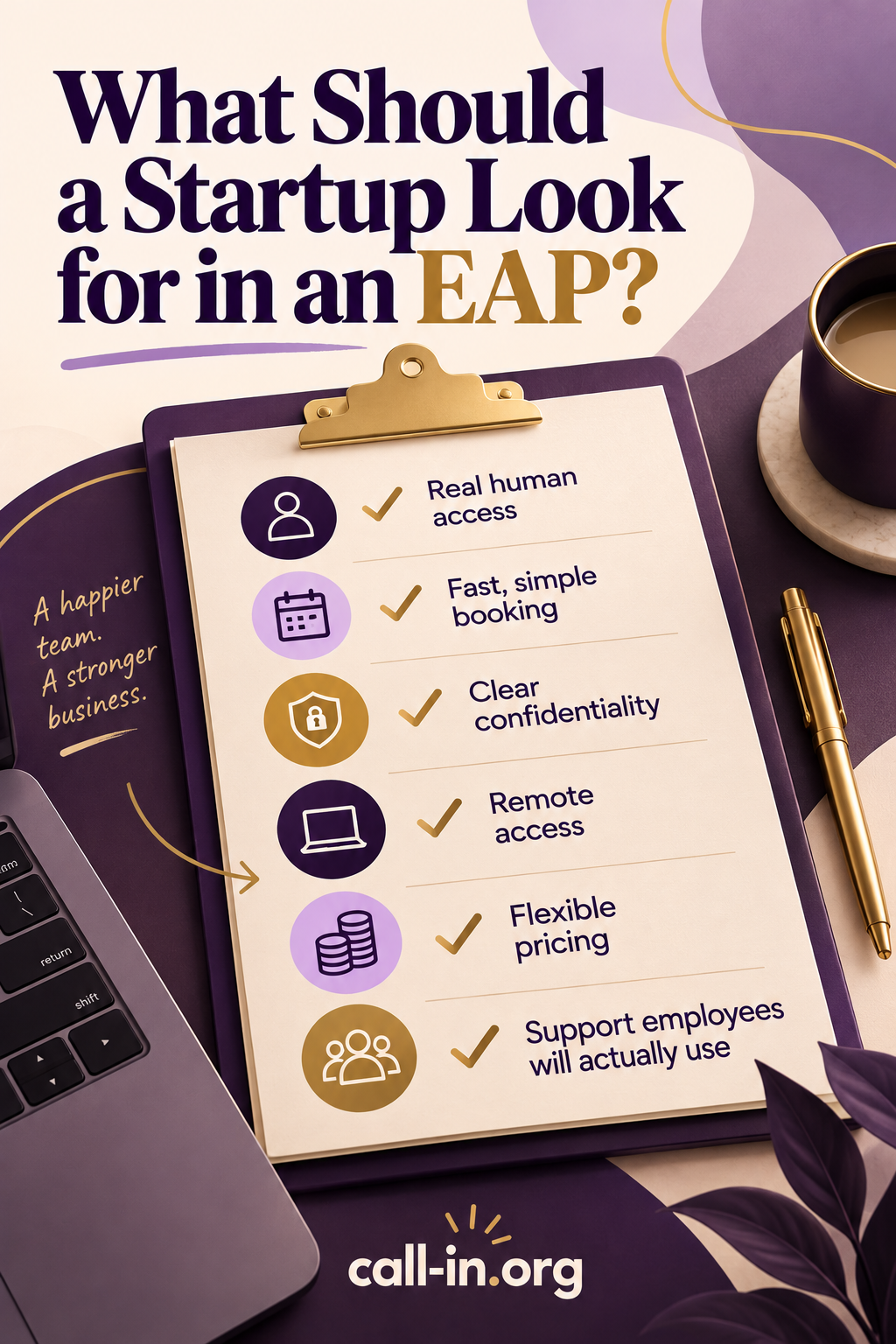
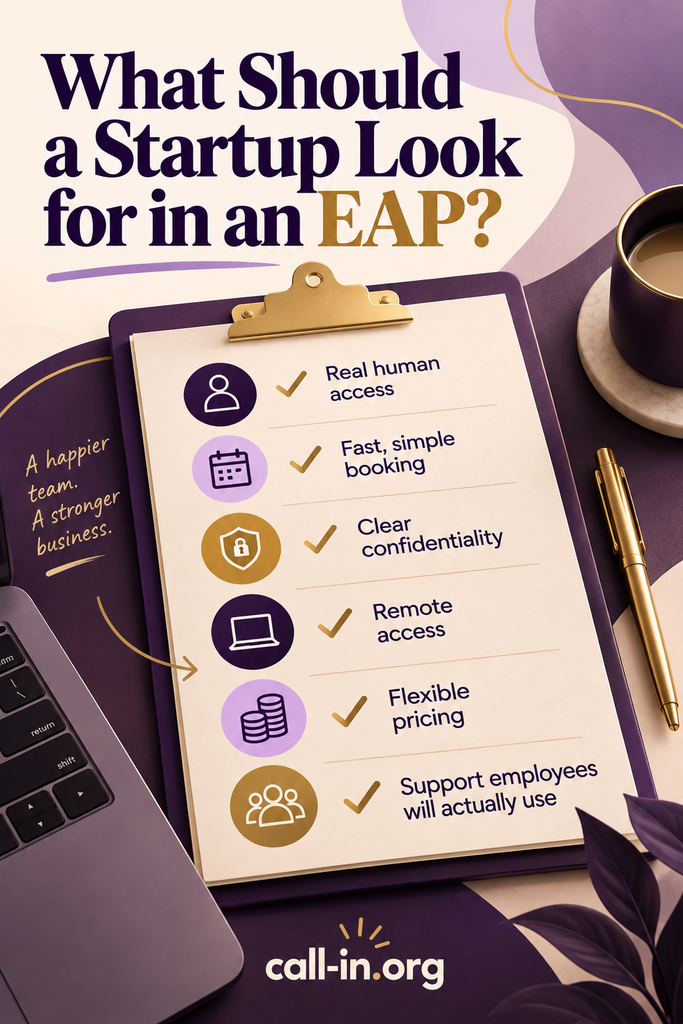
Employers should look for a service that is confidential, easy to access, appropriate for the team’s needs and clear about its limits. A good service should also be practical for a small HR team to administer.
Use these questions when comparing options:
- Is it confidential, and what exactly does the employer receive?
- Can employees access it easily, without unnecessary bureaucracy?
- Can remote employees use it?
- Can employees speak to a real person?
- Is support available before problems become severe?
- Is there continuity between conversations?
- What happens when someone needs clinical care?
- Can it complement an existing EAP?
- Is it practical for a small HR team to administer?
- Will employees actually understand and use it?
Continuity deserves particular attention. Sometimes you want someone to talk to without having to start your story from scratch every time.
Callin’s Human Continuity™ approach aims to keep a person with the same listener wherever operationally possible. That can make it easier to build trust over time, rather than repeatedly explaining the same context to a new person.
Where does Callin fit into workplace wellbeing?
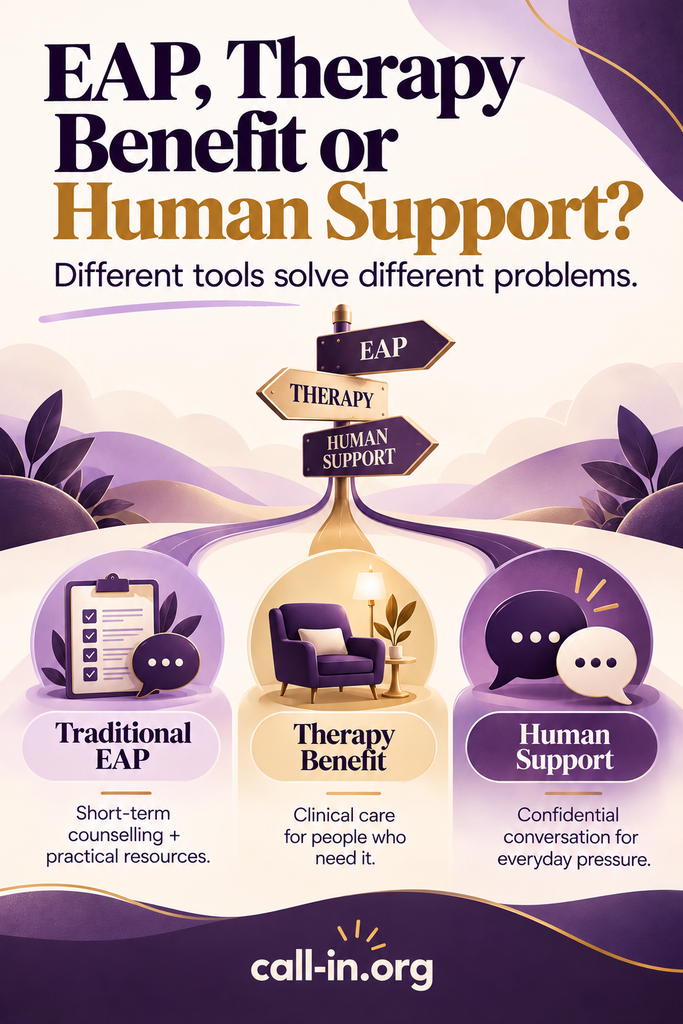
Callin fits as a non-clinical human-support layer within a wider workplace wellbeing ecosystem. It can complement an EAP, therapy, occupational health, insurance benefits or other appropriate care, rather than replacing any of them.
Not every heavy moment in your life needs therapy. Sometimes you just want a safe space to talk things through without having to start your story from scratch.
Callin provides confidential, one-to-one conversations with trained human listeners. Its Human Continuity™ approach aims to keep a person with the same listener wherever operationally possible. Callin is not therapy, counselling, diagnosis, psychiatric care, medical care, crisis intervention or emergency support.
For employees who want somewhere to talk about workplace burnout, Callin’s guide to who to talk to about work burnout that is not therapy explains that distinction further. Its workplace mental health support page also sets out how Callin approaches support for employees. https://call-in.org/workplace-mental-health-support-for-employees-callin/
What should employers do about work stress and burnout?
Employers should support the person and examine the system. Emotional support can help someone feel less alone, but it cannot make an unsustainable workload, poor management or an unsafe culture healthy.callin-eap-workplace-search-article-writer-playbook.docxhse.gov
HSE defines work-related stress as the adverse reaction people have to excessive pressures or other types of demand placed on them. Employers have a legal duty to assess work-related stress risks and act on them.hse.gov
Practical actions include reviewing workload, role clarity, management behaviour, support available and how change is communicated. Callin’s article on why workplace stress needs more than wellness programmes explores why individual benefits alone are not enough.
For employees, practical stress management can also help. Callin’s stress management guide offers techniques for reducing stress, while its guide to overcoming professional burnout looks at practical steps for people experiencing sustained pressure.
Peer connection can also matter. Callin’s article on why peer connection helps prevent burnout explores the value of feeling connected rather than isolated. For someone who wants a safe place to vent about burnout, Callin’s guide to getting support when you feel burnout at work explains what that can look like.
If someone is in immediate danger, cannot stay safe or needs urgent mental health care, contact local emergency services or an appropriate crisis service. Callin is not a crisis service.
Frequently asked questions
Does the employee pay to use an employer-funded EAP?
Under AXA Health’s published arrangement, the employer purchases the service and provides it free to employees. Check the exact contract and tell employees which support is funded and whether anything falls outside it.axahealth.co
Does a monthly EAP price mean we can cancel every month?
No. A monthly price can be a way of expressing an annual contract cost. HealthHero’s advertised SME rates assume a one-year term, while Fitzgerald HR publishes a one-year initial term followed by rolling quarterly arrangements.
Are employees’ partners included in EAP pricing?
Sometimes, but eligibility and access can differ. AXA Health distinguishes standard dependant helpline and in-the-moment support from full dependant access available at quotation stage. Fitzgerald HR’s Premier package includes immediate family cover at the same level as employees.axahealth.co
Is employer-provided counselling tax-free in the UK?
Qualifying welfare counselling can be exempt from tax, National Insurance and reporting obligations, subject to GOV.UK’s conditions. Do not extend that conclusion automatically to every EAP feature, stipend or non-clinical support service. Check the specific arrangement with an adviser.gov
Does a 24/7 helpline mean scheduled counselling is available immediately?
Not necessarily. AXA Health describes its 24/7 helpline separately from scheduled counselling available through EAP Premier. Ask providers for the pathway and waiting arrangements for the particular service employees need.axahealth.co
Can Callin replace an EAP?
No. Callin is not a traditional full-service EAP and does not replace an EAP, therapy, counselling, occupational health, crisis services or specialist care. It can complement existing provision by offering confidential, non-clinical human support.
Is Callin suitable for every employee?
No. Callin may suit employees who want confidential, non-clinical human support for everyday emotional pressure. It is not suitable as a replacement for clinical care, crisis support or emergency medical care where those are needed.
Suggested internal links
These links are incorporated contextually above rather than placed in a generic list:
- Best EAP for startups and small businesses
- Workplace wellbeing and the UN Sustainable Development Goals
- Work stress and burnout support
- Overcoming professional burnout
- Why peer connection helps prevent burnout
- Getting support when you feel burnout at work
- Who to talk to about work burnout that is not therapy
- Workplace mental health support for employees
- Why workplace stress needs more than wellness programmes
- Stress management guide
- Someone to talk to for low mood
- Feeling unseen at work
Relevant UN Sustainable Development Goal
SDG 8: Decent Work and Economic Growth is particularly relevant to this article’s workplace focus. Its targets include protecting labour rights and promoting safe and secure working environments. This is thematic alignment, not a claim of UN endorsement.
Good workplace wellbeing gives people the right place to turn
Good workplace wellbeing is not about finding one service that does everything. It is about giving people appropriate places to turn at different stages of difficulty.
Some people need therapy or clinical care. Some need practical advice through an EAP. Some need changes to workload, management or workplace culture. And some simply need a confidential human conversation before pressure becomes overwhelming.
Leave a Reply