
Your nurses, doctors and clinical teams spend their days holding other people’s fear, pain and grief. Many of them go home carrying it, with nowhere obvious to set it down. This guide is for hospital and health system leaders who want to give clinical staff a confidential, human place to talk, alongside the clinical and occupational support you already offer.
The short answer: Hospitals and health systems can support nurses and clinical staff by fixing the working conditions that drive distress, strengthening peer and leadership support, and adding a confidential, non-clinical place to talk that sits alongside occupational health, counselling and clinical supervision.
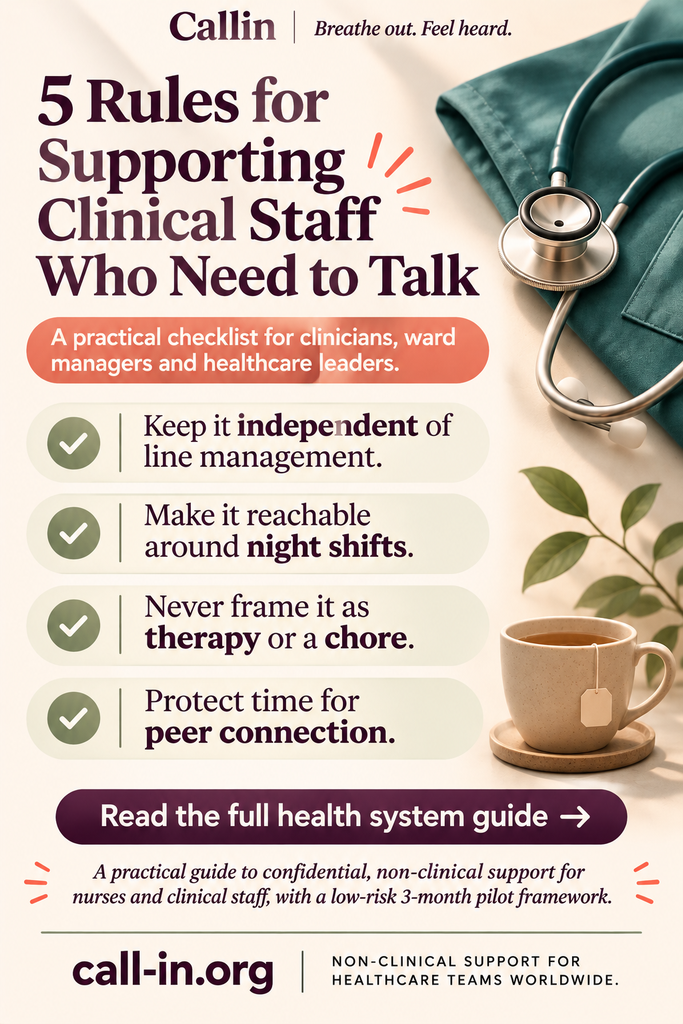
That place should be independent of line management, easy to reach around shift patterns, and never framed as therapy or as another task. Measure trust and uptake, and review it with staff.
Key definitions
- Clinical staff: Nurses, midwives, doctors, allied health professionals and healthcare assistants who provide direct patient care.
- Emotional load of care work: The ongoing effort of managing your own feelings while responding to patients’ and families’ distress, sometimes called emotional labour.
- Burnout: Described by the World Health Organization as an occupational phenomenon resulting from chronic workplace stress that has not been successfully managed. It is not classified as a medical condition.
- Occupational health: A specialist service that assesses and advises on how work affects health and how health affects work, including fitness for work and adjustments.
- Clinical supervision: Structured, profession-specific reflection on practice, usually led by a senior colleague, with a focus on care quality and professional development.
- Non-clinical emotional support: Confidential, human conversation with a trained listener that does not diagnose, treat, assess or replace therapy, occupational health or medical care.
A quick word on boundaries before we begin. Callin offers non-clinical emotional support, not therapy, counselling, clinical debriefing, occupational health, medical care or crisis support, and nothing in this article is clinical, legal or employment advice. If you, a colleague or anyone you are supporting may be in immediate danger or crisis, please contact local emergency services or find a free, confidential helpline in your country at findahelpline.com.
Key takeaways
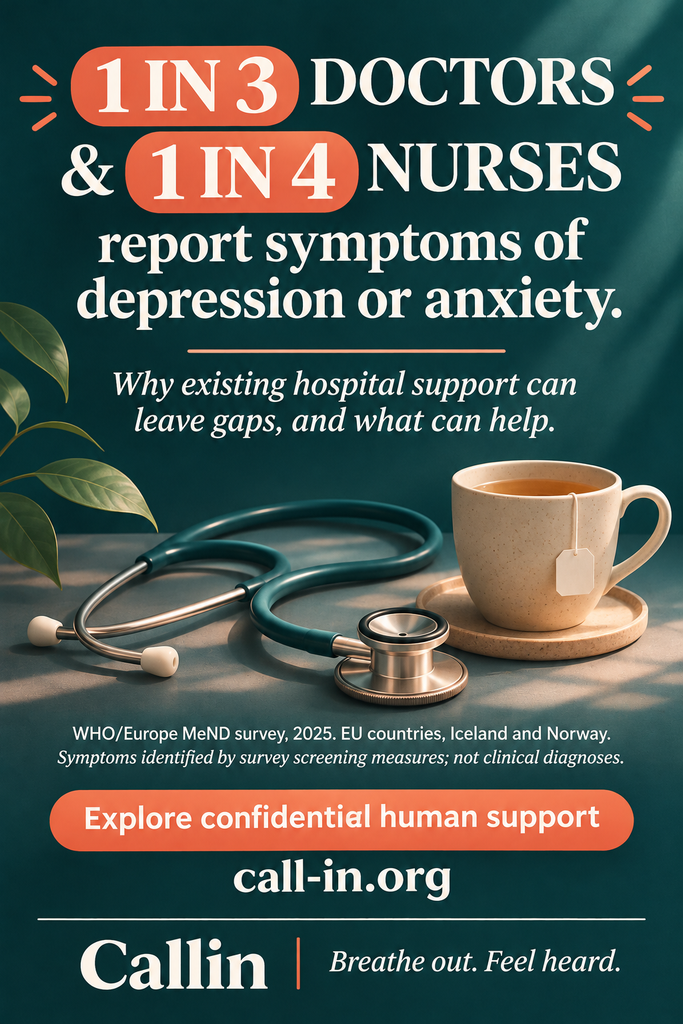
- Clinical staff are under heavy strain: a 2025 WHO/Europe survey of over 90,000 doctors and nurses in 29 countries found one in three reported symptoms of depression or anxiety.
- The biggest drivers are working conditions such as violence, long hours, night shifts and workload, so staff support must sit alongside action on those conditions, never replace it.
- Many health workers hesitate to seek help because of stigma and worries about confidentiality, careers or professional registration.
- Support from colleagues was the most commonly reported protective factor in WHO/Europe’s survey, so protect time and space for peer connection.
- A confidential, non-clinical place to talk fills the gap between “I am fine” and needing clinical care, and works alongside occupational health, counselling and supervision.
- Good staff support is independent of line management, reachable around shifts and time zones, and asks nothing extra of already stretched teams.
- A defined three-month pilot with a clear group, privacy-safe measures and a review point is a low-risk way to test a new layer of support.
Why do nurses and clinical staff need someone to talk to?
Because care work asks people to absorb other people’s distress, often at speed and with little time to process it. When that load builds up without an outlet, it can show up as exhaustion, detachment, sickness absence or a decision to leave.
The scale of the strain is now well documented. In October 2025, WHO/Europe published its Mental Health of Nurses and Doctors (MeND) survey, covering all 27 EU countries plus Iceland and Norway. It found that “1 in 3 doctors and nurses experienced bullying or violent threats at work” in the past year, and that one in three reported depression or anxiety.
The survey also found that “1 in 10 doctors and nurses said they had had thoughts of being ‘better off dead’ or ‘hurting themselves’ in the past 2 weeks.” WHO/Europe notes the survey was cross-sectional, so links between conditions and mental health are associations rather than proof of cause. Even so, it is a sobering picture for any health system leader.
The pattern is not limited to Europe. The US Surgeon General’s advisory on health worker burnout states that health workers “work in distressing environments that strain their physical, emotional, and psychological well-being.” For an individual view of this, our article on how to survive emotional labour explains what it can feel like from the inside.
What causes distress among clinical staff?
Mostly, the system around them. Workload, violence, long hours, shift patterns and a lack of say over their work are consistently linked with poorer mental health, which is why individual support can only ever be one part of the answer.
The US Surgeon General’s advisory is clear that “workplace systems cause burnout among health workers,” pointing to “excessive workloads, administrative burdens, limited say in scheduling, and lack of organizational support.” WHO/Europe’s MeND findings echo this: staff who “experience violence, work consistently long hours and work in shifts (especially at night) are much more likely to be depressed and anxious and to have suicidal thoughts.”
There is also the quieter weight of the work itself. Clinical staff witness death, make hard decisions under pressure, and sometimes cannot give patients the care they believe they deserve. A peer-reviewed review in Frontiers in Public Health names “ethical dilemmas” and “moral injury” among the issues healthcare workers face.
None of this means staff are fragile. WHO/Europe found that “3 out of 4 doctors and 2 out of 3 nurses expressed a strong sense of purpose and meaning in their work.” People are committed; they simply need conditions and support that let them keep going.
Why do healthcare workers often avoid asking for help?
Many fear what asking might cost them. Stigma, worries about confidentiality, concerns about their career or professional registration, and a culture of coping alone all keep clinical staff from speaking up early.
The Frontiers review found that “healthcare practitioners are likely to suffer in silence due to the perceived stigma associated with experiencing ‘stress’ and ‘mental illness,’ as well as fear of getting their medical license withdrawn.” It adds that clinicians “may be hesitant to seek mental healthcare, often due to concerns about confidentiality and its potential impact on their careers.”
The US Surgeon General’s advisory asks healthcare organisations to “review and revise policies to ensure health workers are not deterred from seeking appropriate care.” WHO/Europe’s MeND report goes further, saying support “must be confidential, able to be utilised without fear of repercussions, and aligned with the needs and preferences of staff.”
Guilt plays a part too. Many carers feel they should be the ones giving support, not receiving it. Our article on why you might feel guilty for needing support speaks to that feeling directly, and could be useful to share with staff.
What support should a hospital or health system already have in place?
A strong staff support system has several layers, each with a different job. Most health systems already have some of them, and the aim is to make the layers work together rather than leave gaps between them.
Common layers include:
- Safe working conditions: action on staffing, workload, rostering, rest and violence, which WHO/Europe treats as the foundation.
- Occupational health: fitness for work, adjustments and health surveillance, as set out in the WHO and ILO guide Caring for those who care.
- Clinical and professional supervision: structured reflection on practice, led within each profession.
- Team reflective spaces: for example, Schwartz Rounds, which offer “a structured forum where staff from all disciplines come together regularly to discuss the emotional and social aspects of working in health and care.”
- Peer support: colleague networks, buddy systems and informal check-ins after hard shifts.
- Counselling, therapy or an EAP: clinical or employer-funded support for people who need assessment or treatment.
- Crisis pathways: clear routes to urgent help for anyone at risk.
Local arrangements differ widely. In some countries occupational health is a legal requirement; in others it depends on the employer, and national programmes for health workers exist in some systems but not others. Treat any specific scheme you read about as an example, and check what applies where you operate.
Where are the gaps in hospital staff support?
The gap is usually the space between a hard day and a formal service. Many clinical staff do not need therapy or an occupational health referral, but they do need to talk to someone, soon, and in confidence.
Common gaps include:
- Timing: support that runs in office hours can be hard to reach for people on nights, weekends or long rotating shifts.
- Independence: some staff will not talk openly to anyone in their own line of management or professional hierarchy.
- Threshold: clinical services can feel like a step too far for someone who is “just tired” or “a bit shaken.”
- Continuity: telling your story again to a new person each time can stop people coming back.
- Workload: anything that adds forms, training or meetings to an already full rota is unlikely to be used.
Peer support matters greatly, but colleagues are carrying the same load. Our article on why talking to friends is not always enough explains why people sometimes need someone outside their circle.
How can you add a confidential place to talk without calling it therapy?
Be precise about what it is and is not. A non-clinical emotional support service offers a trained, independent listener for a confidential conversation. It does not assess, diagnose, treat or debrief clinically, and it signposts to clinical or crisis services when needed.
Practical design principles:
- Name it plainly: “someone to talk to” is more inviting, and more honest, than clinical language.
- Keep it independent: make sure conversation content is never shared with managers.
- Make access easy: let staff book at a time that fits their roster, including nights and weekends.
- Add nothing to clinical workload: no referrals, forms or mandatory sessions.
- Connect the layers: agree clear signposting to occupational health, counselling, supervision and crisis support.
- Protect continuity: where possible, let staff keep talking to the same person.
If you want to explain the difference to staff, our guides to what non-clinical mental health support means and EAP vs therapy vs emotional support set it out clearly. Our explainer on warmlines, crisis lines and peer support shows why each has a different job.
How can you support staff after a difficult shift or distressing case?
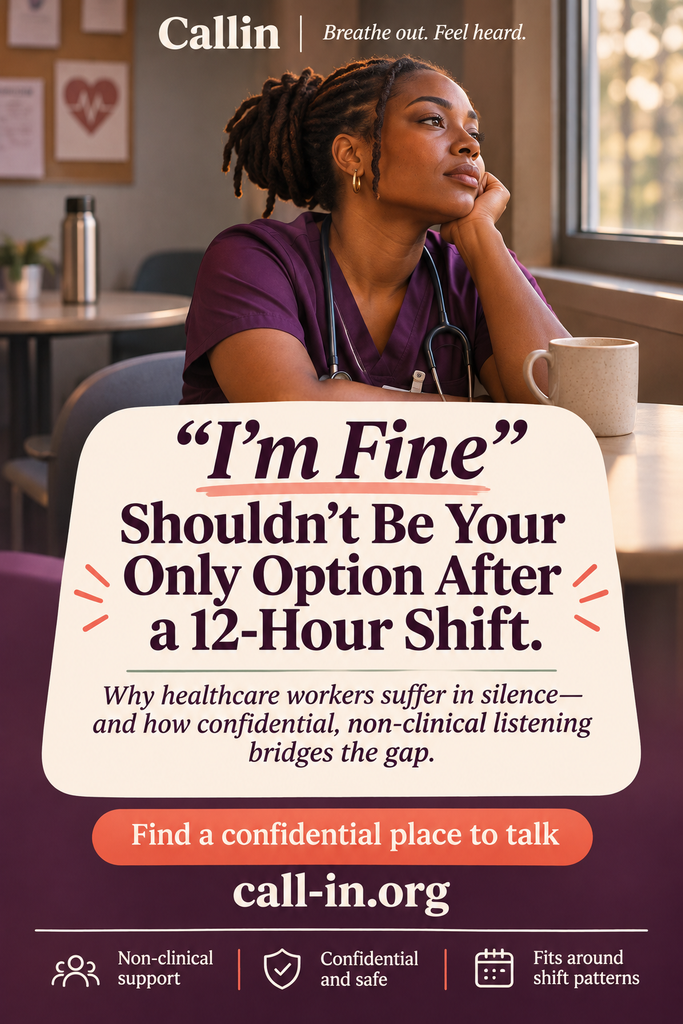
Start with the basics: rest, recognition and a chance to talk. After a distressing event, many people simply want to be heard by someone who will not judge them, and a confidential conversation can sit alongside any formal review or clinical support your organisation provides.
Helpful steps for leaders:
- Acknowledge it: a brief, human check-in from a manager or senior colleague matters.
- Protect rest: where possible, give people time to recover before their next shift.
- Offer choices: some will want team reflection, some a private conversation, some neither, and all are valid.
- Signpost clearly: make sure everyone knows how to reach occupational health, counselling and crisis support.
- Follow up: distress can surface days or weeks later, so check in again.
Loss is part of clinical work, but it still hurts. Some staff may find our guide to non-clinical support for grief helpful, and our article on who to talk to about work burnout when you do not need therapy is written for the individual.
How does this work across different health systems and countries?
Keep the principles the same and adapt the delivery locally. Employment law, data protection rules, occupational health duties and attitudes to talking about emotions vary across the Nordics, Germany, the Netherlands, the UK and Ireland, North America, Australia, New Zealand and beyond.
- Check local rules: confirm data protection, works council or union consultation, and occupational health requirements in each country.
- Mind language and culture: some staff may prefer to talk in a language other than their working language, or may under-report stress.
- Plan for internationally recruited staff: people far from family and familiar systems may feel especially isolated.
- Respect time zones and rosters: make sure support is reachable in practice, not just on paper.
WHO/Europe’s MeND report recommends “regular monitoring and reporting of health worker well-being.” Whatever your system, measuring how staff are doing is part of supporting them.
Where does Callin fit alongside your existing support?
Callin offers non-clinical emotional support: a confidential, human place to talk, alongside your occupational health, counselling, EAP and clinical supervision. It is not therapy, clinical debriefing, trauma treatment, occupational health or a crisis service, and it does not replace any of them.
Callin has offered this kind of support since June 2023. Callin Support Ltd is UK-registered and supports adults aged 18 and over worldwide through one-to-one online sessions in English. Callin is available 24/7, with sessions booked in advance at a time that suits each person, at any hour, which can help staff whose shifts do not fit office hours. Listeners complete Johns Hopkins University Psychological First Aid training and use active listening, with clear safeguarding and signposting procedures.
Through Human Continuity™, Callin prioritises the same listener for ongoing support wherever operationally possible, so clinical staff do not have to repeat their story each time. Callin does not create clinical records, and the content of an employee’s conversations is not shared with their employer. You can read more in our FAQ and privacy policy.
For a wider view of how the layers fit, see our guides to workplace mental health support for employees and how Callin complements EAPs. We do not publish outcome or savings figures for Callin, and we would encourage you to measure impact in your own organisation.
What would a three-month pilot for clinical staff look like?
A three-month pilot tests a new layer of support with a defined group, clear measures and a decision point at the end. Callin offers a defined three-month pilot for organisations through our workplace wellbeing support for organisations page.
A practical pilot plan might include:
- Before launch: choose a group, such as one ward, unit or staff group, agree privacy-safe reporting, and involve staff representatives.
- Month 1, awareness and trust: check through a short anonymous pulse whether staff know the support exists and believe it is confidential.
- Month 2, access and reach: look at aggregate uptake, including across shift patterns, with small numbers suppressed.
- Month 3, early signals: gather anonymous feedback on whether staff felt heard and whether support was easy to reach.
- Review: decide with staff whether to stop, adjust or continue, and keep watching absence and retention over a longer period.
Pair the pilot with honest attention to working conditions. Our article on why workplace stress needs more than wellness programmes explains why, and our guide to preventive emotional care shows the value of reaching people early.
Ready to give your clinical staff someone to talk to?
Supporting nurses and clinical staff starts with safer working conditions and a culture where asking for help is normal, and it is strengthened by giving people a confidential, human place to talk. If you would like to understand what that feels like first, explore non-clinical mental health support with Callin or read what happens in a Callin first session.
When you are ready to talk about your hospital or health system, enquire about a three-month staff support pilot and agree the measures that matter to you and your staff from day one.
Frequently asked questions
How can hospitals support nurses’ mental health and wellbeing?
Hospitals can support nurses by tackling workload, violence, rostering and rest, strengthening peer and leadership support, and offering confidential places to talk alongside occupational health, counselling and supervision. Support should be independent of line management and easy to reach around shifts.
Who can nurses and clinical staff talk to if they do not want to go through their manager?
Options vary by organisation and country, but often include occupational health, an EAP or counselling service, peer support networks, professional bodies and independent non-clinical emotional support. Callin offers confidential, non-clinical conversations, and the content is not shared with employers.
Is non-clinical emotional support the same as clinical supervision or debriefing?
No. Clinical supervision is profession-led reflection on practice, and clinical debriefing is a structured process run within your organisation. Non-clinical emotional support is a confidential conversation with a trained listener that does not assess, diagnose or treat, and it sits alongside those processes.
Does Callin replace occupational health, counselling or an EAP?
No. Callin works alongside occupational health, counselling, EAPs and clinical care, and signposts to them when needed. It is not therapy, occupational health, trauma treatment or a crisis service.
Can staff on night shifts or weekends use Callin?
Yes. Callin is available 24/7, and sessions are booked in advance at a time that suits each person, at any hour. That can make it easier for staff on nights, weekends or rotating rosters to find a time to talk.
Will the hospital see what staff talk about?
No. The content of an employee’s conversations is not shared with their employer, and Callin does not create clinical records. Callin follows safeguarding and signposting procedures where urgent safety concerns arise.
How can we test whether this kind of support works for our staff?
Run a defined three-month pilot with one group, agree privacy-safe measures such as awareness, trust and aggregate uptake, gather anonymous feedback, and review the results with staff before deciding next steps.
UN Sustainable Development Goals alignment
At Callin, we are aligning ourselves with the UN SDGs, and this article connects with two of them. This describes alignment only, not United Nations affiliation or endorsement; read more in our guide to mental health and the SDGs and our workplace wellbeing and the UN SDGs page.
- SDG 3: Good Health and Well-being. Supporting the mental health and wellbeing of the health workforce helps protect the people every health system depends on.
- SDG 8: Decent Work and Economic Growth. Safe, supportive working conditions for clinical staff are part of decent work.
Sources and further reading
- World Health Organization Regional Office for Europe (10 October 2025). Healing hands, hurting minds: MeND survey news release. EU, Iceland and Norway data.
- World Health Organization Regional Office for Europe (2025). Mental Health of Nurses and Doctors survey in the European Union, Iceland and Norway, full report PDF. EU, Iceland and Norway data.
- Office of the US Surgeon General, Department of Health and Human Services. Health worker burnout, advisory summary page, last reviewed February 2025. US context.
- Søvold, L. E. and colleagues (2021). Prioritizing the Mental Health and Well-Being of Healthcare Workers: An Urgent Global Public Health Priority, Frontiers in Public Health, 9:679397. Peer-reviewed, global.
- World Health Organization and International Labour Organization (2022). Caring for those who care: guide for the development and implementation of occupational health and safety programmes for health workers. Global guidance.
- World Health Organization (2019). Burn-out an “occupational phenomenon”: International Classification of Diseases. Global.
- World Health Organization (2025). State of the world’s nursing report 2025. Global.
- The Point of Care Foundation. Schwartz Rounds. UK and Ireland example.
- United Nations. SDG 3 and SDG 8.
Leave a Reply