
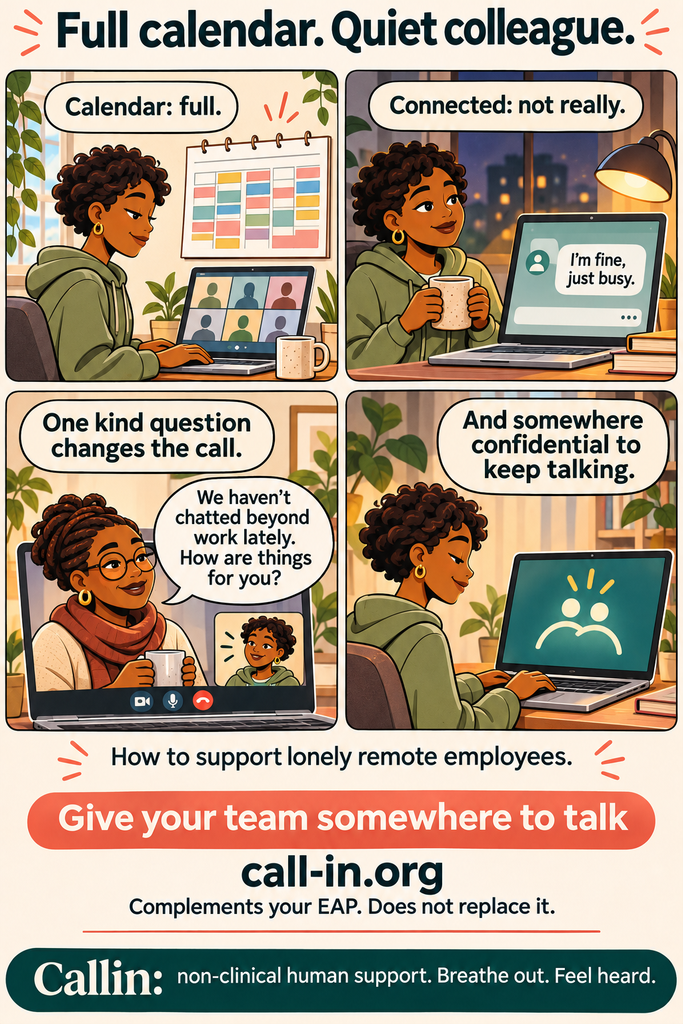
Remote and hybrid work has given many people more freedom and fewer commutes. It has also quietly removed some of the small human moments that used to happen without planning. This guide is for People Ops and HR leaders, and the managers they support, who want colleagues to feel connected wherever they log in from, whether that is Manchester, Melbourne, Malawi, Malta or Minneapolis.
The short answer: To support lonely remote employees, start with the conditions of work rather than the person. Build regular, purposeful human contact into the week, open one-to-ones with a genuine check-in, give new starters proper introductions and protect time for conversation that is not about tasks. Train managers to notice changes and listen well, keep contact balanced, and offer a confidential, human place to talk outside line management.
Loneliness: The World Health Organization describes loneliness as a subjective, distressing feeling that arises when there is a gap between the social connections a person has and those they want or need.
Social isolation: Social isolation is the objective state of having too few roles, relationships and interactions with others, which the WHO notes can be counted and measured.
Workplace loneliness: Workplace loneliness is the feeling of being disconnected, unseen or unsupported by colleagues and the wider organisation, which can happen in an office, at home or anywhere in between.
Hybrid team: A hybrid team is one where people split their working time between a shared workplace and working remotely, for example from home or another location.
Human Continuity™: Human Continuity™ is Callin’s commitment to prioritising the same trusted listener or coach over time, wherever operationally possible, so a person does not have to start their story again.
Non-clinical emotional support: Non-clinical emotional support is confidential, human listening that offers presence and understanding without diagnosis, treatment or clinical labels.
A gentle, honest note before we go further. Callin is non-clinical emotional support; it is not therapy, diagnosis or crisis care. If you, or someone in your team, is in danger or at immediate risk, please contact local emergency services or find a free, confidential helpline in your country at findahelpline.com.
Key takeaways
- Loneliness is a common human experience, and the WHO estimates that about 1 in 6 people worldwide report feeling lonely.
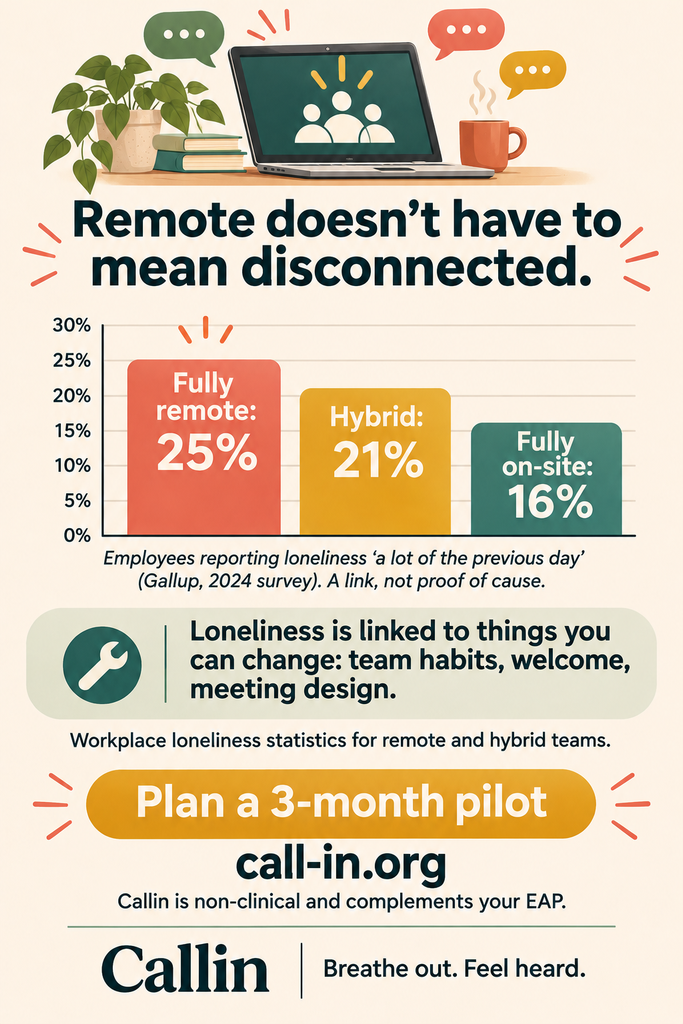
- Gallup’s 2024 global research found daily loneliness was reported by 25% of fully remote employees, 21% of hybrid employees and 16% of fully on-site employees.
- A 2023 review of 49 studies found workplace loneliness was associated with lower job satisfaction, weaker worker-manager relationships and higher burnout, but most studies were cross-sectional, so cause and direction remain untested.
- Loneliness is shaped by how work is designed, so the most useful responses focus on team habits and structures, not on fixing individuals.
- Signs of isolation are often small changes in behaviour or tone, and they are prompts for a kind conversation, never grounds for judgement.
- Managers can care deeply without becoming someone’s whole support system, and People Ops can give them training, boundaries and somewhere to refer.
- A confidential, non-clinical human space with the same trusted person over time can sit alongside an EAP, occupational health and clinical pathways without replacing them.
Why does loneliness matter for remote and hybrid teams?
Loneliness matters because work is one of the main places many adults find routine, purpose and everyday human contact. When that contact thins out, people can feel it, even if their calendar is full of calls.
The WHO’s fact sheet on mental health at work notes that decent work can support good mental health by providing, among other things, “an opportunity for positive relationships and inclusion in a community”.
The same WHO fact sheet lists “limited support from colleagues or authoritarian supervision” among the risks to mental health at work. That framing helps People Ops, because it points to things an organisation can shape. Loneliness is not a character flaw; it is an ordinary response to conditions that make connection harder.
It is also a global issue rather than a local one. According to the WHO’s social connection questions and answers, approximately 1 in 6 people globally (15.8%) report feeling lonely, and 11% of people in high-income countries do. In November 2023 the WHO set up a Commission on Social Connection for three years, aiming to see loneliness and isolation recognised and resourced as a global public health priority, and it published its flagship report in June 2025.
If you want a wider, human look at why so many people feel this way, our piece on the lonely generation is a gentle place to start.
What does the research actually say about loneliness at work?
The research shows that workplace loneliness is linked with several things employers care about, but it does not show that loneliness causes them.
A 2023 mixed-method systematic review and meta-analysis in Occupational Medicine by Bryan and colleagues at King’s College London identified 49 articles meeting its inclusion criteria (PubMed ID 38285544).
Its pooled results indicate that workplace loneliness was associated with reduced job satisfaction (r = -0.34), a worse worker-manager relationship (r = -0.31) and elevated burnout (r = 0.39).
The authors are clear about the limits. As they write, most studies used cross-sectional data and few adjusted for potential confounders, so “the direction and robustness of the associations remain untested”.
So, in plain language, we cannot say whether loneliness leads to burnout, whether burnout leads to loneliness, or whether something else, such as workload or poor management practice, sits behind both.
What the review does offer is hope. Its authors conclude that loneliness is associated with modifiable aspects of the work environment, suggesting the workplace may be a fruitful place for supportive action.
That is the spirit of this guide: change the conditions, include everyone and never treat a lonely colleague as the problem.
Gallup’s State of the Global Workplace 2024 findings on loneliness add a picture by work location. Fully remote employees reported loneliness “a lot of the previous day” at 25%, hybrid employees at 21% and fully on-site employees at 16%.
In Buffer’s 2023 State of Remote Work report, loneliness was the second most selected struggle, chosen by 23 percent of remote workers. These are self-reported surveys, so they describe patterns and associations rather than proof that remote work causes loneliness.
What are the signs an employee is lonely working from home?
The signs are usually small changes rather than one dramatic moment. Acas guidance on managing employees who work from home notes that it can be harder to notice problems when you are not meeting face to face, and suggests managers ask how the employee is feeling, notice “any changes in behaviour or tone of voice” and listen carefully to concerns.
Changes you might gently notice include:
- someone who used to chat in team channels now replies briefly or only about tasks
- a person who once had their camera on now rarely does, or slips out of calls early
- messages arriving very late at night or very early, suggesting the working day has no edges
- quietly skipping optional socials, coffee chats or team rituals they used to enjoy
- a new starter who rarely asks questions or seems unsure who to go to
- a quick “I’m fine, just busy” that does not quite match their voice
- passing comments such as “I haven’t really spoken to anyone this week”
Please hold these lightly. None of them proves someone is lonely, and each has many possible explanations, from caring responsibilities to simply preferring quiet. They are invitations to a kind, private conversation, never data points for performance management or a reason for extra monitoring.
People who are lonely often describe feeling unseen rather than simply alone. Our article on feeling invisible at work explores that experience, and why people can feel lonely even around others explains why a busy team chat does not always help. For many people, a lively group thread can even feel lonelier, as we discuss in why group chats can leave people feeling lonely.
How do you start a conversation with an employee who seems isolated?
Start privately, gently and with curiosity rather than conclusions. Acas suggests starting one-to-ones by asking how someone is and encouraging a genuine response rather than the usual “I’m fine”. It also acknowledges that people may not feel comfortable confiding straight away, and that giving them time and space to talk openly helps.
A few simple openers can make a real difference:
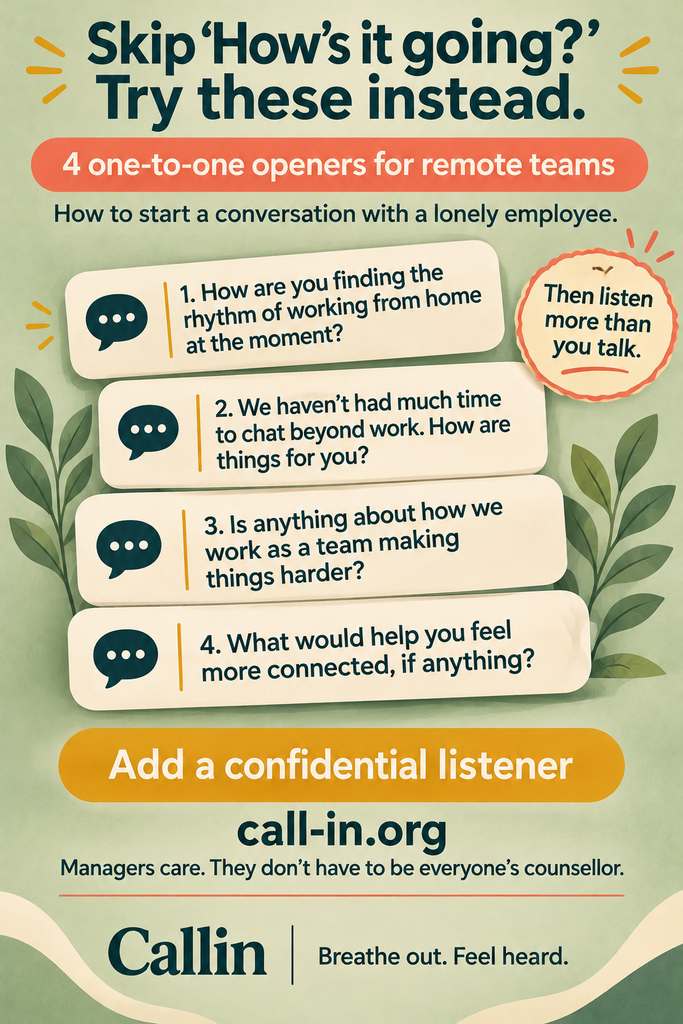
- “How are you finding the rhythm of working from home at the moment?”
- “I’ve noticed we haven’t had much time to chat beyond work. How are things for you?”
- “Is there anything about how we work as a team that is making things harder?”
- “What would help you feel more connected, if anything?”
Then listen more than you speak. You do not need to solve anything in the first conversation, and you should not ask people to explain their personal lives. If someone shares that they are struggling, thank them, agree any practical changes you can make at work, and make sure they know about confidential support options.
It also helps to remember the boundary. A caring manager is not a counsellor, and that is a healthy thing. If a conversation raises concerns about someone’s safety, follow your organisation’s safeguarding route and point them to emergency services or findahelpline.com.
How can you reduce isolation in remote teams without adding more meetings?
You reduce isolation by making connection a designed part of work, not an extra demand on top of it. More video calls are rarely the answer on their own. Acas warns that “constant or unnecessary contact can cause stress and affect morale”, and recommends leaving enough gaps between online meetings.
Practical ideas drawn from Acas guidance and good People Ops practice include:
- Agree how and when the team keeps in touch. Acas suggests offering different ways to stay in touch, such as messaging, video and email, while being clear about the purpose of contact.
- Protect a few minutes for non-work talk. Acas mentions team meetings with a section for non work-related discussion, virtual coffee sessions and internal networks around hobbies or interests.
- Give new starters a proper welcome. Acas advises helping new starters settle in so they do not feel isolated, for example with an induction pack, a clear first-week schedule and meetings to introduce them to colleagues.
- Keep socials optional and varied. Not everyone enjoys the same thing, so mix short, low-pressure options with occasional bigger moments.
- Pair people up. A buddy from another team gives someone a low-stakes person to ask the “small” questions.
- Respect the edges of the day. Clear start and finish times help people rest, and rest makes connection easier.
Acas also reminds employers that relying on emails alone is unlikely to prevent feelings of loneliness and isolation, and that early virtual catch-ups often fade as work demands grow. Checking in on whether your rituals are still happening is a quiet but powerful habit.
If you would like to share self-help ideas directly with employees, our individual guides on coping with remote working loneliness, why remote work loneliness happens and ways to cope as a remote worker are written for them, in their own voice.
What makes loneliness in hybrid teams different?
Loneliness in hybrid teams often comes from uneven experiences rather than distance alone. When some people share an office and others join from home, it is easy for in-room conversations, decisions and jokes to leave remote colleagues on the outside.
Gallup’s findings place hybrid employees between fully remote and fully on-site colleagues on reported daily loneliness, which is a reminder that hybrid is not automatically the “best of both”.
A few habits can make hybrid work feel fairer:
- run meetings “remote first”, so everyone joins from their own screen when some people are remote
- write up decisions made informally in the office and share them openly
- coordinate in-person days so people are not commuting to sit alone
- rotate meeting times when colleagues span time zones, so the same people are not always joining late at night
Acas also cautions against a one-size-fits-all approach to homeworking, encouraging employers to talk and listen to employees to find ways of working that suit both the individual and the business. For an employee in Perth and a colleague in Valletta, the “right” rhythm may look very different, and that is fine.
How can People Ops support managers so they are not carrying everything?
People Ops can support managers by giving them skills, clear boundaries and somewhere confident to refer. The WHO recommends manager training for mental health, which helps managers recognise and respond to supervisees experiencing emotional distress and builds skills like open communication and active listening.
Acas suggests training for working from home and hybrid working could include communication skills, managing staff remotely and managing work-life balance. Managers also benefit from simple, shared scripts and a clear map of what support exists, so they never feel they must improvise.
Most importantly, managers need permission not to be everything, and many are quietly stretched themselves. Our piece on why workplace stress needs more than wellness programmes explores this. A good support plan lets a manager say, “I care, I’m here for the work side, and here is somewhere confidential you can talk about the rest.”
If burnout is part of the picture, our guides to talking about work burnout without therapy and support for work stress and burnout may help you and your managers. For smaller organisations, our guide to setting up mental health support in a small company offers a practical starting point.
Where does confidential, non-clinical support fit alongside an EAP?
Confidential, non-clinical support fits as a human complement to what you already offer, not a replacement for it. An Employee Assistance Programme commonly provides short-term counselling, helplines, practical advice and referrals, and our explainer on what an EAP is and how it works sets out the basics. Our comparison of EAPs, apps, online therapy and emotional support can help you see where each one fits.
Callin offers eligible adult employees, aged 18 and over, confidential one-to-one emotional support online from real people. Listeners complete Psychological First Aid training from Johns Hopkins University and follow Callin’s active-listening materials and protocols on boundaries, safeguarding, signposting and cultural sensitivity. Callin does not create clinical records, and the content of an employee’s support conversation is not shared with their employer or benefits provider.
Not everyone who feels lonely wants a diagnosis or treatment plan. Some simply want to talk to someone who listens and remembers. With Human Continuity™, Callin prioritises the same trusted listener over time wherever operationally possible, so an employee does not have to retell their story at every session.
Read more about how Callin complements EAPs and our workplace mental health support for employees. This can be part of preventive emotional care, giving people somewhere to talk early, while clinical, occupational health and crisis pathways stay in place.
How do you make this work across countries and cultures?
You make it work by keeping the principles steady and letting the details flex. People talk about feelings in different ways, and in some cultures saying “I’m lonely” to a manager would feel very exposed. Offering several routes, such as a buddy, an optional social, a private check-in and a confidential external space, lets people choose what feels comfortable.
Think about time zones, public holidays and the different ways teams in Sydney, Dublin, Toronto or Malta like to socialise. Avoid scheduling every connection moment at a time that only suits head office. Holding the same social at two different times tells people they belong.
Callin is a UK-registered service, founded in June 2023, offering support to adults worldwide. Callin is available 24/7, with sessions you book at a time that suits you, at any hour. Sessions are currently conducted in English, which is worth bearing in mind for a multilingual workforce. You can learn more about Callin and its story or browse our frequently asked questions.
What is a sensible first step for your organisation?
A sensible first step is a small, honest review followed by one or two visible changes. Ask your teams, anonymously if possible, how connected they feel and what gets in the way. Then pick a couple of improvements, such as protected non-work time in team meetings and a better welcome for new starters, and check back in a few months.
Alongside that, make sure every employee knows where they can talk in confidence. If you want to try a human, non-clinical option, Callin’s workplace wellbeing support for organisations begins with a conversation about your people and context, and can start with a defined three-month pilot before you decide on anything longer. Employees can see what to expect in a Callin first session, and eligible new clients can begin with a free first session.
Callin’s workplace approach also aligns with the UN Sustainable Development Goals on health and decent work, which you can explore in our guide to workplace wellbeing and the UN SDGs. This describes alignment only, not UN affiliation or endorsement.
Ready to help your people feel less alone?
Loneliness at work is common, human and nothing to be ashamed of. With thoughtful habits, supported managers and a confidential place to talk, your organisation can help people feel seen wherever they work.
If someone in your team simply needs to talk, they can explore non-clinical emotional support with Callin. If you lead People Ops or HR, talk to Callin about your organisation and a 3-month pilot.
Callin. Breathe out. Feel heard.
Frequently asked questions
How can I tell if a remote employee is lonely?
You usually cannot tell for certain, and you do not need to. Look for gentle changes in behaviour or tone, such as quieter messages, skipped socials or very long hours, and treat them as a prompt for a kind, private check-in. Ask how they are finding things and listen without judgement.
Does remote work cause loneliness?
The evidence shows an association, not proof of cause. Gallup’s 2024 research found fully remote employees reported daily loneliness more often (25%) than fully on-site employees (16%), but these are self-reported surveys. Most remote employees in that survey did not report daily loneliness, and how work is designed matters a great deal.
How do you reduce isolation in remote teams?
Build connection into the working week rather than adding more meetings. Agree clear ways to keep in touch, protect a little non-work time in team meetings, welcome new starters properly, offer optional and varied socials, and give people access to confidential support if they want to talk.
Is loneliness in hybrid teams different from fully remote teams?
It can be. In hybrid teams, loneliness often comes from uneven experiences, when in-office conversations and decisions leave remote colleagues out. Running meetings remote first, sharing informal decisions openly and coordinating in-person days can help everyone feel included.
Should managers provide emotional support to their team?
Managers can and should care, listen well and make reasonable changes at work. They should not have to be anyone’s counsellor or whole support system. People Ops can help by training managers, setting healthy boundaries and making confidential support options easy to find.
Will our organisation see what employees talk about with Callin?
No. The content of an employee’s support conversation is not shared with their employer or benefits provider. Callin does not create clinical records, and only processes the information needed for eligibility, administration, billing or agreed service usage, within its privacy, safeguarding and legal obligations.
Does Callin replace our EAP, therapy or crisis support?
No. Callin is non-clinical emotional support and is not therapy, diagnosis or crisis care. It can sit alongside an EAP, occupational health and clinical pathways as a human complement. Anyone at immediate risk should contact local emergency services or find a helpline at findahelpline.com.
UN SDG alignment
This article and Callin’s workplace approach align with two United Nations Sustainable Development Goals. This describes alignment only; Callin is not affiliated with or endorsed by the United Nations.
- SDG 3: Good Health and Well-being. Supporting social connection and early, human emotional support contributes to wellbeing at work.
- SDG 8: Decent Work and Economic Growth. Inclusive, connected working environments are part of decent work for remote and hybrid teams.
Read more about Callin and the Sustainable Development Goals.
Sources and further reading
- Bryan BT, Andrews G, Thompson KN, Qualter P, Matthews T, Arseneault L. Loneliness in the workplace: a mixed-method systematic review and meta-analysis. Occupational Medicine (London), 2023;73(9):557 to 567. PubMed ID 38285544. DOI 10.1093/occmed/kqad138.
- World Health Organization. Social connection: questions and answers.
- World Health Organization. WHO Commission on Social Connection.
- World Health Organization. Mental health at work fact sheet.
- Gallup. 1 in 5 Employees Worldwide Feel Lonely, State of the Global Workplace 2024 findings.
- Buffer. State of Remote Work 2023.
- Acas. Managing employees who work from home.
- Acas. Wellbeing when working from home.
- Acas. Loneliness at work: addressing an isolating issue.
- Acas. It’s time to talk about loneliness.
- Acas. Requests for home and hybrid working.

Leave a Reply