If you are wondering what non-clinical mental health support actually means, the simplest definition is this:
At Callin, non-clinical support means having a confidential conversation with a trained human listener about experiences such as loneliness, stress, overwhelm, difficult emotions, relationship problems, life transitions, academic pressure, workplace stress, or situations that feel difficult to carry alone.
Callin does not diagnose mental health conditions or provide therapy, psychiatric care, medical treatment, emergency intervention, or crisis support.
That distinction matters because not every difficult emotional experience requires the same kind of response.
Sometimes someone needs clinical treatment.
Sometimes they need crisis intervention.
Sometimes they need practical coaching.
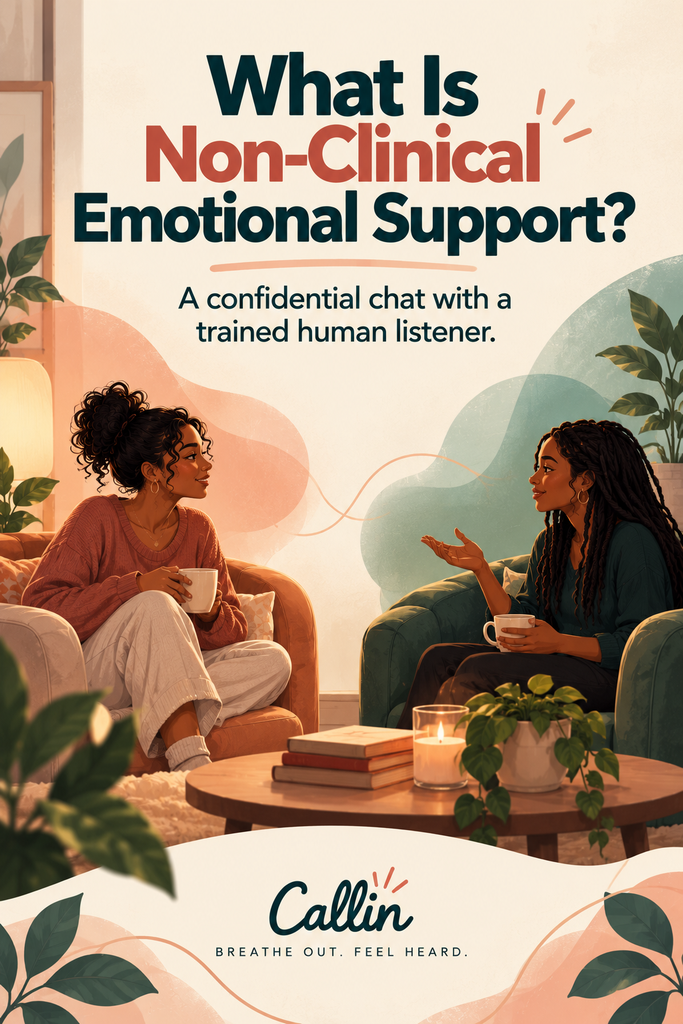
And sometimes they simply need another human being who has the time and space to listen.
Non-clinical emotional support belongs in that last category.
What is non-clinical mental health support?
Non-clinical mental health support is human support focused on listening, emotional expression, reflection, connection and everyday wellbeing rather than clinical diagnosis or treatment.
A person using non-clinical support might be dealing with loneliness, stress, uncertainty, burnout, heartbreak, a difficult transition, workplace pressure, academic pressure or emotions they have been keeping to themselves.
They do not necessarily have a mental health diagnosis.
They may not want therapy.
They may not be in crisis.
They may simply be thinking:
“I need someone to talk to.”
That is an important distinction.
Needing emotional support does not automatically mean that someone needs a clinical intervention. At the same time, non-clinical support should never pretend to provide something that belongs within clinical care.
The useful question is not whether one type of support is “better.”
It is:
What kind of support matches what I actually need right now?
What does non-clinical emotional support look like?
In practice, non-clinical emotional support is usually a conversation.
The person seeking support talks about what is happening in their life, what they are feeling, what has been difficult, or what they have been carrying privately.
A trained listener may listen actively, reflect what they are hearing, ask appropriate questions and give the person room to think out loud.
The purpose is not to diagnose the person.
It is not to determine which disorder they have.
It is not to prescribe treatment.
It is not to force the conversation towards a solution.
It is to provide a supportive human presence while the person talks through what is happening.
At Callin, a conversation may involve someone talking about:
- Feeling lonely despite having people around them
- Workplace stress or burnout
- Relationship difficulties
- Moving to a new country
- Feeling overwhelmed
- Uncertainty about the future
- Academic pressure
- Difficult emotions
- A major life transition
- Family or friendship difficulties
- Feeling emotionally exhausted
- Overthinking
- Heartbreak
- Simply needing somewhere to say what they have been carrying
The listener’s role is not to decide what is “wrong” with the person.
It is to listen, create space for the person to speak, reflect what they are hearing and offer a supportive human presence.
That distinction is central to understanding non-clinical support.
Is non-clinical mental health support the same as therapy?
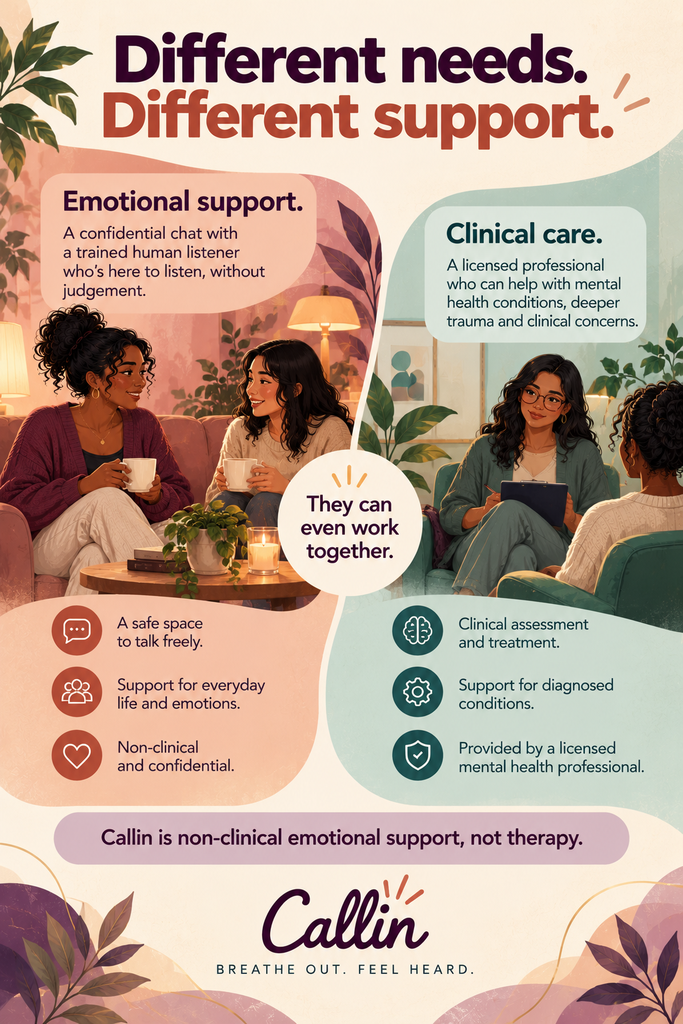
No. Non-clinical emotional support and therapy serve different purposes.
Therapy is a form of clinical or psychotherapeutic care delivered within a professional therapeutic framework. Depending on the type of therapy and the person’s needs, it may involve assessment, formulation, therapeutic interventions, treatment planning and work on mental health conditions or psychological difficulties.
Non-clinical emotional support is different.
It focuses primarily on human connection, listening, emotional expression, reflection and having a place to talk.
Neither is automatically better.
They simply answer different needs.
Non-clinical emotional support may be appropriate when:
- You want someone to listen.
- You feel lonely or disconnected.
- You need to talk through a difficult day.
- You are overwhelmed by everyday pressures.
- You want a sounding board.
- You are going through a life transition.
- You need somewhere to vent without involving someone personally close to you.
- You are not looking for diagnosis or clinical treatment.
Therapy or clinical care may be more appropriate when:
- You want assessment or diagnosis.
- You need treatment for a mental health condition.
- You are experiencing persistent symptoms that are significantly affecting your life.
- You need structured psychological treatment.
- You need trauma-focused clinical care.
- You need medication assessment or management.
- A healthcare professional has recommended clinical treatment.
The two can also coexist.
Someone may use non-clinical emotional support while receiving therapy, for example, because the two conversations serve different purposes.
Callin’s existing guide to affordable emotional support options explores some of the different forms of support available when therapy is not the only option.
Can I talk to someone without going to therapy?
Yes. You can look for emotional support without entering therapy.
Therapy is one form of support, but it is not the only way to have a meaningful conversation about difficult emotions or everyday life.
You might be thinking:
“I don’t know if I need therapy. I just need someone to talk to.”
Or:
“I don’t think something is seriously wrong. I’m just overwhelmed.”
Or:
“I have people in my life, but I don’t feel comfortable talking to them about this.”
Or simply:
“I’m lonely.”
Those are legitimate reasons to look for human connection.
Depending on your circumstances, options can include talking to a trusted friend or family member, joining a community or peer-support group, using a warmline, speaking with a trained listener, accessing professional mental health care, or combining several types of support.
If you are specifically looking for online support, Callin’s guide to online emotional support explores what it can look like to find a human space to talk without turning every difficult experience into a clinical appointment.
Who provides non-clinical emotional support?
Non-clinical emotional support can be provided through different models.
These can include trained peer supporters, trained listeners, community organisations, support groups and dedicated emotional support services.
The training, scope and safeguarding standards can vary significantly between services.
That is why it is important to look at what a service actually says it provides.
A responsible non-clinical support service should be clear about:
- Who provides the support
- What training or standards listeners follow
- What the service can and cannot help with
- How privacy and confidentiality work
- Whether conversations are one-off or ongoing
- Whether you can speak with the same person again
- What happens if your needs fall outside the service’s scope
- How the service handles urgent or crisis situations
Non-clinical support becomes more trustworthy, not less, when it is honest about its limitations.
What is the difference between a listener and a therapist?
A listener provides non-clinical emotional support through listening, reflection and human connection.
A therapist provides clinical or psychotherapeutic care within their professional scope.
A listener does not diagnose a mental health condition or provide clinical treatment.
A therapist may assess psychological difficulties and use therapeutic interventions as part of treatment.
This distinction is particularly important because the words “mental health support” and “mental health treatment” are sometimes used interchangeably online.
They should not be.
Someone can benefit from emotional support without needing mental health treatment.
Someone can also need mental health treatment while benefiting from additional emotional support.
The appropriate response depends on the person’s needs.
When might someone want non-clinical emotional support?
There are many ordinary situations in which someone may want another human being to talk to without needing clinical treatment.
You might want non-clinical emotional support if:
You feel lonely
You may have friends, family, colleagues or a partner and still feel emotionally disconnected.
Loneliness is not simply the absence of people. It can involve feeling that the quality or depth of your connections does not match what you need.
You are overwhelmed
Work, relationships, finances, university, family responsibilities and uncertainty can accumulate.
Sometimes you need somewhere to put all of those thoughts before deciding what to do about them.
You do not want to burden your friends
Friends can be wonderful sources of support, but personal relationships have their own emotional dynamics.
You may worry that you have talked about the same issue too many times.
You may also want to talk about something involving the person you would normally call.
A separate listening space can give you somewhere to speak without having to manage a friend’s reaction at the same time.
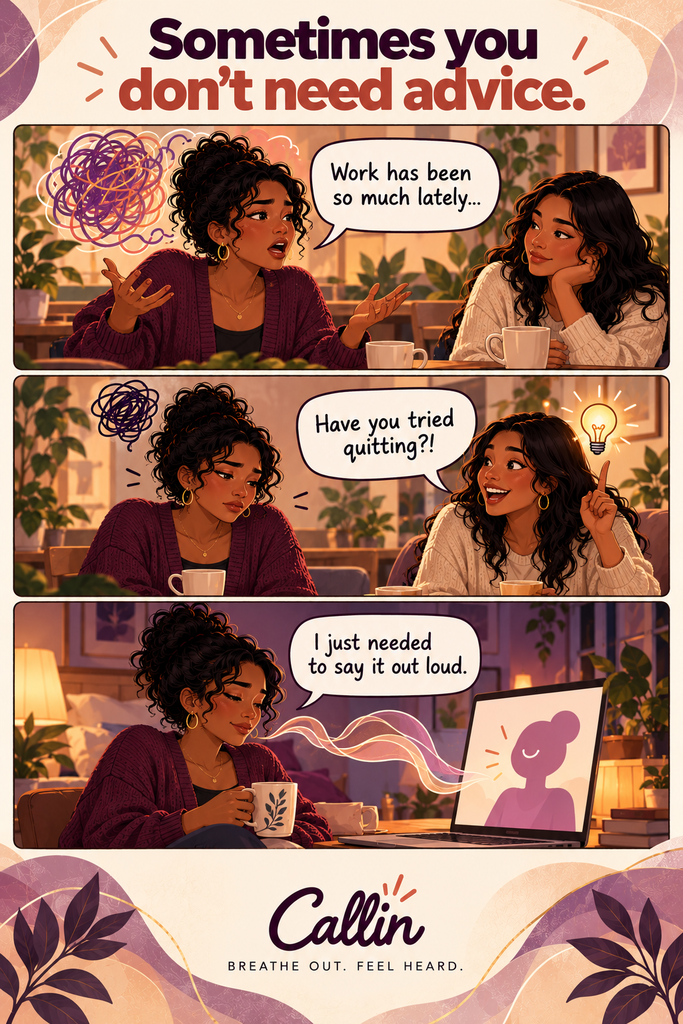
You want to vent without being given advice
Sometimes you know what you need to do.
You just need to say it out loud.
People often give advice because they want to help, but advice is not always what the person speaking is asking for.
Callin has explored this distinction in Why People Give Advice When You Just Want to Vent.
You are carrying too much alone
You may have become the person everyone else talks to.
You listen to friends.
You support your family.
You show up at work.
You help everyone else process their problems.
And then you realise you have nowhere to put your own.
That is one reason a dedicated listening space can be useful.
You are going through a transition
Moving countries, changing jobs, starting university, ending a relationship, becoming a parent, starting a business or entering a completely different phase of life can create emotional pressure even when the change is positive.
You do not need to be in crisis for a transition to feel difficult.
Is non-clinical support useful for loneliness?
Yes. Non-clinical emotional support can provide human connection for someone experiencing loneliness, although it does not replace the longer-term relationships and community connections that may also be important.
This distinction matters.
A listening session can give someone a person to talk to today.
It does not automatically create a friendship, family network or community.
Longer-term loneliness may benefit from building repeated social contact through friendships, groups, volunteering, community activities or other forms of connection.
The goal is not to make one listener responsible for someone’s entire emotional life.
The goal is to make human support easier to access.
For people specifically looking for continuity, Callin’s guide to ongoing online emotional support from the same person explains why some people prefer returning to a familiar listener rather than starting from the beginning every time.
Why might someone prefer talking to the same listener?
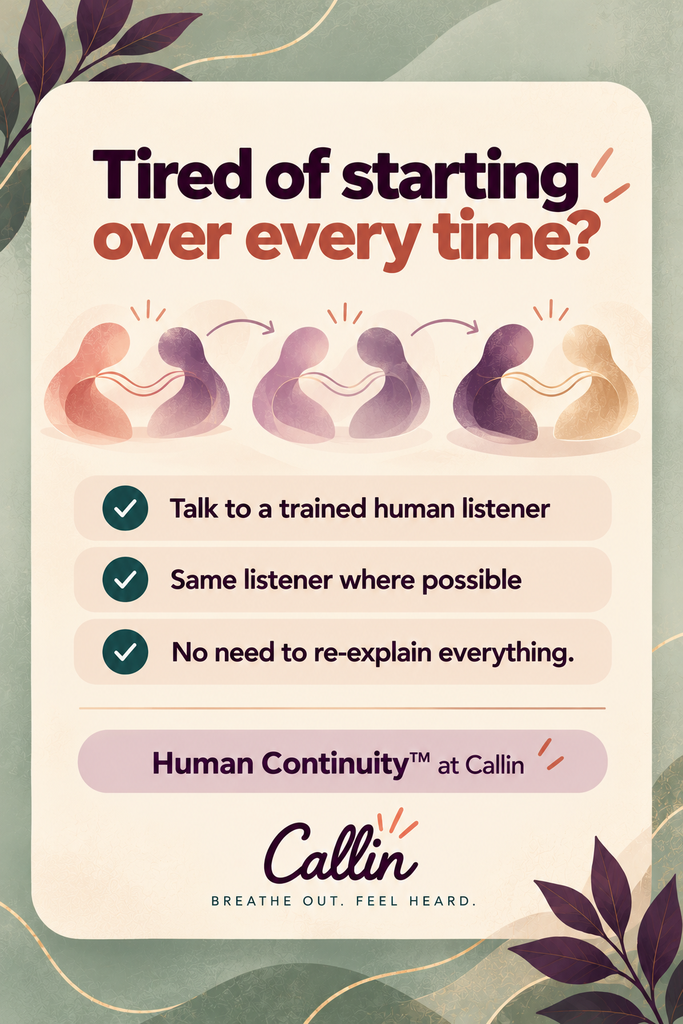
Starting over can be exhausting.
You explain the breakup.
You explain the situation at work.
You explain the family dynamic.
You explain why something that sounds small to another person does not feel small to you.
Then the next time you need support, you may have to explain it all again.
Continuity can reduce that emotional effort.
At Callin, Human Continuity™ means the service aims to provide the same listener where operationally possible.
That does not mean continuity is automatically better for everyone.
Some people prefer different perspectives or occasional one-off conversations.
For others, familiarity makes it easier to open up.
The important point is that people should understand what kind of support they are actually receiving before they choose a service.
Is non-clinical support the same as peer support?
Not necessarily.
The terms can overlap, but they are not interchangeable in every context.
Peer support generally refers to support grounded in shared experience or a peer relationship. Depending on the organisation, peer supporters may be trained and may provide structured support.
Non-clinical emotional support is a broader description of support that does not involve clinical diagnosis or treatment.
A service can therefore describe itself as providing non-clinical emotional support without claiming to provide clinical mental health care.
Callin uses the term non-clinical emotional support to make its scope clear: human conversation, listening and emotional support without diagnosis, therapy, psychiatric care or emergency intervention.
For readers comparing different options, Callin’s guide to what a warmline is and how crisis lines differ from peer support provides another useful distinction.
What is a warmline, and is it the same as non-clinical support?
A warmline is generally a peer or emotional-support telephone or messaging service intended for people who want someone to talk to but are not experiencing an emergency requiring crisis intervention.
Warmlines and crisis lines therefore serve different purposes.
A crisis line is designed for people experiencing a crisis or immediate risk.
A warmline generally provides non-crisis emotional support.
A dedicated non-clinical listening service can overlap with the supportive purpose of a warmline while offering a different model, such as scheduled one-to-one conversations or ongoing continuity.
The important thing is not the label.
It is knowing what the service actually provides.
What can I talk about with a non-clinical listener?
There does not have to be one particular “type” of problem.
A conversation might be about:
- Loneliness
- Stress
- Burnout
- Overthinking
- Heartbreak
- Relationship difficulties
- Workplace pressure
- Academic pressure
- Moving or starting over
- Family difficulties
- Feeling overwhelmed
- Uncertainty
- A difficult decision
- A major life change
- Something that happened that you cannot stop thinking about
- Or simply needing to hear your own thoughts out loud
You also do not have to arrive with a perfectly organised explanation.
Sometimes you only know:
“Something feels wrong and I need to talk.”
That can be enough to start.
Is venting the same as trauma dumping?
No.
Venting and trauma dumping are often treated as though they are the same thing online, but the distinction is more nuanced.
Venting is generally a bounded conversation in which someone shares difficult feelings while remaining aware of the other person’s capacity and the nature of the interaction.
Trauma dumping is a popular, non-clinical term generally used for intense, unbounded or unsolicited disclosure that overwhelms the person receiving it.
The subject matter alone does not determine the difference.
Consent, boundaries, context and reciprocity matter.
If you want to understand the distinction in greater depth, see Trauma Dumping vs. Venting: The Real Difference Explained.
A dedicated listening service can also provide an alternative to repeatedly relying on friends who may not have the capacity for a difficult conversation.
Why does having a safe space to vent matter?
Holding everything in can become exhausting.
You may spend your day functioning normally while privately carrying a growing backlog of thoughts and emotions.
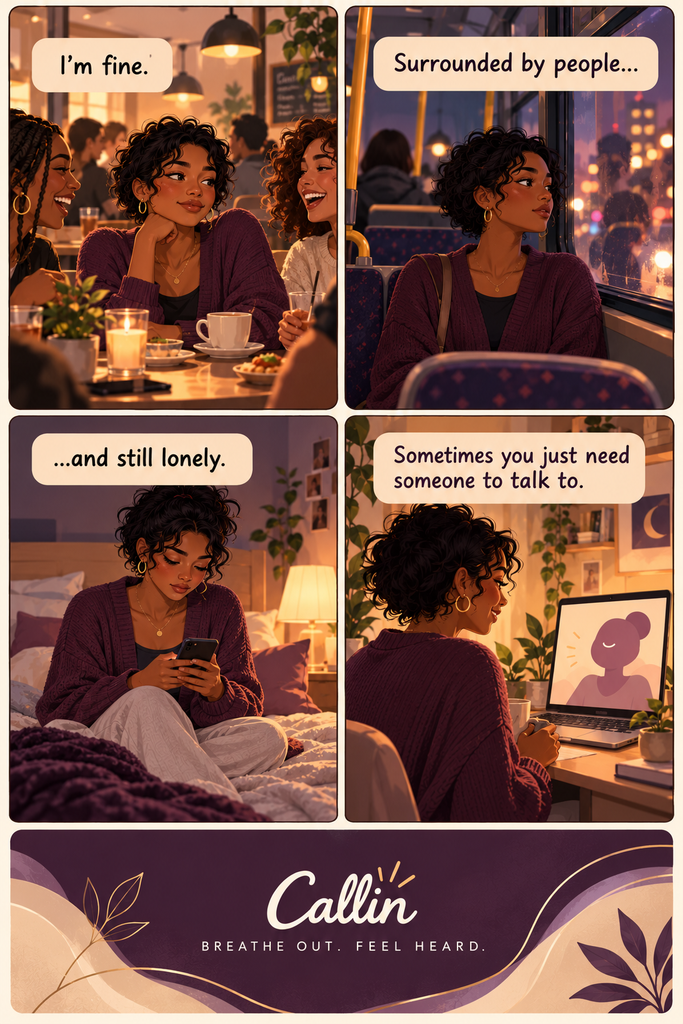
You say “I’m fine” because you do not want to burden anyone.
You move on because there is work to do.
You answer messages.
You attend meetings.
You keep going.
And then, when everything becomes quiet, everything you did not say comes back.
Having a space where you can speak openly can give those thoughts somewhere to go.
That does not mean venting automatically solves a problem.
It means conversation can create space for reflection, emotional expression and human connection.
Callin’s guide to why a safe space to vent matters for your wellbeing explores this further.
You can also read Looking for a Safe Space to Vent Online? Why Holding It In Is Draining You for a more detailed look at why people sometimes find it difficult to talk openly with the people closest to them.
How does non-clinical support work at Callin?
Callin provides online, non-clinical emotional support through conversations with trained human listeners.
The basic process is simple.
You book a session.
You speak with a trained human listener.
You have space to talk about what is happening in your life.
The listener provides a supportive, non-clinical conversation.
Where operationally possible, Human Continuity™ allows clients to return to the same listener rather than starting from zero every time.
The conversation can be about loneliness, stress, overwhelm, relationships, life changes, workplace pressure, academic pressure or simply something that has been sitting heavily on your mind.
The listener’s role is not to diagnose you or provide clinical treatment.
Callin does not provide therapy, psychiatric care, medical treatment, emergency intervention or crisis support.
It is a human listening service for people who want somewhere to talk.
Callin’s safe space to vent guide explains more about the experience and the principles behind its listening model.
What makes Callin different from talking to a friend?
Friends matter.
Nothing in non-clinical emotional support should suggest otherwise.
But friendship and dedicated emotional support serve different purposes.
A friend is personally involved in your life.
They have their own feelings about what you are telling them.
They may have their own problems.
They may want to protect you.
They may immediately start suggesting what you should do.
A dedicated listener has a different role.
The purpose of the conversation is to give you space to talk.
That can be particularly useful when you do not want to burden someone you love, when the issue involves someone close to you, or when you simply want a neutral human presence.
This is not about replacing friendship.
It is about giving people more than one place to be heard.
When is clinical or emergency support more appropriate?
Non-clinical emotional support is not a substitute for clinical or emergency care.
You should consider professional mental health or medical support when you need diagnosis, assessment, treatment, medication management, specialist intervention, or structured therapy.
If you are experiencing a mental health emergency, are in immediate danger, or believe you may harm yourself or someone else, a crisis or emergency service is more appropriate than a non-clinical listening service.
Callin is not a crisis line.
It is not an emergency service.
It does not provide psychiatric care.
It does not diagnose mental health conditions.
This boundary is part of responsible emotional support.
Prevention and early support also matter. You do not have to wait until a situation becomes a crisis before seeking appropriate support. Callin explores this idea in Suicide Prevention Month: Prevention Starts Before Crisis.
For people in immediate danger, contact the appropriate emergency or crisis service in your country.
What should I look for in a non-clinical emotional support service?
If you are considering a listening service, look beyond the words used in its marketing.
Ask:
Who am I actually speaking to?
You should be able to understand whether you are speaking with a trained listener, peer supporter, therapist, coach, volunteer or another type of provider.
What can they help me with?
A trustworthy service should explain its scope clearly.
What can they not help me with?
Clear boundaries are a positive sign.
How does privacy work?
You should understand how your information and conversations are handled.
Will I speak to the same person again?
If continuity matters to you, check whether it is actually offered.
What happens if I need more support than the service can provide?
A responsible service should be able to explain where its boundaries end.
You should never have to guess what kind of support you are buying.
Is Callin a therapy service?
No. Callin is not a therapy service.
Callin provides online, non-clinical emotional support through trained human listeners.
The service is designed for people who want a confidential human conversation about everyday emotional difficulties, loneliness, stress, overwhelm, life transitions and other experiences that can feel difficult to carry alone.
Callin does not diagnose mental health conditions and does not provide therapy, psychiatric care, medical treatment, emergency intervention or crisis support.
For some people, non-clinical support may complement professional care.
For others, it may simply provide a place to talk when therapy is not what they are looking for.
The important thing is choosing support that matches the need.
Why does the distinction between types of support matter?
Because the internet has blurred many of these categories.
“Someone to talk to.”
“Emotional support.”
“Peer support.”
“Therapy.”
“Mental health support.”
“Crisis support.”
They can sound interchangeable when they are not.
A person searching for someone to talk to may not need therapy.
A person who needs therapy should not be told that a listening service is an equivalent replacement.
A person in crisis needs appropriate crisis support.
And a person experiencing ordinary but heavy emotional difficulties should not have to believe that the only legitimate reason to seek human support is having a diagnosis.
Understanding the support ecosystem helps people make better decisions.
It also makes it easier to ask a simple question:
What do I actually need right now?
Frequently asked questions
What is non-clinical mental health support?
Non-clinical mental health support is human emotional support that does not involve diagnosing, treating or clinically managing a mental health condition. It can provide listening, reflection, connection and space to talk through everyday emotional difficulties.
Is non-clinical support the same as therapy?
No. Therapy is clinical or psychotherapeutic care delivered within a professional therapeutic framework. Non-clinical emotional support focuses on listening, emotional expression, reflection and human connection without providing diagnosis or clinical treatment.
Can I talk to someone without going to therapy?
Yes. Depending on your needs, you can speak with a trusted person, peer supporter, trained listener, warmline, community group or other emotional support service. Therapy is one form of support, not the only form.
Who provides non-clinical emotional support?
Non-clinical emotional support can be provided by trained listeners, peer supporters, community organisations, support groups and dedicated emotional support services. Training, scope and safeguarding standards vary, so it is important to understand what a particular service provides.
What can I talk about with a non-clinical listener?
You can talk about many everyday emotional experiences, including loneliness, stress, overwhelm, burnout, heartbreak, relationship difficulties, workplace pressure, academic pressure, life transitions, uncertainty and difficult emotions.
Can non-clinical support help with loneliness?
Yes. A non-clinical listening service can provide human connection and a dedicated space to talk when someone feels lonely. It does not replace friendship, community or clinical care when those are needed.
Can I use emotional support if I do not have a mental health diagnosis?
Yes. You do not need a mental health diagnosis to want or benefit from an emotionally supportive conversation. Non-clinical support is specifically designed to remain outside diagnosis and clinical treatment.
When should I seek therapy instead?
Consider therapy or other clinical care when you need assessment, diagnosis, treatment for a mental health condition, structured psychological intervention, trauma-focused treatment, medication management or specialist mental health care.
What is the difference between a listener and a therapist?
A listener provides non-clinical emotional support through listening, reflection and human connection. A therapist provides clinical or psychotherapeutic care within their professional scope. A listener does not diagnose or clinically treat mental health conditions.
Is Callin a therapy service?
No. Callin is an online non-clinical emotional support service. Clients speak with trained human listeners about experiences such as loneliness, stress, overwhelm, difficult emotions and life transitions. Callin does not provide therapy, diagnosis, psychiatric care, medical treatment, emergency intervention or crisis support.
Is Callin a crisis line?
No. Callin is not a crisis or emergency service. If you are in immediate danger or experiencing a mental health emergency, contact the appropriate emergency or crisis service where you live.
Can I talk to the same Callin listener again?
Callin uses Human Continuity™ and aims to provide the same listener where operationally possible. Continuity can allow conversations to develop over time without requiring someone to repeatedly explain their circumstances from the beginning.
The simplest way to understand non-clinical emotional support
Non-clinical emotional support exists because human beings do not only need clinical treatment.
Sometimes we need treatment.
Sometimes we need crisis intervention.
Sometimes we need practical advice.
And sometimes we need someone to sit with the mess of an ordinary difficult day and listen.
That last need is easy to underestimate.
You can be functioning.
You can be working.
You can be studying.
You can have friends.
You can have family.
You can look completely fine.
And still need someone to talk to.
Non-clinical emotional support gives that need a name.
At Callin, that means a confidential conversation with a trained human listener, without diagnosis or clinical treatment, for the everyday emotional experiences that can become surprisingly heavy when you have nowhere to put them.
You do not need to prove that you are struggling “enough.”
You simply need to know what kind of support you are looking for.
Callin. Breathe out. Feel heard.
Sources and further reading
For readers who want to understand the wider context of loneliness, peer support and social connection, useful external evidence includes work from the World Health Organization, NHS and other established public-health and research organisations.
Callin’s related resources include:
- 8 Easy & Affordable Emotional Support Options
- Online Emotional Support: Define Success on Your Own Terms
- What Is a Warmline? Crisis Lines vs Peer Support
- Looking for a Safe Space to Vent: 12 Reasons Callin is Your Answer
- Where Can I Find Ongoing Online Emotional Support From the Same Person?
- Looking for a Safe Space to Vent Online? Why Holding It In Is Draining You
- Trauma Dumping vs. Venting: The Real Difference Explained
- Why People Give Advice When You Just Want to Vent
- Why a Safe Space to Vent Matters for Your Wellbeing
- Why Can’t I Open Up Even Though I Listen to Everyone Else?
- I Am So Lonely and Have Nobody to Talk To: Where Can I Get Support?
- Suicide Prevention Month: Prevention Starts Before Crisis
Educational disclaimer: This article is for general educational purposes. It does not constitute medical or clinical advice. Non-clinical emotional support is not a replacement for appropriate professional, medical, psychiatric, crisis or emergency care.