
Short answer: When an employee is struggling, find a private moment, say what you have noticed without guessing the cause, and ask an open question such as “How are things for you at the moment?”
Then listen more than you speak. Thank them for telling you, agree what stays confidential, ask what would help at work, and signpost them to confidential support so you are not carrying everything alone.
Non-clinical emotional support is a private conversation with a trained listener who offers attention, empathy and a space to think, without diagnosis, treatment or therapy.
Signposting means pointing someone towards services that can help, such as an employee assistance programme, a GP, a medical doctor, or a support line, and leaving the choice to use them with that person.
Callin offers non-clinical emotional support. It is not therapy, counselling, diagnosis, medical care, or crisis or emergency support. If you or someone you are supporting is in immediate danger, contact local emergency services now, or find a free helpline in your country at findahelpline.com.
Key takeaways
- You do not need to be a mental health expert. Acas says managers should not be expected to be, but knowing what support exists can help.
- Start with what you have noticed, not what you think is wrong. Describe changes; never diagnose.
- Choose a private place, offer flexible timing and open with a warm, open question.
- Listening is the main skill. Thank them for opening up and let silences happen.
- Agree what will stay private and what, if anything, will be shared. Be honest that safety concerns are the exception.
- Your role is to support the person at work, adjust what you reasonably can and signpost. It is not to become their counsellor or only source of support.
- Confidential external support, such as an EAP, a GP or a non-clinical listening service like Callin, can help the employee and protect your boundaries too.
How do you recognise an employee is struggling without making assumptions?
You recognise struggle by noticing changes in how someone is working or connecting, not by guessing what is going on inside them. Your job is to notice and ask, not to diagnose or decide the cause.
Changes might include someone going quiet in meetings, missed deadlines, more short-notice absence, a sharper tone or longer hours online. None of these prove anything on their own.
It can help to hold three cautions in mind:
- Notice patterns, not single days. Everyone has an off week. A change that lasts or keeps returning is more worth a gentle check-in.
- Do not diagnose. Avoid labels such as “depressed”, “burnt out” or “anxious” unless the employee uses them first. The Callin guide to workplace mental health support for employees makes the same point: a useful conversation does not require a manager to diagnose anything.
- Do not assume the cause is personal, or that it is work. Acas reminds employers that factors outside of work could also have an impact on someone’s mental health, such as a bereavement. Equally, the cause may sit in the job itself.
If the pressure comes from workload, unclear roles or a difficult team dynamic, a kind conversation is a start, not a fix. The Health and Safety Executive’s Stress Talking Toolkits are designed to help managers talk with workers about the causes of work-related stress and possible solutions. Our piece on why workplace stress needs more than wellness programmes explores this further.
Remote and hybrid teams need extra care, because the signs are easier to miss. Remote work loneliness can build quietly behind a reliable stream of emails.
How do you start a supportive conversation with a struggling employee?
Start in private, at a time that suits them, with an open question and genuine attention. Acas advises that if you believe a worker has poor mental health, you should arrange a conversation as soon as possible, and that you should talk in private, be flexible about when and where, and approach it positively and supportively.
Practical ways to set the conversation up well:
- Pick the right place. A quiet room, a walk, or a one-to-one video call with no one else in earshot. Avoid open-plan desks or the end of a team meeting.
- Offer choice. Acas suggests adapting to each person, for example asking someone working from home whether they would rather talk by phone, video or another way.
- Protect the time. Do not squeeze it between two meetings.
- Ask open questions. Questions starting with “how” or “what” invite more than a yes or no. Acas suggests keeping questions open ended to help understand what is going on.
- Listen more than you speak. Reflect back what you hear, allow pauses and resist jumping to solutions.
Acas also notes that someone may not feel comfortable talking straight away. Letting them know the door stays open, and arranging a follow-up if concerns continue, can matter as much as the first conversation.
If you would like to strengthen your own listening, our guide to active listening and feeling heard covers the basics in plain language. The World Health Organization recommends manager training that helps managers recognise and respond to people experiencing emotional distress and builds skills such as open communication and active listening.
What should you say to an employee who is struggling? Sample scripts
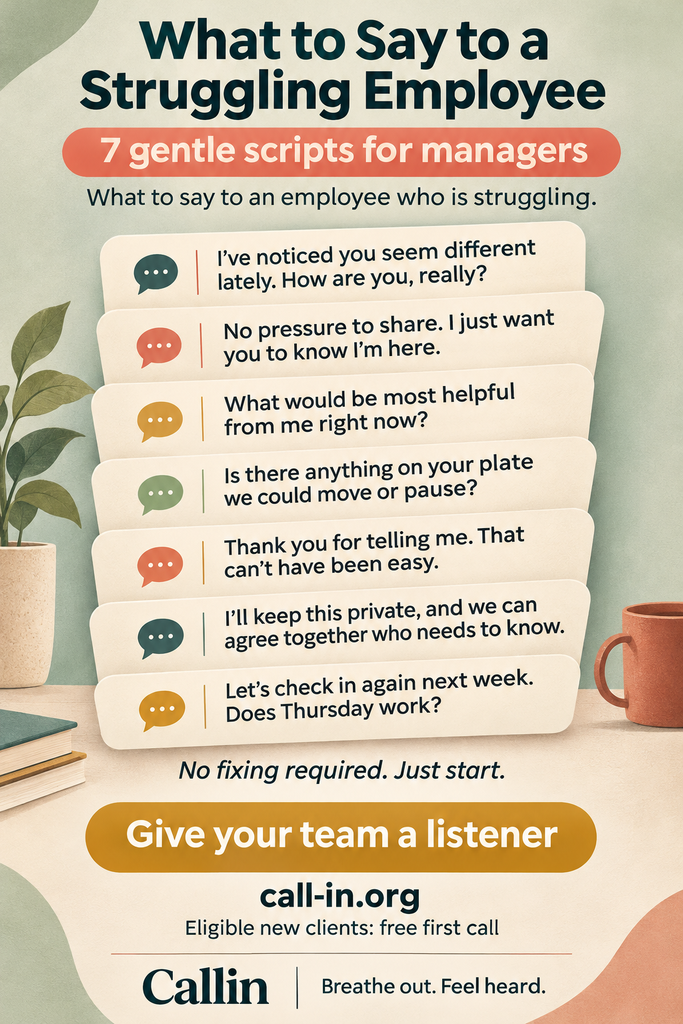
Say something short, specific and kind: what you have noticed, that you care, and that you are open to listening. The scripts below are starting points; put them in your own words so they sound like you.
1. The gentle opener
“I wanted to check in with you. You’ve seemed a bit quieter in the last few weeks, and I just wanted to ask how things are for you at the moment. There’s no agenda here; I’m happy to listen.”
2. When you have noticed a change in work
“I’ve noticed a couple of deadlines have slipped lately, which isn’t like you. I’m not raising it to criticise. I wanted to ask how you’re doing, and whether anything about your workload or how we’re working is making things harder.”
3. When they open up
“Thank you for telling me. I know that can’t have been easy. Take as much time as you need. Would it help more right now for me to listen, or to think through some practical next steps together?”
4. Warmly naming your role and the support available
“I really want to help where I can. As your manager, the things I can do are look at your workload, your hours and anything at work that might make this easier. I also want you to have somewhere confidential to talk, so let me tell you about the support we have, and you can choose what feels right.”
5. Explaining confidential external support
“We offer confidential support outside the team. It’s a private space to talk with someone trained to listen, and what you say there isn’t reported back to me. You don’t need my permission to use it, and you can still come to me whenever you want.”
6. When they don’t want to talk yet
“That’s absolutely fine. You don’t have to share anything you’re not ready to. I just want you to know the door is open, and I’ll check in again next week if that’s OK.”
7. Agreeing next steps
“So, to recap: we’ll move the report deadline to the end of the month, and you’ll have a look at the support details I’ve sent. Shall we catch up again on Thursday? And is there anything you’d like me to keep between us, or anything you’d like me to pass on?”
These scripts describe rather than diagnose, leave the employee in control and present support as a choice. Acas suggests you could also agree to take time to think through what you have discussed before making any decisions, which takes pressure off both of you.
What to avoid saying to an employee who is struggling?
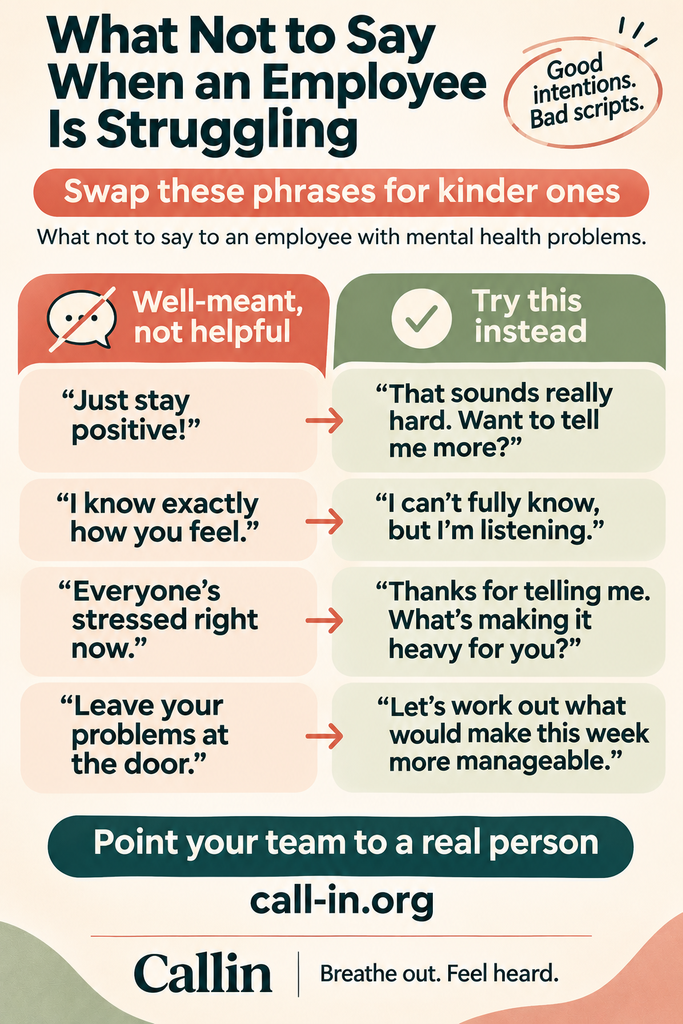
Avoid anything that minimises, diagnoses, compares or rushes the person. Well-meant phrases can still leave someone feeling unheard.
- “Everyone’s stressed at the moment.” It may be true, but it dismisses their experience and can shut the conversation down.
- “You seem depressed” or “Is this burnout?” This is a diagnosis, and it is not yours to make. Describe what you have seen instead.
- “I know exactly how you feel.” You might not, and the focus moves to you. Try “That sounds really hard” instead.
- “Have you tried yoga or getting more sleep?” Unsolicited fixes can sound like the problem is their fault.
- “You need to manage your time better.” This frames struggle as a performance issue before you understand it.
- “Don’t worry, I won’t tell anyone.” You may not be able to keep that promise if there is a safety concern. Be honest about limits instead.
- “Suffering from mental health issues.” Acas encourages sensitive language; for example, “someone who has concerns related to their mental health” rather than “suffering from mental health issues”.
If you say something clumsy, “I don’t think I put that well” can repair a great deal.
What should you keep confidential, and what are the limits?
Keep what the employee tells you private by default, share only with their permission, and be clear from the start that genuine safety concerns are an exception.
Acas advises reassuring the person that you will not share anything they tell you without their permission unless there is a good reason to, and if there is, being clear about who you will share it with and why.
In practice, that means:
- Ask before sharing anything. Agree together what, if anything, goes to HR, a senior leader or the team. Something like “Would you like the team to know anything, or shall we just say you’re on leave?” keeps them in control.
- Share the minimum needed. If HR needs to know about an adjustment, they may not need the personal story behind it.
- Store notes carefully. Health information counts as special category data under UK and EU GDPR. Follow your organisation’s policy and keep only what you need.
- Be honest about safety exceptions. If you believe someone is at serious risk of harm, you may need to involve others. Say so kindly, and tell them who you will contact.
- Explain how external support is private. Acas suggests reassuring employees that conversations with external support, such as an EAP, will be confidential, while letting them know they can still talk to you.
Rules differ by country, sector and contract, so check your own policies and take qualified local advice where needed. For transparency about how Callin handles information, see the Callin Privacy Policy and Community Standards. Callin does not create clinical records, and confidentiality there also has legal and safeguarding limits.
What are managers responsible for, and what are they not?
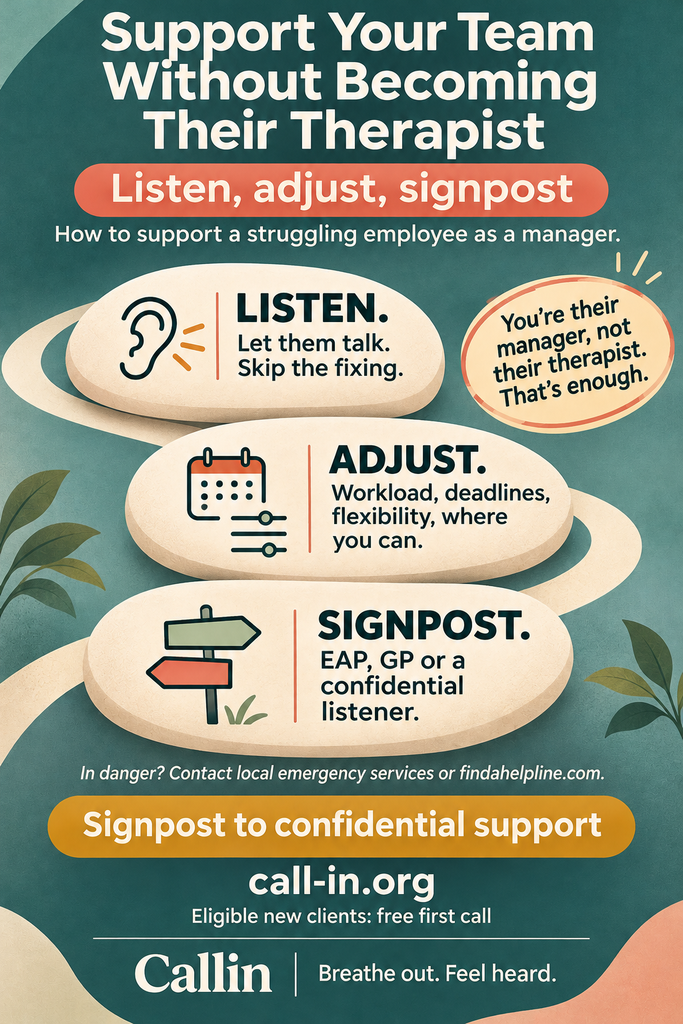
You are responsible for noticing, listening, making reasonable changes at work and signposting to support. You are not responsible for diagnosing, treating or being someone’s only source of emotional support.
What you can reasonably own:
- Checking in regularly. Acas suggests keeping regular contact with your team about how they are feeling and how their work is going.
- Listening without judgement and taking what they say seriously.
- Looking at workload, deadlines, hours and working arrangements.
- Considering adjustments. Acas notes that if a worker’s mental health problem is a disability, or could reasonably be believed to be one, reasonable adjustments must be made under UK law. Even when it is not, small changes can still help.
- Knowing what support your organisation offers and telling people about it.
- Following your organisation’s policies and escalating concerns appropriately.
What is not yours to carry:
- Diagnosing or deciding whether someone “needs therapy”.
- Providing counselling or ongoing emotional support yourself.
- Being available at all hours, or solving every problem in someone’s life.
- Pressuring anyone to disclose health information.
Holding these boundaries keeps support sustainable for both of you. Callin’s own guidance for organisations puts it simply: a good manager can care without becoming someone’s therapist, counsellor or entire emotional support system. Acas also reminds managers that supporting others can be a challenge, so look after your own wellbeing too.
For small teams without an HR department, our guide to setting up mental health support in a small company offers practical steps.
When should you involve HR, occupational health or clinical support?
Involve HR or occupational health when someone may need adjustments, time off or a formal process, and encourage clinical support when difficulties persist or affect daily life. If there is immediate risk to someone’s safety, contact emergency services straight away.
HR can help with policy, absence, adjustments, return-to-work plans and making sure you are treating people fairly and consistently. Talk to the employee about what you will share first, wherever possible.
Occupational health, if your organisation has access to it, can advise on fitness for work, adjustments and phased returns. Referrals usually work best when the employee understands and agrees to them.
Clinical support means a GP or other healthcare professional, therapy or counselling. If an employee’s difficulties are lasting, worsening or affecting sleep, eating or daily functioning, you can gently encourage them to speak to their GP or doctor. Acas lists speaking to a GP, occupational health or a trusted friend or family member as routes to encourage if you think a worker is at risk.
Emergency services come first if there is immediate danger. Acas states that if someone is in immediate danger, call 999 in the UK. Elsewhere, use your local emergency number, such as 112 across the EU, 911 in the US and Canada, or 000 in Australia. Acas gives an example of the duty of care in practice: a manager staying on the phone with someone until help reaches them.
Once the person is safe, Acas suggests thinking about how to support them going forward, including following your absence policy and agreeing how you will keep in touch.
How do you signpost an employee to confidential external support?
Signpost by sharing a short list of options, explaining briefly what each one is for, and leaving the choice with the employee. Sending the details in writing afterwards helps, because people rarely remember everything in a difficult conversation.
A simple signposting list might include:
- Your EAP, if you have one. Acas notes that some organisations offer counselling through an employee assistance programme. If you are unsure what an EAP covers, see what an employee assistance programme is and how it works.
- Their GP or healthcare provider. For anything that may need assessment, treatment or medical advice.
- Crisis lines. In the UK, Acas points to services such as Samaritans and Shout. The NHS explains where to get urgent help for mental health. Anywhere in the world, findahelpline.com lists free, confidential helplines by country.
- Non-clinical emotional support. For everyday emotional weight such as work stress, loneliness, life changes or simply needing to talk, a confidential listening service can help. Read what non-clinical mental health support means and what a listening service is.
Different services meet different needs. Our comparison of EAPs, therapy and emotional support can help you explain the options clearly, and how Callin complements an EAP covers why some employees want another place to talk.
How can Callin support your employees so you don’t have to carry it alone?
Callin gives eligible adult employees a confidential, non-clinical place to talk with a trained human listener, by voice, video or private chat. That means your employee has somewhere to turn outside the team, and you can focus on what a manager can change at work.
What employers and employees can expect, from Callin’s official pages:
- Trained listeners. Callin listeners complete mandatory Psychological First Aid training from Johns Hopkins University and follow Callin’s active-listening materials and internal protocols on boundaries, safeguarding and signposting.
- Clear scope. If something suggests a need for clinical, specialist or urgent support, the listener may explain that boundary and signpost onwards.
- Privacy. Sessions are confidential, Callin does not create clinical records, and the content of an employee’s conversations is not shared with their employer. Information is handled in line with GDPR and safeguarding obligations.
- Human Continuity™. Callin prioritises keeping clients with the same trained listener wherever possible, so people do not have to start their story again each time. Learn more about ongoing support with the same person.
- More than listening. Callin also offers career coaching and student or accountability coaching, which can help when struggle is tied to career direction or motivation.
- An easy first step. Eligible new clients can start with a free first session. See what happens in a Callin first session.
Callin can sit alongside your EAP, occupational health and clinical pathways; it does not replace them, or your organisation’s safeguarding and emergency responsibilities. If you are weighing options for a growing team, our guide to EAP options for startups and small businesses and our piece on who to talk to about work burnout that is not therapy may help. Supporting people early, before pressure builds, is the idea behind preventive emotional care.
A next step for decision-makers: if you would like your managers to have somewhere confidential to signpost, you can make an employer enquiry or discuss a three-month pilot. You can also read more about workplace mental health support for employees. Individuals can find support directly through Callin’s non-clinical emotional support service.
FAQs
What is the first thing to say to an employee who seems to be struggling?
A simple, private, open question is usually the best start, such as “I wanted to check in. How are things for you at the moment?” Mention what you have noticed, without guessing the cause, and make it clear you are there to listen rather than judge.
Should a manager ask an employee directly about their mental health?
You can ask how they are and gently mention changes you have noticed, but you should not press for a diagnosis or health details. Let the employee decide what to share. Acas advises letting people know they can talk about their mental health at any time.
Do I have to keep what an employee tells me confidential?
Wherever possible, yes. Share only with their permission and agree together what, if anything, is passed on. Be honest that if you believe someone is at serious risk, you may need to involve others, and tell them who and why.
What if an employee tells me they are not safe?
Stay with them, take it seriously and get help. If there is immediate danger, call emergency services, which is 999 in the UK. Otherwise, encourage urgent support such as a GP, NHS urgent mental health help or a crisis line via findahelpline.com.
How can I support a struggling employee without becoming their therapist?
Focus on what you can change at work, such as workload, deadlines and working arrangements, and signpost to confidential support such as an EAP, a GP or a non-clinical listening service. Warmly explaining what your role covers, and what other support exists, helps you both.
Is Callin a replacement for our EAP or occupational health?
No. Callin offers confidential, non-clinical emotional support and coaching. It can complement an EAP, occupational health and clinical care, but it does not replace them or your safeguarding and emergency responsibilities.
Can employees use Callin without telling their manager?
Callin’s organisational page states that the content of an employee’s support conversation is not shared with their employer. Individuals can also find support directly through Callin’s non-clinical emotional support service.
Most relevant UN SDG
- SDG 8: Decent work and economic growth. Supportive, well-managed conversations and fair working conditions are part of decent, safe work.
- SDG 3: Good health and well-being (supporting). Early, accessible support and clear signposting to healthcare contribute to wellbeing, within Callin’s non-clinical scope.
See also: workplace wellbeing and the UN SDGs from Callin Support.
Sources and further reading
- Acas, Supporting mental health at work (guide overview)
- Acas, Talking about mental health (private conversations, listening, confidentiality, risk, last updated 16 January 2025)
- Acas, Creating a supportive environment (being a supportive manager, regular check-ins, training managers)
- Acas, Mental health support and training (EAPs, helplines, looking after yourself)
- Acas, Reasonable adjustments for mental health
- World Health Organization, Mental health at work fact sheet (states that an estimated 12 billion working days are lost every year globally to depression and anxiety, and recommends manager training)
- World Health Organization, WHO guidelines on mental health at work
- Health and Safety Executive, Stress Talking Toolkits
- Health and Safety Executive, Work-related stress
- NHS, Where to get urgent help for mental health
- Samaritans
- Find A Helpline
- Callin, About Callin and Callin FAQ
Leave a Reply