Non-clinical mental health support is intentional, structured emotional or practical support provided by trained individuals to help people navigate psychological and emotional challenges without diagnosing, treating, or managing a clinical mental health condition.
It is not therapy. It is not psychiatric care. It is not diagnosis. It is not crisis intervention.
It is also not simply the same thing as talking to a friend.
Non-clinical mental health support describes a distinct kind of support relationship: one that is intentional, structured, human, non-diagnostic, and delivered within defined professional boundaries.
This distinction matters because people do not experience emotional difficulty in only two states: completely fine or clinically unwell.
Someone can be lonely, overwhelmed, grieving, uncertain about a decision, struggling with a difficult transition, carrying workplace pressure, questioning a relationship, or simply needing somewhere to think out loud without requiring clinical treatment.
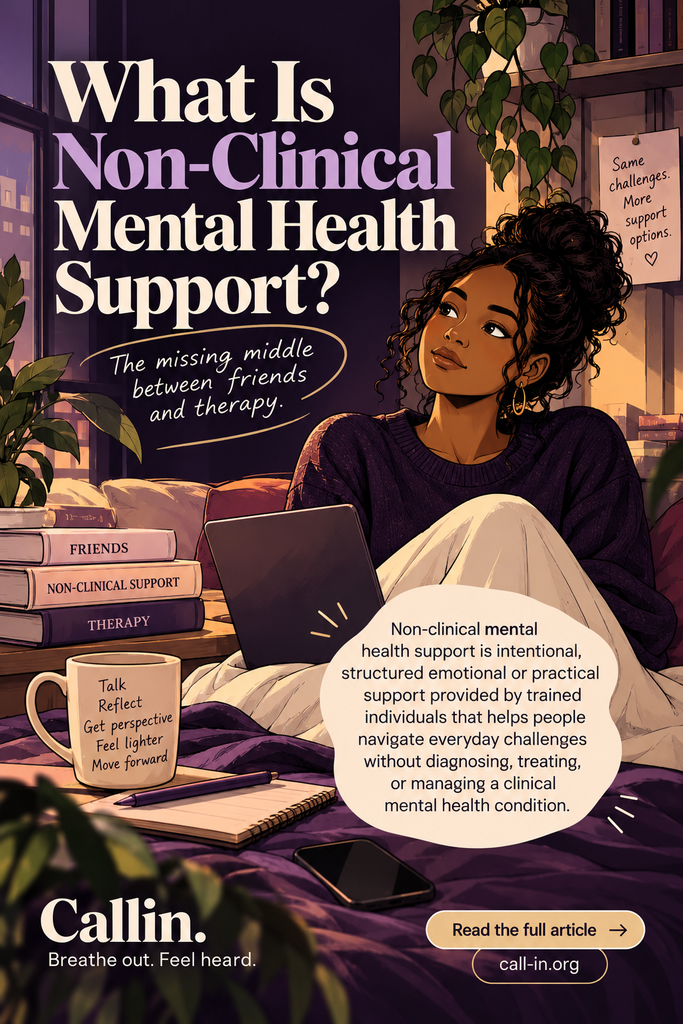
The absence of a clinical diagnosis does not mean the absence of a legitimate need for support.
That is the space this article examines.
It asks five questions:
- What exactly is non-clinical mental health support?
- How does it differ from clinical care and informal support?
- What does the evidence say about structured support delivered by trained non-specialists?
- What are the boundaries of non-clinical support?
- Where does Callin fit within this support framework?
The phrase “missing middle” is used here as an accessible description of that space. It is not presented as an established academic or medical category.
The argument is simple:
Not needing therapy does not mean needing no support.
Key Takeaways
- Non-clinical mental health support is intentional, structured emotional or practical support provided by trained individuals without diagnosing, treating or managing a clinical mental health condition.
- Non-clinical support is not therapy, psychiatric treatment, diagnosis, medical intervention or crisis care.
- Informal support from friends, family and communities remains essential, but it operates within relationships that involve shared history, reciprocity and emotional roles.
- The “missing middle” describes the space between needing clinical treatment and relying solely on existing relationships for support. It is a useful conceptual description, not an established medical classification.
- Research on trained non-specialist interventions, peer support and community-based approaches suggests that structured support can be useful when training, supervision, clear boundaries and appropriate referral pathways are present.
- Evidence for a particular intervention should not automatically be treated as evidence that every non-clinical support service produces the same outcomes.
- Non-clinical support should complement appropriate clinical care and existing human relationships rather than attempt to replace either.
For a shorter discussion of this framework, read the LinkedIn article on non-clinical mental health support and the missing middle between friends and therapy.
What Is Non-Clinical Mental Health Support?
Non-clinical mental health support is intentional, structured emotional or practical support provided by trained individuals to help people navigate psychological and emotional challenges without diagnosing, treating, or managing a clinical mental health condition.
The definition has several important parts.
Non-clinical support is intentional
The relationship exists specifically to provide support.
This distinguishes it from the spontaneous support that happens between friends, family members, partners, colleagues, neighbours, faith communities, and other existing relationships.
Non-clinical support is structured
The interaction has a defined purpose, role and set of boundaries.
It may involve active listening, reflection, emotional support, practical guidance, coaching, accountability or signposting.
The structure does not make the relationship cold or impersonal. In fact, structure can create a different kind of psychological space because both people understand what the relationship is for.
Non-clinical support is human
It is based on conversation, listening, empathy, reflection and interpersonal connection.
Technology can facilitate access, but the support itself is relational.
Non-clinical support is non-diagnostic
A non-clinical support provider does not determine whether someone has a mental health disorder.
The purpose is not to assign a diagnosis or interpret someone’s experiences as symptoms of a particular condition.
Non-clinical support is non-treatment-based
Non-clinical support does not attempt to treat or manage a clinical mental health condition.
Where someone requires clinical assessment or treatment, appropriate clinical services remain important.
Non-clinical support operates within defined boundaries
Good non-clinical support is not simply “someone who listens.”
It requires clarity about what the service can provide, what it cannot provide, when a situation needs escalation, and how safeguarding is handled.
Non-clinical support can be emotional, practical or coaching-oriented
Different forms of non-clinical support can serve different purposes.
Someone may need a confidential space to talk.
Someone else may need help thinking through a difficult decision.
Another person may need practical accountability while studying.
Another may want career guidance.
These needs are not identical, and they should not all be forced into a clinical framework.
What is non-clinical support not?
Non-clinical mental health support is not:
- psychotherapy
- psychiatric treatment
- diagnosis
- medical intervention
- crisis care
- a replacement for appropriate clinical treatment
It is a complementary form of support.
That distinction should remain clear throughout any discussion of the field.
Why Does the Distinction Between Clinical, Informal and Non-Clinical Support Matter?
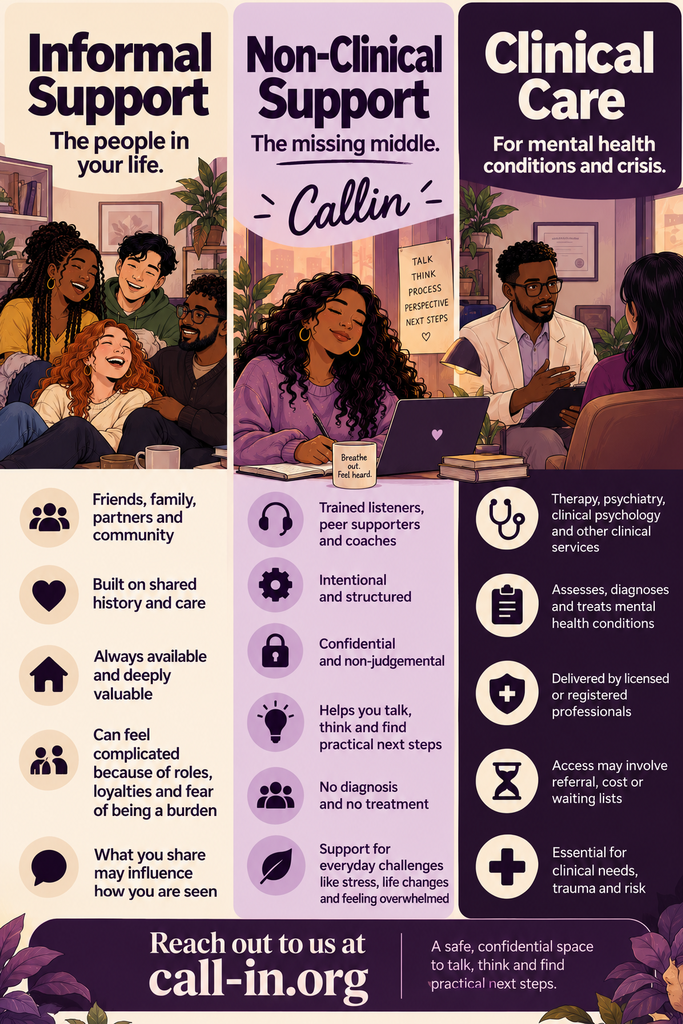
People have access to different kinds of support, and those forms of support perform different functions.
A useful way to understand the distinction is to look at three broad forms of support.
Clinical care is professional care concerned with assessment, diagnosis, treatment or management of clinical conditions.
Informal support occurs within existing relationships such as friendships, families, partnerships, communities and faith groups.
Non-clinical support is intentional and structured support provided by trained individuals without diagnosis or clinical treatment.
These categories overlap in people’s lives, but they should not be treated as interchangeable.
A person may talk to a friend, work with a coach and see a therapist at different points in the same week.
One form of support does not invalidate another.
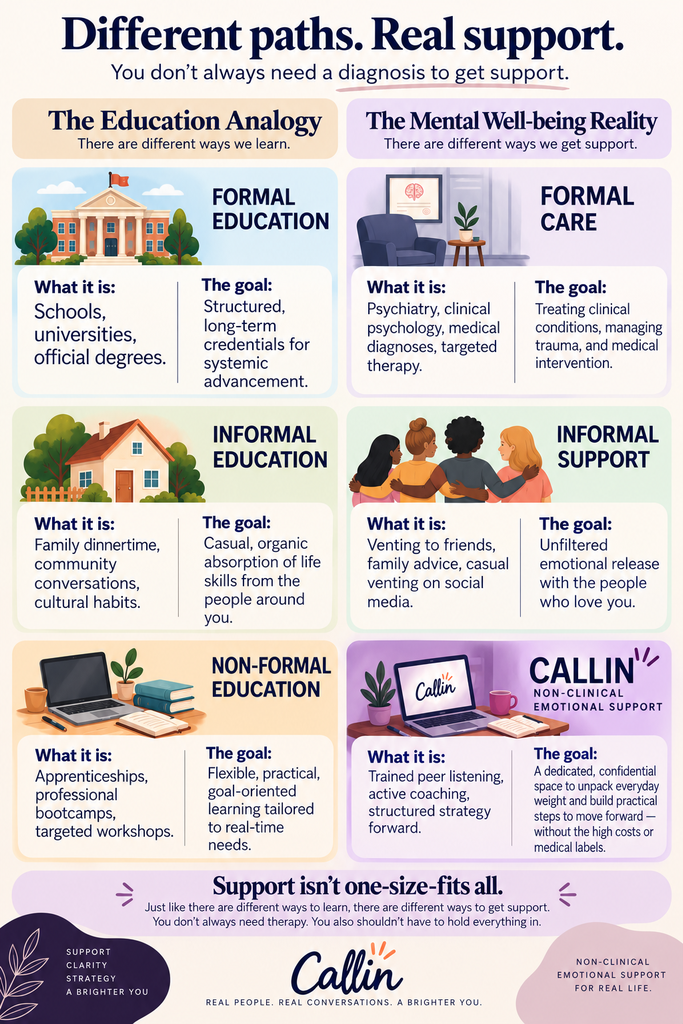
Can the Education Model Help Us Understand Mental Health Support?
Education provides a useful analogy, but it is important not to mistake the analogy for an established classification of mental health care.
Education takes different forms.
Formal education takes place through recognised institutions such as schools and universities and usually leads to recognised qualifications.
Informal education happens through family, friends, communities, culture, workplaces and everyday experience.
Non-formal education is intentional and structured but occurs outside traditional formal education. Examples include apprenticeships, workshops and targeted training.
Philip H. Coombs and Manzoor Ahmed explored the role of non-formal education outside conventional school systems in their 1974 work Attacking Rural Poverty: How Nonformal Education Can Help. UNESCO’s later classification work also distinguishes formal, non-formal and informal learning.
This provides a useful way of thinking about differences in structure, intention and setting.
Mental health support does not, however, have an identical formal, informal and non-formal taxonomy.
The framework used in this article is therefore conceptual rather than medical.
The comparison is useful because it helps explain why support does not have to exist only in two forms: informal relationships or clinical services.
The relevant distinction is:
Clinical care: professional clinical intervention involving assessment, diagnosis, treatment or management.
Informal support: emotional connection, companionship and advice within existing relationships.
Non-clinical support: intentional, structured support from trained individuals that helps people navigate emotional or psychological challenges without diagnosis or clinical treatment.
The point is not that one category is better than another.
The point is that they do different jobs.
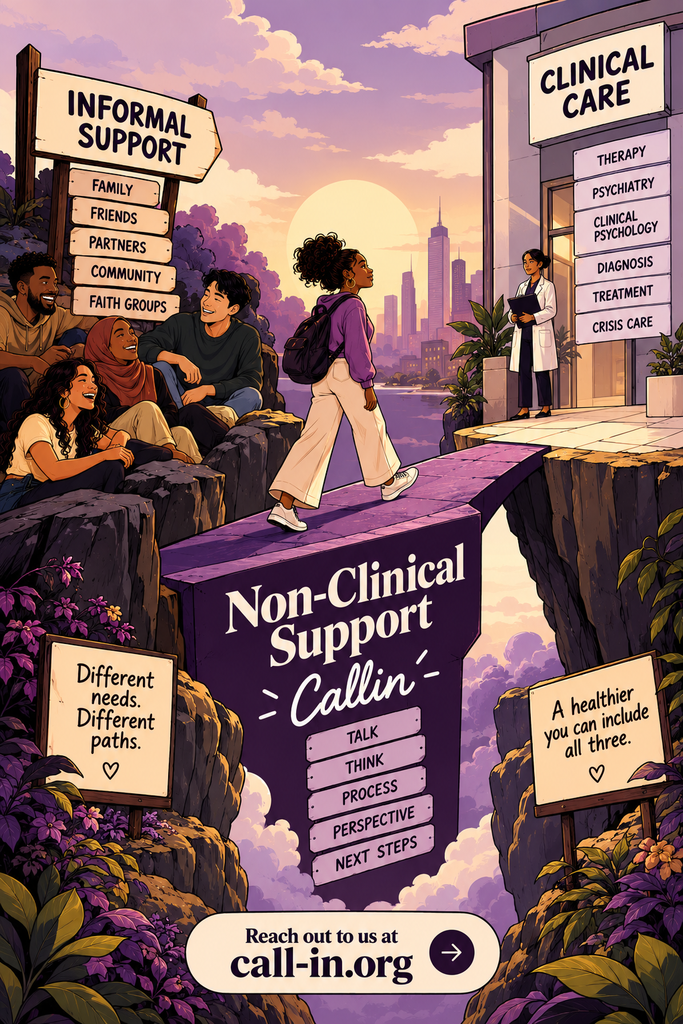
What Is the “Missing Middle” Between Friends and Therapy?
The “missing middle” is a useful description for people who need meaningful support but do not necessarily need clinical treatment.
A person can be struggling without having a clinical disorder.
They can also need more support than they currently receive from friends or family.
That creates a practical gap between:
“I need professional clinical treatment.”
and
“I’ll just talk to my friends or keep it to myself.”
Non-clinical support can occupy that space.
This does not mean that everyone who feels distressed should seek a support service rather than clinical care.
It means that emotional needs exist on a wider spectrum than the simple question of whether someone has a diagnosis.
Naming the middle changes the question.
Instead of asking:
“Am I ill enough to need help?”
someone can ask:
“What kind of support fits what I am carrying?”
That is a more useful question.
Why Might Someone Need Support Without Needing Therapy?
People experience emotional difficulty for many reasons that do not automatically require clinical intervention.
They may be navigating a breakup, relocation, university life, career uncertainty, loneliness, workplace pressure, family expectations, grief, difficult decisions or a major life transition.
Sometimes the person does not want treatment.
They want to be heard.
Sometimes they want to think out loud.
Sometimes they want practical guidance.
Sometimes they want accountability.
Sometimes they are already receiving clinical care but need another form of support alongside it.
These needs should not be collapsed into one category.
Clinical care remains essential for people who need clinical assessment and treatment.
But the existence of clinical care does not mean every form of emotional difficulty must become a clinical problem.
Has Modern Life Made the Boundary Between Ordinary Distress and Mental Illness More Complicated?
Sociologist Peter Conrad’s work on medicalization examined how aspects of ordinary human life can increasingly be understood through medical categories.
Allan Horwitz and Jerome Wakefield also examined the distinction between normal sadness and depressive disorder in The Loss of Sadness.
Their argument is debated, and depression is a real and serious condition. Their work nevertheless provides a useful lens for examining how the language of diagnosis can influence the way ordinary distress is understood.
This does not mean that mental health conditions are simply ordinary sadness.
It means that the existence of genuine clinical disorders does not eliminate the much broader territory of human emotion.
A person should not have to prove that they have a disorder before they are allowed to say that something is difficult.
Non-clinical support separates the right to be heard from the requirement for a clinical label.
Why Does the Need for Support Matter at Scale?
The need for mental health support exists alongside significant limitations in access to clinical services.
The World Health Organization reported in 2025 that more than one billion people worldwide were living with mental health conditions.
WHO has also called for greater use of community-based approaches and for strengthening community providers and other forms of support.
This does not mean that non-clinical support can solve the global mental health treatment gap.
It means that a broader mental health system requires more than clinical professionals alone.
Different forms of support can serve different needs.
What Does Social Connection Have to Do With Mental Health Support?
Social connection is relevant because emotional wellbeing does not exist independently of relationships.
The World Health Organization’s Commission on Social Connection reported that approximately one in six people worldwide experience loneliness and linked loneliness and social isolation with significant health consequences.
A 2010 meta-analysis by Holt-Lunstad, Smith and Layton examined 148 studies and found that people with stronger social relationships had a 50% greater likelihood of survival.
These findings do not prove that one supportive conversation prevents mental illness.
They do, however, demonstrate that relationships and social connection are important dimensions of health.
The implication for non-clinical support is not that every social interaction is therapeutic.
It is that human connection matters, and the structure of a person’s support network can affect how they experience difficult periods of life.
How Does Emotional Labour Explain Why Asking Friends for Support Can Feel Difficult?
One of the most useful sociological perspectives for understanding informal emotional support comes from Arlie Russell Hochschild.
In The Managed Heart, Hochschild examined how people manage emotions according to social expectations or “feeling rules.”
She distinguished between emotional labour, which refers to emotion management performed as part of paid work, and emotion work, which refers to similar emotional management in private life.
That distinction matters when thinking about friendship and family support.
Supporting someone emotionally takes effort.
Listening takes attention.
Remembering what someone told you takes attention.
Responding compassionately takes emotional energy.
Checking in takes time.
The person providing support may also have problems of their own.
This does not make friendship inadequate.
It means relationships have their own emotional economies.
Why Can You Feel Guilty About Leaning on Friends?
Hochschild’s concept of emotion work helps explain why asking for support can sometimes feel costly.
Friendships are reciprocal relationships.
People give care to one another.
They remember each other’s problems.
They listen.
They show up.
They expect, usually without explicitly stating it, that the relationship will contain some exchange of care over time.
When someone repeatedly needs support, they may worry that the balance has changed.
They may think:
“Am I becoming too much?”
“Have I talked about this too many times?”
“They have their own problems.”
“I don’t want them to worry about me.”
That hesitation is not necessarily irrational.
It can be an awareness of the emotional responsibilities built into an existing relationship.
A structured support relationship changes that equation.
The listener is there specifically to listen.
The person receiving support does not have to provide the same kind of emotional care in return.
Who Supports the Strong One?
Emotional work is not distributed equally.
Hochschild’s framework examined how social expectations around emotion can vary according to status, class and gender.
Similar patterns can appear within families and relationships.
The oldest child may become the responsible one.
The person who moved abroad may become the person everyone calls.
The successful sibling may become the one expected to cope.
The friend who appears calm may become the person everyone calls during a crisis.
The person who is good at listening may become everyone’s unofficial counsellor.
Over time, being “the strong one” can become a role rather than a choice.
The important question is:
Who supports the person who is always supporting everyone else?
A non-clinical support relationship can provide a space in which that person does not have to perform competence, stability or emotional availability for someone else.
What Happens When There Is No Emotional Backstage?
Erving Goffman’s work on social interaction provides another useful lens.
In The Presentation of Self in Everyday Life, Goffman described social life using the metaphor of performance.
There is a “front stage,” where people perform roles for others, and a “back region,” where the performance can be relaxed.
Hochschild later built on this kind of thinking in her work on emotion.
For some people, there is very little reliable backstage.
Home may involve another set of responsibilities.
Work may require competence.
Family may expect strength.
Friendships may involve a particular role.
Social media can create another layer of presentation.
A person can therefore appear perfectly functional while having very little space in which they can stop performing.
This is a sociological lens, not a diagnosis.
Feeling emotionally flat or disconnected does not, by itself, establish a mental health condition.
It does illustrate why a neutral space for reflection can be valuable.
Does Talking to Friends Always Help?
No.
Talking to people we trust can be deeply valuable, but not every form of talking has the same effect.
One concept relevant here is co-rumination, which refers to repeatedly discussing problems and negative feelings together.
Research by Rose, Carlson and Waller found that co-rumination was associated with closer friendships but also with increases in anxiety and depressive symptoms among the girls studied.
That does not mean people should stop talking to their friends.
It means the way people listen and respond matters.
Support can help someone process an experience.
It can also, under some circumstances, keep someone circling the same experience.
The distinction is important.
Good listening does not necessarily mean endlessly repeating the problem.
Sometimes useful support involves helping someone clarify what they feel, identify what they need, consider their options and decide what they want to do next.
What Is a Third Place, and How Is It Different From Bhabha’s Third Space?
The concept of “third space” is useful here, but two different intellectual traditions need to be distinguished.
Ray Oldenburg used the term third place to describe social environments outside home and work.
Cafés, libraries and similar spaces can provide neutral ground where people interact without the responsibilities associated with their primary environments.
Homi K. Bhabha used Third Space differently.
In The Location of Culture, Bhabha’s concept concerns the space in which cultures meet and meanings are negotiated. His work focuses on colonial and postcolonial encounters, hybridity and cultural translation.
These concepts should not be collapsed into one.
Neither theory was developed specifically to explain non-clinical mental health support.
Their relevance here is analogical.
Could Non-Clinical Support Function as a Third Space for Emotional Reflection?
Possibly.
The analogy is useful because a structured support relationship can create a space outside both the person’s existing social roles and the clinical system.
A friend knows your history.
A family member may be affected by your decisions.
A colleague may be part of the problem you are trying to process.
A clinician operates within a clinical framework.
A non-clinical support relationship can occupy a different position.
It can provide neutral relational space without pretending to be clinical care.
From Oldenburg’s idea, we can borrow the notion of neutral ground.
From Bhabha, we can borrow the idea of translation and meaning-making.
People do not always experience distress in clinical language.
They may describe it through family expectations, spirituality, culture, physical sensations, relationships or responsibilities.
A useful support space does not necessarily force someone to abandon those frameworks.
It can allow them to explore what their experience means to them.
This may be particularly relevant for people who move between cultural or social worlds.
Migrants, first-generation students, people of faith, and people navigating unsupportive environments may encounter different expectations about how distress should be expressed.
Non-clinical support should not automatically overwrite those frameworks with clinical language.
It should make room for the person to explain their own experience.
What Does the Evidence Say About Trained Non-Clinical Support?
The evidence does not establish that every form of non-clinical mental health support works.
It does, however, provide evidence that trained non-specialists can deliver useful psychological and emotional interventions under specific conditions.
That distinction is essential.
Evidence about one intervention should not be presented as evidence about every non-clinical support service.
The strongest examples involve defined programs, training, supervision, structured methods and referral pathways.
What Does the Friendship Bench Research Show?
The Friendship Bench is one of the most frequently cited examples of trained non-specialist mental health support.
In Zimbabwe, supervised lay health workers delivered structured problem-solving sessions.
The trial cited in the existing evidence base found that after six months, 14% of participants in the intervention group still had depression symptoms compared with 50% receiving standard care.
This is significant evidence about that particular intervention.
It is not evidence that every listener, coach or support service will produce the same outcome.
The program involved specific training, supervision, structure and clinical oversight.
The appropriate conclusion is therefore narrower:
The Friendship Bench trial provides evidence that trained and supervised non-specialist workers can deliver a structured intervention with measurable benefits in a particular setting.
That is different from saying that non-clinical support has been universally proven effective.
What Is WHO’s Problem Management Plus?
The World Health Organization’s Problem Management Plus, or PM+, is another important example.
PM+ was developed as a structured intervention that can be delivered by trained and supervised non-specialist helpers.
Its existence demonstrates an important principle in contemporary mental health systems:
Some forms of psychological support can be delivered by trained non-specialists rather than exclusively by highly specialised clinical professionals.
Again, PM+ should not be confused with ordinary listening or with Callin’s service model.
It is a specific intervention with a defined methodology.
Its evidence supports the broader proposition that training, structure and supervision can allow non-specialists to provide useful forms of psychological support.
What Does the Research Say About Peer Support?
Peer support is another related area of evidence.
A meta-analysis by Pfeiffer and colleagues examined peer support interventions for depression and found benefits compared with usual care, although the studies varied considerably.
Peer support is not identical to non-clinical mental health support.
It usually places particular emphasis on shared lived experience.
Non-clinical support is broader.
It can include peer support, trained active listening, coaching and structured accountability.
The common thread is that the relationship is intentional and bounded and does not depend on diagnosis or clinical treatment.
What Does This Evidence Actually Tell Us?
The evidence suggests that useful mental health support does not always require a clinical professional to deliver every form of intervention.
It also suggests that the quality of the support matters.
Training matters.
Supervision matters.
Structure matters.
Safeguarding matters.
Referral pathways matter.
Defined roles matter.
This is a more defensible conclusion than saying that non-clinical support “works” in the same way as a single medical treatment.
The evidence base is heterogeneous.
Different interventions serve different populations.
Different programs use different methods.
Some are designed to address specific symptoms or conditions and therefore cannot simply be generalised to every form of emotional support.
For that reason, the evidence should support cautious confidence rather than exaggerated certainty.
Why Does Active Listening Matter?
Active listening is central to many forms of non-clinical emotional support.
The idea is not simply to remain silent while someone talks.
Active listening involves sustained attention, reflection, clarification and a genuine effort to understand the speaker’s experience without immediately imposing judgement or solutions.
Carl Rogers’ work placed empathy, genuineness and unconditional positive regard at the centre of his theory of therapeutic personality change.
Those principles have influenced wider approaches to helping relationships and listening.
They are relevant to non-clinical support, but the distinction between Rogers’ therapeutic theory and a modern non-clinical support service should remain clear.
A listener is not a therapist simply because both relationships may involve empathy.
The role, purpose, training, scope and boundaries are different.
Can Putting Feelings Into Words Help?
There is some evidence for mechanisms associated with emotional labelling.
A small UCLA brain-imaging study by Lieberman and colleagues found that putting feelings into words was associated with reduced activity in the amygdala during the experimental task.
That study was conducted in a laboratory setting using images.
It therefore suggests a possible mechanism rather than proving that a non-clinical support conversation produces a clinical benefit.
This distinction matters.
Research can help explain why certain elements of a conversation may be useful without proving that an entire service model is effective.
Why Might Confidentiality Change the Experience of Talking?
One difference between informal and structured support is the absence of ordinary relational reciprocity.
When someone talks to a friend, that conversation takes place inside an existing relationship.
The friend knows them.
The friend may have opinions about the situation.
The friend may later be affected by what happens.
A structured support relationship can create a different environment.
The person receiving support does not owe the listener an equivalent disclosure.
They are not expected to manage the listener’s emotions.
They are not responsible for protecting a family relationship or friendship.
This can make disclosure easier for some people.
Research on mental health stigma also supports the importance of concerns about disclosure.
A 2015 systematic review by Clement and colleagues examined barriers to help-seeking across 144 studies and found that concerns related to disclosure were among the most commonly reported stigma-related barriers.
Confidentiality therefore matters.
But confidentiality should never be presented as absolute without qualification. Any legitimate support service needs clearly defined confidentiality and safeguarding policies.
Does Continuity Matter in Emotional Support?
Trust often develops over time.
Repeating the same story to different people can be tiring.
Continuity can allow someone to spend less time reconstructing their history and more time discussing what is happening now.
This is one reason continuity can be valuable in structured support.
It is also the principle behind Callin’s Human Continuity™ approach, which seeks to connect people with the same listener whenever possible.
Continuity does not make a support relationship clinical.
It simply recognises that relationships can become more useful when there is consistency.
Is Paid Emotional Support Always a Good Thing?
There is a legitimate critique of turning intimate human experiences into services.
Arlie Hochschild explored this problem in The Outsourced Self, examining what can happen when increasingly personal aspects of life become commercialised.
That critique should not be dismissed.
If paid support replaces friendships, family relationships or community, something important may be lost.
A healthy model should therefore complement human relationships rather than encourage people to withdraw from them.
The useful question is not simply:
“Can emotional care be paid for?”
It is:
“What function is the service performing, and what happens to the person’s wider relationships as a result?”
Non-clinical support is most defensible when it adds capacity rather than replacing connection.
A person should ideally leave with more ability to navigate their life, not a greater dependence on a service.
How Is Non-Clinical Support Different From Therapy?
The difference is primarily one of purpose, scope and professional role.
Therapy is a clinical or therapeutic intervention delivered within a professional framework designed to address psychological difficulties and mental health conditions.
Non-clinical support does not diagnose or treat a clinical mental health condition.
A non-clinical listener may help someone articulate what they are feeling.
A therapist may assess and treat a mental health condition.
A coach may help someone think through a career decision.
A clinician may assess whether a person’s symptoms indicate a condition requiring treatment.
These functions can coexist.
They should not be confused.
Non-clinical support can complement clinical care, but it should never claim to replace it.
How Is Non-Clinical Support Different From Talking to Friends?
Friends and family provide something that a paid or structured support relationship cannot fully reproduce: shared history, intimacy, belonging and mutual connection.
Those relationships matter.
Non-clinical support serves a different purpose.
The listener is there because supporting the person is their defined role.
There is no expectation that the person receiving support must listen to the listener in return.
There is no family history to manage.
There is no friendship to protect.
There may be less concern about changing how someone sees you afterward.
This does not make non-clinical support better than friendship.
It makes it different.
A person may need both.
Is Peer Support the Same as Non-Clinical Support?
No.
Peer support is one form of non-clinical support, particularly where people draw on shared lived experience.
Non-clinical support is a broader category.
It can include trained active listening, peer support, coaching and structured accountability.
The defining feature is not simply whether two people share an experience.
It is the intentional nature of the support, the role of the provider, the training and the boundaries within which the relationship operates.
When Is Non-Clinical Support Not Enough?
Non-clinical support has limits.
Those limits are a strength, not a weakness.
A responsible support service should know when a situation falls outside its scope.
Clinical support may be more appropriate when someone is experiencing persistent or severe psychological distress, significant disruption to daily functioning, symptoms associated with trauma, significant changes in eating or substance use, experiences that are difficult to distinguish from reality, or concerns about personal safety.
Thoughts of suicide or self-harm require urgent attention.
Non-clinical support is not crisis care.
A listener should not attempt to diagnose the situation or provide treatment outside their role.
Instead, appropriate services should be contacted.
Depending on the situation and location, this may include a GP, university health service, clinical mental health service, emergency service or other appropriate professional support.
If someone is in immediate danger, they should contact their local emergency service.
In the UK, Samaritans can be reached on 116 123.
In the US, call or text 988.
In Australia, Lifeline can be reached on 13 11 14.
No article can assess an individual’s personal risk.
What Are the Boundaries of Non-Clinical Mental Health Support?
The boundaries can be stated plainly.
A non-clinical support provider should not diagnose.
A non-clinical support provider should not present themselves as a therapist unless they are separately qualified and operating in that clinical role.
A non-clinical support provider should not claim to treat a mental health condition.
A non-clinical support provider should not present ordinary emotional support as a substitute for necessary clinical care.
A non-clinical support service should have clear safeguarding procedures.
A responsible service should also have pathways for referring or signposting people towards appropriate clinical or emergency support when their needs exceed the service’s scope.
These boundaries protect both the person receiving support and the person providing it.
How Can Someone Decide What Kind of Support They Need?
There is no requirement to choose only one form of support.
People can use different forms of support for different purposes.
A friend may provide companionship.
A family member may provide belonging.
A coach may help with a practical decision.
A trained listener may provide a confidential space to think.
A clinician may provide assessment and treatment.
Useful questions include:
Do I mainly need to be treated, or mainly need to be heard?
Do I need assessment because something is affecting my functioning, health or safety?
Would I find it easier to talk to someone outside my existing relationships?
Do I want advice, practical guidance, accountability or simply room to think out loud?
Would talking to a friend feel supportive, or would I be worried about burdening them?
Is what I am experiencing becoming persistent, severe or disruptive enough that clinical assessment may be appropriate?
These questions are not diagnostic tools.
They are prompts for thinking about what kind of support might fit.
How Can You Ask a Friend for Support Without Making Them Feel Responsible for Fixing You?
Sometimes the simplest thing is to define what you need before beginning the conversation.
You might say:
“I don’t need you to fix this. I just need to talk for ten minutes.”
Or:
“I trust you, but I don’t need advice right now. I just need somewhere to say this out loud.”
Clear boundaries can protect both people.
Friends do not have to become therapists.
And people should not feel ashamed for needing support.
If a friendship cannot hold a particular conversation, that does not necessarily mean the friendship has failed.
Different relationships have different capacities.
Where Does Callin Fit?
Callin fits within the non-clinical support space described in this article.
Callin Support provides non-clinical emotional support through trained human listeners and coaches, alongside career coaching and student accountability services.
Its listeners receive ongoing training in active listening and Psychological First Aid.
The service is designed around structured conversations, practical support and defined professional boundaries.
Callin does not present its service as therapy, counselling, diagnosis or crisis support.
That distinction is central to the model.
The purpose is not to turn ordinary emotional difficulty into a medical problem.
It is to provide a structured place where someone can talk, reflect and receive appropriate support without requiring a diagnosis.
What Is Human Continuity™?
One feature of Callin’s approach is Human Continuity™.
Where possible, people are connected with the same listener so that they do not have to repeatedly start from the beginning.
Continuity matters because support is relational.
A person may be more comfortable speaking openly when they know who they are talking to.
They may also spend less time explaining the history of a situation and more time working through what is happening now.
Human Continuity™ is therefore not a claim that Callin provides clinical continuity of care.
It is a design principle for making non-clinical human support more consistent.
Who Might Use Non-Clinical Support?
Non-clinical support can be relevant to people experiencing ordinary but meaningful emotional challenges.
For example:
A university student may be lonely or overwhelmed and want somewhere to talk.
A professional may be carrying workplace pressure and want to think through a difficult situation.
A founder may have no one in their immediate circle who understands the particular pressure of their role.
Someone navigating a major life transition may want practical and emotional support without entering a clinical pathway.
Someone already receiving therapy may want additional non-clinical support for day-to-day reflection or accountability.
These examples do not mean that non-clinical support is appropriate for everyone.
They illustrate the range of needs that can exist outside the clinical treatment relationship.
Why Does Naming Non-Clinical Support Matter?
Language affects how people understand their options.
If the only recognised categories are “talk to your friends” and “see a therapist,” people whose needs fall between those options can struggle to describe what they want.
They may conclude that they are not struggling enough for professional help.
Or they may feel guilty because they keep asking friends for emotional support.
Or they may wait until a problem becomes much more serious before seeking any support at all.
Naming non-clinical mental health support does not solve those problems automatically.
It does something more basic.
It gives people language.
It allows someone to say:
“I do not necessarily need treatment. I do need somewhere to talk.”
That is a legitimate distinction.
What Is the Future of Non-Clinical Mental Health Support?
The strongest case for non-clinical support is not that it should replace clinical mental health care.
It should not.
The stronger case is that a healthy support system needs multiple levels of response.
Clinical professionals are essential.
Friends and family are essential.
Communities are essential.
And there may also be value in structured support delivered by trained people whose role is neither friend nor clinician.
The evidence from peer support, trained non-specialist interventions and community-based approaches suggests that the question is not simply whether a person has a clinical title.
Training, supervision, structure, role clarity and safeguarding matter.
The challenge is to build support systems that respect those distinctions rather than erasing them.
Frequently Asked Questions
What is non-clinical mental health support?
Non-clinical mental health support is intentional, structured emotional or practical support provided by trained individuals to help people navigate psychological and emotional challenges without diagnosing, treating or managing a clinical mental health condition.
How is non-clinical support different from therapy?
Therapy is a professional therapeutic intervention that can involve assessment and treatment of psychological difficulties and mental health conditions. Non-clinical support does not diagnose or treat clinical mental health conditions. It can provide listening, reflection, practical guidance or accountability within defined boundaries.
How is non-clinical support different from talking to friends?
Friends and family provide support within existing relationships based on shared history and mutual connection. Non-clinical support is an intentional service relationship in which supporting the person is the defined role. The person receiving support does not have to provide equivalent emotional care in return.
Is non-clinical support the same as peer support?
No. Peer support is one form of non-clinical support. Non-clinical support is broader and can include trained active listening, coaching and structured accountability.
Do I need a diagnosis to receive mental health support?
No. A person does not need a diagnosis to deserve support or to talk to someone. Clinical services may require assessment when treatment is indicated. Non-clinical support can provide help for emotional or practical difficulties that do not require a clinical diagnosis.
Can non-clinical support replace therapy?
No. Non-clinical support should not replace appropriate clinical care. It can complement therapy, provide support while someone is waiting for care, or meet needs that are not clinical in nature.
What did Arlie Hochschild mean by emotional labour?
Hochschild used emotional labour to describe the management of feelings as part of paid work. She used the related concept of emotion work for similar emotional management in private life. Her work helps explain how social expectations influence emotions and why providing or requesting emotional support can involve effort and obligation.
What is a third place?
Ray Oldenburg used the term third place to describe social spaces outside home and work where people can interact on relatively neutral ground.
What is Bhabha’s Third Space?
Homi K. Bhabha used Third Space to describe an in-between cultural space in which meanings are negotiated and translated. His concept concerns cultural and postcolonial theory rather than mental health. Its application to non-clinical support in this article is therefore an analogy.
What does the evidence say about trained non-specialist support?
Evidence from specific programs, including the Friendship Bench and WHO’s Problem Management Plus, indicates that trained and supervised non-specialists can deliver certain structured interventions effectively. Research on peer support has also reported benefits in some contexts. These findings should not be interpreted as evidence that every non-clinical support service produces the same outcomes.
When should someone seek clinical support instead?
Clinical support may be appropriate when distress is persistent or severe, significantly disrupts daily functioning, involves concerns about safety, or includes symptoms that require professional assessment or treatment. Non-clinical support is not crisis care.
How This Connects to the Sustainable Development Goals
This discussion connects most directly to Sustainable Development Goal 3: Good Health and Well-Being, whose target 3.4 includes the aim to promote mental health and well-being.
It also relates to Sustainable Development Goal 10: Reduced Inequalities, particularly the broader question of whether people can access appropriate forms of support regardless of income, diagnosis or cultural context.
The argument here is not that non-clinical support solves inequality or replaces public mental health provision.
It is that a wider range of clearly defined support options can help people identify forms of help that fit their circumstances.
Callin is not affiliated with or endorsed by the United Nations.
Sources and Further Reading
- Coombs, P. H., and Ahmed, M. (1974). Attacking Rural Poverty: How Nonclinical Education Can Help. Johns Hopkins University Press. https://eric.ed.gov/?id=ED118340
- UNESCO Institute for Statistics. Glossary: Education (ISCED 2011 definitions). https://www.uis.unesco.org/sites/default/files/medias/fichiers/2025/02/Glossary_education_March2023DR-edited.pdf
- UNESCO-UNEVOC. TVETipedia Glossary: Inclinical learning. https://connect.unevoc.unesco.org/home/sandbox-tvetipedia/lang=en/id=306
- Hochschild, A. R. (1983/2012). The Managed Heart: Commercialization of Human Feeling. University of California Press. https://www.ucpress.edu/books/the-managed-heart/paper
- Hochschild, A. R. (1979). Emotion Work, Feeling Rules, and Social Structure. American Journal of Sociology, 85(3), 551 to 575. https://www.journals.uchicago.edu/doi/abs/10.1086/227049
- Hochschild, A. R. (2012). The Outsourced Self: Intimate Life in Market Times. Coverage in the Los Angeles Times. https://www.latimes.com/style/la-xpm-2012-jun-09-la-he-outsourced-selves-20120609-story.html
- Goffman, E. (1959). The Presentation of Self in Everyday Life. Summary, Portland State University. https://web.pdx.edu/~tothm/theory/Presentation of Self.htm
- Bhabha, H. K. (1994). The Location of Culture. Routledge. https://www.routledge.com/The-Location-of-Culture/Bhabha/p/book/9780415336390
- Oldenburg, R., and Christensen, K. Third places, true citizen spaces. The UNESCO Courier. https://www.unesco.org/en/articles/third-places-true-citizen-spaces
- Conrad, P. (2007). The Medicalization of Society. Johns Hopkins University Press. https://www.press.jhu.edu/books/title/3280/medicalization-society
- Horwitz, A. V., and Wakefield, J. C. (2007). The Loss of Sadness. Oxford University Press. https://academic.oup.com/book/54291
- World Health Organization (2025). Over a billion people living with mental health conditions. https://www.who.int/news/item/02-09-2025-over-a-billion-people-living-with-mental-health-conditions-services-require-urgent-scale-up
- UN News (2025). Mental health takes centre stage at the General Assembly. https://news.un.org/en/story/2025/09/1165899
- World Health Organization. UHC technical brief: mental health (World Mental Health Report recommendations). https://cdn.who.int/media/docs/default-source/universal-health-coverage/who-uhl-technical-brief—mental-health.pdf
- World Health Organization (2025). Social connection linked to improved health and reduced risk of early death. https://www.who.int/news/item/30-06-2025-social-connection-linked-to-improved-heath-and-reduced-risk-of-early-death
- Holt-Lunstad, J., Smith, T. B., and Layton, J. B. (2010). Social Relationships and Mortality Risk. PLOS Medicine. https://journals.plos.org/plosmedicine/article?id=10.1371/journal.pmed.1000316
- Chibanda, D., et al. (2016). Friendship Bench trial, JAMA. Summary from King’s College London. https://www.kcl.ac.uk/archive/news/ioppn/records/2016/december/friendship-bench-therapy-reduces-anxiety-and-depression-in-zimbabwe
- World Health Organization. Problem Management Plus (PM+). https://www.who.int/publications/i/item/9789240109926
- Pfeiffer, P. N., et al. (2011). Efficacy of Peer Support Interventions for Depression. General Hospital Psychiatry. https://pmc.ncbi.nlm.nih.gov/articles/PMC3052992/
- Rogers, C. R. (1957). The necessary and sufficient conditions of therapeutic personality change. https://pubmed.ncbi.nlm.nih.gov/22122245/
- Lieberman, M. D., et al. (2007). Putting Feelings Into Words. Psychological Science. https://sanlab.psych.ucla.edu/wp-content/uploads/sites/31/2015/05/Lieberman_AL-2007.pdf
- Rose, A. J., Carlson, W., and Waller, E. M. (2007). Prospective Associations of Co-Rumination. Developmental Psychology. https://www.apa.org/pubs/journals/releases/dev-4341019.pdf
- Clement, S., et al. (2015). What is the impact of mental health-related stigma on help-seeking? Psychological Medicine. https://pubmed.ncbi.nlm.nih.gov/24569086/
- Evidence-Based Mental Health (2015). Commentary on Clement et al. https://pmc.ncbi.nlm.nih.gov/articles/PMC11234574/
- United Nations. Sustainable Development Goal 3. https://sdgs.un.org/goals/goal3
Final Thought
Non-clinical mental health support does not ask people to choose between pretending everything is fine and entering clinical care.
It recognises that there is a wider range of human need.
Sometimes people need treatment.
Sometimes they need friendship.
Sometimes they need community.
And sometimes they need a structured, confidential place to talk to someone who is trained to listen without turning the conversation into a diagnosis.
Those forms of support can coexist.
The important thing is knowing what each one is for, what it can reasonably provide, and where its boundaries begin.
If a confidential, non-clinical space to be heard sounds right for you, you are welcome to learn more about Callin and start with a free conversation.

Leave a Reply