
Every wellbeing budget eventually meets the same question from a finance director: what are we getting back? It deserves a better answer than a glossy usage report. This guide gives finance, HR and People leaders a practical, honest way to measure the ROI of employee wellbeing programmes, wherever your people work.
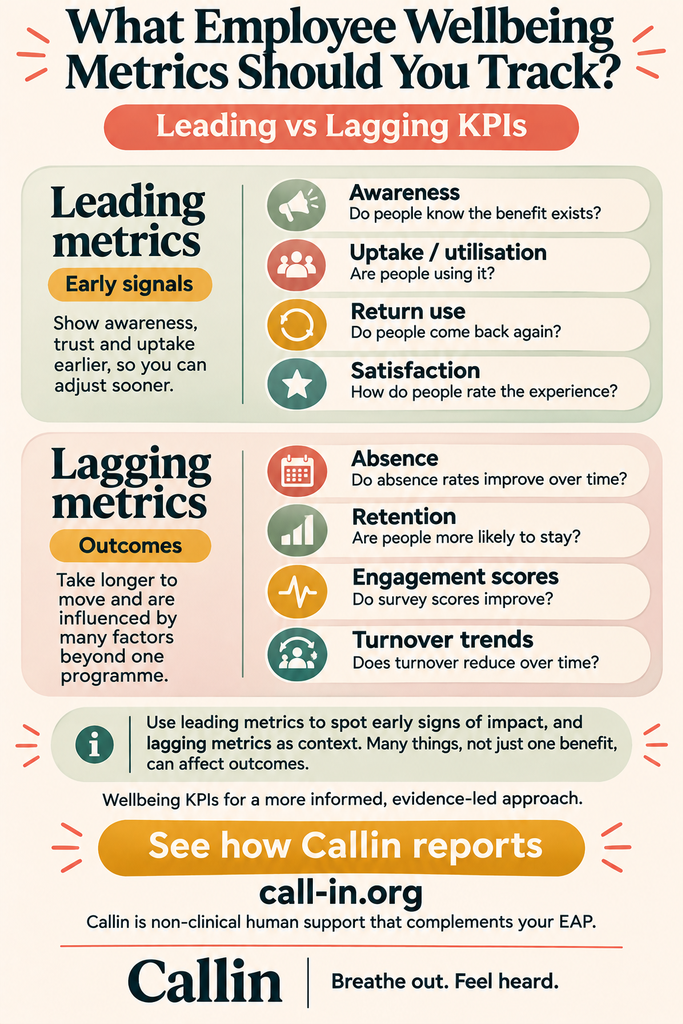
The short answer: To measure the ROI of employee wellbeing programmes, set a baseline before launch, then track leading indicators (awareness, uptake, trust, early help-seeking) alongside lagging indicators (absence, retention, presenteeism and self-reported wellbeing).
Compare change against cost, report only anonymised aggregate data, and treat published ROI figures as a guide rather than a promise. Combine the numbers with qualitative feedback before deciding.
Key definitions
- ROI (return on investment): The financial benefit of a programme minus its cost, expressed relative to that cost.
- Presenteeism: Working while unwell or struggling, so that a person is present but not able to perform at their usual level.
- Absenteeism: Time lost when an employee is absent from work, usually recorded as sickness absence days.
- Leading indicator: An early signal, such as awareness or uptake, that suggests whether outcomes are likely to change later.
- Lagging indicator: An outcome measured after the fact, such as absence, turnover or a change in wellbeing scores.
- EAP (Employee Assistance Programme): An employer-funded service that typically offers confidential advice, counselling and referral to employees.
- Non-clinical emotional support: Confidential, human conversation with a trained listener that does not diagnose, treat or replace therapy or medical care.
A quick word on boundaries before we begin. Callin offers non-clinical emotional support, not therapy, counselling, medical care or crisis support, and nothing in this article is clinical or financial advice. If you, or someone you are supporting, may be in immediate danger or crisis, please contact local emergency services or find a free, confidential helpline in your country at findahelpline.com.
Key takeaways
- Measuring the ROI of employee wellbeing programmes starts with a baseline; without one, any “return” is guesswork.
- Deloitte’s 2024 UK analysis found employers get, on average, about £4.70 back for every £1 spent supporting workforce mental health, mostly through productivity, with earlier, organisation-wide action showing the highest returns.
- Published ROI figures are averages from mixed studies, so use them to frame expectations, not to promise a result for your organisation.
- EAP impact is genuinely hard to measure; most organisations only see take-up and satisfaction data, so ask for more.
- Track a balanced set of leading and lagging indicators: uptake, absence, retention, presenteeism, self-reported wellbeing and qualitative feedback.
- Privacy is not optional; report only anonymised, aggregated data with small numbers suppressed, and never ask a provider for individual conversation content.
- A defined three-month pilot with agreed measures is a low-risk way to test whether a new layer of support works for your people.
Why is measuring the ROI of employee wellbeing programmes so hard?
It is hard because benefits are spread across absence, performance, retention and culture, and many are delayed or invisible on a spreadsheet. Isolating one programme’s effect is difficult, and confidentiality rules mean many leaders measure what is easy rather than what matters.
The UK government’s independent Keep Britain Working final report captured this well. It found that many employers “describe a confusing patchwork of wellbeing initiatives like ‘a random set of explosions’ with no clarity on what works.” It also noted that employers “already invest billions in health and wellbeing but need greater clarity on what works.”
The September 2026 Keep Britain Working update, a national growth opportunity, went further on measurement. It states that “Almost no organisation measures whether the people it helps back to work are still there 6 months later.” That is a UK observation, but the gap will feel familiar in many countries.
If your approach feels like a collection of perks, see why workplace stress needs more than wellness programmes.
What does the evidence say about the return on mental health support?
The best-known figure comes from Deloitte’s 2024 UK report, which estimates an average return of £4.70 for every £1 employers invest in employee mental health and wellbeing. The return varies by type of intervention, and Deloitte is open that the evidence base needs to grow. Treat it as a strong signal of direction, not a guaranteed outcome.
Here is what the sources actually say:
- Deloitte, UK, 2024. The Mental health and employers report states that employers “can achieve an average return of £4.7 for every £1 invested, but the size of the return varies with the nature of the intervention.” Deloitte’s press release puts it as employers getting “(on average) about £4.70 back in increased productivity.”
- Earlier is better. The same report found that organisation-wide early interventions, “such as culture change and raising awareness of mental health issues, provide the highest ROI, at £6.3 for every £1 invested.”
- Honest caveat. Deloitte acknowledges “there needs to be more published studies on the ROI of employer interventions to increase the evidence base used for our analysis and the confidence in these financial return numbers.”
- The cost of doing nothing, UK. Deloitte estimates that poor mental health “can now be costing employers around £51 billion annually,” with presenteeism the largest contributor at “around £24 billion annually.”
- Government endorsement, UK. The Keep Britain Working final report cites the same evidence: “Deloitte (2024) reported an average £4.70 return per £1 spent, based on 26 studies since 2011.”
- Global picture. The World Health Organization’s mental health at work fact sheet states that “Globally, an estimated 12 billion working days are lost every year to depression and anxiety at a cost of US$ 1 trillion per year in lost productivity.”
In plain terms, supporting mental health tends to pay back, especially early. It cannot tell you the exact return your organisation will see, which is why your own measurement matters.
Is mental health support worth it for employers?
For most employers, the evidence says yes, provided the support is well chosen, easy to access, trusted and genuinely used. The financial case rests mainly on reduced presenteeism, lower absence and better retention; the human case is that people do better work when they feel supported.
UK data from the Keep Britain Working final report shows how quickly costs add up. It reports that “each sickness absence day costs £120 in lost profit,” that “replacing an employee lost to ill-health costs employers over £11,000 including recruitment and onboarding costs,” and that presenteeism “costs employers the equivalent of 4 to 9 lost productive days per person per year.”
Timing matters too. The September 2026 update notes that “Someone absent for 4 to 6 weeks has a 96% chance of returning to work,” while “After a year, fewer than half return.” Its conclusion is simple: “The cheapest intervention is always the earliest one.”
Our guide to preventive emotional care explains why waiting until someone is at breaking point is costly for everyone, and our article on the cost of saying “I’m fine” shows how quietly struggles can hide in plain sight.
How do you measure EAP ROI honestly?
Start by accepting that EAP impact is difficult to measure, and say so in your business case. Most organisations receive utilisation and satisfaction reports, which show activity but not outcomes, so pair them with your own absence, retention and survey data.
The Institute for Employment Studies, in research commissioned by EAPA UK, put it clearly: “very few providers or their clients are able to collect systematic evaluation data beyond ‘take-up’ or utilisation statistics and satisfaction surveys.” It also noted “a number of methodological barriers to conducting detailed and systematic evaluations of ROI.”
Industry figures do exist. The Keep Britain Working final report cites an EAP association report (2022) that “found an average £8 return for every £1 invested, based on data covering 7 million UK employees.” It comes from the EAP sector itself, so weigh it alongside independent evidence.
To make an EAP evaluation more meaningful:
- Ask how “usage” is counted. Providers may count users, cases or contacts differently, so agree a definition up front.
- Look at reach across groups. Check whether uptake differs by location, role or shift pattern, using aggregate data only.
- Measure awareness and trust. Low usage can mean people are thriving, or that they do not know the service exists or do not trust it.
If you are still working out what an EAP covers, start with what an Employee Assistance Programme is and how it works, then compare options in EAP vs therapy vs emotional support. For budgeting context, see our guide to EAP cost per employee.
How should you measure wellbeing programme ROI? A practical framework
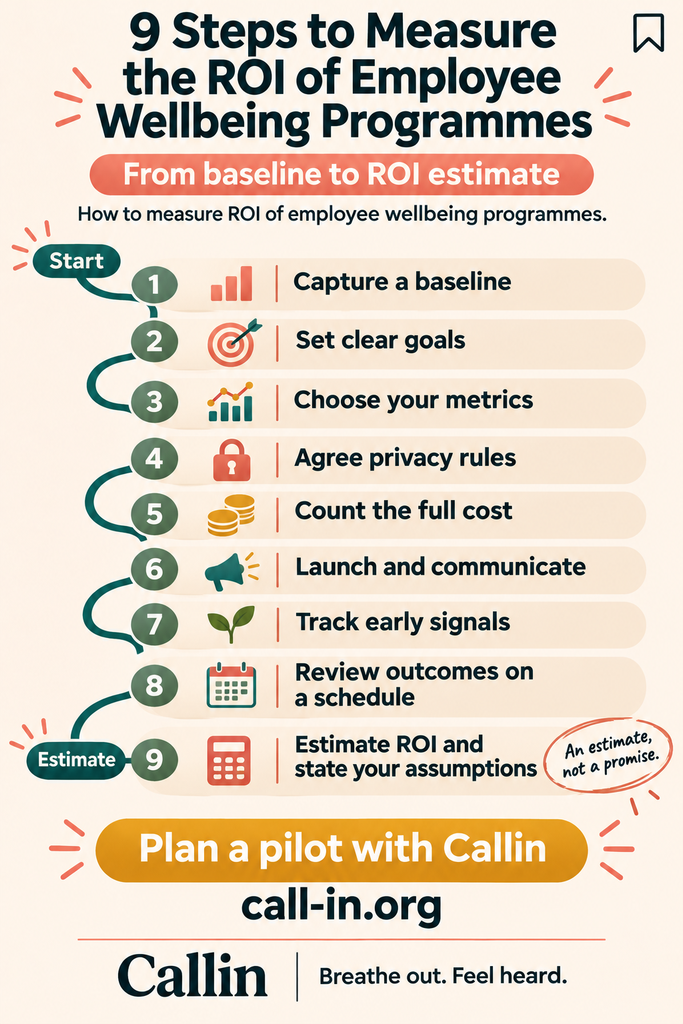
Use a simple, repeatable framework: set a baseline, track leading indicators monthly, review lagging indicators quarterly, and report everything as anonymised aggregates. Then combine the numbers with what people tell you.
Step 1: Set your baseline and question
- Name the problem, such as rising stress-related absence or isolation among remote staff.
- Record the last 6 to 12 months of absence, turnover and any existing survey scores before launch.
- Agree with finance, in advance, which measures will count as success and over what period.
Step 2: Track leading indicators
- Awareness: the share of employees who know the support exists and how to access it.
- Trust: the share who believe the support is confidential and independent of their manager.
- Ease of access: time from wanting support to receiving it.
- Early help-seeking: whether people reach out before problems escalate, shown by aggregate patterns rather than individual cases.
Step 3: Measure uptake and reach
- Uptake rate: the number of people using the service as a share of those eligible, using an agreed definition.
- Reach by group: aggregate uptake across sites, countries, working patterns and seniority, to spot who is being missed.
Step 4: Monitor absence
- Track sickness absence days per employee and the share that is long-term.
- Look at stress, anxiety and burnout-related absence where your recording allows it, at aggregate level only.
- Compare against your baseline, noting restructures or seasonal peaks that may explain movement.
Step 5: Watch retention
- Measure voluntary turnover and regretted leavers against your baseline.
- Where relevant, check whether people returning from health-related absence are still in work six months later, the very gap the Keep Britain Working update highlighted.
Step 6: Capture self-reported wellbeing and presenteeism
- Use a short, validated wellbeing scale in a regular pulse survey, at the same point each cycle.
- Add one or two questions on presenteeism, such as how often people worked while struggling to focus.
- Keep surveys anonymous and report only results above a minimum group size.
Step 7: Gather qualitative feedback
- Run small, anonymous focus groups or open-text survey questions.
- Ask what helped, what got in the way and what people would change.
- Listen for language about feeling heard or less alone, which numbers miss.
Step 8: Report privacy-safe aggregate data
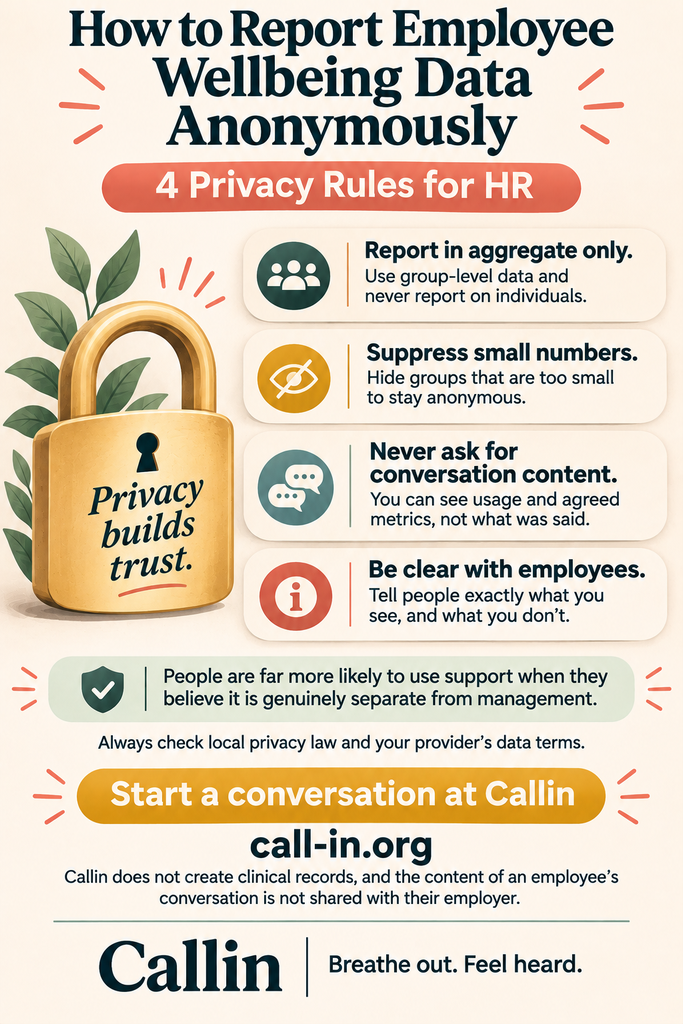
- Agree with any provider that you will receive only anonymised, aggregated information.
- Suppress or combine any results based on very small numbers so no individual can be identified.
- Never request the content of support conversations.
- Tell employees what you will and will not see, because trust drives uptake.
The September 2026 Keep Britain Working update models this standard for its proposed toolkit: “Employers receive only protected, aggregated insight above a suppression threshold, never individual answers.” For UK organisations, the ICO’s employment practices guidance is a useful reference, and you should follow equivalent data protection rules in every country where you operate.
Step 9: Turn it into a simple ROI estimate
- Estimate benefits: reduced absence days multiplied by your own cost per day, plus avoided replacement costs for retained staff, plus any measured presenteeism improvement.
- Total your costs: provider fees, internal time and communications.
- Calculate: benefits minus costs, divided by costs.
- Show your workings: state assumptions, stay conservative and present a range.
Which wellbeing metrics should you track, and which should you avoid?
Track a small, balanced set: awareness, uptake, absence, retention, self-reported wellbeing, presenteeism and qualitative themes. Avoid metrics that could identify individuals or turn wellbeing into a performance target.
Metrics to avoid or handle with great care:
- Anything linked to a named person or a very small team
- Topics people discussed in support sessions
- Uptake used as a manager performance target
- One-off survey scores with no baseline
Our UN SDG guide makes a related point well: measure what matters, but do not reduce people to metrics. Smaller organisations can find a lighter version of this in our guide to setting up mental health support in a small company.
How do you make the business case to finance without overclaiming?
Lead with your own baseline and a clear problem, then use published ROI figures as context rather than a promise. Finance leaders trust ranges and honest caveats more than a single impressive number.
A credible business case includes the problem in your own data, why this support fits it, external evidence labelled as averages, the measures and review date, and a stop, adjust or scale decision point.
The Keep Britain Working final report also reminds leaders that “employers also cite benefits that are harder to quantify but commercially important: improved morale and engagement, better relationships, stronger cultures, reduced absence, better staff retention, and enhanced customer service and brand.” Include these as qualitative outcomes, not invented numbers.
How does this framework work across a global workforce?
Keep the measures consistent and adapt how you collect and interpret them locally. Absence recording, data protection law and attitudes to talking about emotions vary between countries, so compare trends within each location rather than ranking countries.
- Respect local law: check data protection and employment rules in each country first.
- Mind cultural context: where people may under-report stress, pair surveys with anonymous qualitative feedback.
- Check language and time zones: make sure support is accessible in practice, not just on paper.
Remote and distributed teams deserve particular attention. Our article on why remote work loneliness happens explains signals that standard absence data can miss.
Where does non-clinical emotional support fit in your wellbeing mix?
Non-clinical emotional support fills the gap between doing fine and needing clinical care. It gives people a confidential, human place to talk early, before stress turns into absence or resignation. It complements, rather than replaces, EAPs, occupational health and clinical services.
Many employees do not need therapy, but they do need someone to talk to. Our guide to workplace mental health support for employees sets out the range of options, and our article on how Callin complements EAPs shows how the layers fit together.
Callin has offered this kind of support since June 2023. Callin Support Ltd is UK-registered and supports adults aged 18 and over worldwide through one-to-one online sessions in English. Callin is available 24/7, with sessions you book at a time that suits you, at any hour. Listeners complete Johns Hopkins University Psychological First Aid training and use active listening, with clear safeguarding and signposting procedures.
Through Human Continuity™, Callin prioritises the same listener for ongoing support wherever operationally possible, so people do not have to repeat their story each time. Callin does not create clinical records, and the content of an employee’s conversations is not shared with their employer. You can read more in our FAQ and privacy policy.
Callin is not a crisis line; our explainer on warmlines, crisis lines and peer support shows why each has a different job. For people facing work pressure specifically, see support for work stress and burnout, overcoming professional burnout and why peer connection helps prevent burnout. Some employees also value career coaching for professionals alongside emotional support.
We do not publish ROI or savings figures for Callin, and we would encourage caution with any provider that promises a specific return. Measure impact in your own organisation, using the framework above.
What would a three-month pilot with defined measures look like?
A three-month pilot tests a new layer of support with a defined group, clear measures and an end decision point, giving finance real data rather than assumptions. Callin offers a defined three-month pilot for organisations through our workplace wellbeing support for organisations page.
A practical pilot plan might include:
- Before launch: agree the eligible group, record baseline absence, turnover and pulse survey scores, and confirm privacy-safe reporting.
- Month 1, leading indicators: awareness, trust and ease of access, measured through a short anonymous pulse.
- Month 2, uptake and reach: aggregate uptake and repeat use, with small numbers suppressed.
- Month 3, early outcomes: self-reported wellbeing, presenteeism questions and qualitative themes from anonymous feedback.
- Review: compare against baseline, note a short pilot’s limits, and decide to stop, adjust or continue, tracking absence and retention for longer.
Smaller teams may also like our guide to the best EAP options for startups and small businesses.
Ready to explore human support for your people?
Measuring the ROI of employee wellbeing programmes is about knowing your baseline, choosing support people trust, and learning honestly from the results. If you would like to understand what non-clinical emotional support feels like first, explore non-clinical mental health support with Callin or read what happens in a Callin first session; eligible new clients can start with a free first session.
When you are ready to talk about your organisation, enquire about a three-month employee support pilot and agree the measures that matter to you from day one.
Frequently asked questions
What is the ROI of employee wellbeing programmes?
The ROI of employee wellbeing programmes is the financial benefit, such as reduced absence, presenteeism and turnover, minus the programme cost, relative to that cost. Deloitte’s 2024 UK analysis found an average return of about £4.70 for every £1 invested in employee mental health, though returns vary by intervention and organisation.
How do I measure wellbeing programme ROI?
Set a baseline before launch, then track leading indicators such as awareness, trust and uptake, and lagging indicators such as absence, retention, presenteeism and self-reported wellbeing. Compare changes against total cost, use conservative assumptions, and report only anonymised, aggregated data.
Is mental health support worth it for employers?
The evidence suggests it usually is, especially when support is offered early and organisation-wide. Deloitte found the highest returns from early, universal interventions such as culture change and awareness. Your own results will depend on fit, access and trust, so measure locally.
How do you measure EAP ROI?
EAP ROI is hard to measure because most providers share only take-up and satisfaction data. Agree how usage is counted, check reach across groups, measure awareness and trust, and look at absence and retention trends over time. Treat sector-reported ROI figures as context alongside independent evidence.
What wellbeing metrics should we track?
Track awareness, trust, uptake and reach, sickness absence, voluntary turnover, self-reported wellbeing, presenteeism and qualitative feedback themes. Avoid anything that could identify individuals or turn usage into a performance target.
How can we report wellbeing data without breaching confidentiality?
Receive only anonymised, aggregated information, suppress or combine small-number results, and never request conversation content. Tell employees clearly what you will and will not see, and follow data protection law in every country where you operate.
Does Callin share employee conversations with employers?
No. The content of an employee’s support conversation is not shared with their employer, and Callin does not create clinical records. Callin follows safeguarding and signposting procedures where urgent safety concerns arise, and it is not a crisis service.
UN Sustainable Development Goals alignment
This article supports two of the United Nations Sustainable Development Goals. Callin describes alignment only, not United Nations affiliation or endorsement; read more in our guide to mental health and the SDGs.
- SDG 3: Good Health and Well-being. Measuring and improving workplace wellbeing helps organisations promote mental health and wellbeing for working adults.
- SDG 8: Decent Work and Economic Growth. Evidence-led wellbeing investment supports productive, sustainable and decent work.
Sources and further reading
- Deloitte UK (2024). Mental health and employers: The case for investment, report PDF. UK data.
- Deloitte UK (17 May 2024). Poor mental health costs UK employers £51 billion a year for employees, press release. UK data.
- UK Government, Department for Work and Pensions and Department for Business and Trade. Keep Britain Working: Final report, published November 2025, updated 31 March 2026. UK data.
- UK Government. Keep Britain Working: a national growth opportunity, September 2026. UK data.
- UK Government. Keep Britain Working collection page.
- World Health Organization. Mental health at work fact sheet. Global data.
- Bevan, S. and Bajorek, Z. (2019). Designing and testing a Return on Investment tool for EAPs, Institute for Employment Studies, commissioned by EAPA. UK context.
- Health and Safety Executive. Management Standards for work-related stress. UK guidance.
- Information Commissioner’s Office. Employment guidance. UK guidance.
- United Nations. SDG 3 and SDG 8.

Leave a Reply