
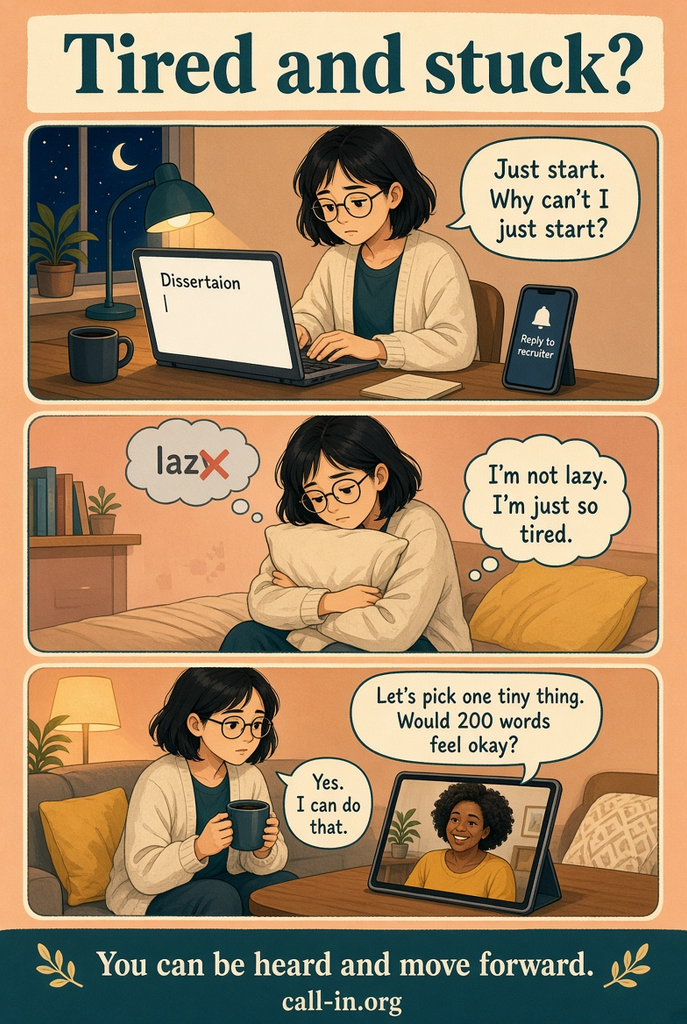
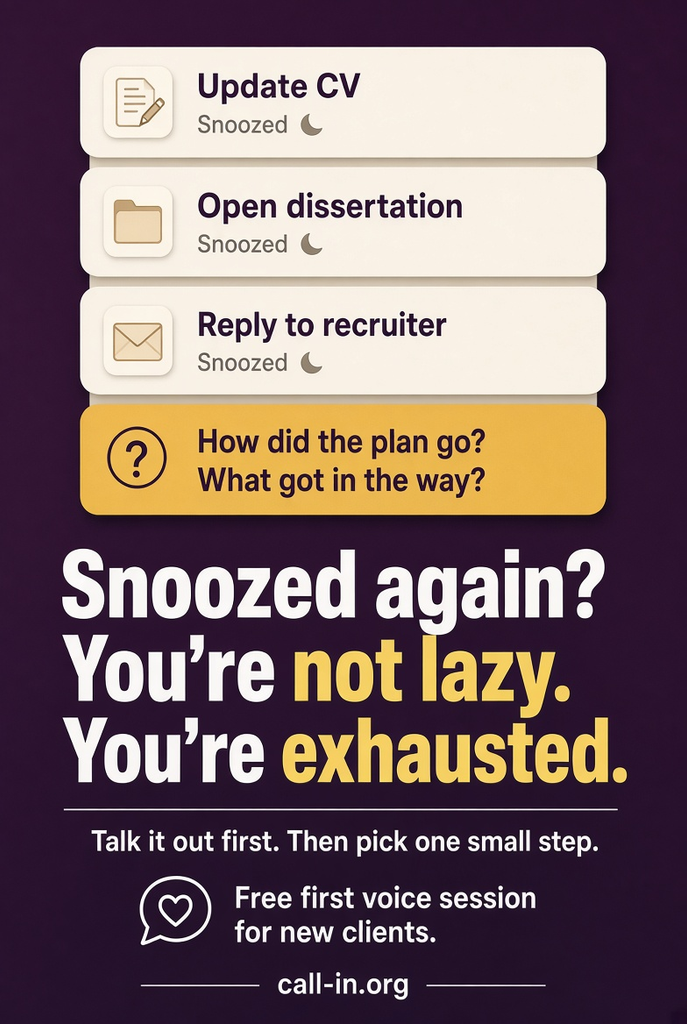
You know what you should be doing: update the CV, open the dissertation, reply to the recruiter. Yet every time you try, something heavy sits on your chest and the tab stays closed. You are not lazy, and you are not broken. You are probably exhausted, and the exhaustion and the to-do list have become knotted together.
This guide is for that knot. It explains the difference between a life coach and a therapist, why neither may feel quite right when you are both overwhelmed and stuck, and what a gentler middle path can look like.
Callin offers non-clinical emotional support, Career Coaching and Student Accountability Coaching. None of these are therapy, medical care or crisis intervention. If you are in danger or thinking about ending your life, please contact emergency services now, call Samaritans free on 116 123 (UK and Ireland), call or text 988 (US), call Lifeline on 13 11 14 (Australia), or find a helpline in your country at findahelpline.com.
Key takeaways
- Therapy is a professional treatment for mental health problems and difficult feelings, and you do not need a diagnosis to use it, according to the NHS.
- Coaching is usually goal-focused: the International Coaching Federation describes it as helping clients “maximize their personal and professional potential”.
- When burnout is behind your procrastination, some people find pure productivity coaching too pushy and therapy more than they need right now.
- Callin combines non-clinical emotional support with gentle accountability, so you can talk about how you feel and what to do next in the same space.
- Through Human Continuity™, Callin keeps you with the same trained listener or coach whenever possible, so your context and goals build over time.
- Callin uses real, trained people on Zoom, Google Meet, WhatsApp or Telegram, never AI bots, with no diagnosis, no clinical notes and no hustle pressure.
- Eligible new clients can start with a free introductory live voice session, with no credit card and no obligation.
Should I get a therapist or a life coach?
Choose a therapist if you want professional help with your mental health, past experiences or patterns that keep hurting you; choose a coach if you mainly want help reaching a goal; and consider non-clinical support with accountability if you need both to feel heard and to move forward.
The right choice depends on what you need the relationship to do, not on how “bad” things are. We explore that question in depth in therapy, coaching or emotional support: what do I need?, so here we focus on one specific situation: feeling stuck because you are worn out.
According to the NHS, talking therapies involve talking to a trained professional about your thoughts, feelings and behaviours, and you do not need a diagnosed mental health condition to use them.
The BACP describes therapy as a safe, confidential space to explore your thoughts, feelings and behaviours, which may include your childhood or present-day situations. Therapy is not only about the past either: the NHS explains that in CBT, “the main aim is making changes to solve your problems”.
Coaching is different in purpose. The International Coaching Federation defines it as “partnering with clients in a thought-provoking and creative process that inspires them to maximize their personal and professional potential.” Good coaches are thoughtful and humane, but coaching is not designed to treat mental health problems.
What is the difference between a life coach, a therapist and Callin?
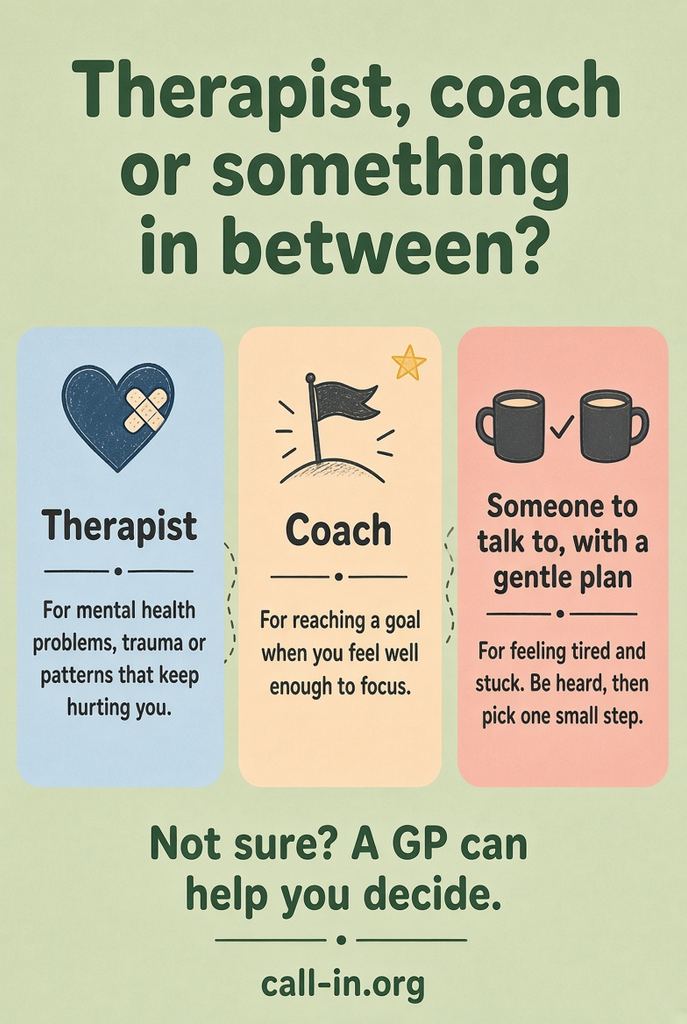
While therapy offers professional, often clinical help with mental health and emotional difficulties, and traditional coaching tends to focus on goals and performance, Callin offers non-clinical emotional support combined with gentle accountability coaching for adults navigating everyday burnout and life transitions. In plain terms, Callin is for the space between “I need to be heard” and “I need a plan”.
Here is how the three compare in practice:
- Therapy: a qualified clinician, often with an assessment, working on mental health problems, trauma or long-standing patterns. Right for clinical needs.
- Traditional coaching: a coach helping you set and reach goals, often around performance, career or productivity. Right when you feel well enough to focus on output.
- Callin: a trained listener or coach who makes room for how you feel and helps you choose a realistic next step, with no diagnosis, no clinical notes in the medical sense and no hustle-culture pressure.
If you are unsure whether you need professional care, our guide on how to tell if you need therapy is a kind place to start.
Why can’t I stop procrastinating when I’m burnt out?
Procrastination during burnout is often a sign of depleted energy, not a lack of discipline, which is why more pressure rarely fixes it. The World Health Organization describes burn-out as resulting from chronic workplace stress that has not been successfully managed, with exhaustion, mental distance from your job and “reduced professional efficacy”.
That last phrase matters. When you are running on empty, a task can feel enormous, and avoiding it brings brief relief followed by guilt. Some people find that a productivity system or a “just push through” coach makes the guilt louder. Others find that weekly therapy explores the roots but leaves them wanting help with Monday’s deadline.
We have written about why high achievers procrastinate and why you can’t start your uni work. If burnout is the bigger story, see our work stress and burnout support page and our guide to overcoming professional burnout.
Can one person help with my feelings and my plans?
Yes. At Callin you can talk about what feels heavy emotionally and also get structured support with work or study, while keeping the same person whenever possible through Human Continuity™. You do not have to split your life across two services and explain yourself twice.
Emotional wellbeing, work and study are connected. A break-up affects your concentration; a toxic job affects your sleep; loneliness in a new city affects your grades. Callin’s Career Coaching describes itself as whole-person coaching that makes room for confidence, money, family, relationships and values. Our Student Coaching and Accountability page says the same about university life: the unfinished assignment may not be the only thing asking for your attention.
What is an accountability coach for overwhelmed adults?
An accountability coach helps you turn an intention into a small, specific commitment and then checks in with you about how it went. At Callin, accountability is collaborative and kind: you choose the goal, and your coach helps you make it realistic.
Callin’s student page puts it simply: accountability is not about asking why you didn’t do it, but about asking what happened, whether the plan was realistic, what got in the way and what needs changing.
Because you return to the same coach wherever possible, the next session can begin with “How did the plan go?” instead of you explaining everything again. If you have felt judged by rigid accountability before, our manager’s guide to accountability and wellbeing explains why the two belong together.
Caught between needing to vent and needing a plan? Start with a free introductory voice conversation, with no obligation and no credit card.
What does this look like in real life?
The scenarios below are illustrative examples, not real clients, showing how a free first session and continuing with the same person could work at Callin. Names and details are invented.
Illustrative example 1: a remote worker with isolation and job-search anxiety
Maya works remotely for a company that has just announced restructuring. She has not spoken to a colleague out loud in days, and every time she opens a job site her chest tightens and she closes the laptop. She does not feel she needs therapy; she feels lonely and frozen.
Maya books a free introductory voice call on Google Meet. For the first part, she simply talks about how isolating the past months have been, and her listener reflects back without rushing to fix anything. If she decides to continue, she can return to the same person, and when she is ready, the conversation can turn towards career coaching: one realistic step, like updating one section of her CV before the next session. Our guide on coping with loneliness as a remote worker covers this feeling in more depth.
Illustrative example 2: an adult university student with exam stress and procrastination
Tom is 24, in his final year, and works evening shifts. His dissertation has been open in another tab for a week, and he feels ashamed every time he looks at it. Exams are coming and he is barely sleeping.
Tom starts with a free student session. His coach helps him look honestly at his deadlines, his shifts and his energy, then replaces “finish the dissertation” with something he can actually start, like writing 200 words of the methods section.
At the next session, the same coach asks how it went, and if it did not happen, they work out what got in the way, with no shame spiral. Callin does not write or proofread work, so academic integrity stays his. Our page on emotional support for university students has more.
Illustrative example 3: a burnt-out manager thinking about a career change
Priya manages a team, is everyone’s go-to person, and has started dreading Sunday evenings. She keeps saying she wants something different, but cannot tell whether she wants a new job or just needs rest.
In her early sessions, Priya mostly needs space to say how tired she is. Later, her coach helps her compare options without forcing an answer: stay with new boundaries, move, or test a new direction. Because it is the same person, the plan grows out of everything she has already shared.
Is Callin therapy or coaching?
Callin is neither therapy nor traditional performance coaching: it is non-clinical emotional support, Career Coaching and Student Accountability Coaching delivered by trained humans. Callin listeners and coaches do not diagnose, prescribe or provide treatment.
Every listener completes mandatory Psychological First Aid training from Johns Hopkins University and is trained in active listening, working within clear boundaries and safeguarding frameworks. They are not therapists, psychologists or counsellors. Sessions are with real people, never AI bots, by live voice or video on Zoom or Google Meet, with private paid chat available on WhatsApp or Telegram. If you are curious why that matters, read our comparison of AI and human emotional support.
When do I need more than coaching or emotional support?
You need more than coaching or non-clinical support if you are struggling to keep yourself safe, if symptoms like low mood or anxiety are seriously affecting your daily life, or if you are dealing with trauma or a mental health condition. In those situations, a GP, a qualified therapist or a crisis service is the right first step.
If you are in the UK, the NHS explains you can often refer yourself to talking therapies without seeing a GP. If you are in crisis, contact emergency services, Samaritans on 116 123 (UK and Ireland), the 988 Suicide and Crisis Lifeline by calling or texting 988 (US), Lifeline on 13 11 14 (Australia), or find local help at findahelpline.com. Callin can sit alongside therapy, but it does not replace psychotherapy, medical care or crisis intervention.
How does Callin work, and can I trust it?
Callin is available 24/7 and sessions are booked in advance, so you can book a time at any hour that suits you, from anywhere in the world. You choose emotional support, career coaching or student coaching, bring what is on your mind, and continue in the way that helps.
Callin is run by Callin Support Ltd, registered in England and Wales, and is GDPR-compliant, with no clinical records created. It is rated 4.4 out of 5 on Trustpilot and is available to adults 18+ worldwide, including the UK, USA, Canada and Australia. You can see current rates on our pricing page.
Callin is also aligning itself with the UN Sustainable Development Goals, particularly SDG 3 (Good Health and Well-being) and SDG 8 (Decent Work and Economic Growth). Callin is not affiliated with or endorsed by the United Nations; our page on mental health and the SDGs explains why we care about this.
How we wrote this
We based definitions of therapy and coaching on the NHS, the BACP and the International Coaching Federation, and the description of burn-out on the World Health Organization. Crisis numbers were checked on each service’s official website on 12 November 2026. Callin details come from our own published pages, and the scenarios are illustrative, not real clients.
Frequently asked questions
What is the difference between a life coach and a therapist?
A therapist is a trained professional who helps with mental health problems and emotional difficulties. A life coach helps you set and reach personal or professional goals and does not treat mental health conditions.
Should I see a therapist or a coach for burnout?
If burnout comes with symptoms that seriously affect your daily life, start with a GP or therapist. If you mainly need to be heard and to find a realistic way forward, non-clinical support with gentle coaching may suit you.
How do I stop procrastinating when I’m burnt out?
Start by recognising that burnout drains energy, so make the next step much smaller and talk honestly about what is getting in the way. An accountability partner who checks in kindly can help.
Can I get emotional support and career coaching from the same person?
At Callin, yes, wherever possible. Human Continuity™ keeps you with the same trained listener or coach so your context and goals build over time.
Is Callin’s coaching clinical?
No. Callin’s emotional support, Career Coaching and Student Accountability Coaching are all non-clinical and do not replace therapy, medical care or crisis support.
Does Callin use AI?
No. Every Callin session is with a real, trained person, never an AI bot.
How do I start with Callin?
Eligible new clients can book a free introductory live voice session on Zoom or Google Meet, with no credit card and no obligation to continue.
Ready to feel lighter and move forward?
You do not have to choose between being heard and making progress. If you are tired, stuck and ready for someone to help with both, a free introductory voice conversation is a gentle place to begin, with no obligation and no credit card. Book your free session at call-in.org, or explore Career Coaching and Student Accountability Coaching.
For employers and universities: if your people are burnt out and stuck, enquire about Callin for your organisation or a 3-month pilot.
Callin provides non-clinical emotional support, Career Coaching and Student Accountability Coaching. These services are not therapy, counselling, diagnosis, medical care or crisis intervention.

Leave a Reply