
If you have been asking yourself “what kind of emotional support do I need?”, you are already doing something brave. Many people feel lonely, overwhelmed, frustrated, disconnected or exhausted long before they can name the help that would fit.
This guide covers types of emotional support, where to get emotional support that matches your situation, and how to find emotional support without waiting for a breaking point.
Callin provides confidential, one-to-one, non-clinical human support by voice call, video call or private chat. It is not therapy, counselling, diagnosis, medical or psychiatric care, or crisis or emergency support. Everyone you speak to is a real person, not an AI.
If you are in danger right now, or think you might act on thoughts of harming yourself or someone else, please contact your local emergency services or a crisis line. You can find a free, confidential line in your country at findahelpline.com.
You can start with taking this short assessment to know what works best for you right now: START QUIZ.
Key takeaways
- Knowing something feels wrong is useful, even when you cannot yet name the right type of help.
- Common emotional support needs include expression, connection, perspective, continuity and professional care. These are not diagnoses and they often overlap.
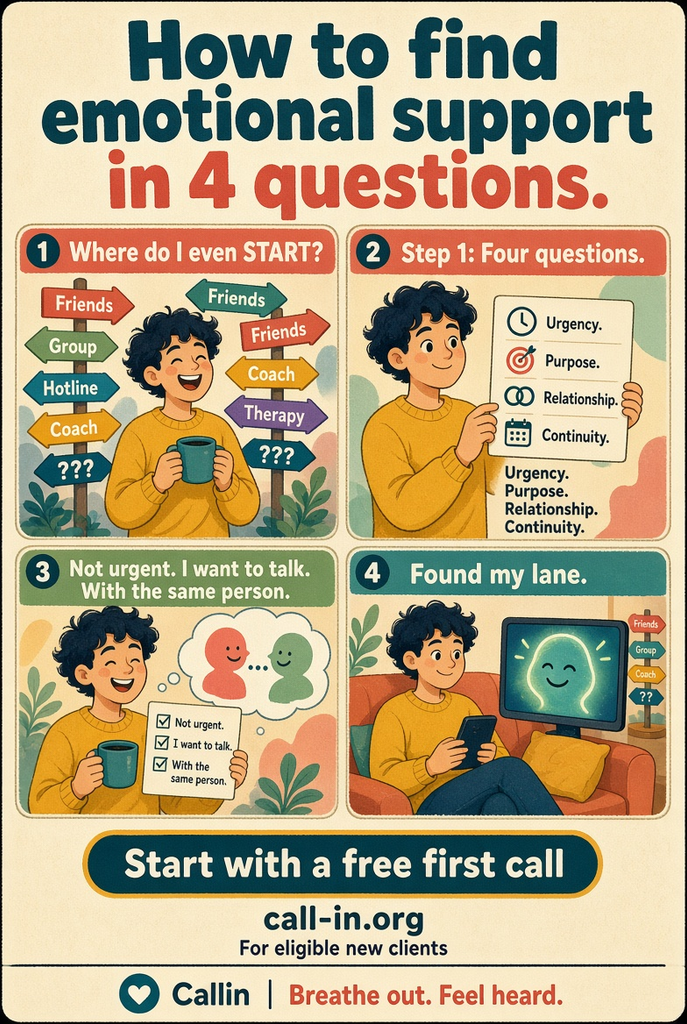
- A simple framework of urgency, purpose, relationship and continuity can help you choose emotional support options with clearer eyes.
- Culture, language, family norms, hierarchy and stigma shape how needs show up and how safe asking for help feels.
- You do not need crisis or a clinical condition to benefit from emotional wellbeing support.
- Callin may suit adults who want dedicated one-to-one listening in a non-clinical space, often with the same person.
- Crisis care, clinical treatment and friendship each have their place. Callin does not replace emergency or professional clinical care.
Why is it hard to know what kind of emotional support you need?
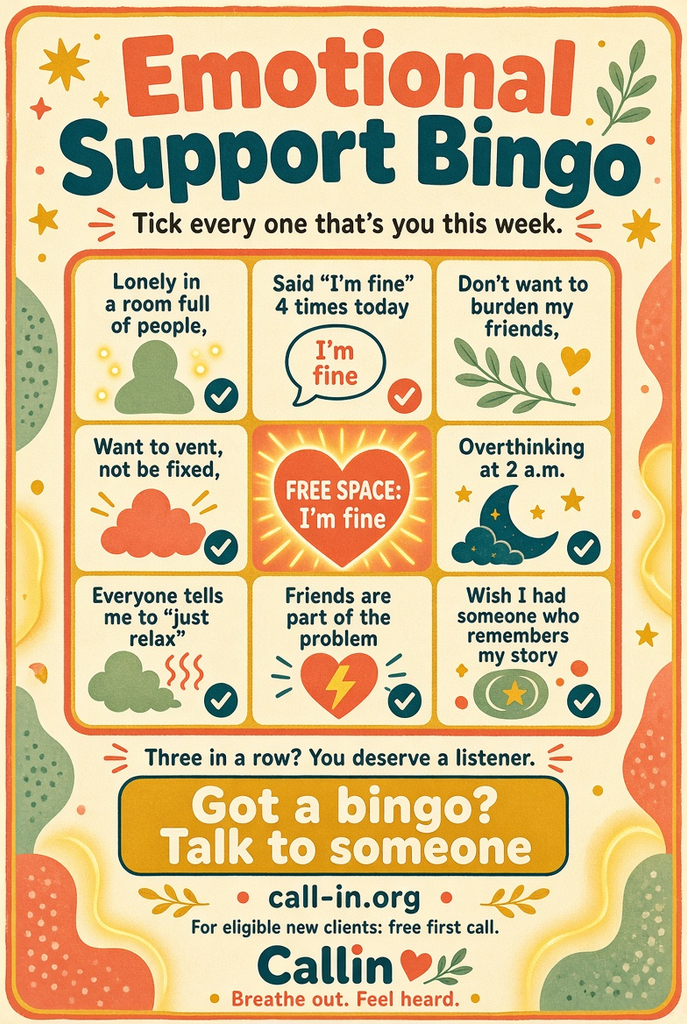
It is hard because emotional needs often overlap, shift week to week, and sit under words that feel too small. You might feel lonely and exhausted, want to vent and also want advice, or sense that talking to friends is not enough without knowing where to get emotional support next.
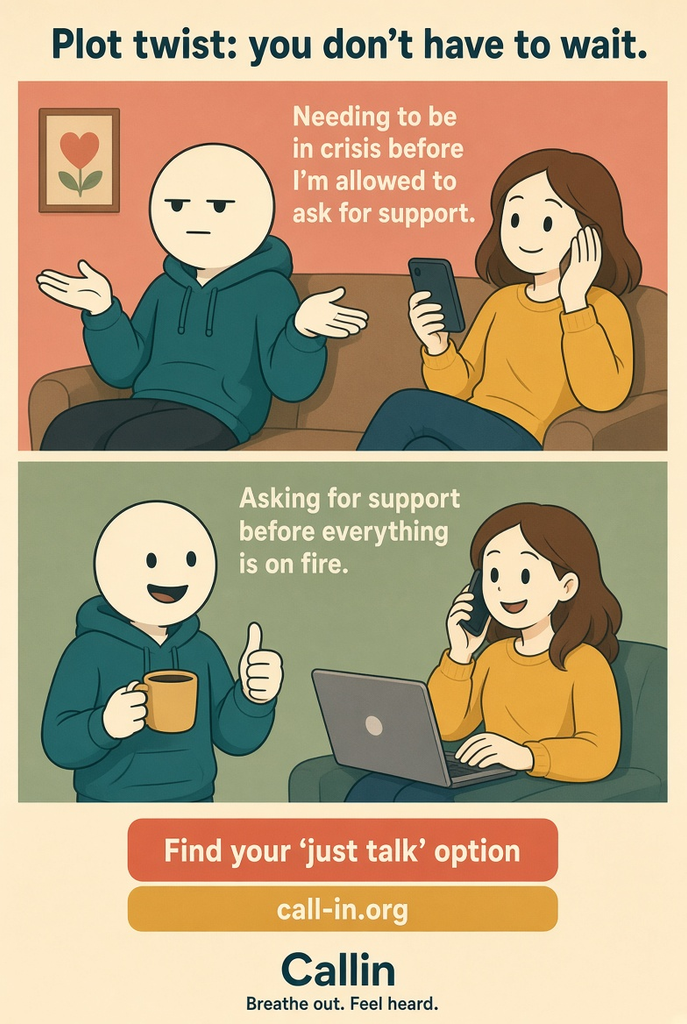
Culture can make naming a need even harder. In some families, private struggle stays inside the household, or hierarchy means you do not “burden” elders or leaders.
Language itself can lack everyday words for emotional support. Stigma around help-seeking is real in many communities worldwide, and wanting someone to talk to does not make you weak.
You also do not need a crisis or a clinical condition to benefit from support. The World Health Organization describes mental health as more than the absence of mental disorders, so feeling unheard or isolated can still deserve care. Callin’s About Us page names this middle ground as the Support Gap between friendship and therapy.
For sensing the need, see How Do I Know If I Need Emotional Support & Not Therapy?. After clarifying, Not Ready for Therapy? Alternatives for Emotional Support maps options without replacing this needs-first guide.
What are the main types of emotional support needs?
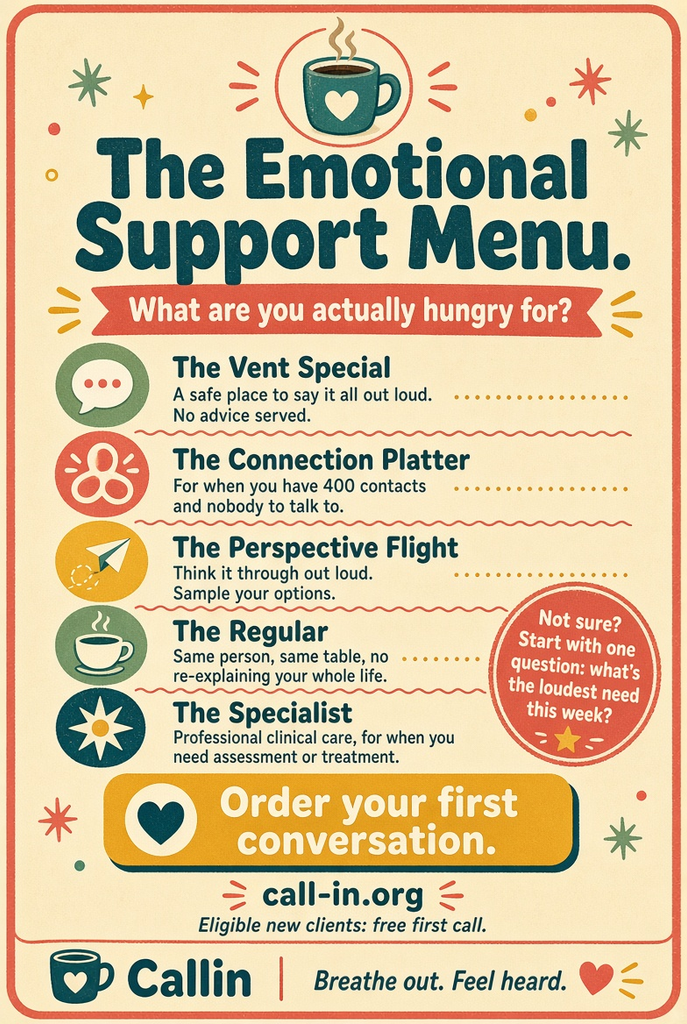
The main types of emotional support needs often fall into five practical categories: expression, connection, perspective, continuity and professional care. These are ways of naming what you are seeking, not diagnoses, and many people hold more than one at once.
Do you need space to express what you have been holding?
The need to express shows up when feelings or thoughts have been sitting inside with nowhere safe to go. You may want a dedicated space to talk openly, without managing someone else’s reaction, where venting or naming anger, grief, shame or confusion is the whole point.
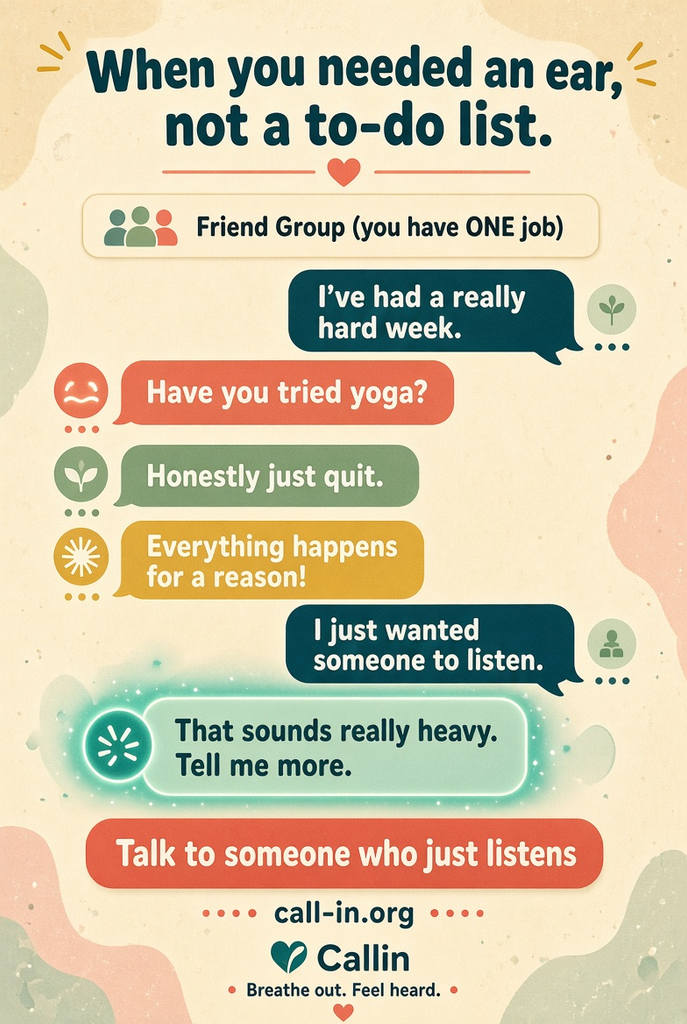
This need is common when you do not want to burden friends, or when people closest to you are part of the story. A listening service or warmline can fit for many people; see Who to Talk to When You Don’t Need Therapy But Need a Safe Space to Vent.
Do you need connection more than advice?
The need for connection is about isolation, loneliness or the absence of meaningful contact, even when you have people around you. The WHO Commission on Social Connection treats social connection as a global health priority, and a 2025 WHO news release reported that around 1 in 6 people worldwide are affected by loneliness.
Connection can mean community, companionship, peer spaces or a steady one-to-one relationship. Friendship matters deeply here, and so can structured human contact when everyday social life feels thin. Callin’s piece on feeling lonely even with friends explores that gap gently.
Do you need perspective on a situation or decision?
The need for perspective appears when you are navigating a difficult decision, relationship or personal situation and want to talk thoughts through. You are not necessarily looking for treatment. You want space to hear yourself think, test options aloud, or notice patterns.
Coaching can fit when the focus is goals, skills or forward movement. A listener can also help you unpack a situation without turning it into a clinical process. For a side-by-side view of lanes, see Therapy, Coaching or Emotional Support: What Do I Need?.
Do you need continuity with the same person?
The need for continuity shows up when the challenge is ongoing and restarting your story each time feels costly. You want someone who remembers context, tone and what mattered last week. Continuity is about familiarity and reduced retelling, not a promise of any particular outcome.
Warmlines and drop-in peer spaces are often designed for shorter contact, while ongoing listening or therapy relationships are designed differently. If continuity is central for you, read Where Can I Find Ongoing Online Emotional Support From the Same Person?.
Do you need professional clinical care?
The need for professional care arises when difficulties feel persistent, severe or complex, or when you want assessment, treatment or specialised help where you live. Wanting clinical care is matching intensity to need, not a failure of “lighter” support.
If you are unsure, Do I need Therapy? How to Know the Best Support for You and Therapy vs. a Listening Service can help without pressure.
How can you find emotional support using a simple four-part framework?
You can find emotional support more clearly by checking four dimensions: urgency, purpose, relationship and continuity. This practical, non-diagnostic framework helps you match a need to a setting without turning every feeling into a label.
Urgency: how pressing is safety right now?
Ask whether there is an immediate safety concern, an acute crisis, or a non-emergency difficulty. Immediate danger belongs with local emergency services or a crisis line via findahelpline.com. Non-emergency difficulty, loneliness, stress, grief or everyday overwhelm can still deserve support, and waiting until everything breaks is not a requirement; see What Is Preventive Emotional Care?.
Purpose: what do you want the support to do?
Ask whether you mainly need to express yourself, connect with others, gain perspective, develop practical skills, or receive treatment. Purpose shapes the room you walk into. Venting into a goal-coaching session, or seeking clinical treatment from a peer chat, can leave you mismatched.
The WHO fact sheet on mental health at work notes that workplaces can protect or harm mental health, and that support should be matched to need. The same matching logic applies outside work: name the purpose first, then look at emotional support options that serve it.
Relationship: who do you want beside you?
Ask whether you want community or peer company, a dedicated listener, a coach, or a qualified clinical professional. Friendship and family can offer love that no service replaces, while peer groups offer “me too.” A listening service offers dedicated attention without a clinical frame. Coaching partners with you around potential and goals, and clinical professionals bring assessment and treatment skills.
Continuity: how often, and with whom?
Ask whether you need one conversation, occasional support, or an ongoing relationship. A single warmline call can release pressure, while occasional check-ins can steady a hard month. An ongoing relationship can hold a longer chapter. Continuity matters most when your story is complex or when retelling drains you.
Once you have rough answers on these four dimensions, choosing an emotional support service becomes less mysterious. You are matching urgency, purpose, relationship and continuity as honestly as you can, not hunting for a perfect product.
What questions should you ask before choosing an emotional support service?
Before choosing an emotional support service, ask what you want, who you will speak with, what training they have, whether the service is clinical, whether you can return to the same person, how confidentiality works, and what happens if your needs change.
What kind of support am I actually looking for? Clarity here prevents you from buying a clinical frame when you wanted company, or a chat when you needed treatment. Revisit the five needs above.
Who will I be speaking with? A volunteer peer, a trained listener, a coach, a counsellor or a clinician are different roles, and knowing who is on the other side sets realistic expectations.
What training do they have? Training does not automatically mean clinical care, but it does tell you whether the person has preparation for listening, safeguarding and knowing their limits.
Is the service clinical or non-clinical? This boundary matters for safety and honesty. Non-clinical mental health support focuses on listening and presence rather than diagnosis or treatment, while clinical services can assess and treat. Mixing the labels confuses everyone; see also Non-Clinical Mental Health Support vs. Therapy.
Can I speak to the same person again? If continuity is part of your need, ask before you start. Some services rotate by design; others aim for the same person wherever possible.
What are the confidentiality arrangements? Confidentiality builds trust, and it usually has limits around safety. Ask how information is stored, who can access it, and when confidentiality would be broken, noting that laws differ by country.
What happens if my needs change? Good services can signpost when your need moves beyond their scope, including from expression toward clinical care or the reverse. Ask how they handle that shift.
How might Callin fit if you need dedicated one-to-one listening?
Callin may fit if you are an adult seeking dedicated one-to-one emotional support with a trained human listener, in a non-clinical space, through regular conversations and continuity with the same listener wherever possible.
Callin conversations happen by voice call, video call or private chat, with the focus on being heard rather than diagnosed. Listeners are trained in active listening and Psychological First Aid, which supports humane listening without turning Callin into therapy. See What Happens in a Callin First Session? and the FAQ.
Human Continuity™ is Callin’s way of aiming for the same listener across sessions wherever possible. For the fuller explanation, see ongoing online emotional support from the same person, and for why consistency can matter, see Benefits of Consistent Emotional Support.
If your four-dimension answers point to non-emergency need, expression or perspective, a dedicated listener, and some continuity, Callin’s non-clinical mental health support may be worth exploring. Clarity that points elsewhere is still a win. See also Connect with a Listening Service When You Feel Down and What Is Non-Clinical Mental Health Support? What It Looks Like in Practice.
When do you need a different kind of support?
You need a different kind of support when the setting in front of you no longer matches your urgency, purpose, relationship or continuity needs. Needs change, and matching them again is wisdom, not failure.
Friends and family often fit when you want love, shared history and everyday care. They may not fit when they are exhausted, involved in the conflict, or when cultural rules make honesty unsafe; see When Talking to Friends Doesn’t Feel Like Enough Anymore.
Community and peer support can fit shared experience and belonging, though they may be less suited to private processing of a complex personal story.
Warmlines can fit non-crisis moments when you want to talk soon, often with a volunteer. Learn more in What Is a Warm Line? and warmline versus crisis line.
Professional therapy or counselling can fit persistent, severe or complex difficulties, trauma processing, or a wish for clinical methods. Look for qualified professionals recognised in your country or region, as titles and regulation differ worldwide.
Healthcare professionals matter when physical health, medication, risk or diagnosis may be involved. Start with your local doctor, clinic or health system for that lane.
Crisis and emergency services are essential when safety is at risk. Callin is not crisis care and not a substitute for professional treatment. Please use local emergency services or findahelpline.com when you need that level of help.
WHO’s Psychological first aid guide is clear that Psychological First Aid is not professional counselling. Different tools have different jobs.
What if you are still unsure how to find emotional support?
If you are still unsure how to find emotional support, start with one honest sentence about this week. Name whether you most need to be heard, to feel less alone, to think something through, to keep the same person, or to seek clinical care.
Recognising a need is a positive act. You do not have to wait until breaking point. There is no single right way to seek emotional wellbeing support across cultures and countries, only support that fits you and your circumstances.
If a confidential one-to-one conversation with a real listener feels like a possible fit, eligible new clients can start with a free first call session with no obligation to continue. You can find out more about Callin’s non-clinical emotional support whenever you are ready.
You deserve support that matches the size of what you are carrying.
Frequently asked questions
What kind of emotional support do I need?
You can narrow what kind of emotional support you need by noticing whether you mainly want to express feelings, find connection, gain perspective, keep continuity with one person, or seek professional clinical care. Start with the loudest need this week, then match urgency, purpose, relationship and continuity.
What are the main types of emotional support?
Common types of emotional support include friendship and family care, community and peer support, warmlines, listening services, coaching, and clinical therapy or counselling. They serve different purposes and none cancels out the others.
Where can I get emotional support if I am not in crisis?
Where to get emotional support when you are not in crisis can include trusted people, peer groups, warmlines, online emotional support with a human listener, coaching, or preventive clinical care if that feels right. Availability varies by country, and local crisis lines remain important if safety changes.
How do I choose an emotional support service?
Choosing an emotional support service works best when you ask what you want, who you will speak with, what training they have, whether the service is clinical, whether continuity is possible, how confidentiality works, and what happens if your needs change.
Is online emotional support enough on its own?
Online emotional support can be enough for some people some of the time, especially for expression, perspective and continuity with a listener. It is not enough for emergency care, medical treatment or specialised clinical work, and many people combine supports.
When should I seek professional therapy instead of a listening service?
Seek professional therapy or another clinical pathway when difficulties are persistent, severe or complex, when you want assessment or treatment, or when a non-clinical conversation is clearly not enough. A listening service can sit beside therapy, but should not replace clinical care when that care is needed.
Can culture affect how I ask for emotional support?
Yes. Culture, language, family norms, hierarchy and stigma shape what feels sayable and who feels safe to approach. Wanting support outside your usual circle can protect relationships rather than reject them.
Most relevant UN Sustainable Development Goal
SDG 3: Good Health and Well-Being, especially Target 3.4. Helping people name emotional support needs earlier supports healthier lives across countries and cultures.
Sources and further reading
- World Health Organization (2025). Social connection linked to improved health and reduced risk of early death. News release on the WHO Commission on Social Connection.
- World Health Organization. Commission on Social Connection.
- World Health Organization. Social isolation and loneliness.
- World Health Organization. Mental health at work. Fact sheet.
- World Health Organization. Guidelines on mental health at work.
- World Health Organization. Mental health: strengthening our response. Fact sheet.
- World Health Organization, War Trauma Foundation and World Vision International (2011). Psychological first aid: Guide for field workers. WHO, Geneva.
- Find A Helpline. findahelpline.com. Free, confidential helplines by country.
- United Nations. Sustainable Development Goal 3: Good Health and Well-Being.
- Callin Support Ltd. About Us and Everything You Need to Know About Callin.

Leave a Reply