
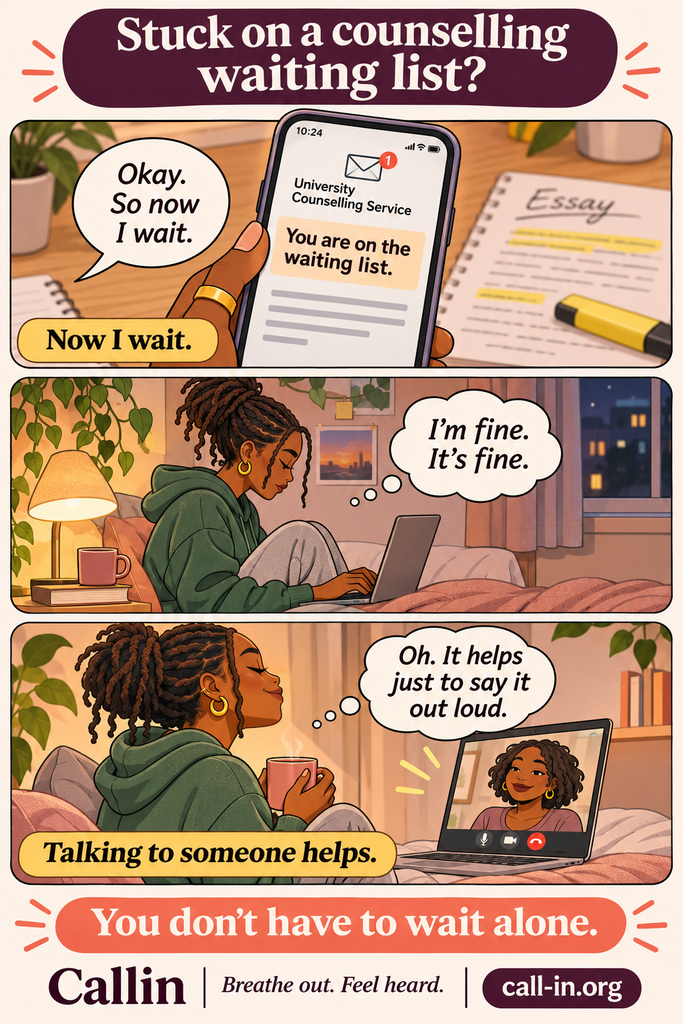
When your counselling service has a waiting list, the people on it do not stop needing support. Students still sit exams, move countries and lose sleep, and staff still teach, research and quietly field the distress of the students in front of them.
This guide is for university wellbeing directors, student services leads and HR teams who want to offer something real while people wait, without pretending it replaces counselling.
The short answer: Universities can support students and staff during long counselling waits by keeping in touch with people on the list, triaging clearly, adding a range of non-clinical options such as peer support, wellbeing advice and a confidential place to talk, and equipping staff who already support students.
Make the options easy to reach outside office hours, include university employees as well as students, and never present non-clinical support as a replacement for counselling, disability support, safeguarding or emergency care.
Key definitions
- Counselling waitlist: The time between someone asking a university counselling or mental health service for help and their first, or next, appointment.
- Whole-university approach: A model in which, as Student Minds puts it, all aspects of university life can support and promote mental health and wellbeing, for staff as well as students.
- Stepped support: A way of organising help so that people can reach lighter-touch options quickly, with clear routes to more specialist care when they need it.
- Burnout: Described by the World Health Organization as an occupational phenomenon resulting from chronic workplace stress that has not been successfully managed. It is not classified as a medical condition.
- Non-clinical emotional support: Confidential, human conversation with a trained listener that does not diagnose, treat, assess or replace counselling, therapy or medical care.
A quick word on boundaries before we begin. Callin offers non-clinical emotional support, not therapy, counselling, disability support, occupational health, medical care or crisis support, and nothing in this article is clinical, legal or employment advice.
If you, a student, a colleague or anyone you are supporting may be in immediate danger or crisis, please contact local emergency services or find a free, confidential helpline in your country at findahelpline.com.
Key takeaways
- Need is high across many countries: a WHO-linked survey of first-year students in eight countries found 35% screened positive for at least one common mental disorder in their lifetime.
- University counselling demand has grown faster than enrolment in some systems, so waiting lists are a structural problem, not a failure of individual counsellors.
- University staff need support too: a 2024 to 2025 US survey of over 9,000 faculty and staff found 27% felt highly burnt out by their work.
- A wait is time you can use well: keep in contact, triage clearly and give people something they can reach this week.
- Non-clinical options such as peer support, wellbeing advice and a confidential place to talk fill the space between “I am fine” and needing counselling, without replacing it.
- Staff who support students need clear routes to refer and somewhere of their own to offload, so they do not become counsellors by default.
- A defined three-month pilot with a clear group, privacy-safe measures and a review point is a low-risk way to test a new layer of support.
Why are university counselling waitlists so long?
Mostly because demand has grown faster than capacity. More students arrive with existing mental health needs, more seek help, and counselling services cannot expand at the same pace.
The WHO World Mental Health International College Student project, a peer-reviewed survey of 13,984 full-time first-year students at 19 colleges in eight countries including Australia, Belgium, Germany, Spain and the United States, found that 35% screened positive for at least one common lifetime mental disorder. The authors note that “the demand for services on campus far exceeds the available resources” in many cases.
In the United States, the Center for Collegiate Mental Health 2015 annual report found that across 93 institutions, the number of students seeking counselling grew by 29.6% over five years, while enrolment grew by 5.6%. These are older US figures, but they show how quickly demand can outpace a service designed for a smaller caseload.
None of this means your counsellors are failing. Student Minds’ University Mental Health Charter, a UK framework, notes that waiting lists can grow because of “unpredictable rises in demand and management or triage practices,” and that appropriate resourcing can be a factor.
What happens to students and staff while they wait?
Some people cope, some get worse, and some give up on asking. A long wait can leave someone feeling that their problem was not serious enough, or that nobody is coming.
The University Mental Health Charter is direct about this: “If students in need have to wait several months or if service lists are closed down all together, then a service is no longer genuinely accessible.” It also observes that “a majority of staff and students who experience poor mental health” do not seek formal support at all.
The Healthy Minds Study, a large US survey of more than 84,000 students in 2024 to 2025, found that 37% reported moderate to severe depressive symptoms. The top barriers to treatment were lack of time, financial reasons, and preferring to handle things alone or with family. Those barriers do not disappear because someone is on a list.
If you want to share a student-facing perspective, our guide to online emotional support for university students is written for the student, and our article on asking for help without a diagnosis speaks to anyone who worries they are not “ill enough” to reach out.
Why should university staff be part of the plan?
Because staff are struggling too, and many of them are already supporting students informally. A strategy that covers only students leaves out the people holding the institution together.
The Healthy Minds Network’s survey of more than 9,000 US faculty and staff at 22 institutions found that 16% met criteria for depression, 17% showed signs of anxiety, and 27% reported feeling burnt out from their work to a high or very high degree. Nearly half, 47%, had had one-to-one conversations with students about mental health in the past year, yet only about half felt confident recognising when a student was in distress.
In the UK, the Higher Education Policy Institute’s report Pressure Vessels gathered data from 59 universities and found steep rises in staff referrals to counselling and occupational health, linked by the author to workload models, performance management and short-term contracts. That is a UK example, but the pressures it describes will be familiar in many systems.
Staff who are not doing well will find it harder to support students. Our article on who to talk to about work burnout when you do not need therapy is written for the individual and could be shared with colleagues.
What can a university offer people while they wait for counselling?
Offer a mix of options at different levels of intensity, so people can reach something useful quickly. The aim is not to make anyone wait less for counselling by pushing them elsewhere, but to make sure the wait is not empty.
Options many universities combine:
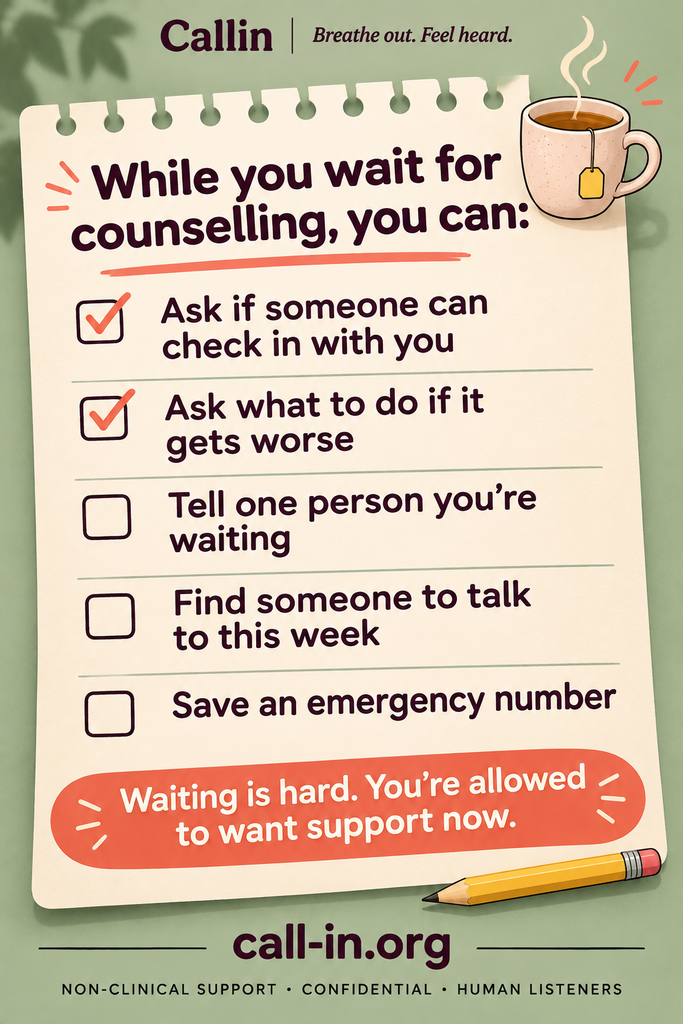
- Active waitlist contact: a brief, regular check-in so people know they have not been forgotten, with clear advice on what to do if things get worse.
- Clear triage and signposting: a simple explanation of which service is for what, including urgent and out-of-hours routes.
- Wellbeing advice and workshops: practical sessions on sleep, study stress, managing workload or settling into a new country.
- Peer support: trained student peer supporters or staff networks, with supervision and clear boundaries.
- Academic and pastoral support: personal tutors, advisers or academic coaching for study-related pressure.
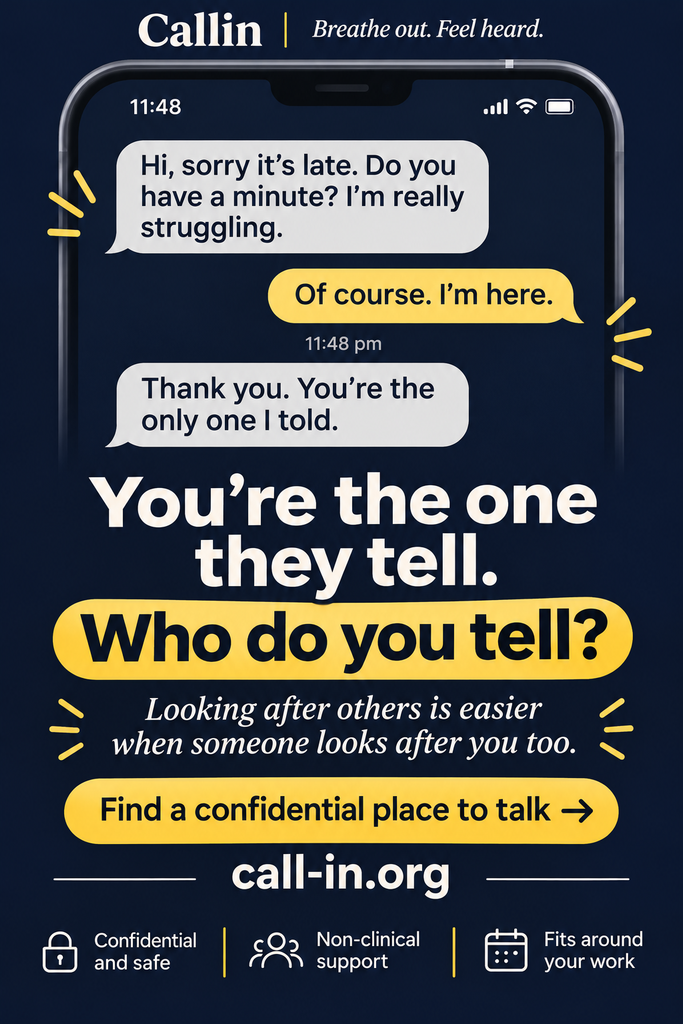
- A confidential place to talk: non-clinical emotional support from a trained listener, independent of the university, for people who mainly need to be heard.
- Staff support: an EAP, occupational health and a confidential space for employees, not only students.
For study-related pressure, Callin’s coaching and academic support for students is a separate offer from emotional support. Our explainer on what non-clinical mental health support means sets out where a listening service sits, and our guide to warmlines, crisis lines and peer support shows why each option has a different job.
How do you add non-clinical support without undermining counselling?
Be clear about what each layer is for, and protect the counselling service rather than competing with it. Non-clinical support works best as an extra option for people who do not need clinical care right now, with clear routes back to counselling for anyone who does.
Practical principles:
- Name it plainly: call it “someone to talk to” or “a place to be heard,” not therapy or counselling.
- Keep counselling resourced: the University Mental Health Charter warns against diverting resources away from clinical services, so add non-clinical support alongside them, not instead.
- Agree signposting both ways: listeners should know how to direct people to counselling, disability support, safeguarding and emergency services, and counsellors should know the non-clinical option exists.
- Check quality and safety: ask any external provider about training, safeguarding, data protection and how they handle risk.
- Keep it confidential: people are more likely to use support if conversations are not reported back to tutors, managers or departments.
- Protect continuity: being able to talk to the same person again helps people build trust.
The Charter itself notes that universities “must consider the safety and effectiveness of any interventions which they contract in from external providers.” That is good advice for any new service, including ours.
How can you support staff who support students?
Give them three things: confidence, clear routes and a place of their own to offload. Academic and professional staff are often the first people a student tells, and they need to know they are not expected to be counsellors.
Helpful steps:
- Short, practical guidance: how to respond kindly, what to say, and when and how to refer.
- One clear referral map: a single page showing counselling, disability support, safeguarding, out-of-hours and non-clinical options.
- Permission to step back: make it clear that listening and referring is enough, and that staff should not carry ongoing cases alone.
- Support for the supporters: confidential space for staff to talk through hard conversations, separate from their line manager.
- Fit training into existing time: the Healthy Minds researchers suggest that bringing training into spaces where staff time is already required sends a message that mental health is integral to the mission.
For the wider employer picture, our guides to workplace mental health support for employees and how Callin complements EAPs explain how non-clinical support sits alongside an employee assistance programme.
How does this work across different countries and university systems?
Keep the principles the same and adapt the delivery locally. Student health, counselling and staff support are organised very differently across the Nordics, Germany, the Netherlands, Malta, Cyprus, the UK and Ireland, North America, Australia, New Zealand and beyond.
National frameworks can help you benchmark. Examples include the Okanagan Charter, an international charter for health promoting universities and colleges; Canada’s voluntary National Standard for Mental Health and Well-Being for Post-Secondary Students; Orygen’s Australian University Mental Health Framework; and the UK’s University Mental Health Charter. Treat each as an example and check what applies where you operate.
- Check local rules: confirm data protection, staff consultation and any student health obligations in each country.
- Think about international students and staff: people far from home may face language barriers, time differences and isolation. Our student-facing piece on feeling lonely and homesick after moving abroad to study shows what this can feel like.
- Plan for different study patterns: distance learners, part-time students and those on placement may not be on campus in office hours.
- Respect time zones: make sure support is reachable in practice for people studying or working remotely.
Where does Callin fit alongside your existing support?
Callin offers non-clinical emotional support: a confidential, human place to talk, alongside your counselling service, disability support, EAP and occupational health. It is not therapy, counselling, disability support, safeguarding, occupational health or a crisis service, and it does not replace any of them.
Callin has offered this kind of support since June 2023. Callin Support Ltd is UK-registered and supports adults aged 18 and over worldwide through one-to-one online sessions in English, so it suits enrolled adult students and university employees. Callin is available 24/7, with sessions booked in advance at a time that suits each person, at any hour, which can help students and staff who are busy in the day or in a different time zone. Listeners complete Johns Hopkins University Psychological First Aid training and use active listening, with clear safeguarding and signposting procedures.
Through Human Continuity™, Callin prioritises the same listener for ongoing support wherever operationally possible, so people do not have to repeat their story each time. Callin does not create clinical records, and the content of conversations is not shared with the university. Our FAQ explains how Callin works with students and institutions, and our privacy policy sets out how data is handled.
We do not publish outcome figures for Callin, and we would encourage you to measure impact in your own institution. Our article on the benefits of consistent emotional support explains why continuity matters to us.
What would a three-month pilot at a university look like?
A three-month pilot tests a new layer of support with a defined group, clear measures and a decision point at the end. Callin offers a defined three-month pilot for organisations through our workplace wellbeing support for organisations page, and we are open to talking with universities about how a pilot could work for your staff and students.
A practical pilot plan might include:
- Before launch: choose a group, such as one faculty, a staff group or students on a long waitlist, agree privacy-safe reporting, and involve student and staff representatives.
- Month 1, awareness and trust: check through a short anonymous pulse whether people know the support exists and believe it is confidential.
- Month 2, access and reach: look at aggregate uptake, including evenings, weekends and different time zones, with small numbers suppressed.
- Month 3, early signals: gather anonymous feedback on whether people felt heard and whether support was easy to reach while they waited.
- Review: decide with students, staff and your counselling team whether to stop, adjust or continue.
Pair the pilot with continued investment in counselling and in the conditions that affect wellbeing. Our guide to preventive emotional care explains the value of reaching people before they reach crisis point.
Ready to make the wait less lonely?
Long counselling waits are a real problem, but they do not have to mean silence. A whole-university approach that includes staff, keeps counselling resourced and adds a confidential, human place to talk can make sure nobody waits alone. If you would like to understand what that feels like first, explore non-clinical mental health support with Callin or read what happens in a Callin first session.
When you are ready to talk about your institution, enquire about a three-month pilot for your staff and students and agree the measures that matter to your community from day one.
Frequently asked questions
What can universities do about long counselling waiting lists?
Universities can keep regular contact with people on the list, triage clearly, and add lighter-touch options such as wellbeing advice, peer support and a confidential place to talk. They should also keep counselling properly resourced, because non-clinical options add to it rather than replace it.
What support can students use while they wait for university counselling?
Depending on the university, options may include wellbeing workshops, peer support, personal tutors, academic coaching and non-clinical emotional support. Students should always know how to reach urgent and out-of-hours help if things get worse.
Should university staff be included in wellbeing support?
Yes. Staff face their own pressures and often support students informally. Including employees, with an EAP, occupational health and a confidential place to talk, makes a whole-university approach genuinely whole.
Does Callin replace university counselling?
No. Callin complements, but does not replace, university counselling, disability support, safeguarding or emergency services. It offers non-clinical emotional support and signposts to other services when needed.
Can students and staff use Callin outside office hours?
Yes. Callin is available 24/7, and sessions are booked in advance at a time that suits each person, at any hour. That can help people who study, work or live in different time zones.
Will the university see what students or staff talk about?
No. The content of conversations is not shared with the university, and Callin does not create clinical records. Callin follows safeguarding and signposting procedures where urgent safety concerns arise.
How can a university test whether this kind of support works?
Run a defined three-month pilot with one group, agree privacy-safe measures such as awareness, trust and aggregate uptake, gather anonymous feedback, and review the results with students, staff and your counselling team.
UN Sustainable Development Goals alignment
At Callin, we are aligning ourselves with the UN SDGs, and this article connects with three of them. This describes alignment only, not United Nations affiliation or endorsement; read more in our guide to mental health and the SDGs and our workplace wellbeing and the UN SDGs page.
- SDG 3: Good Health and Well-being. Making emotional support easier to reach supports the wellbeing of students and staff.
- SDG 4: Quality Education. Students learn better when they feel supported, and staff teach better when they are not running on empty.
- SDG 8: Decent Work and Economic Growth. Supporting university employees is part of decent, sustainable work.
Sources and further reading
- Auerbach, R. P. and colleagues (2018). The WHO World Mental Health Surveys International College Student Project: Prevalence and Distribution of Mental Disorders, Journal of Abnormal Psychology, 127(7). Peer-reviewed, eight countries.
- Center for Collegiate Mental Health, Penn State University. 2015 Annual Report. US data, 2009 to 2015.
- Hughes, G. and Spanner, L. (2024). The University Mental Health Charter, second edition. Student Minds. UK framework.
- University of Michigan School of Public Health (9 September 2025). Healthy Minds Study: College student depression, anxiety decline for third consecutive year. US student, faculty and staff data, 2024 to 2025.
- Morrish, L. (2019). Pressure Vessels: The epidemic of poor mental health among higher education staff, HEPI Occasional Paper 20. UK data.
- Canadian Health Promoting Campuses Network. Okanagan Charter: An International Charter for Health Promoting Universities and Colleges (2015). International.
- Mental Health Commission of Canada. National Standard for Mental Health and Well-Being for Post-Secondary Students. Canadian example.
- Orygen. Australian University Mental Health Framework. Australian example.
- World Health Organization (2019). Burn-out an “occupational phenomenon”: International Classification of Diseases. Global.
- United Nations. SDG 3, SDG 4 and SDG 8.
Leave a Reply