
Feeling overwhelmed in college does not automatically mean you need therapy, and it does not mean you should handle everything alone.
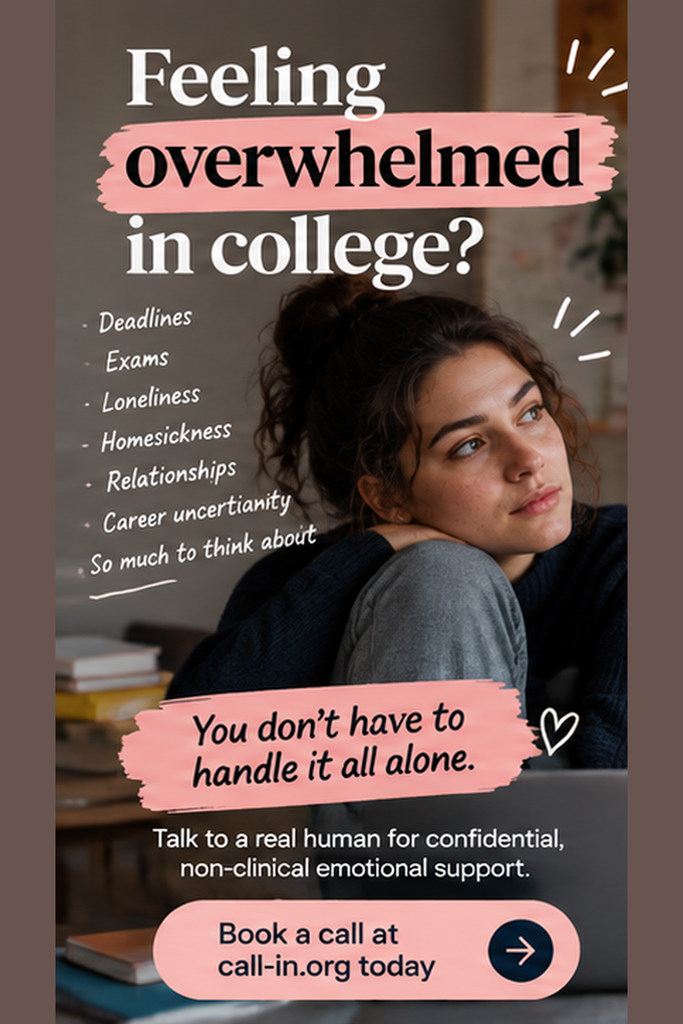
Online emotional support for college students can offer a private, human place to talk through academic pressure, loneliness, homesickness, relationship problems, or the vague sense that life has become one long browser tab with 47 things loading.
The useful question is not whether your struggle is “serious enough.” It is what kind of support fits what you are carrying right now.
Key takeaways
•Feeling overwhelmed can come from several pressures arriving together, not from a personal failure or a diagnosis.
•Online emotional support usually means being heard by a real person without diagnosis, treatment, or pressure to have a perfect explanation.
•Friends, campus services, peer listeners, support groups, warm lines, coaching, and therapy can all be useful for different needs.
•A short conversation can help you name the problem and choose a next step, but it cannot replace clinical care when symptoms are persistent, severe, or affecting daily functioning.
•If you may be in immediate danger or thinking about harming yourself, use local emergency or crisis services rather than a non-clinical support platform.
What does it mean to feel overwhelmed in college?
Feeling overwhelmed often means that the demands on your attention, energy, time, or emotions have begun to exceed the resources you can access. The demands might be obvious, such as exams, deadlines, money worries, work shifts, or caregiving responsibilities. They might also be quieter: homesickness, loneliness, cultural adjustment, conflict with a roommate, uncertainty about your future, or missing someone after a breakup.
The World Health Organization describes mental health as a state of wellbeing shaped by individual, family, community, and structural factors. Protective factors include social connection and access to quality education, while financial pressure, inequality, unsafe environments, and other conditions can undermine wellbeing.
In other words, overwhelm is not always a problem inside your personality. Sometimes it is useful information about the amount of pressure around you.
College can also make ordinary distress feel strangely private. You may be surrounded by people in lectures, residence halls, labs, or group chats and still have no place to say, “I am not coping brilliantly at the moment.” Everyone else can look busy and competent.
This is one of the great campus magic tricks: thousands of people quietly panicking while carrying reusable water bottles.
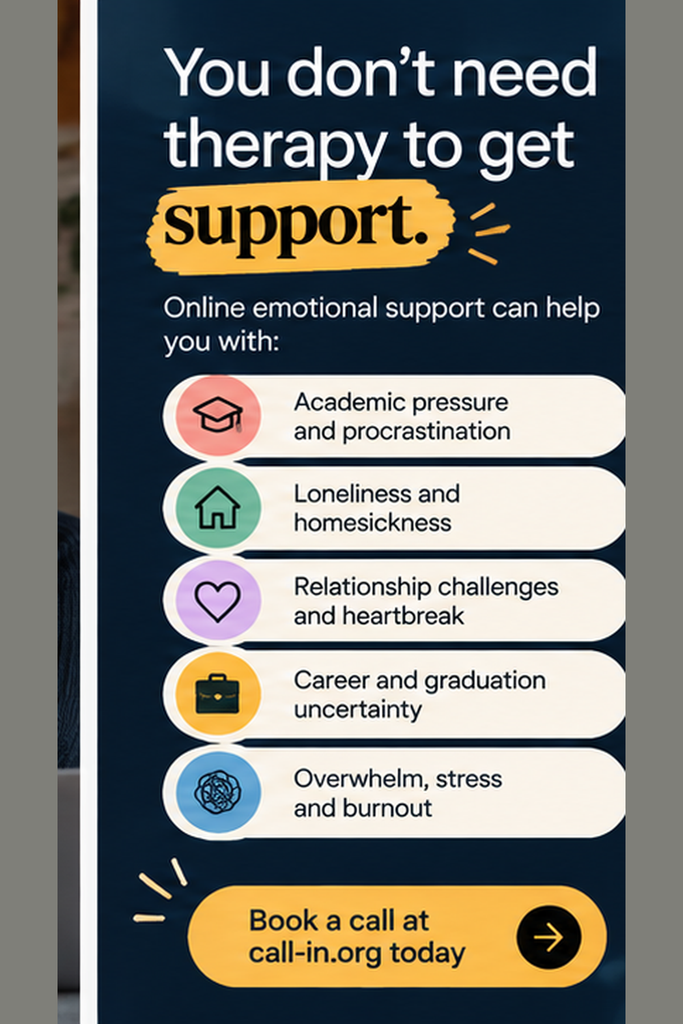
Why online emotional support can help
Emotional support is the experience of being heard, understood, and accompanied while you process something difficult. It is not the same as advice, problem-solving, or clinical treatment.
A good listener may reflect what they hear, ask an open question, and help you put words around an experience that has been circling your mind without a name.
That can matter because overwhelm tends to flatten different problems into one large statement: “Everything is too much.” Talking can help separate the pile. Maybe the largest part is academic pressure.
Maybe it is loneliness. Maybe you are exhausted because your schedule leaves no recovery time. Maybe the assignment is not the whole problem, but the fear that falling behind proves something terrible about you.
You do not need a diagnosis to ask for support. Callin’s guidance on asking for help without a mental health diagnosis makes an important distinction: a diagnosis can be necessary for some forms of treatment or accommodation, but it should not be the price of being listened to.
Online support can also reduce a practical barrier. You may not want to walk across campus, explain your situation to someone who knows your friends, or wait several weeks for an appointment. Depending on the service, online support can offer text, phone, or video access from a place where you feel reasonably private.
The quality of the service still matters. Look for clear information about who listens, what training they have, how privacy works, what hours or response times apply, and what happens if your needs fall outside the service’s scope. How to Find Emotional Support Online offers a useful overview of those questions.
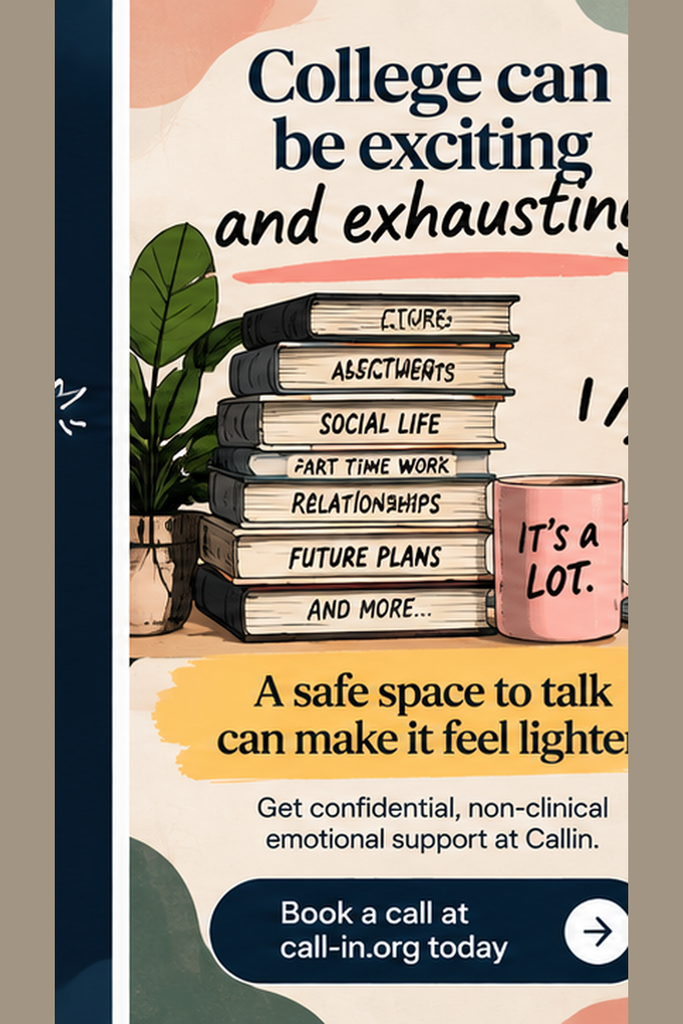
What kind of overwhelm are you experiencing?
You do not need to label yourself perfectly. A rough description is enough to choose a sensible next step.
Academic pressure and procrastination
You may have several deadlines, an unfinished dissertation, or an assignment that has become so emotionally enormous that even opening the document feels like an act of diplomacy. The problem may not be a lack of intelligence or discipline. The task may be unclear, too large, badly scheduled, or competing with work and family responsibilities.
In this situation, emotional support can help you say what is happening without turning the conversation into a productivity lecture. Academic coaching may be more useful if you want to sort deadlines, make a realistic study plan, understand what keeps blocking the start, and return to review your progress.
Callin’s student coaching and academic support is designed for students aged 18 and over who want help with planning, motivation, procrastination, academic pressure, and accountability. It is coaching, not tutoring, therapy, or assignment completion.
Loneliness, homesickness, and cultural adjustment
Moving away for college can bring freedom and grief in the same suitcase. You may miss familiar food, language, routines, faith communities, humor, or the people who understood you without a long explanation.
You can be grateful for the opportunity and still feel lonely. Those two truths do not cancel each other out.
A friend, student society, cultural organization, resident adviser, faith leader, campus group, or peer support service may help. If speaking in person feels too exposed, online emotional support can offer a lower-pressure place to begin.
You can also ask a listener to help you think about what kind of connection is missing rather than simply telling you to “put yourself out there,” which is advice that has ruined many perfectly good afternoons.
Relationship heartbreak
A breakup can disrupt concentration, appetite, sleep, routines, mutual friendships, and your idea of the future. That does not mean you are weak or permanently damaged. It means a relationship was woven into ordinary life, and now the threads are being pulled in several places at once.
Sometimes you need a friend who knows the history. Sometimes you need practical boundaries around contact or social media. Sometimes you need to tell the story to someone who is not personally involved and will not ask for live updates about your ex at breakfast.
Callin’s guide to relationship heartbreak discusses support, small stabilizing routines, and the point at which heartbreak may need more specialized care.
Career and graduation uncertainty
The approach of graduation can make every decision feel permanent. You may be comparing further study, employment, migration, family expectations, finances, and the fear that your degree has somehow failed to reveal your one true calling.
Degrees are often less like prophecy and more like a set of tools. Annoyingly, you still have to decide what to build.
A listening conversation may help you process fear, disappointment, or pressure. Career coaching can help when the main need is to compare options, clarify values, make a plan, or stay accountable to a next action. Callin’s career coaching is non-clinical and does not promise a job, promotion, or particular outcome.
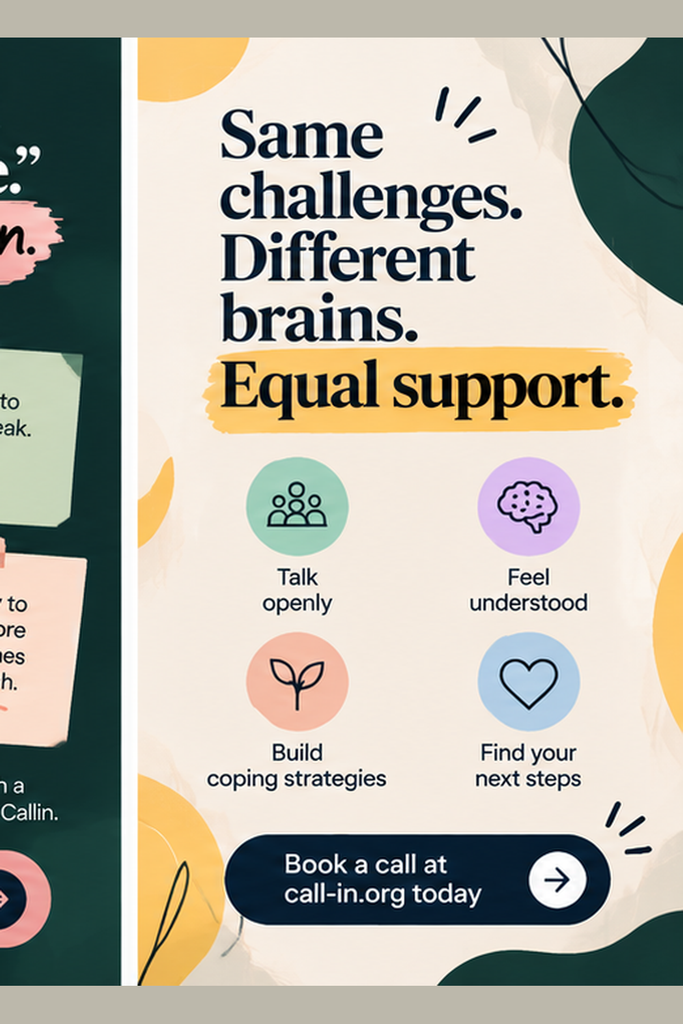
What can you do today when everything feels too much?
The goal is not to repair your entire semester before dinner. Try to reduce the size of the next step.
1. Name the heaviest part
Complete this sentence in a note or voice memo: “The part that is hardest today is…”
Keep going until the sentence becomes specific. “College” is broad. “I have not started the lab report and I am afraid I will disappoint my supervisor” gives you something to work with. You might discover that the next step is emotional, practical, academic, or relational.
2. Separate the urgent from the loud
Some problems make a lot of noise without being the most time-sensitive. Write down everything competing for attention, then identify one deadline, one basic need, and one conversation that matters most. The rest can remain on the page without demanding immediate heroism.
The National Institute of Mental Health recommends practical coping steps such as keeping a journal, maintaining regular sleep and meals, moving your body, identifying unhelpful thoughts, and reaching out to supportive people. None of these turns a difficult life into a wellness brochure. They can, however, give your brain slightly better working conditions.
3. Decide what you want from the conversation
Before contacting someone, you can say:
•“I do not need advice yet. I need to say this out loud.”
•“Can you listen for 10 minutes and then help me think about one next step?”
•“I am not sure what I need. I think I need company while I work it out.”
•“I want practical help, not a diagnosis.”
These are invitations, not contracts. The point is to give the other person a map instead of hoping they will navigate by emotional satellite.
4. Choose one accessible person or service
That might be a trusted friend, campus counselor, academic adviser, resident adviser, tutor, student support office, peer group, warm line, or online listener. If cost is a barrier, look at your college’s included services, community organizations, support groups, and free warm lines in your region. Affordable therapy alternatives explains how peer support, support groups, active listening, and sliding-scale options can fit different needs.
Emotional support, coaching, therapy, and crisis care are not the same
The word “support” covers several different kinds of help. Choosing well becomes easier when the boundaries are clear.
Emotional support or active listening is usually appropriate when you want to process a difficult day, loneliness, uncertainty, relationship stress, or ordinary overwhelm with a person who listens without diagnosing or treating you.
Academic or career coaching is more practical. It can help with planning, priorities, accountability, procrastination, decisions, and next actions. It should not be presented as therapy or medical care.
Therapy or other clinical care is important when distress is persistent, severe, linked to trauma, significantly interferes with daily functioning, or may reflect a mental health condition that needs assessment and treatment. NIMH advises seeking professional help when stress or anxiety does not go away, interferes with everyday life, causes avoidance, or feels constantly present.
Crisis support is for immediate danger, suicidal thoughts, a risk of harming yourself or another person, or a situation that cannot safely wait. A warm line is non-crisis support. It is not the same as a crisis line. What Is a Warm Line? explains the difference and why students do not have to wait for an emergency before using a warm line.
You can use more than one kind of support. For example, a student might see a therapist for ongoing clinical care, talk with a peer listener between appointments, and work with an academic coach on a dissertation plan. These roles can complement one another when everyone is clear about the boundaries.
How to choose an online support service safely
Before you share personal information, check whether the service:
1.Explains whether listeners are peers, coaches, volunteers, or licensed clinicians.
2.States clearly whether it provides therapy, diagnosis, treatment, or crisis intervention.
3.Describes privacy and confidentiality in plain language, including exceptions for safeguarding or legal duties.
4.Tells you whether conversations are live, scheduled, asynchronous, or monitored continuously.
5.Gives a realistic response time and a way to get urgent help elsewhere.
6.Makes cost, age eligibility, location, and cancellation terms easy to find.
7.Lets you leave if the conversation feels judgmental, pressuring, or outside what you agreed to.
Callin describes its service as private, one-to-one, non-clinical emotional support with real human listeners. It offers active listening and reflection, not diagnosis, psychotherapy, medical treatment, or crisis intervention. Its current student coaching page is for eligible students aged 18 and over, so younger students should check local or campus alternatives. For students who prefer writing to speaking, Callin’s online emotional support chat describes text support through WhatsApp or Telegram, with clear limits around response times and emergencies.
If you are considering Callin, its non-clinical mental health support page is the most useful place to understand the service’s scope before deciding whether it fits. It may suit someone who wants a confidential place to talk through academic stress, loneliness, heartbreak, overthinking, or a difficult transition without turning the conversation into a clinical assessment.
When should a college student seek more help?
Reach out to a licensed professional, medical provider, or campus mental health service if your distress is lasting, intensifying, or interfering with sleep, eating, attendance, relationships, concentration, or basic daily tasks. You do not need to wait until you have a diagnosis. A professional can help assess what is happening and discuss appropriate options.
Seek urgent help if you are thinking about suicide, harming yourself or someone else, unable to stay safe, experiencing a severe mental health emergency, or in immediate danger. Contact the emergency or crisis service for your location. In the United States, call or text 988. In other countries, use the local emergency number or crisis service. Do not wait for a non-clinical platform, email, or scheduled conversation to respond.
If you are worried about a classmate, you do not have to become their therapist. You can stay with them while they contact an appropriate service, involve a trusted campus professional, or seek emergency help when safety is at risk. Ask directly and calmly whether they are in immediate danger. If the answer is yes or unclear, treat it as urgent.
Frequently asked questions
Is online emotional support the same as online therapy?
No. Online therapy is clinical care delivered by a qualified professional who can assess and treat mental health conditions. Online emotional support usually focuses on listening, connection, and reflection without diagnosis or treatment. Both can be valuable, but they are different services.
Can I ask for emotional support if I am not in crisis?
Yes. Emotional support is specifically useful for non-crisis experiences such as academic stress, loneliness, homesickness, grief, heartbreak, uncertainty, and feeling overloaded. You do not need to prove that your situation is dramatic enough to deserve a conversation.
What if I only want to vent?
Say that at the beginning. You might say, “I would like you to listen before we look for solutions.” A trusted friend, warm line, peer listener, support group, or online listening service may be a reasonable fit. What to Do When You Need to Vent, But Not Therapy explores why being heard can be different from receiving advice.
Are warm lines available to college students?
Many warm lines serve people who are struggling but not in immediate danger, including students, though eligibility, hours, and locations vary. Check the specific warm line in your region. Warm lines are not crisis services. If there is immediate danger or risk of self-harm, contact emergency or crisis support instead.
Can I use emotional support and therapy at the same time?
Often, yes. Emotional support can provide a place to talk through everyday stress between therapy appointments, while therapy addresses ongoing clinical needs. Let your healthcare providers know about other support you are using when that information would help coordinate your care.
What if I cannot afford therapy?
Start with your college counseling or student support service, which may be included in tuition or offer a limited number of sessions. You can also look for community clinics, support groups, warm lines, sliding-scale providers, peer support, guided self-help, and other low-cost options. Availability depends on your location and the type of help you need.
Is Callin suitable for every overwhelmed college student?
No service is right for everyone. Callin may fit an eligible student aged 18 or over who wants non-clinical human listening, reflection, or academic accountability. It is not therapy, medical care, diagnosis, or crisis support. If you need clinical assessment, treatment, or immediate safety help, choose the appropriate professional or emergency service.
How this connects to the UNSDGs
This article connects most directly to UN Sustainable Development Goal 3: Good Health and Well-Being because accessible, non-judgmental support can help people care for their emotional wellbeing and seek appropriate help earlier. It also relates to SDG 4: Quality Education, since emotional, academic, and practical support can make it easier for students to participate in education without pretending that wellbeing and learning are separate departments.
Sources and further reading
[1] World Health Organization, Mental Health
[2] National Institute of Mental Health, I’m So Stressed Out! Fact Sheet
[3] Callin, Emotional Support Online: What It Is and Where to Find It
[4] Callin, How Do I Know If I Need Emotional Support Instead of Therapy?
[5] Callin, Someone to Talk To: 9 Real Options to Call Right Now
[6] Callin, Non-Clinical Mental Health Support
Final CTA: If you are an eligible adult student and a private, non-clinical conversation sounds like the kind of support you need, you can learn more about Callin or explore its student coaching and academic support without treating either as a substitute for therapy or crisis care.

Leave a Reply