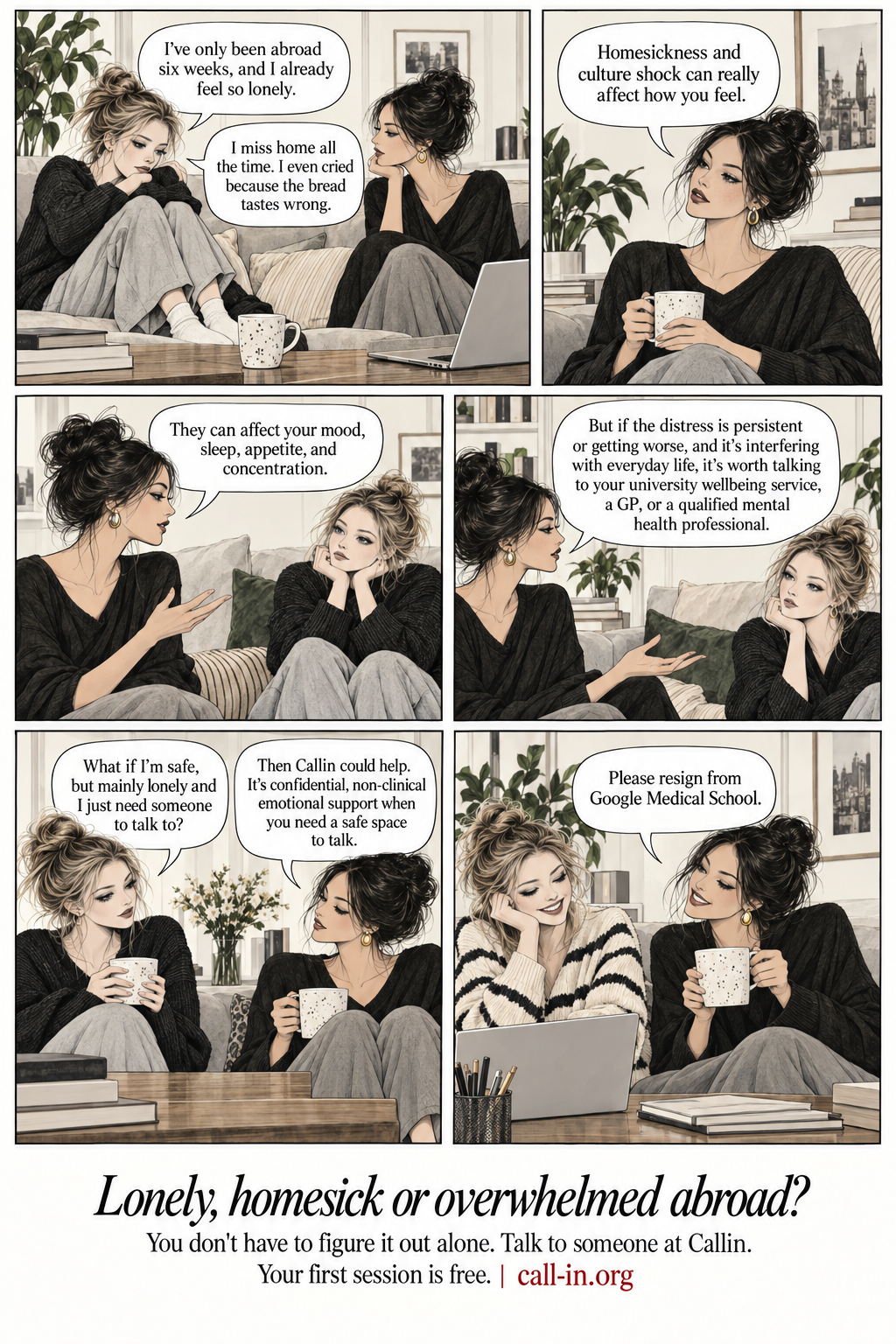
The new country may be exciting. It can still hurt to build a life where nobody knows you yet.
Homesickness in international students is common, especially during the first weeks and months of living abroad. You can feel grateful for the opportunity, excited about your studies, and painfully lonely at the same time. Feeling this way does not mean you chose the wrong university, lack independence, or are failing at life abroad.
You can spend years planning to study in another country and still cry because the supermarket does not sell the right bread. You can be proud of yourself and desperately miss your mother’s voice from the next room. Human emotion has never been famous for respecting a neat narrative.
Key Takeaways
- Homesickness is not ingratitude. It is a response to separation, unfamiliarity, and the loss of everyday emotional anchors.
- International students can feel lonely even on a crowded campus because social contact is not the same as belonging.
- Culture shock affects ordinary tasks, language, identity, friendships, and academic confidence.
- Familiar routines, repeated social contact, support from home, and honest conversations can make adjustment easier.
- Persistent or worsening distress may require support from a university service, GP, counselor, or mental health professional.
- Callin can support you with feeling lonely and homesick, and you can start your free session here.
Why Does Moving Abroad for University Feel So Lonely?
Moving abroad to study does not change only your address. It changes almost every system that previously made life feel understandable.
At home, you knew how to buy food, interpret people’s tone, travel across town, ask for help, make a joke, and tell when someone was being friendly. You probably had people who understood your history without requiring a forty-minute presentation first. In a new country, even small decisions can require thought.
Which bus ticket do you buy? Is the person at the reception desk being rude or simply direct? Was your classmate genuinely inviting you out, or were they just being polite? Why does every form appear to require another form that nobody mentioned?
This constant interpretation creates an invisible mental workload. You are not only attending lectures. You are learning a new social operating system while managing assignments, money, immigration rules, accommodation, food, transport, and the occasional administrative email that appears to have been written by a committee of riddles.
Home is not merely a location. It is a system that knew how to hold you.
When that system is suddenly far away, loneliness can become more intense. You may miss your family, but you may also miss being recognized, understood, and able to move through the day without explaining yourself.
What Is the Difference Between Homesickness and Culture Shock?

Homesickness is emotional distress connected to being separated from familiar people, places, routines, and ways of life. It may involve sadness, longing, loneliness, irritability, or a strong desire to return home. Sometimes it is less about missing a building and more about missing who you were inside that familiar world.
Culture shock is the disorientation that can happen when the rules of everyday life change. The UK Council for International Student Affairs explains that students may have to adjust to unfamiliar food, weather, accents, values, social behavior, teaching styles, and unspoken cultural expectations.
Homesickness says, “I miss what I know.” Culture shock says, “I do not yet know how to exist comfortably here.” Many international students experience both.
You may also be grieving fluency. Not only fluency in language, but fluency in humor, affection, social cues, food, community, and the thousand small things you once did without thinking.
What Does International Student Homesickness Feel Like?
Homesickness does not look the same for every student. Some people cry often or spend hours looking at photographs from home. Others become irritable, withdrawn, unusually tired, or obsessed with booking the next flight back.
It may feel like:
- Missing family and friends so intensely that it becomes difficult to concentrate
- Feeling worse after video calls or seeing social media posts from home
- Eating alone because approaching other students feels awkward
- Staying in your room even though isolation makes you feel worse
- Losing motivation for lectures, assignments, or activities
- Comparing everything in the new country unfavorably with home
- Feeling embarrassed because other international students appear to be adjusting better
- Experiencing changes in sleep, appetite, energy, or concentration
The last point deserves care. Changes in sleep, appetite, motivation, and concentration can accompany an ordinary period of adjustment, but they can also occur with anxiety or depression. The difference is not something you must diagnose alone.
A student can attend lectures, submit assignments, smile in photographs, and still feel deeply unhappy. Academic functioning is not always proof of emotional adjustment. Sometimes competence simply means you have become very good at struggling without witnesses.
Why Do I Feel Lonely When I Am Surrounded by Other Students?
A university can contain thousands of people and still feel emotionally empty. Loneliness is not calculated by counting how many bodies occupy the library. It is shaped by whether you feel known, included, and able to be yourself.
The first weeks can make this worse. Everyone appears to be forming lifelong friendships over lukewarm drinks and introductory events. Social media then presents the edited version, in which everyone has apparently found six best friends, joined a society, and mastered public transport by Tuesday.
Real friendship is usually slower and less cinematic. It grows through repeated, ordinary contact. Sitting beside the same person in class, seeing someone at a weekly society meeting, cooking with a flatmate, or exchanging messages after several small conversations can gradually create familiarity.
Language can add another layer. Even if you speak the local language well, humor, slang, accents, and fast group conversations can be tiring. You may know exactly who you are in your first language and feel like a quieter, less interesting version of yourself in your second.
Some students also face racism, xenophobia, religious misunderstanding, homophobia, or pressure to hide parts of their identity. If belonging feels complicated by sexuality or gender identity, you may find this guide to LGBTQ+ non-clinical emotional support online helpful.
How Long Does Homesickness Last for International Students?
Honestly, there is no correct deadline for feeling settled. Some students feel better after several weeks. Others need a semester, an academic year, or longer before the new country begins to feel familiar.
Adjustment is rarely a smooth upward line. You may feel settled for a month and become homesick again during a birthday, religious festival, family event, illness, examination period, or cold Sunday evening when everybody seems to have somewhere else to be.
This does not mean you have returned to the beginning. Homesickness can reappear because attachment remains alive, not because adjustment has failed. Missing home and building a new life are allowed to happen together.
Culture shock is generally temporary, but persistent distress should not be dismissed as something you simply have to endure. If your feelings are worsening, affecting your studies, or making ordinary life difficult, it is worth speaking with someone.
What Helps With Homesickness While Studying Abroad?
There is no single cure because homesickness is not one single problem. It contains separation, loneliness, unfamiliarity, stress, identity, and sometimes disappointment. Different parts of it need different kinds of support.
Stay Connected to Home Without Leaving Your New Life
Regular calls, messages, photographs, and familiar conversations can help you remain connected to the people you love. It may be useful to agree on times to speak, especially when time zones make spontaneous contact difficult.
At the same time, spending every free hour digitally at home can make it harder to become present where you are. The goal is not to contact your family less because you must prove your independence. It is to let home comfort you without preventing your new environment from becoming familiar.
You are not replacing one home with another. You are slowly making your idea of home large enough to hold both.
Build Familiarity Before Expecting Friendship
“Make friends” is common advice, but it can sound rather like “acquire confidence” or “become cheerful.” Technically lovely. Logistically vague.
Repeated contact is often more useful than chasing instant closeness. Attend the same class, library session, sports group, volunteering activity, faith community, or student society regularly. Familiar faces become acquaintances, and acquaintances sometimes become the people who notice when you have gone quiet.
A meta-analysis of international-student research found that social support was associated with lower acculturative stress. This does not mean you need an enormous social circle. One or two reliable connections can matter more than a calendar full of shallow interaction.
Give Your Body and Surroundings Something Familiar
Familiar food, music, scents, photographs, bedding, television programs, or small cultural rituals can make an unfamiliar room feel less temporary. These are not childish comforts. They are signals of continuity.
Routine also reduces the number of decisions your brain must make. Eating regularly, sleeping at consistent times, leaving your room, moving your body, and studying in familiar places can create small islands of predictability.
The first goal does not have to be “love this country.” It can simply be “make Tuesday feel manageable.”
Let Someone Know Before It Becomes Unbearable
You do not have to wait until homesickness becomes a mental health crisis. Tell a family member, friend, classmate, personal tutor, international student adviser, residence-life staff member, or someone from your Students’ Union.
You can be specific about what you need. Try saying, “I do not need you to solve it. I need to tell someone how lonely this has been.” That one sentence can prevent a conversation from becoming a surprise lecture on confidence, networking, and why you should join fourteen societies before breakfast.
If you feel as though you have nobody safe to contact, this guide explores what to do when you feel alone and have no one to talk to.
Who Can International Students Talk to About Loneliness?
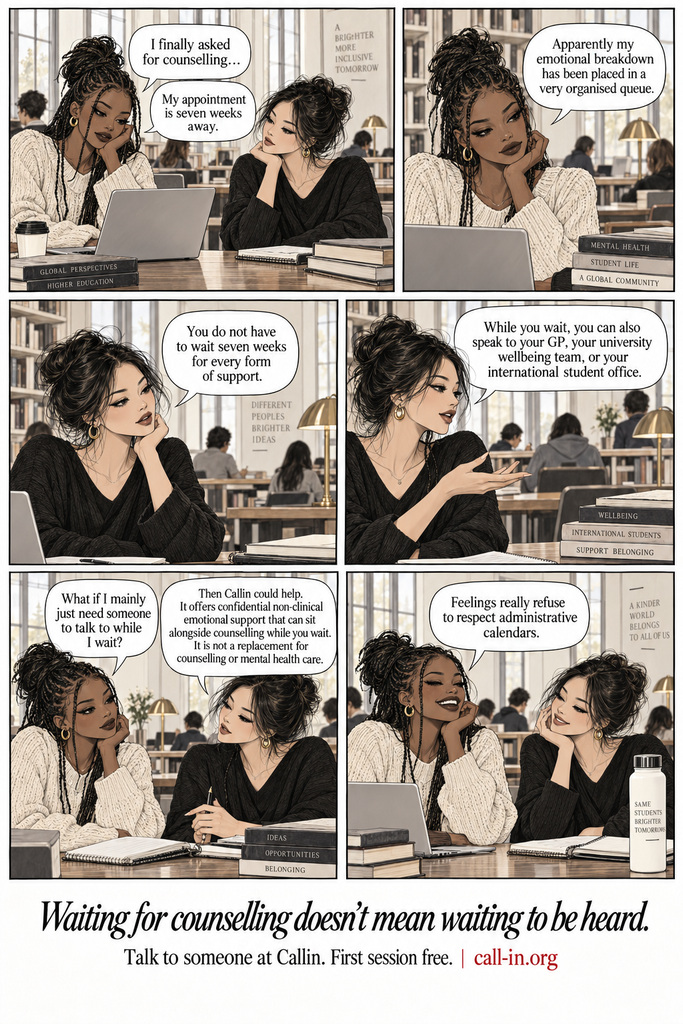
Your university may have an international office, wellbeing team, counseling service, GP or health center, academic adviser, personal tutor, chaplaincy, student-support officer, or accommodation team. Different services handle different problems, so you may need practical support, emotional support, or both.
For example, loneliness may be made worse by financial pressure, unsafe accommodation, visa concerns, discrimination, or academic confusion. Talking cannot replace practical action when the situation itself needs to change. The right university department may be able to remove part of the pressure.
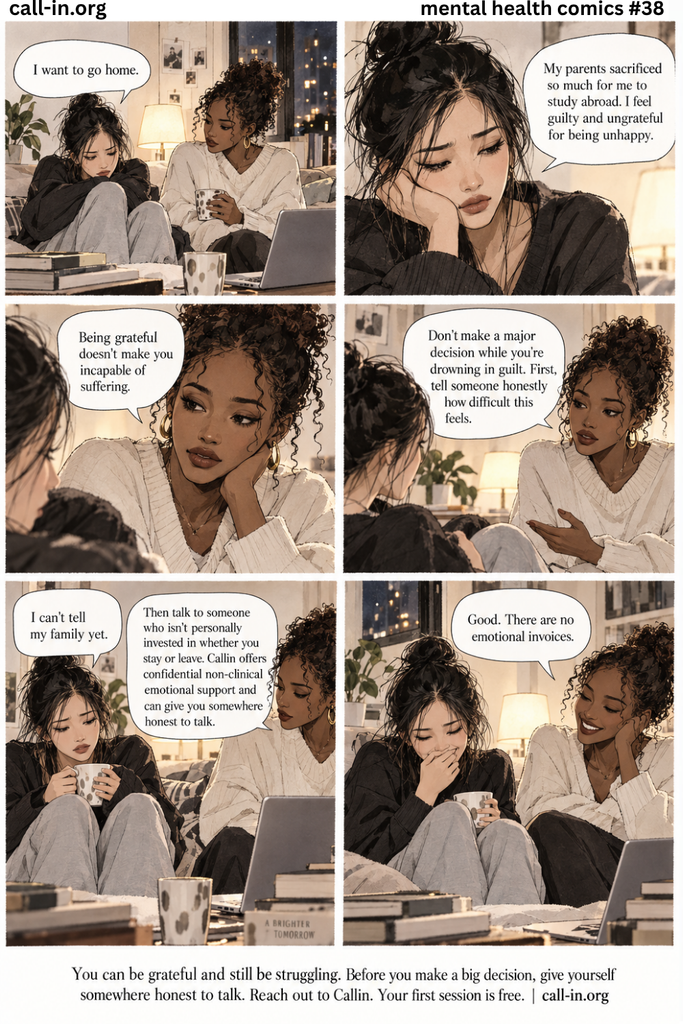
Friends and family can provide comfort, but some students censor themselves because they do not want people at home to worry. Others fear hearing, “We made sacrifices for you to be there,” when what they needed was kindness. Love can be present while emotional safety is missing.
Some students benefit from an objective, confidential, non-clinical space where they can speak without managing another person’s reaction. Callin provides online sessions with trained active listeners, including the option to continue with the same dedicated listener so you do not have to explain your life again each time.
Your first Callin session is free and can last from 20 minutes to one hour, depending on what you need. There is no diagnosis and no pressure to commit. You can learn more about what happens during a first Callin session.
What If I Am Not Sure Whether I Need Therapy?
You do not need therapy simply because you feel homesick. Sometimes you need company, perspective, practical help, cultural connection, or someone patient enough to listen while you work out what you feel.
Therapy or clinical support may be appropriate if sadness, anxiety, panic, hopelessness, or withdrawal is persistent or worsening. It may also help if distress is affecting your sleep, appetite, studies, relationships, personal care, or ability to leave your room.
If anxiety has become the main concern, read more about where to get affordable support for anxiety. Students who want support without immediately entering therapy can also explore affordable mental health support that is not therapy.
If you are in the UK and feel unable to keep yourself safe, call 999 or go to A&E. If you need urgent mental health help but it is not an emergency, use NHS 111 online or call 111 and select the mental health option. Outside the UK, contact the emergency or crisis service in your current country.
You Are Not Failing at Studying Abroad
Moving abroad can be brave and painful. It can expand your life while temporarily removing almost everything that once made life feel easy.
The goal is not to become so independent that you no longer miss anyone. The goal is to build enough connection, familiarity, and support that missing home no longer has to swallow the life you are creating.
One day, you may notice that you have a preferred grocery store, someone to message after class, a meal you know how to cook in your tiny kitchen, and a route home you can walk without checking your phone. None of it will look dramatic. That is how belonging often begins.
You are not failing at the adventure. You are living the part nobody puts in the prospectus.
Frequently Asked Questions
Is It Normal to Feel Homesick as an International Student?
Yes. Homesickness is a common response to separation from familiar people, routines, places, and cultural surroundings. It can affect students who were excited to move abroad just as easily as those who felt uncertain.
Why Do I Feel Worse After Calling My Family?
A call can briefly make home feel close, then emphasize the physical distance when it ends. You may also feel that life is continuing without you. This reaction does not mean you should stop calling, but adjusting the timing or doing something grounding afterward may help.
What Should I Do If I Have No Friends at University?
Focus on repeated contact rather than immediate friendship. Attend the same classes, societies, study groups, faith communities, volunteering sessions, or campus events regularly. Familiarity usually comes before trust.
Does Feeling Homesick Mean I Should Go Home?
Not necessarily. It may mean you need more support or time to adjust. However, if your environment is unsafe, unaffordable, unsuitable, or seriously damaging your wellbeing, discussing your options with your university and trusted people can help you make an informed decision.
Can Homesickness Affect My Studies?
Yes. Homesickness and loneliness can affect concentration, motivation, sleep, confidence, and class attendance. Speaking with a tutor or student-support service early may prevent emotional distress from becoming an academic problem.
Do I Need Therapy for International Student Loneliness?
Not everyone experiencing loneliness or homesickness needs therapy. Peer support, friendship, university services, community groups, or non-clinical emotional support may be enough. Persistent, severe, or worsening symptoms deserve assessment from a qualified health professional.
Who Can I Talk to When I Feel Lonely Abroad?
You could contact someone at home, a fellow student, your personal tutor, university wellbeing team, international office, GP, counselor, faith leader, helpline, or trained active listener. The best option is the one that matches your need and allows you to speak honestly without feeling judged.