
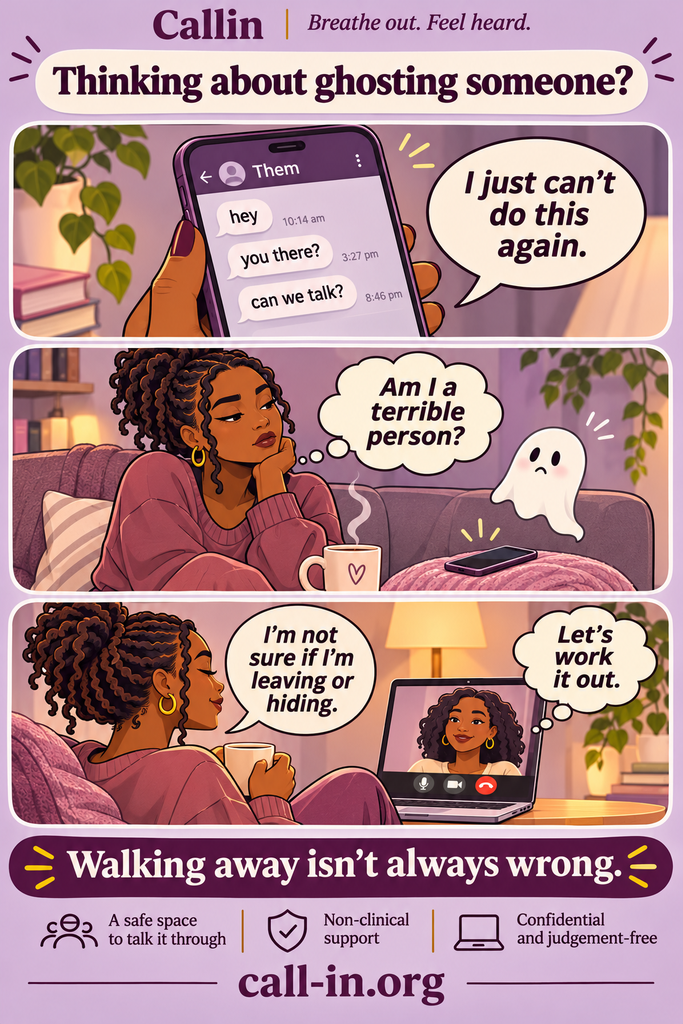
You have probably been told that ghosting is cruel. And often, it can be: being left in silence by someone you cared about hurts. But if you are the one thinking about stepping back, the picture can feel more complicated.
Maybe every conversation drains you, your boundaries keep being ignored, or you simply do not feel it anymore, and the thought of writing another explanation makes your chest tighten.
This guide is for the person doing the leaving. It looks at when walking away can be healthy, whether you owe an explanation, and how to end a connection with kindness, including for yourself. If you have been ghosted rather than doing the ghosting, our guide to why ghosting happens and how to respond is written for you.
Callin offers non-clinical emotional support. It is not therapy, counselling, diagnosis or crisis intervention. If you are in danger or thinking about ending your life, please call 999 or 112 (or your local emergency number), call Samaritans free on 116 123 (UK and Ireland), call or text 988 (US), call Lifeline on 13 11 14 (Australia), or find a helpline in your country at findahelpline.com.
Key takeaways
- Ghosting means ending or withdrawing from a connection through silence, without explaining that it is over.
- Not every situation needs another explanation, and sometimes walking away is an act of self-preservation.
- Five common times stepping back may be healthiest: draining interactions, one-sided effort, repeatedly ignored boundaries, unnecessary emotional labour, and simply losing interest.
- Whether you owe an explanation depends on the connection: a few dates is different from a committed relationship, and a brief, considerate message often prevents confusion.
- If someone is abusive or you feel unsafe, you do not owe them contact, conversation or closure.
- You can be kind and still be unavailable: leaving is not the same as using silence as punishment.
- If you are unsure whether to stay or go, talking it through with a trained, non-judgemental listener can help you hear your own answer.
What does ghosting actually mean?
Ghosting means ending a relationship, friendship or dating connection by stopping communication without telling the other person it is over. Researchers have described it as a “digital dissolution disappearance strategy”, a way of ending things through withdrawal rather than conversation (LeFebvre and colleagues, 2019).
It is worth separating ghosting from a slow reply. Being busy, unwell or overwhelmed for a few days is not the same as deliberately disappearing. Ghosting is the choice not to return at all, and not to say so.
Is ghosting always bad?
No, ghosting is not always bad, but it is not neutral either: whether it is fair depends on the relationship, your safety and why you are leaving. Disappearing on a partner of three years is very different from not replying to a stranger after one awkward coffee.
Not every situation needs another explanation. Sometimes you have already explained, more than once, and nothing changed. Sometimes a conversation would only invite pressure, guilt or argument. In those moments, walking away can be less about avoiding discomfort and more about protecting your peace.
That said, silence does land on a real person. A 2026 study in Personality and Social Psychology Bulletin found that people who are ghosted underestimate how bad the person who ghosted them feels about it, and that this gap was smaller when people sent a short reply such as “sorry, can’t talk” instead of going silent (Li, Zheng and Schroeder, 2026).
So it is worth asking: is silence protecting you, or just postponing a message that would feel lighter once sent?
When is walking away the healthiest choice?
Walking away may be the healthiest choice when staying costs you more than it gives, especially if the connection is draining, one-sided, disrespectful of your boundaries or simply no longer right for you. Here are five times stepping back can be self-preservation rather than cruelty.
1. When every interaction leaves you emotionally exhausted
Some connections leave you feeling lighter. Others leave you needing to lie down. If you dread their name on your screen, replay conversations for hours afterwards, or feel tense before every message, your body may be telling you something your mind is still negotiating. Our piece on why texting can feel emotionally exhausting explores that drain.
2. When the effort is always one-sided
You start every conversation, remember their news and make the plans, and you notice that if you stopped, contact would simply end. Relationships naturally ebb and flow, but a long pattern of giving without receiving can quietly erode your sense of worth. If you are always the strong one in your relationships, it may be time to ask who is holding you.
3. When your boundaries are repeatedly disregarded
You have said you need space, or that a topic is off-limits, or that late-night calls do not work for you. And it keeps happening. A boundary that is ignored once may be a mistake; a boundary that is ignored repeatedly is information. Our guides on setting boundaries without feeling bad and emotional consent can help you name what you need.
4. When you are carrying unnecessary emotional labour
Emotional labour is the invisible work of managing someone else’s feelings: calming them down, anticipating their moods, softening every sentence so they do not react. Some of this is part of caring.
But if you are constantly managing someone at your own expense, and they show no interest in meeting you halfway, stepping back is a reasonable response. If this sounds familiar, our guide to stopping people-pleasing may resonate.
5. When you have simply lost interest
Sometimes nothing is wrong and nobody behaved badly; you just do not feel it anymore. Losing interest is a valid reason to end a connection, and you do not need to invent a dramatic justification.
The kindest response here is usually a short, honest message rather than a slow fade, especially if the other person is clearly invested.
Do you owe someone an explanation for leaving?
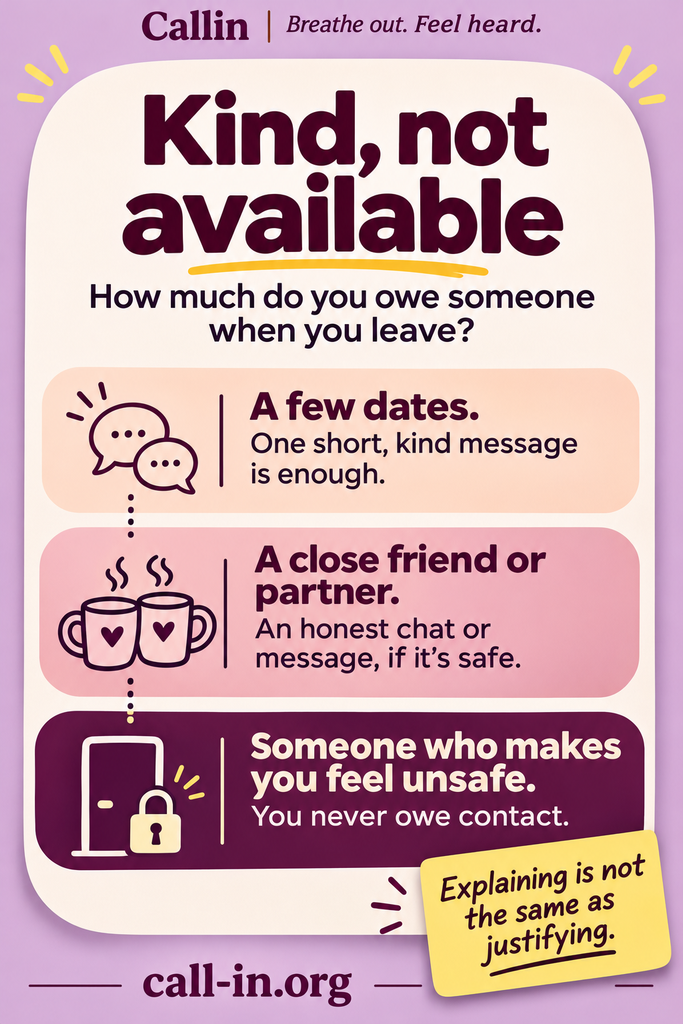
It depends on the connection: you rarely owe a detailed explanation after a few dates, but in a committed relationship or close friendship, an honest conversation or message is usually the kinder choice, as long as it is safe. Explanation and justification are not the same thing, and you can end something without having to win an argument about it.
Here is a gentle way to think about it:
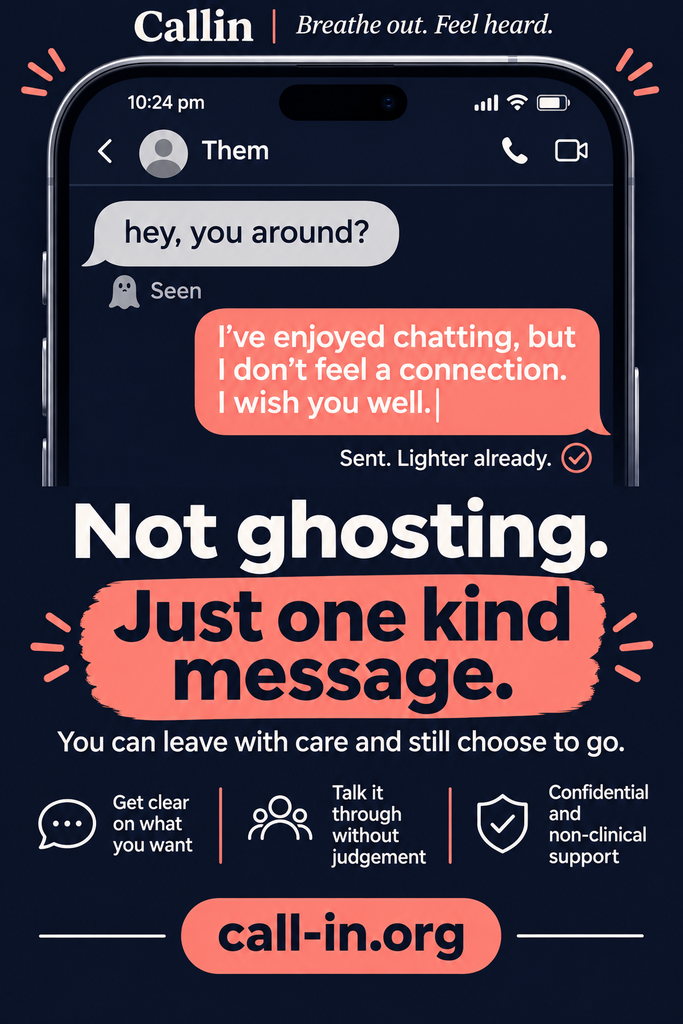
- A few messages or dates: a brief, considerate message such as “I’ve enjoyed chatting, but I don’t feel a romantic connection. I wish you well” prevents confusion without inviting a debate.
- An established friendship or relationship: an honest conversation, in person or by message, respects what you shared, if you feel safe having it.
- Someone who has ignored your boundaries before: a clear, short statement is enough. You do not need to keep explaining to someone who has shown they will not listen.
You can end something without making them responsible for your decision, and without taking responsibility for their reaction. Their disappointment is real, but it is theirs to process. If leaving still hurts, our piece on why it hurts to leave a relationship explains why even a right decision can ache.
What if the person is abusive or I feel unsafe?
If someone is abusive, controlling or makes you feel unsafe, you do not owe them contact, an explanation or closure. Your safety comes first, and cutting contact without warning can be the safest option.
If you are in immediate danger, call 999 (UK) or your local emergency number. In the UK, the National Domestic Abuse Helpline, run by Refuge, is free and open 24/7 on 0808 2000 247. In the US, the National Domestic Violence Hotline is on 1-800-799-7233, and elsewhere you can find local support at findahelpline.com. If you are trying to make sense of a relationship that felt confusing or harmful, our guide on narcissistic abuse versus a bad relationship may help.
Do they miss you, or just your attention?
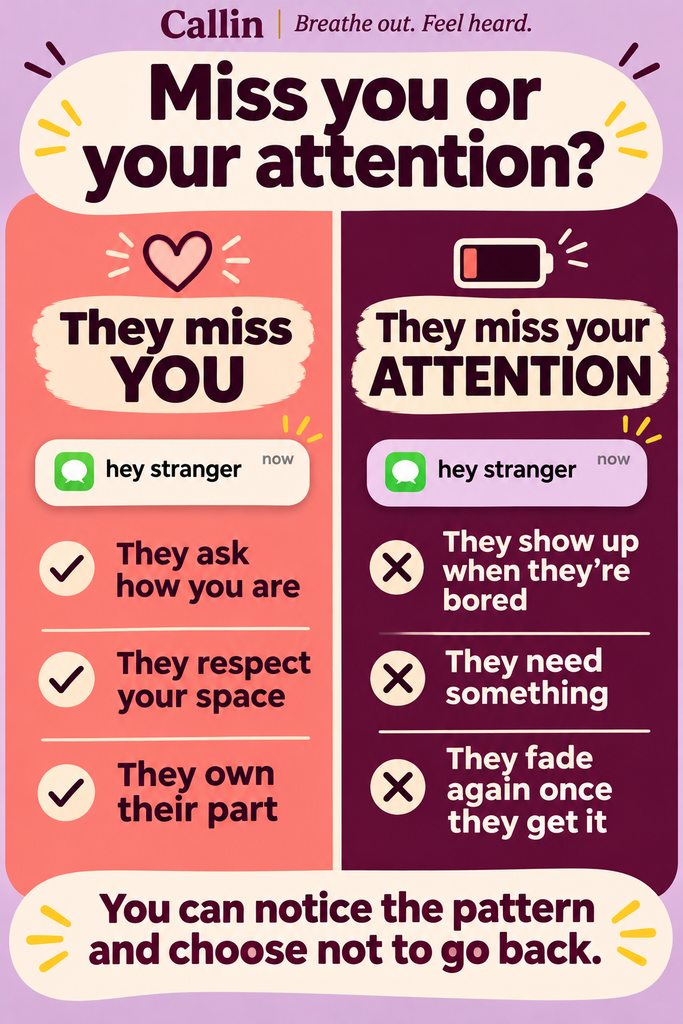
When someone reappears after you have stepped back, it is worth asking whether they miss you as a person or miss the attention, availability and support you used to give. The answer can help you decide whether to reopen the door.
Someone who misses you tends to show curiosity about how you are, respect the distance you asked for and take responsibility for their part. Someone who misses your attention often returns when they are bored, lonely or need something, then fades again once they have it.
A late-night “hey stranger” is not the same as an apology. You are allowed to notice the pattern and choose not to step back into it.
How do you know when it’s time to walk away?
You know it may be time to walk away when, after honest reflection, the connection consistently costs more than it gives and talking about it has not changed anything. These reflection questions can help you check in with yourself:
- How do I usually feel after spending time with or talking to this person?
- Am I giving far more than I receive, and has that been true for a long time?
- Have I expressed my needs clearly, and what happened when I did?
- Am I staying out of care, or out of guilt, fear or habit?
- If a friend described this relationship to me, what would I tell them?
- What would I gain, and what would I lose, by stepping back?
There is no score that gives you the answer. But writing your responses down, or saying them out loud to someone who will not judge you, can make what you already know feel clearer. If you tend to crave connection but withdraw from relationships, these questions can also help you notice whether you are leaving for your wellbeing or out of fear.
Can you be kind and still choose to leave?
Yes. You can be kind and still be unavailable, and leaving with care is very different from using silence as punishment. Kindness is about how you leave, not whether you are allowed to.
Silence used as punishment is designed to make someone feel small, anxious or chasing. Walking away for self-preservation is about protecting your energy, not hurting theirs. Where it is safe, a short, warm message is often the gentlest way to close the door: it gives them clarity and lets you leave without carrying unfinished business. And if it is not safe, or you have already explained many times, choosing silence does not make you a bad person.
Need someone to talk to?
If you are wrestling with whether to walk away, how to say it or how to cope afterwards, Callin gives you a confidential space to talk it through with a trained human listener. You do not need to have it figured out before you book.
Callin listeners are trained in active listening and complete mandatory Psychological First Aid training from Johns Hopkins University. Through Human Continuity™, Callin prioritises keeping you with the same listener whenever possible, so you do not have to retell the whole story each time. Callin is available 24/7 and sessions are booked in advance, so you can book a time at any hour, on Zoom or Google Meet.
Many people find it easier to say the hard thing out loud to someone outside the situation, especially if they don’t want to burden their friends. If you are grieving the end of something, our page on heartbreak support is there too. Eligible new clients can start with a free introductory voice session, with no credit card required: book your free session.
Callin. Breathe out. Feel heard.
Watch: Is ghosting always bad?
Prefer to watch? Our video on this topic, Is Ghosting Always Bad? Walking Away Is Self-Preservation, covers these ideas in a few minutes on the Callin Media YouTube channel.
How we wrote this
This article expands a Callin video on ghosting and self-preservation. We checked research references on PubMed and Crossref on 12 November 2026: LeFebvre and colleagues (2019) for the definition of ghosting, and Li, Zheng and Schroeder (2026) on how people who ghost feel. Helpline numbers were checked on the official National Domestic Abuse Helpline and National Domestic Violence Hotline websites the same day. Callin details come from our own published pages.
Frequently asked questions
Is ghosting ever justified?
Sometimes. Walking away without further explanation can be justified if someone is abusive, has repeatedly ignored your boundaries, or if a further conversation would put your safety or wellbeing at risk.
Is it rude to ghost after one or two dates?
It is not usually a serious wrong, but a short, kind message such as “I don’t feel a connection, but I wish you well” is clearer and often easier for both of you.
Do I owe my ex an explanation?
In a committed relationship, an honest explanation is usually kinder if it is safe. You do not owe repeated explanations, and you do not owe contact to anyone who has been abusive.
How do I stop talking to someone without ghosting them?
Send one clear, respectful message saying you are stepping back, without blame or a long justification, and then stick to your decision.
Is ghosting a form of self-care?
It can be when it protects you from harm or exhaustion. It becomes less about self-care when it is used to avoid a simple conversation or to punish someone.
Why do I feel guilty after ghosting someone?
Guilt often means you care about how your actions affect others. Research suggests people who ghost often feel worse about it than others realise. If silence is sitting heavily with you, a short, kind message may help you both close the chapter.
Can I talk to someone at Callin about a relationship decision?
Yes. Callin offers non-clinical emotional support with trained listeners, and eligible new clients can start with a free introductory voice session, no credit card required.
Is ghosting ever justified? Tell us what you think
We would love to hear your view. Have you ever walked away without explaining, and did it feel like self-preservation or something you regret? Share your thoughts in the comments below or on our video.
For employers and universities: if your people are carrying relationship stress into work or study, enquire about Callin for your organisation or a 3-month pilot.

Leave a Reply