
Have you ever looked at your messages, social feeds, or list of contacts and still felt as though there was nobody you could really talk to?

You may be surrounded by people and still feel alone. You may have friends, family, colleagues, classmates, or an active online life, yet not feel understood by anyone close to you.
Loneliness affects people across the UK, the US and beyond. That is part of why the phrase “lonely generation” has been appearing in conversations about young people and modern life. It isn’t a diagnosis.
It isn’t a way of labelling everyone. But it does describe a real experience that many people are finding easier to recognise and talk about, especially in the current media conversation, including The Guardian’s October 2026 coverage of the “Lonely Generation”.
You do not need to be in crisis to want connection. You do not need a perfect explanation. Sometimes you simply need loneliness help or someone to talk to when lonely.
What does “the lonely generation” mean?
“Lonely generation” is a media phrase, not an official category. It is often used to describe younger adults who are living with high levels of loneliness despite having more ways to connect than ever before.
The phrase has also been used as the title of a new book by Dr Michelle Lim, a clinical psychologist and loneliness researcher whose work informed recent Guardian reporting on the “Lonely Generation”. It can be a useful shorthand for a wider conversation, but it is still only that: a media phrase, not a diagnosis.
You can send a message instantly. You can join a group chat, follow hundreds of people, or speak to someone on the other side of the world. But digital contact is not always the same as feeling known, remembered, or emotionally close.
The UK government defines loneliness as the unwelcome feeling that there is a gap between the relationships you have and the relationships you want. Social isolation is different. It describes having limited contact or few social ties.
You can be socially isolated and enjoy being alone. You can also feel lonely while sitting in a crowded room.
That distinction matters. Loneliness is not always about the number of people around you. It is often about whether you feel able to be yourself with someone.
The numbers behind the conversation
The latest Community Life Survey for England found that:
- Around 7% of adults reported feeling lonely often or always.
- Among adults aged 16 to 24, the figure was 9%.
- When broader signs such as feeling left out, isolated, or lacking companionship were included, 12% of 16-to-24-year-olds reported high levels of indirect loneliness.
The government uses feeling lonely “often or always” as a measure of chronic loneliness. These statistics relate to England specifically, rather than the whole UK, and they do not describe every young person’s experience.
Still, the pattern is clear: younger adults are among the groups most likely to report frequent loneliness.
And this is not only an England story. The WHO Commission on Social Connection reports that around 1 in 6 people globally experience loneliness, with young people among the groups most affected. In the United States, a CDC report using 2022 BRFSS data found that 43.3% of adults aged 18 to 34 across 26 states reported loneliness, the highest rate of any adult age group in that dataset.
That wider context matters. Loneliness can affect people across different countries, ages, and life situations, even when the details look slightly different from place to place.
The figures also remind us that loneliness is not a personal failure. It can be connected to moving away from home, starting university, changing jobs, losing a relationship, living with disability, facing financial pressure, or feeling different from the people around you.
You do not have to prove that your loneliness is serious enough to deserve support.
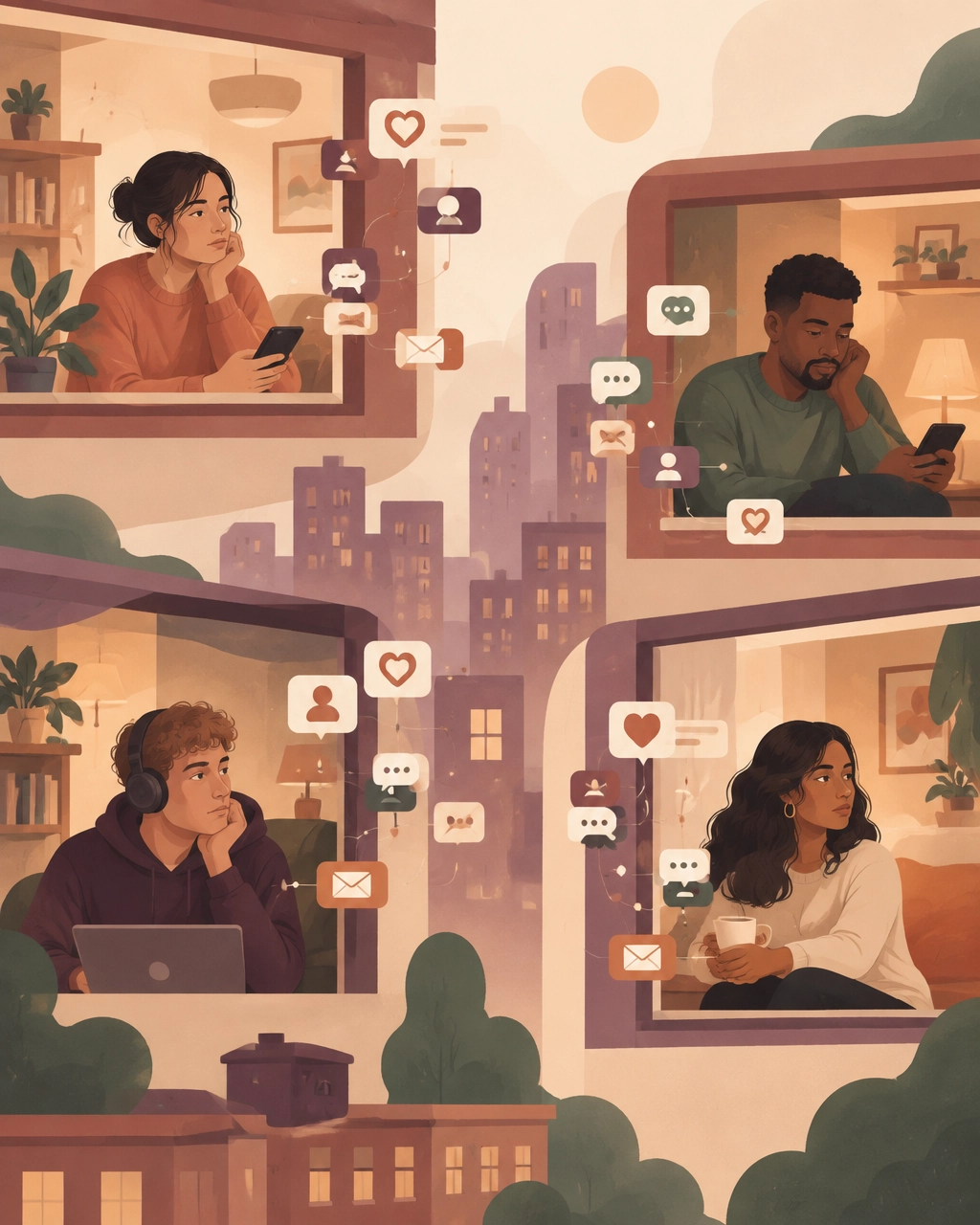
Why can you feel lonely when you are “connected” and still need loneliness help?
Modern life can create contact without always creating closeness.
You might have regular conversations that stay on the surface. You might spend time with people who do not really understand what you are carrying. You might be the person who listens to everyone else while keeping your own thoughts private.
Sometimes loneliness develops quietly. You continue going to work or university. You answer messages. You smile when people ask how you are. From the outside, nothing looks particularly wrong.
Inside, you may be thinking:
- “I don’t want to bother anyone.”
- “My friends already have enough going on.”
- “I wouldn’t know where to start.”
- “Other people have it worse.”
- “I should be able to handle this myself.”
These thoughts can make reaching out feel harder. The longer you keep everything to yourself, the more difficult it may feel to begin.
But you do not need a polished explanation. You can start with, “I’ve been feeling lonely,” or “I don’t really know what I need, but I wanted to talk.”
That is enough.
Loneliness help does not have to begin with a big social plan
When you feel lonely, advice can sometimes sound more demanding than helpful.
“Join a club.”
“Make more friends.”
“Get out more.”
“Put yourself out there.”
These suggestions may work for some people. But they do not always meet you where you are. If you are already tired, anxious, heartbroken, or overwhelmed, planning a whole new social life may feel impossible.
A smaller step may be more realistic.
You could try:
- Sending one honest message to someone you trust.
- Sitting in a shared space rather than staying alone at home.
- Returning to an activity you used to enjoy.
- Joining a group connected to an interest, not simply “meeting people”.
- Speaking to a listener who is separate from your personal life.
- Writing down what you wish you could say before you say it aloud.
You do not have to fix your whole social life today. You can simply create one moment of genuine contact.
Finding loneliness help and someone to talk to when lonely
You may want a friend. You may want professional support. You may want a low-pressure conversation with someone who is not personally involved in your situation.
Each option serves a different purpose.
A trusted friend may offer warmth and familiarity. A therapist may be more appropriate if you need clinical assessment, treatment, or structured therapeutic support. A community group may help you build connection around a shared interest.
Non-clinical emotional support is another option. It is not therapy, but it is still support. It can give you a private place to talk about loneliness, stress, relationships, heartbreak, grief, burnout, or difficult life changes without needing a diagnosis.
You decide what you want to share. You can talk about the day you have had, the relationship you are missing, or the feeling that you do not quite belong anywhere at the moment.
Why continuity can make talking feel easier
Opening up to a stranger can take energy.
You may have to explain your background, your relationships, and what happened before you can reach the part that is hurting. If you need to repeat that story every time, support can begin to feel temporary.
This is why continuity matters to some people.
With Human Continuity™, Callin aims to help you speak with the same listener over time wherever possible. You are not a stranger starting from zero each time. The person supporting you can become familiar with the wider context of your life and where the last conversation ended.

That does not guarantee a particular outcome. It does not replace therapy, medical care, or crisis support. But it may reduce the emotional effort of repeatedly introducing yourself and your circumstances.
Sometimes being remembered is part of feeling heard.
What can you talk about?
You do not need to arrive with a clear agenda.
You might talk about:
- Feeling lonely in a relationship.
- Missing home after moving or starting university.
- Feeling disconnected from friends.
- Finding it hard to make friends as an adult.
- Work stress or burnout.
- A breakup that other people think you should be over.
- Anxiety about what comes next.
- Feeling surrounded by people but unable to open up.
- The pressure to seem fine when you are not.
Callin offers confidential, one-to-one non-clinical mental health support with trained human listeners. Conversations are available through voice calls, video calls, or private chat options, depending on the service you choose.
It is real human support, not an automated conversation. If you are looking for emotional support online, you can learn more about Callin’s confidential non-clinical mental health support or read about Human Continuity™ ongoing online emotional support with the same person.
You are allowed to want more than contact
The conversation around the “lonely generation” is not about blaming phones, social media, young people, or modern life.
It is about noticing that contact and connection are not always the same thing.
You may not need more notifications. You may need a conversation where you do not have to perform, reassure someone else, or pretend that everything is fine.
You do not need fixing. You need somewhere to talk.
Frequently asked questions
What should I do if I feel lonely but do not want to burden my friends?
You can choose a support option outside your personal relationships. A trained listener, peer-support service, community group, or therapist may give you space to speak without worrying about how your words will affect someone close to you.
Is loneliness a mental health condition?
No. Loneliness is a human experience, not a diagnosis. It can affect your wellbeing, mood, motivation, and sense of belonging, but feeling lonely does not mean that something is wrong with you.
Do I need to be in crisis to ask for loneliness help?
No. You can ask for support before things become overwhelming. Wanting someone to talk to when lonely is a valid reason to reach out.
Is Callin therapy?
No. Callin provides confidential, non-clinical human support. It does not provide therapy, counselling, diagnosis, medical or psychiatric care, emergency intervention, or crisis support.
If you are in immediate danger or need urgent help, contact emergency services or a crisis service in your location.
How do I know if I’m lonely or just introverted?
You may be introverted and still feel lonely, or introverted and feel completely content. Introversion usually relates to how you recharge, while loneliness is the painful feeling that the connection you have is less than the connection you want.
What if I don’t know what to say?
You do not need to know exactly what to say before you ask for support. You can start with one honest sentence, such as “I’ve been feeling lonely” or “I’m not sure how to explain it, but I wanted to talk.”
Start in the way that feels manageable
You could message someone you trust. You could explore a local group. You could read more about support before deciding. You could have a private conversation with a trained listener.
There is no single correct first step.

If you are looking for loneliness help, Callin offers a calm, confidential place to begin. You do not need the right words, a diagnosis, or an immediate plan. If what you need right now is simply someone to talk to when lonely, that kind of steady, human support can still matter.
You can start when you’re ready.
Explore confidential support for loneliness and emotional overwhelm or read more about finding someone to talk to.
Sources and further reading
- The Guardian: “There’s a lot of silence’: have we created a new ‘Lonely Generation’?”
- Community Life Survey 2024/25: Loneliness and support networks
- Social Connection Framework
- NHS Every Mind Matters: Loneliness
- World Health Organization Commission on Social Connection
- WHO Q&A: Social connection
- CDC: Loneliness, Lack of Social and Emotional Support, and Mental Health Issues — United States, 2022
This article is for informational purposes and does not constitute clinical or medical advice. Callin provides non-clinical emotional support and does not replace therapy, healthcare, crisis services, or emergency support.

Leave a Reply