
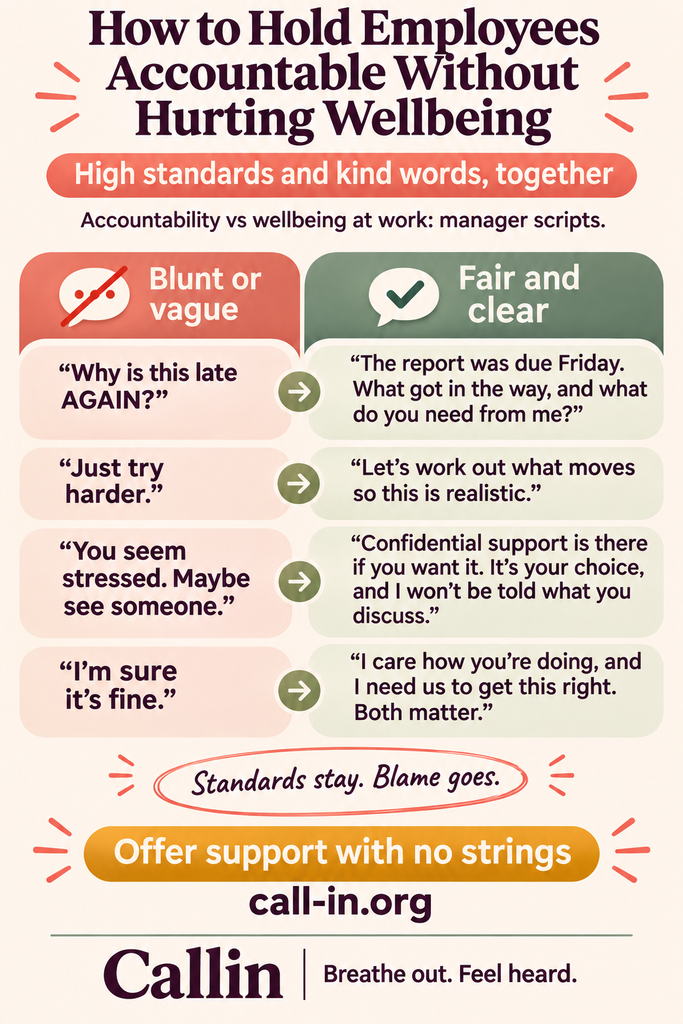
Many managers feel caught between two instructions: deliver results, and look after your people. This guide is for managers, HR teams and leaders who want to do both well, without blurring roles that should stay separate.
Short answer: Accountability and wellbeing are not opposites. Clear, fair standards help people know where they stand, while support helps them meet those standards sustainably.
The skill is keeping the two honest and separate: be direct about the work, curious about obstacles, and realistic about workload. Offer confidential support as a genuine choice, never as a condition of a performance process or a way to manage someone.
Accountability at work is the shared, explicit agreement about what someone is expected to deliver, how progress will be reviewed, and what support they will have to get there.
Wellbeing support is help offered for a person’s own sake, such as a confidential conversation, a workload change or signposting, with no link to their performance record.
Accountability coaching is a goal-focused, collaborative conversation in which a person chooses their own goal and a coach helps them plan, follow through and review what happened.
Callin Support Ltd provides non-clinical emotional support. It is not therapy, counselling, diagnosis, medical care, or a crisis or emergency service. If you or someone you are supporting is in immediate danger, contact local emergency services now, or find a free helpline in your country at findahelpline.com.
Key takeaways
- High standards and wellbeing work together. Amy Edmondson describes psychological safety and accountability as “two different dimensions, not as a tradeoff.”
- Emotional support, accountability coaching and line-manager accountability are three different things with three different purposes. Keep them apart.
- Never use wellbeing support as a performance tool. Offer it freely, keep it voluntary, and keep it out of performance records.
- When performance slips, try to understand why before you act. In the UK, Acas guidance says employers “should try to understand why.”
- Look at the work itself. Workload, control, role clarity and support often explain more than motivation does.
- Use short, plain, non-defensive language. Say what you expect, ask what is getting in the way, and agree what you will do too.
- Confidential external support protects both the employee and the manager. Callin’s organisational page states that the content of an employee’s support conversation is not shared with their employer.
Is accountability the opposite of wellbeing at work?
No. Accountability and wellbeing are separate dimensions, and good teams need both. Amy Edmondson, the Harvard Business School faculty member known for her work on psychological safety, puts it plainly in an HBS interview: “I see these as two different dimensions, not as a tradeoff.”
She goes further. Psychological safety on its own creates a comfort zone, she says, while “if you are ONLY talking about accountability for excellence, then you are creating an anxiety zone where people are less able to do their best work.” When both are present, people can move into what she calls the learning zone, “which also happens to be the high-performance zone.”
Kim Scott’s Radical Candor framework makes a similar point about feedback. It asks managers to “Care Personally® and Challenge Directly® at the same time,” and names the failure many kind managers fall into, Ruinous Empathy®: “You care, but you stay quiet or sugar-coat it.”
The practical lesson is simple. Lowering standards to protect someone’s wellbeing is rarely kind, and raising pressure without safety rarely improves performance. If you are noticing quieter, more controlled ways that pressure shows up in teams, our piece on why micromanagement after autonomy feels so hard explores the employee side.
What is the difference between emotional support and accountability coaching?
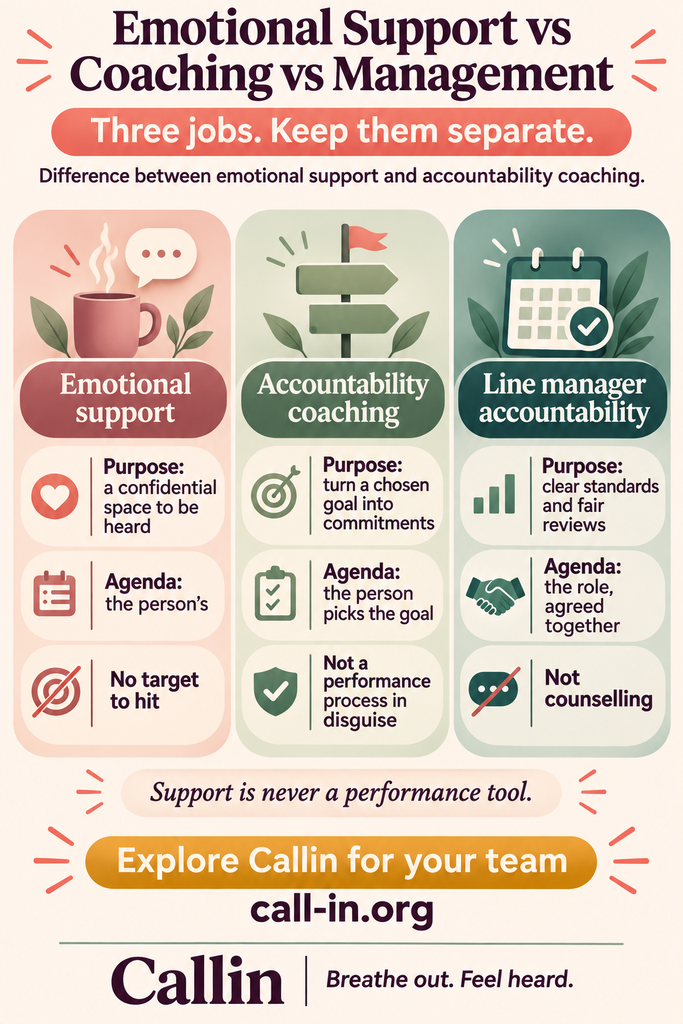
Emotional support helps a person process what they are carrying; accountability coaching helps a person move towards a goal they have chosen. Both are different again from a manager holding someone to the standards of their role. Blurring them confuses everyone, so it helps to see them side by side.
Emotional support
- Purpose: a confidential space to talk, vent, feel heard and make sense of what is happening.
- Who sets the agenda: the person. There is no target to hit.
- What it is not: therapy, diagnosis, advice on how to perform, or a report on anyone’s progress.
- Good for: stress, loneliness, overwhelm, life changes, or simply needing to talk before deciding anything.
Accountability coaching
- Purpose: turning an intention into specific commitments, then reviewing what happened.
- Who sets the agenda: the person chooses the goal; the coach helps make it clear and realistic.
- What it is not: therapy, clinical care, or a manager’s performance process in disguise.
- Good for: procrastination, career decisions, transitions and following through on personal or professional plans.
Line-manager accountability
- Purpose: agreeing what the role requires, reviewing progress fairly, and providing the resources to deliver it.
- Who sets the agenda: the organisation and the manager, ideally in conversation with the employee.
- What it is not: counselling, coaching someone’s private life, or a judgement on their worth.
- Good for: clarity, fairness and shared standards across a team.
Callin’s own guide to therapy, coaching or emotional support describes the difference well: coaching asks “Where do you want to go, what is getting in the way, and how do we help you move forward?” while emotional support asks “What are you carrying, and would it help to have somewhere safe to talk about it?” For a wider comparison that includes employee assistance programmes, see EAP vs therapy vs emotional support.
Why should wellbeing support never be used to manage performance?
Because support only works when people trust it. If an employee suspects that using a wellbeing service will be noted, tracked or mentioned in their next review, many will simply not use it, and the ones who do may not speak freely.
Keep a few lines firm:
- Offer support as a choice, not an instruction. “This is available to you” is very different from “I need you to do this before our next review.”
- Do not make support part of an improvement plan. Objectives, timelines and training belong in the plan. Private conversations with a listener do not.
- Do not ask what was discussed. It is not yours to know, and asking undermines the whole offer.
- Do not treat uptake as evidence. Whether someone uses support, or does not, says nothing reliable about their commitment or capability.
This protects managers too. Callin’s page for organisations notes that “a good manager can care without becoming someone’s therapist, counsellor or entire emotional support system.” Callin’s guide to workplace mental health support for employees makes a related point: support should be easier to use “without turning it into another performance metric.”
How do you hold employees accountable without hurting wellbeing?
Start with clear, fair expectations, review them regularly, and investigate obstacles before you judge effort. Most of the harm in accountability comes from vagueness, surprise and unrealistic demands, not from the standard itself.
Practical steps that travel well across cultures and sectors:
- Make expectations explicit and fair. UK Acas guidance on reviews and appraisals says objectives “should be fair and reflect the employee’s usual tasks and workload,” and suggests making them specific, measurable, achievable, relevant and time-bound.
- Talk little and often. The same Acas page says managers should still talk to employees informally about performance on a regular basis, through feedback, coaching and regular check-ins. Surprises at an annual review are a sign the system failed earlier.
- Ask why before deciding what. Acas guidance on problems with an employee’s performance (UK) says employers “should try to understand why,” and distinguishes capability (ability to do the job) from conduct (behaviour).
- Check the work design. The UK Health and Safety Executive’s Management Standards cover six areas: demands, control, support, relationships, role and change. If several are out of balance, a performance conversation alone will not fix the problem.
- Own your side. Ask what you could do differently: clearer priorities, fewer competing deadlines, better resources.
- Adapt the conversation to the person. Directness is read differently across cultures, and some people need time to respond. Clarity matters more than tone matching any one style.
Globally, the World Health Organization’s mental health at work fact sheet lists risks such as “excessive workloads or work pace, understaffing,” “lack of control over job design or workload,” “unclear job role” and “limited support from colleagues or authoritarian supervision.” These are things managers and leaders can influence directly. For more on why individual wellness offers cannot carry this alone, read why workplace stress needs more than wellness programmes.
What does supportive accountability sound like in practice?
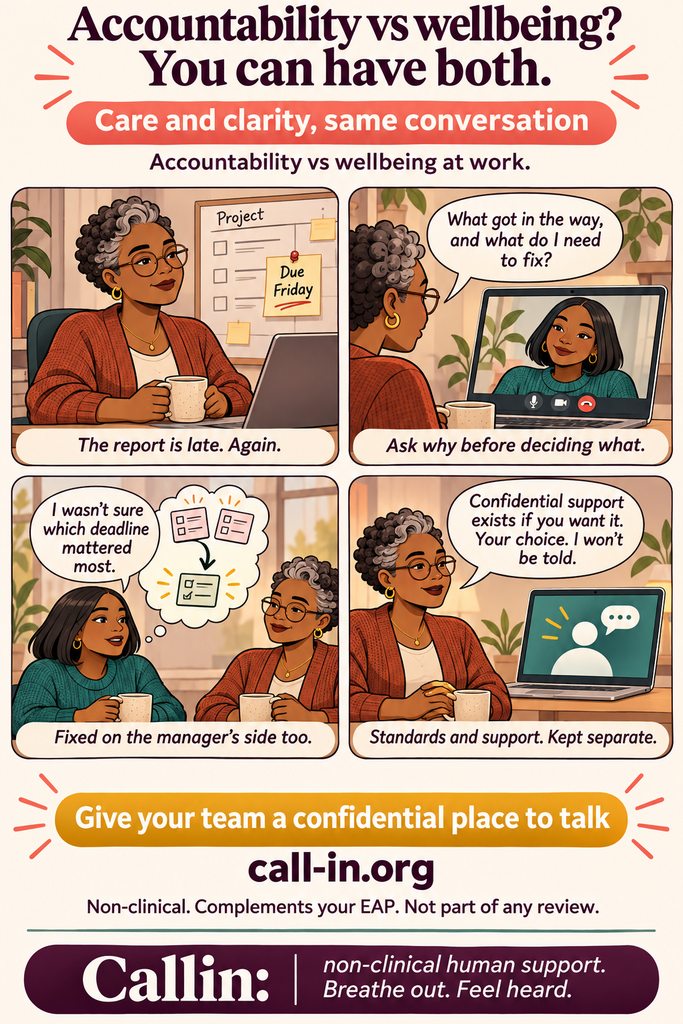
It sounds calm, specific and two-way. You name the standard, show you care about the person, and keep the support offer separate from the performance point. A few short scripts you can adapt:
Setting expectations at the start
“Here’s what good looks like for this project by the end of March. Does that feel realistic given everything else on your plate? If not, let’s work out what moves.”
Raising a missed standard without blame
“The client report was due Friday and it hasn’t arrived. I’d like to understand what got in the way, and what you need from me to get it over the line.”
Holding both without trading one for the other
“I care about how you’re doing, and I also need us to get this right. Both matter. Would it help to talk about the work today, and anything else separately?”
Offering support with no strings
“There’s confidential support available if you ever want it. Using it is completely your choice, it isn’t part of any review, and I won’t be told what you discuss.”
Owning your part
“Looking back, I may not have been clear about which deadline mattered most. Let’s fix that now.”
These scripts focus on the work and the conditions around it. For conversations where someone is clearly struggling and the priority is simply to listen, a separate guide is the better starting point. Managers who carry a lot of this weight themselves may also find our piece on surviving emotional labour useful.
How should performance management and mental health interact?
Fairly, and in that order: understand, support, adjust, then review. In the UK, legal duties apply, so follow your policies and take advice where needed. Elsewhere, check local employment and disability law, as protections and processes differ widely.
Key points from UK Acas guidance:
- Do not assume. Acas guidance on capability and performance when someone is disabled says employers should “never assume someone is not capable of doing their job, or why someone is behaving in a certain way.”
- Consider adjustments first. Acas notes that something that looks like a conduct issue, such as regular lateness, could be linked to an impairment or condition, and that a reasonable adjustment should be considered before any disciplinary action.
- Support before formality. Employers “should take steps to try and help someone to improve, before starting a formal disciplinary procedure.”
- You are not expected to be an expert. Acas guidance on talking about mental health says managers “should not be expected to be an expert in mental health,” but knowing what resources exist can help.
Acas gives a useful example: an employee called Eden had a performance review after a sudden drop in work quality, explained that they had been in severe pain, and their manager agreed support and “a small reduction in Eden’s targets so they can maintain the quality of their work.” That is accountability and wellbeing working together.
Internationally, the WHO describes reasonable accommodations such as flexible hours, extra time to complete tasks and “regular supportive meetings with supervisors.” The WHO guidelines on mental health at work set out evidence-based recommendations on organisational interventions, manager training and return to work.
What are leaders and HR responsible for, beyond individual managers?
Leaders and HR own the system that managers work inside. If workloads are unrealistic or roles unclear, asking managers to “balance” accountability and wellbeing simply moves the strain onto them.
Areas worth reviewing:
- Workload and staffing. The WHO fact sheet estimates that “12 billion working days are lost every year to depression and anxiety at a cost of US$ 1 trillion per year in lost productivity.” Prevention starts with how work is designed.
- Manager training. The WHO recommends manager training that helps managers “recognize and respond to supervisees experiencing emotional distress” and builds skills like active listening. UK Acas guidance on creating a supportive environment also advises training managers to talk and listen sensitively.
- Risk assessment (UK). HSE states that employers “have a legal duty to protect employees from stress at work by doing a risk assessment and acting on it.”
- Clear support routes. Managers need to know where to signpost. Our guides to how Callin complements an EAP and mental health support for a small company can help you map options.
- Culture. Watch for signals that productivity has become identity, such as hustle culture, productivity guilt or people feeling invisible at work.
Supporting people before pressure builds is the idea behind preventive emotional care, and it is far easier than repairing burnout later. If burnout is already showing up, see how to overcome professional burnout and work stress and burnout support.
Where does Callin fit, and where does it not?
Callin offers confidential, non-clinical human support that sits outside the line-management relationship. It is not HR, not a performance tool and not a reporting channel to employers.
What Callin’s official pages state:
- Who and where. Callin began in June 2023, is operated by Callin Support Ltd, registered in the United Kingdom, and supports adults aged 18 and over worldwide. Sessions are currently conducted in English.
- How it works. Callin is available 24/7, with sessions you book at a time that suits you, at any hour. It is not an instant, continuously monitored helpline. See what happens in a Callin first session.
- Trained listeners. Listeners complete mandatory Psychological First Aid training from Johns Hopkins University and follow Callin’s active-listening materials and protocols covering boundaries, safeguarding and signposting.
- Privacy. Callin does not create clinical treatment records, and its organisational page states that the content of an employee’s support conversation is not shared with their employer or benefits provider. Read the Callin privacy policy.
- Human Continuity™. Callin prioritises the same listener or coach for ongoing support wherever operationally possible. Learn more about ongoing support with the same person.
- Separate coaching. Callin also describes a separate Career & Accountability Coaching service in which, in its own words, “You choose the goal.” It is non-clinical and centred on the person’s own goals, not on an employer’s performance process.
- A first step. Eligible new clients can start with a free first session.
Callin can complement an EAP, occupational health, HR and clinical pathways, but it does not replace them, or your safeguarding and emergency responsibilities. More detail is in the Callin FAQ and on the About Callin page.
If you are an individual who wants somewhere private to talk about work pressure, or anything else, you can start with Callin’s non-clinical emotional support.
If you lead a team or an organisation, you can make an employer enquiry or discuss a 3-month pilot to give your people a confidential human place to talk, separate from how their performance is managed.
FAQs
Is accountability bad for employee wellbeing?
Not when it is fair and clear. Amy Edmondson describes psychological safety and accountability as two different dimensions, not a tradeoff. Problems tend to come from vague expectations, unrealistic workloads and fear, not from standards themselves.
How do you hold employees accountable without hurting their wellbeing?
Agree clear, fair expectations, review them regularly, and ask what is getting in the way before judging effort. Check workload, role clarity and resources, own your part, and offer confidential support as a free choice that is kept separate from any performance process.
What is the difference between emotional support and accountability coaching?
Emotional support gives a person a confidential space to talk and feel heard, with no target to hit. Accountability coaching is goal-focused: the person chooses a goal and a coach helps them plan, follow through and review progress. Neither is the same as a manager’s performance process.
Should a manager refer an employee to wellbeing support during a performance process?
A manager can let the employee know confidential support exists, but it should be offered as a genuine choice. It should not be a condition of an improvement plan, recorded as evidence, or followed up by asking what was discussed.
How should performance management and mental health interact?
Try to understand the reasons behind a performance issue, offer support and consider adjustments before any formal steps. In the UK, Acas guidance and the Equality Act 2010 apply. In other countries, check local employment and disability law.
Does Callin report to employers on individual employees?
No. Callin’s organisational page states that the content of an employee’s support conversation is not shared with their employer or benefits provider, within applicable privacy, safeguarding and legal obligations. Callin also does not create clinical treatment records.
Does Callin offer accountability coaching?
Yes. Alongside non-clinical emotional support, Callin’s official pages describe a separate Career and Accountability Coaching service, where the person chooses the goal. It is non-clinical and is not therapy, counselling or a crisis service.
UN SDG alignment
- SDG 3: Good health and well-being. Target 3.4 includes promoting mental health and well-being. Early, accessible, non-clinical support and clear signposting to healthcare contribute to this, within Callin’s non-clinical scope.
- SDG 8: Decent work and economic growth. Fair standards, realistic workloads and supportive management are part of decent, productive work.
Callin describes this as alignment, not United Nations affiliation or endorsement. See workplace wellbeing and the UN SDGs from Callin Support.
Sources and further reading
- Acas (UK), Reviews and appraisals, performance management guide, last updated 23 June 2026
- Acas (UK), Problems with an employee’s performance, last updated 23 June 2026
- Acas (UK), Capability and performance when someone is disabled
- Acas (UK), Supporting mental health at work, last updated 16 January 2025
- Acas (UK), Talking about mental health, last updated 16 January 2025
- Acas (UK), Creating a supportive environment, last updated 16 January 2025
- Health and Safety Executive (UK), What are the Management Standards? and Management Standards
- World Health Organization, Mental health at work fact sheet, 15 September 2026
- World Health Organization, Guidelines on mental health at work
- Harvard Business School, Leading in Tough Times: Amy C. Edmondson on Psychological Safety
- Radical Candor, Our approach (Kim Scott’s framework)
- United Nations, SDG 3 and SDG 8
- Find A Helpline
- Callin, Workplace wellbeing support for organisations, Career and Accountability Coaching, Callin FAQ and About Callin
Leave a Reply