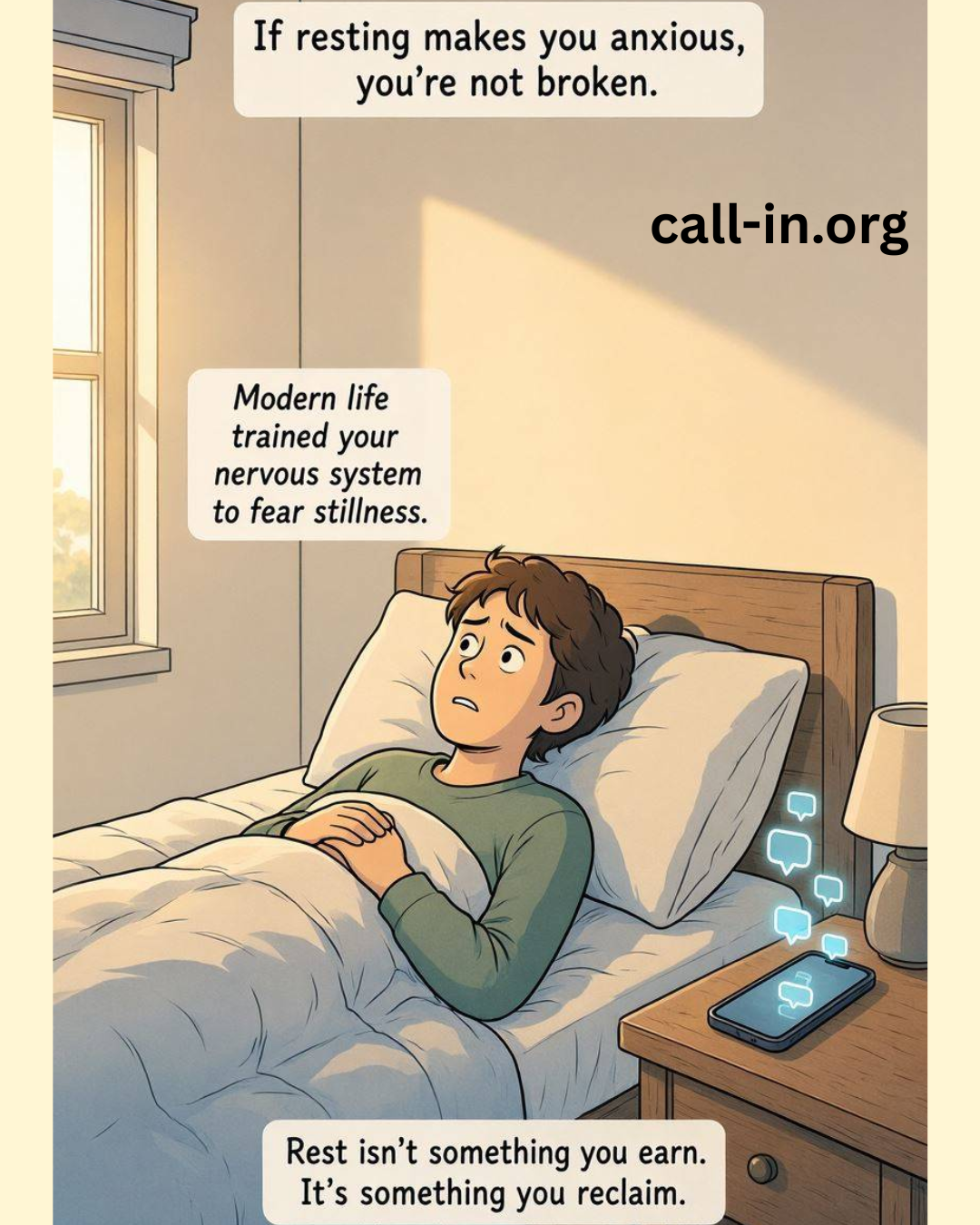
Productivity guilt is the anxious, self-critical feeling that shows up the moment you stop working, even when you have nothing left to prove. It happens because modern life has quietly trained your brain to treat rest as a risk instead of a right. The good news is that this response is learned, which means it can also be unlearned.
Key Takeaways
- Productivity guilt is a conditioned response to busy culture, a culture that fuses identity with output, not a personal character flaw or a lack of discipline.
- Cognitive work has erased the physical boundaries that once told the brain a workday was over, leaving many people in a near-permanent state of task readiness.
- Turning rest into another optimized activity, like a step count or a sleep score, quietly cancels out its restorative effect.
- After long stretches of high stress, the nervous system can misread sudden stillness as danger, which is what produces the guilt and restlessness.
- Short, deliberately unmeasured periods of stillness help retrain the brain to associate rest with safety rather than failure.
What Productivity Guilt Actually Is
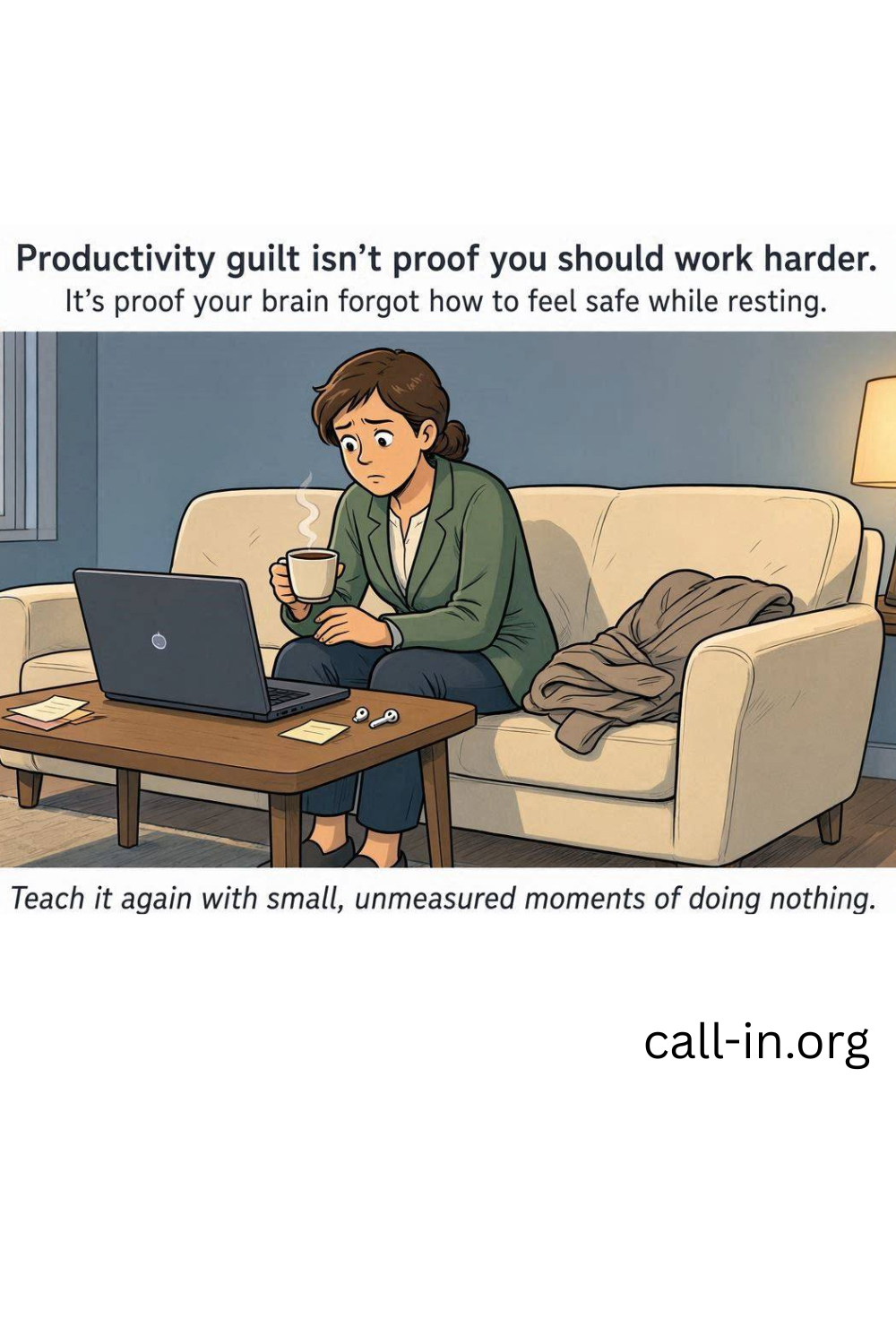
Productivity guilt is the discomfort that surfaces when you’re not producing something visible, even during moments that are meant to be restful. It’s not the same as a healthy work ethic.
A healthy work ethic drives you toward goals; productivity guilt punishes you for stopping, regardless of whether the goals have been met.
In 2019, journalist Derek Thompson popularized the term workism to describe a culture in which work has replaced religion and community as the primary source of meaning. Under workism, output becomes a stand-in for identity. Once that fusion happens, stepping away from tasks stops feeling like a break and starts feeling like a small betrayal of who you’re supposed to be.
The Quiet Inversion of Leisure and Status
More than a century ago, the economist Thorstein Veblen described a leisure class whose visible idleness signaled wealth and status. Servants worked so their employers didn’t have to be seen working.
That arrangement has almost completely reversed. Today, a packed calendar and a full inbox function as the new status symbols, while unstructured time can feel like a quiet admission that you’re falling behind.
This inversion matters because it explains why guilt shows up even in private, when no one is watching you rest. If your self-worth becomes tangled up with your productivity, then an empty afternoon doesn’t read as freedom. It reads as evidence.
Why Cognitive Work Never Feels Finished
Physical labor used to come with built-in stopping points. When the shift ended or the sun went down, the work was structurally over. Cognitive and creative work has no such edge. There is always one more email, one more idea to refine, one more thread to follow, so the job never announces its own completion.
Smartphones made this worse by dissolving the last physical boundary between the office and everywhere else. Your workplace now lives in your pocket and, more importantly, in your head.
Under constant busy culture, the brain settles into a baseline of task readiness that doesn’t switch off just because the laptop does. Rest starts to feel less like a pause and more like an unresolved obligation.
When Rest Becomes One More Thing to Optimize
Toxic productivity doesn’t stop at the workday. It has crept into leisure itself, turning walks into step counts, sleep into a score, and hobbies into side hustles waiting to happen.
On the surface this looks like self-improvement.
Underneath, it keeps rest trapped inside the same performance framework that caused the exhaustion in the first place.
This is worth naming directly: gamifying rest cancels much of its restorative value. A nervous system that is still being measured, ranked, or optimized has not actually left work mode, even if the activity looks relaxing from the outside.
True recovery requires at least some time that produces nothing trackable at all.

The Nervous System’s Role in Rest Anxiety
Chronic high output trains the body to run on a steady supply of stress hormones and dopamine from finishing tasks. When you suddenly stop, those levels drop, and an alert nervous system can misread that quiet as a threat rather than relief. It searches for something to justify the shift and often lands on your unread inbox or unfinished project list.
There’s a related and lesser-known pattern researchers have called leisure sickness, where certain people fall ill or feel unwell specifically during weekends and vacations, once the pressure that was holding their stress response together finally eases.
In 2019, the World Health Organization added burnout to its diagnostic manual as an occupational phenomenon rather than a medical condition, a small but telling acknowledgment that this exhaustion is structural, not personal.
One detail rarely gets mentioned: physical labor left the body visibly tired, which functioned as a permission slip to stop. Cognitive work leaves no equivalent signal. Without sore muscles or a spent body to point to, the mind never receives clear proof that it has earned the right to rest, so it manufactures guilt instead.
There’s also a quieter case for stillness itself. Neuroscientists have identified a network in the brain that activates specifically when you’re not focused on an external task, and it appears to play a role in memory consolidation and creative problem-solving. In other words, the blank, unproductive-feeling minutes when your mind wanders aren’t empty.
They may be doing some of your most important cognitive work in the background, just not in a form that shows up on a to-do list.
Learning to Feel Safe While Doing Nothing
Recovering from productivity guilt isn’t about forcing yourself to relax through sheer willpower. It’s about giving your nervous system repeated, predictable evidence that stillness is safe.
Short windows of genuinely purposeless time, where nothing is being tracked or improved, help interrupt the old pattern more effectively than an elaborate self-care routine.
Clear end-of-day rituals help too. Closing the laptop, silencing notifications, or physically leaving the room where you work all signal to your brain that the production phase of the day is over.
These cues matter more than people expect, because a mind recovering from professional burnout needs consistent signals before it can lower its guard. Over time, these small, repeated boundaries do more to ease guilt than any single weekend off ever could.
You Don’t Have to Earn Your Rest
It’s worth sitting with one reversal: rest was never meant to be a reward you earn through exhaustion. For most of human history, rest was the default state, and work was simply what interrupted it. Somewhere along the way, that order flipped so completely that many people now need permission just to return to their own baseline.
There are moments when the pressure to keep producing feels heavier than anyone should carry alone, especially without wanting to unload it onto family, friends, or coworkers. This is where a confidential, non-clinical space can help, and it’s part of why Callin’s trained peer listeners exist: to give people somewhere to think out loud, without needing a solution ready or an accomplishment to report.
Frequently Asked Questions
Is productivity guilt a diagnosable mental health condition?
No. Productivity guilt is a conditioned response shaped by culture and habit, not a clinical diagnosis. That said, if the guilt is severe, constant, or paired with symptoms like persistent low mood or panic, it’s worth speaking with a doctor or licensed mental health professional to rule out an underlying condition.
Why do I feel more anxious resting on vacation than at work?
This pattern lines up with what researchers call leisure sickness, where the body’s stress response, which had been holding steady under pressure, suddenly has nothing to push against. The drop in stimulation can feel unsettling before it feels relaxing. This tends to fade as the nervous system gets more practice with rest.
Does technology make productivity guilt worse?
Yes, largely because it erases the physical boundaries that once marked the end of a workday. When email, chat, and work documents are always one tap away, the brain stays in a low-grade state of task readiness even during personal time, which keeps the guilt response active longer than it needs to be.
Are certain personality types more prone to productivity guilt?
People with high achievement orientation, perfectionist tendencies, or a strong need for external validation often report this guilt more intensely. It’s also common among caregivers and high performers whose sense of value has historically been tied to what they accomplish for others.
Is unstructured downtime actually good for the brain?
Yes. Periods of mind-wandering appear to support memory consolidation and creative problem-solving, even though they don’t feel productive in the moment. Unstructured time isn’t wasted time; it simply produces results that aren’t immediately visible.
How long does it take to feel comfortable resting again?
There’s no fixed timeline, since it depends on how long the pattern has been reinforced and how consistently new boundaries are practiced. Most people notice gradual relief within a few weeks of regularly protecting small, unmeasured pockets of rest, with steadier improvement over a few months.

Leave a Reply