
If you need someone to talk to about grief months later, you are not doing grief wrong. The people around you may have returned to normal life while the loss still sits heavily with you. There is no timeline to grieving, because there really are no verifiable stages of grief.
Consistent support often comes from one dedicated listener who already knows your story, so you can keep talking for as long as you need.
Callin provides confidential, one-to-one, non-clinical human support by voice call, video call or private chat. It is not therapy, counselling, diagnosis, medical or psychiatric care, or crisis or emergency support. Everyone you speak to is a real person, not an AI.
If grief ever brings thoughts of not wanting to be here, or of harming yourself, please contact your local emergency services or a crisis line straight away. You can find a free, confidential line in your country at findahelpline.com.
Key takeaways
- You can find consistent emotional support months after a loss by building a relationship with one dedicated listener who already understands what and who you lost.
- Support often fades after the early weeks while grief continues; a study of 328 recently widowed adults found their support networks became smaller over the first 18 months.
- Grief does not move through fixed stages, and bereavement researchers warn that expecting people to follow stages can harm those who do not.
- Waves of grief months later, often triggered by ordinary moments, are a common part of loss and do not on their own mean something is wrong with you.
- Non-clinical listening offers a place to talk about your loss without milestones or fixing, while grief counselling and therapy can offer clinical assessment and treatment; they are different rooms, and neither is lesser.
- Grief that stays very intense and makes daily life hard over a long period is a good reason to speak to a doctor or qualified grief professional, alongside any other support you use.
- Callin’s Human Continuity™ means that, wherever possible, you keep talking with the same listener, so you never have to re-explain who you lost or what they meant.
Where can I find someone to talk to about grief months later?
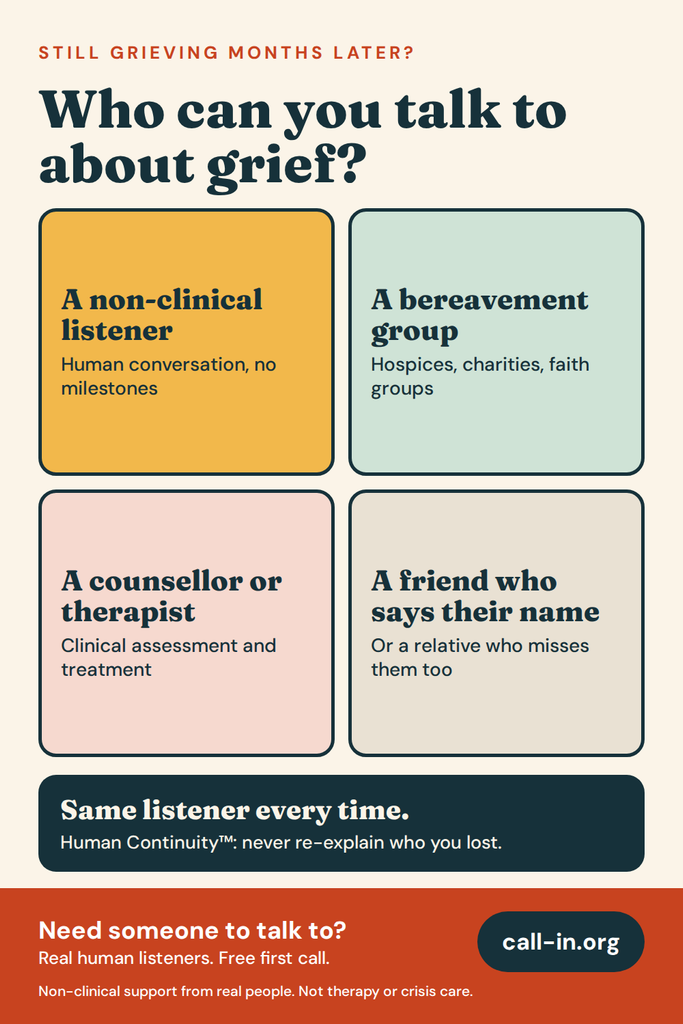
You can find someone to talk to about grief months later through a non-clinical listening service, a bereavement support group, a grief counsellor or therapist, or a trusted person who is willing to keep listening. The most consistent option is usually one where you speak to the same person each time. That way your story, and the person you lost, stay held between conversations.
Here are the main routes, in plain terms.
A non-clinical listening service. This is human conversation, not treatment. Callin is one example. Callin listeners are trained in active listening and Psychological First Aid, and they will not push you towards milestones or tell you how you should be feeling by now.
A bereavement support group. Many communities, faith groups, hospices and charities run groups for people who have lost someone. Sitting with others who understand can ease the sense that you are the only one still hurting. Availability varies by country and region.
Grief counselling or therapy. A qualified professional can offer structured support and, where needed, clinical assessment and treatment. This is a different kind of room, and it is right for many people.
Someone in your life. A friend who is happy to keep hearing their name, or a relative who also misses them, can be a real comfort. You do not need to replace these people. You may simply need more than they can give right now.
If cost is a worry, Callin’s guide Where Can I Get Affordable Emotional Support for Grief Now looks at a range of options.
Why does support fade after a bereavement while the grief stays?
Support often fades because other people’s lives return to their usual rhythm, while your loss is still part of every day. Friends and family are usually most present in the first weeks. After that, many assume you are coping, or worry that mentioning the person will upset you.
Research reflects this pattern. A longitudinal study by Utz and colleagues, published in The Journals of Gerontology, followed 328 recently widowed adults aged 50 and over. Over the first year and a half, the size of their support networks declined, and so did visits from family. The authors suggest the extra support people receive early on tends to trail off over time.
That study focused on older adults who had lost a spouse, so it does not describe every loss. Still, many people of all ages recognise the feeling. The cards stop. The meals stop. The questions stop.
The weight does not stop at the same time. That gap can be one of the loneliest parts of grief.
If you feel lonely even with people around you, Callin’s article Why You Feel Lonely Even Though You Have Friends: Exploring the Support Gap may feel familiar. For a wider look at options, see Who Can I Talk to When I Feel Lonely? Real Options That Actually Help.
Is it normal to still be grieving months after a loss?
Yes, it is common to still be grieving months after a loss, and there is no fixed timetable for how long grief should last. Grief often changes shape over time rather than ending on a set date. Many people carry their loss for years in some form, while also finding ways to live alongside it.
The World Health Organization’s ICD-11 classification is clear on this point. It states that grief reactions lasting longer periods, but within what is normal for a person’s cultural and religious context, “are viewed as normal bereavement responses and are not assigned a diagnosis”.
So the length of your grief alone does not make it a problem. You do not have to justify still missing someone, and you do not need a diagnosis to ask for support. Callin’s article It’s Okay To Ask for Help Without a Mental Health Diagnosis explores this.
Is grief supposed to happen in stages?
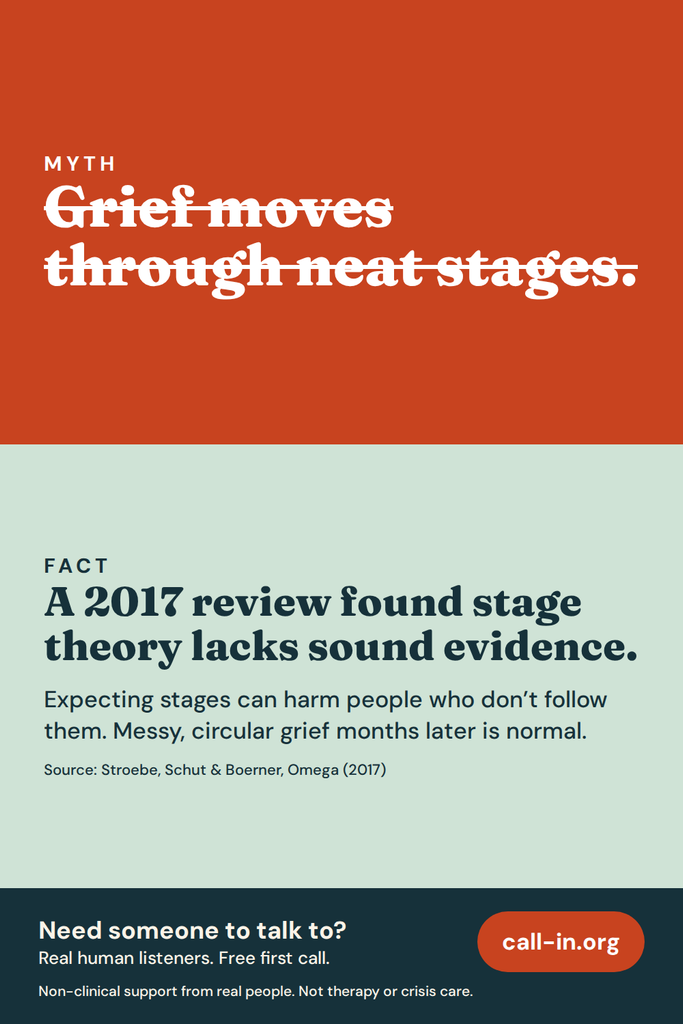
No, grief is not supposed to happen in neat stages. In a 2017 review in Omega: Journal of Death and Dying, bereavement researchers Margaret Stroebe, Henk Schut and Kathrin Boerner concluded that stage theory lacks sound empirical evidence. They warned that expecting people to go through stages “can be harmful to those who do not”.
The same paper describes grief as involving “complex, fluctuating” reactions that vary greatly between people and cultures. If your grief feels messy, circular or unpredictable, that is not a sign you are failing at it.
Why does grief come back in waves months later?
Grief often comes back in waves because ordinary moments carry reminders of the person you lost. A song in a shop. A birthday. A recipe. The time of day you used to call them. These waves can arrive without warning, even on days that started well.
The Dual Process Model of Coping with Bereavement, developed by Stroebe and Schut, offers a helpful way to picture this. It describes bereaved people moving back and forth between facing the loss itself and dealing with the changes it brings to daily life. Moving between the two, rather than staying in one, is part of how many people come to terms with a loss.
In plain language: having a good week and then a hard day does not mean you have gone backwards.
Why do I feel pressured to move on after a loss?
You may feel pressured to move on because the people around you are uncomfortable with long grief, want you to feel better, or simply do not know what to say. That pressure usually says more about them than about you. It can still leave you feeling isolated, or as though something is wrong with you for still hurting.
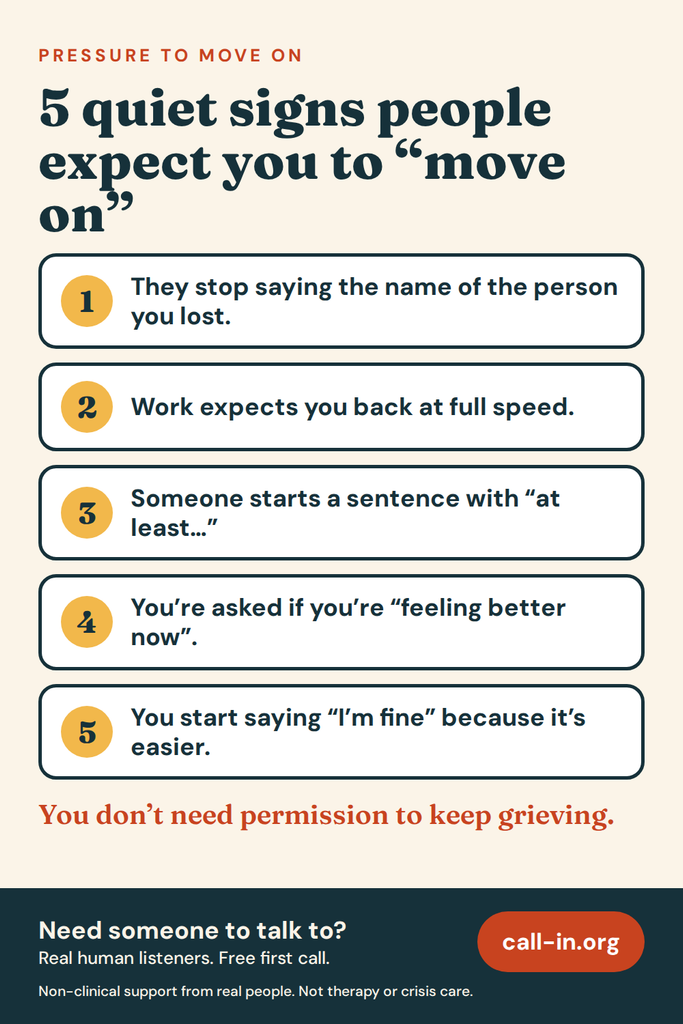
The pressure often shows up quietly:
- People stop saying the name of the person you lost.
- Work expects you to be back to full speed.
- Someone says “at least” before a sentence about your loss.
- You are asked if you are “feeling better now”.
- You start saying “I’m fine” because it is easier.
Callin’s article The Dangers of “I’m Fine”: The Cost of Surface-Level Interactions explores what happens when that becomes a habit.
You do not need anyone’s permission to keep grieving. You also do not need to keep defending it.
What might sit underneath the loneliness of long-tail grief?
Underneath the loneliness of long-tail grief there are often ordinary, understandable pressures: changes to your routines, roles and relationships, a lack of space to talk, and the expectations of the people and culture around you. Noticing them in your own words can make the weight feel a little more understandable. This is reflection, not diagnosis.
Here are some things people often find underneath, as they understand them:
- Routines that have changed shape. Mealtimes, weekends or phone calls that used to include the person.
- Roles you have lost or gained. You may no longer be someone’s carer, partner or child in the same way, or you may have taken on new responsibilities.
- Relationships that have shifted. Some people come closer. Others drift away, sometimes because your loss reminds them of their own fears.
- Unspoken expectations. Family, workplace or cultural ideas about how long mourning should last.
- Protecting other people. Holding back tears so that others do not worry, or because they are grieving too.
- Secondary losses. A home, an income, shared friends, plans for the future or a sense of who you were.
- Loss that others do not see as loss. A breakup, an estrangement, a pregnancy loss, or the death of a pet or a former partner can be grieved just as deeply.
That last point matters. Grief is not only for deaths. If the loss you are carrying is a relationship ending, Callin’s guide What Is the Best Way to Cope with Relationship Heartbreak? may help.
A good listener will not tell you what is underneath. They might gently reflect something you have mentioned more than once. You stay in charge of what it means.
How is non-clinical grief support different from grief counselling or therapy?
Non-clinical grief support is human listening without diagnosis, assessment or treatment. Grief counselling and therapy are delivered by qualified professionals and can include assessment, structured approaches and treatment when grief becomes very hard to live with. They are different rooms, and neither is a lesser version of the other.
Non-clinical support gives you space to talk about the person you lost, the day it happened, the things you wish you had said, or the dull ache of an ordinary Tuesday. There are no progress notes or milestones. The focus is on being heard.
Callin listeners are trained in Psychological First Aid. The World Health Organization’s guide to Psychological First Aid describes it as “a humane, supportive response to a fellow human being who is suffering and who may need support”. The guide is clear that it is not professional counselling, and one of its themes is “listening to people, but not pressuring them to talk”.
Callin’s explainer What Is Non-Clinical Mental Health Support? The Missing Middle Between Friends and Therapy covers this difference in more detail.
When might grief counselling or therapy be the better fit?
Grief counselling, therapy or medical support may be the better fit if your grief stays very intense over a long period and makes it hard to manage daily life, work or relationships. It may also help if you feel stuck, numb or unable to engage with life in a way that worries you.
A minority of bereaved people develop a recognised clinical condition. A meta-analysis by Lundorff and colleagues in the Journal of Affective Disorders estimated that around one in ten bereaved adults after a non-violent loss may be at risk of prolonged grief disorder. The authors note that the studies varied a lot, so this figure should be read with caution.
Only a qualified professional can assess this. If you are worried, please speak to a doctor or a qualified grief professional. Non-clinical support can sit alongside that care, and it is never a reason to stop treatment or medication that is helping you.
How does talking to the same person help when grief lasts a long time?
Talking to the same person helps because you do not have to start again each time. A listener who already knows who you lost, how they died and what they meant to you can meet you where you are today. Your grief is held as a continuing story, not a series of introductions.
Re-telling a loss to a new person can be exhausting. Saying the name, the illness, the date and the circumstances again can feel like reopening something before you even get to what you wanted to say.
Callin’s Human Continuity™ means that, wherever possible, you keep talking with the same dedicated listener. You can say “it was her birthday on Sunday” and they already know who “her” is. You can read more in Where Can I Find Ongoing Online Emotional Support From the Same Person?.
Continuity is a comfort for many people, not a promise of any particular outcome. It simply means you are continuing a conversation.
What can I talk about with a grief listener?
You can talk about anything connected to your loss, and anything that is not. That might be memories, guilt, anger, relief, regret, practical worries or the strange experience of laughing again. Some days you may not want to talk about the loss at all, and that is fine too.
There is no pressure to reach milestones or “fix” your grief. You do not need to be making progress for the conversation to matter.
Is Callin a grief counselling or crisis service?
No, Callin is neither a grief counselling service nor a crisis service. Callin provides non-clinical emotional support from a real person, for people who are not in immediate danger. Callin does not diagnose, assess or treat grief or any mental health condition.
If you need clinical support for grief, a doctor, grief counsellor or therapist is the right place. If you are in crisis, please contact your local emergency services or find a free line at findahelpline.com.
What Callin can offer is a steady, confidential place to keep talking about your loss, with someone who listens and remembers. If you are unsure if you need therapy or simply someone to talk to, Callin’s article Who to Talk to When You Don’t Need Therapy But Need a Safe Space to Vent walks through the options.
How do I keep finding emotional support months after a bereavement?
You can keep finding emotional support months after a bereavement by choosing at least one place where your grief is expected rather than tolerated. That might be a regular conversation with the same listener, a support group, a professional, or a friend you can be honest with. Having somewhere reliable to return to matters more than having many places.
Some gentle questions you can ask yourself:
- Who in my life is still comfortable hearing their name?
- Do I want to talk weekly, or only when it feels heavy?
- Would I rather speak, see someone on video, or type?
- Is it important to me to talk to the same person each time?
Some questions you can ask a support service:
- Will I speak to the same person next time?
- What training do your listeners have?
- How is my privacy protected?
- What happens if I need more support than you offer?
You can also tell the people close to you what helps. “Please keep saying her name” or “I don’t need advice, I just need you to listen” can be enough. Callin’s article Why People Give Advice When You Just Want to Vent explains why the urge to fix is so common.
If you are holding back because you do not want to weigh friends down, Someone To Talk To When I Don’t Want to Burden My Friends may help.
Frequently asked questions
Who can I talk to about grief months after a loss?
You can talk to a non-clinical listening service, a bereavement support group, a grief counsellor or therapist, or a trusted person in your life. If consistency matters to you, look for an option where you speak to the same person each time. Callin offers confidential, non-clinical support where, wherever possible, you keep the same dedicated listener.
Is it normal to still be grieving after six months or a year?
Yes, it is normal for grief to continue for many months or longer. The WHO’s ICD-11 states that longer grief within what is normal for a person’s cultural and religious context is a normal bereavement response. If grief stays very intense and makes daily life hard, speaking to a doctor or grief professional can help.
Why did everyone stop checking on me after the funeral?
People often stop checking in because their own lives return to normal, or because they fear upsetting you by mentioning the loss. Research on widowed adults found support networks tend to shrink over the first 18 months. It does not mean your grief matters less.
Is non-clinical grief support the same as grief counselling?
No, non-clinical grief support is not the same as grief counselling. Grief counselling and therapy are delivered by qualified professionals and can include assessment and treatment. Non-clinical support offers listening and presence, and some people use both.
Will I have to explain my loss again every time I talk to Callin?
Wherever possible, no. Callin’s Human Continuity™ means you usually keep the same dedicated listener, so you do not have to re-explain who you lost or what they meant. Continuity is about comfort and familiarity, not a promise of a particular outcome.
Is Callin a crisis line for grief?
No, Callin is not a crisis or emergency service. If grief brings thoughts of harming yourself or not wanting to be here, please contact your local emergency services or find a free crisis line at findahelpline.com. Callin is for people who are not in immediate danger and want ongoing, non-clinical support.
Can I talk about a loss that is not a death?
Yes, you can talk about any loss that feels heavy to you. Breakups, estrangement, pregnancy loss, the death of a pet, a lost job or a changed future can all bring real grief. You do not need anyone else to agree that it counts.
What is a gentle next step if I am still grieving?
A gentle next step is to choose one place where you can talk about your loss without being hurried. You do not need the right words. You do not need to be at breaking point.
If Callin feels like it might fit, eligible new clients can start with a free first call session, with no obligation to continue. You can find out more about Callin’s non-clinical emotional support whenever you are ready. To see what that first conversation looks like, read What Happens in a Callin First Session? What to Expect.
Your grief can take the time it takes. So can you.
Most relevant UN Sustainable Development Goal
SDG 3: Good Health and Well-Being, in particular Target 3.4, which includes promoting mental health and well-being. Accessible, non-clinical listening can sit alongside bereavement services, healthcare, grief counselling and community support as one part of caring for people after loss.
Sources and further reading
- World Health Organization. ICD-11 for Mortality and Morbidity Statistics: 6B42 Prolonged grief disorder.
- World Health Organization, War Trauma Foundation and World Vision International (2011). Psychological first aid: Guide for field workers. WHO, Geneva.
- Stroebe, M., Schut, H. and Boerner, K. (2017). Cautioning health-care professionals: Bereaved persons are misguided through the stages of grief. Omega: Journal of Death and Dying, 74(4), 455 to 473.
- Stroebe, M. and Schut, H. (2010). The dual process model of coping with bereavement: A decade on. Omega: Journal of Death and Dying, 61(4), 273 to 289.
- Utz, R. L., Swenson, K. L., Caserta, M., Lund, D. and deVries, B. (2014). Feeling lonely versus being alone: Loneliness and social support among recently bereaved persons. The Journals of Gerontology, Series B, 69B(1), 85 to 94.
- Lundorff, M., Holmgren, H., Zachariae, R., Farver-Vestergaard, I. and O’Connor, M. (2017). Prevalence of prolonged grief disorder in adult bereavement: A systematic review and meta-analysis. Journal of Affective Disorders, 212, 138 to 149.
- Find A Helpline. findahelpline.com. Free, confidential crisis lines by country.
- United Nations. Sustainable Development Goal 3: Good Health and Well-Being.

Leave a Reply