
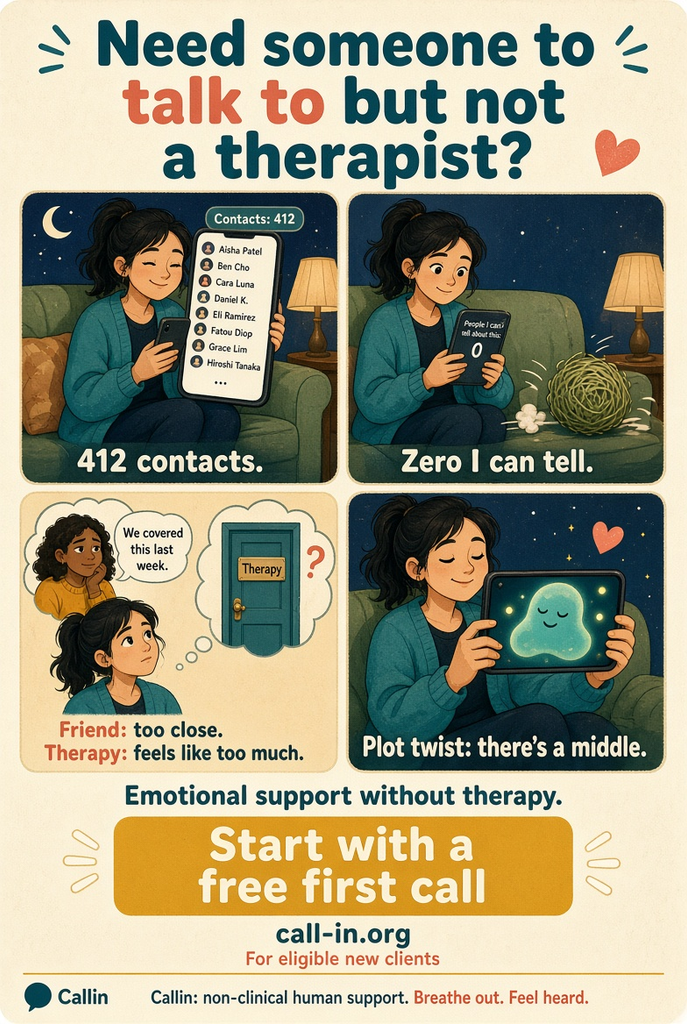
Personal Emotional Support is a way of describing the missing middle in emotional care: regular, one-to-one conversations with someone whose role is to listen, who remembers your story and whom you can go back to. It sits in the Support Gap between friends and therapy.
If you have ever needed someone to talk to but felt that a friend was too close and therapy was too much, this is the space we mean. Ongoing emotional support of this kind, built on Human Continuity, is what this article explores.
Callin offers confidential, non-clinical emotional support with trained listeners by voice call, video call or private chat. It is not therapy, counselling, diagnosis, medical or psychiatric care, or a crisis or emergency service. Everyone you speak to is a real person.
If you are in danger right now, or think you might act on thoughts of harming yourself or someone else, please contact your local emergency services or a crisis helpline wherever you live.
You can find a free, confidential line in your country at findahelpline.com. Crisis services are exactly the right place in that moment.
Key takeaways
- Personal Emotional Support is a proposed name for the space between everyday conversations with friends and family and professional clinical care.
- Callin calls this space the Support Gap: the place between friendship and therapy where a lot of ordinary emotional life actually happens.
- Friends and family, peer support, warmlines, crisis services and therapy are all valuable, and each was designed for a different job.
- Five things tend to define Personal Emotional Support: dedicated attention, continuity, familiarity, emotional space and consistency.
- Being heard matters, and being remembered changes the conversation, because you no longer have to start from the beginning each time.
- The World Health Organization’s Commission on Social Connection reported in 2025 that around 1 in 6 people worldwide are affected by loneliness.
- Callin is one example of continuity-based Personal Emotional Support, keeping you with the same trained listener wherever possible through Human Continuity™.
What is Personal Emotional Support?
Personal Emotional Support is ongoing, one-to-one, non-clinical listening from a person whose role is to give you their full attention and to remember your story over time. It is not friendship, and it is not therapy. It is a distinct kind of support for people who need to talk regularly but are not looking for diagnosis or treatment.
We use the phrase as a way of naming something many people already recognise but rarely have words for. It is a proposed category, not a trademark or a claim that any one organisation owns the idea. Plenty of people and services have been working in this space in different ways.
What makes it personal is the relationship over time. You are not a case number or a caller in a queue. You are someone whose week, family, work and worries are already familiar to the person listening.
Why do so many people fall into the Support Gap?
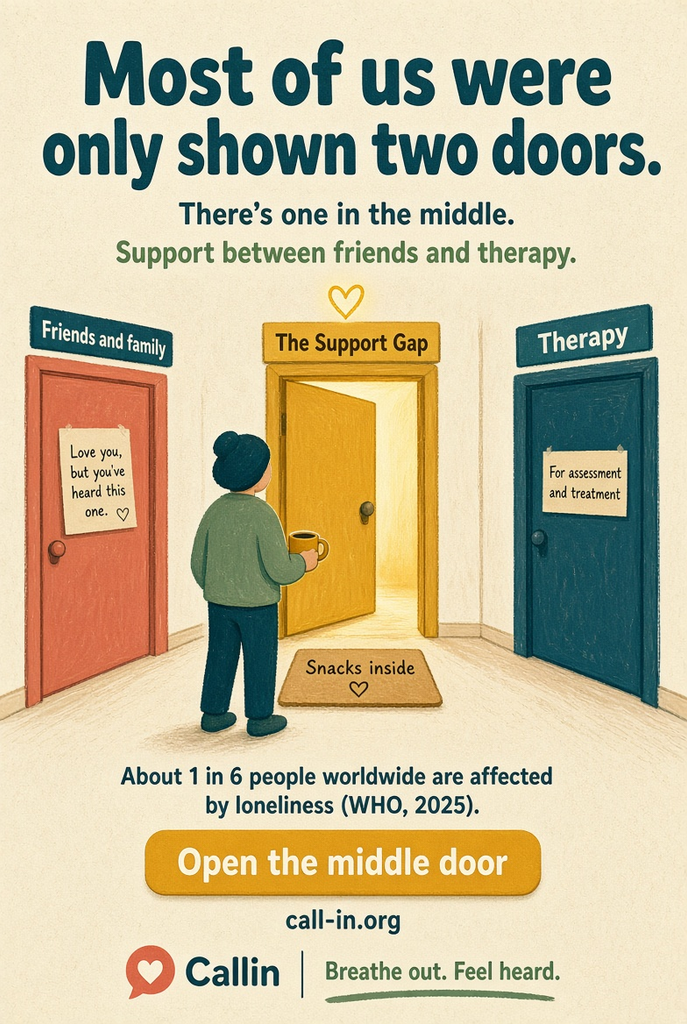
Many people fall into the Support Gap because emotional support is often pictured as two doors: friends and family on one side, professional help on the other. Most ordinary difficulty does not fit neatly through either. So the conversation that needs to happen often has nowhere to go.
Picture a quiet weeknight, somewhere in the world. You have spent the day being the steady one, answering messages and holding things together. Now the house is still and the thing you have carried all week feels very loud.
You scroll to a friend’s name and stop. She has had a hard month too, and you talked about this only last week. Your family may be asleep in another time zone, and in some families this kind of thing is simply not discussed.
Therapy crosses your mind. But you are not unwell, and this is not a crisis. You just need to talk, so you put the phone down. This is an illustration, not a client story, yet many people will recognise it.
Callin’s About page describes this as the space “between friendship and therapy, between silence and care, where most emotional experience actually lives.” You can read more about the idea of the missing middle in non-clinical mental health support if it feels familiar.
Is the Support Gap a global need or a niche one?
The Support Gap is a global need. In 2025, the World Health Organization’s Commission on Social Connection reported that around 1 in 6 people worldwide are affected by loneliness. That is not a small corner of human experience.
WHO describes loneliness as a distressing feeling that arises when there is a gap between the social connections you have and those you want or need. That definition matters. It means loneliness is not only about being alone.
You can have a full calendar, a busy family group chat and a kind circle of friends, and still feel unheard. If that sounds like you, Callin’s piece on why you feel lonely even though you have friends explores it gently. The same pattern shows up in the cost of always saying “I’m fine”.
Where do friends, peer support, helplines and therapy fit?
Friends, peer support, helplines and therapy each fit a different need, and none of them is the problem. Every one of these doors leads somewhere valuable. The question is simply what happens to the conversations that do not belong behind any of them.
Friends and family know you in ways nobody else can. They are also busy, closely involved in your life and sometimes part of the story you need to talk through. In many cultures there are also unspoken rules about what stays private or who is allowed to struggle.
Leaning on the same people again and again can start to feel heavy, for you and for them. Callin has written about finding someone to talk to when you don’t want to burden your friends, and about what to do when talking to friends doesn’t feel enough.
Peer support groups offer community and the relief of hearing “me too”. They are often built around a shared circumstance or a group setting, rather than one person’s ongoing story.
Crisis lines and emergency services are essential in moments of acute distress, wherever you live. They are designed to respond quickly to whoever needs help most, not to become an ongoing personal relationship.
Warmlines, where they exist, offer non-crisis listening, often free and volunteer-led, usually through shorter, unscheduled calls. You can learn what a warm line is and how warmlines differ from crisis lines and peer support.
Therapy and clinical services matter enormously for people who need professional assessment and treatment. Not everyone who needs to talk is looking for that. If you are unsure, Do I need therapy? and therapy vs. a listening service can help you think it through.
Put side by side, something is missing. It is a regular, one-to-one conversation with someone whose role is to listen, whom you can return to, and who does not need you to start from the beginning.
What are the five dimensions of Personal Emotional Support?
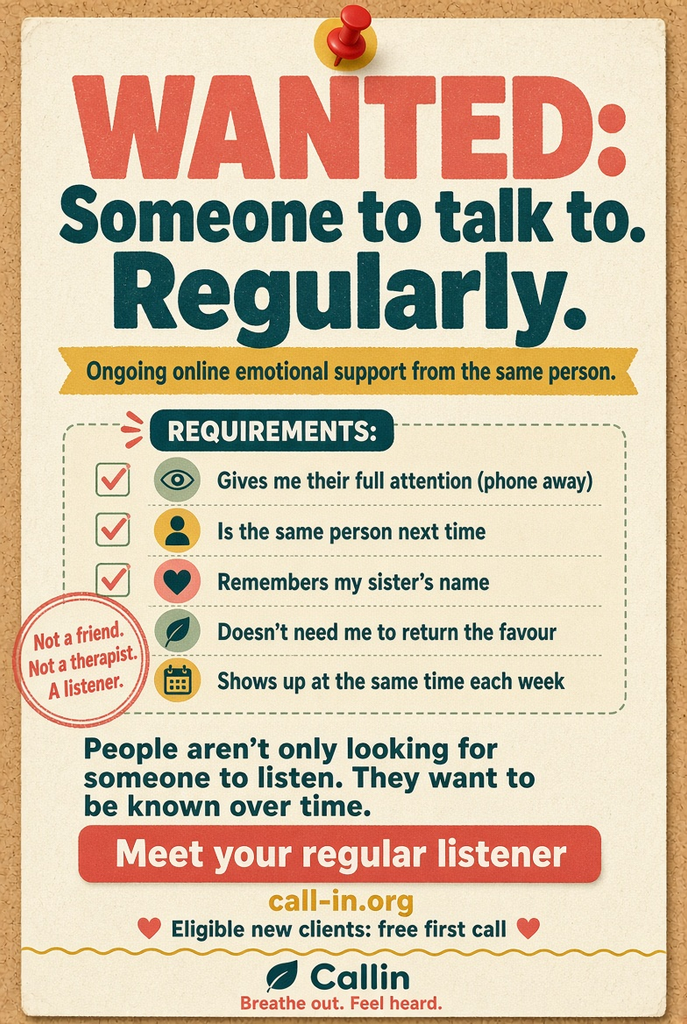
The five dimensions of Personal Emotional Support are dedicated attention, continuity, familiarity, emotional space and consistency. Together they describe what people often say they are looking for when friends feel too close and therapy feels like too much. Each one is simple on its own, but rare in combination.
Dedicated attention. The time is entirely about you. Nobody is checking their phone, waiting for their turn or steering the conversation back to themselves. Callin’s guide to how active listening makes you feel truly heard explains why this kind of attention feels different.
Continuity. You speak to the same person next time. Trust has a chance to build, and you are not reintroducing yourself to a stranger.
Familiarity. You do not need to retell the whole saga. The person already knows who your manager is, why the move was hard and what happened with your sister.
Emotional space. You have somewhere to say it without worrying that you are wearing someone out. There is no need to balance the conversation or return the favour.
Consistency. There is a rhythm you can rely on. Knowing a conversation is coming can make a difficult week feel more manageable. Callin explores this further in the benefits of consistent emotional support.
Here is the quiet insight underneath all five. People are not only looking for someone to listen. They are looking to be known over time.
Why does being remembered change the conversation?
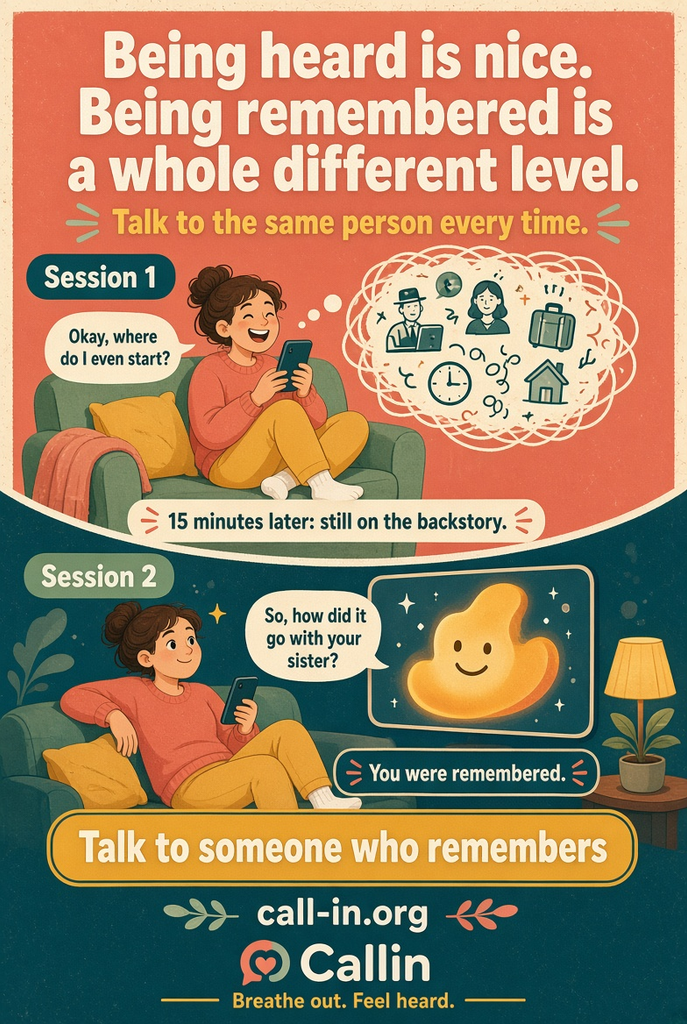
Being remembered changes the conversation because you can start where you actually are, instead of at the beginning. Shared context lets a conversation go deeper, sooner. It also tells you, without anyone saying so, that your story matters.
Imagine two conversations. The first opens with “Okay, where do I even start?” Fifteen minutes later you have introduced your manager, your sister, the move and the reason this week felt worse than last.
The second opens with “So, how did it go with your sister?” In one sentence you know you were remembered and that your story has a thread. Both scenes are illustrations, not real sessions.
Callin puts it simply: being heard matters, and being remembered changes the conversation. If you have ever felt drained by explaining yourself to someone new each time, the page on ongoing online emotional support from the same person explains why continuity can reduce that effort.
How does Callin approach Personal Emotional Support?
Callin approaches Personal Emotional Support through Human Continuity™, which means keeping you with the same trained listener or coach wherever possible. You are not a stranger after your first session. You do not have to keep restarting your story.
Callin began in June 2023 and is operated by Callin Support Ltd, a company registered in the United Kingdom. It works online with adults aged 18 and over around the world, by voice call, video call or chat.
Its slogan sums up the feeling it hopes to offer: Callin. Breathe out. Feel heard.
Callin listeners complete mandatory Psychological First Aid training from Johns Hopkins University and are trained in active listening. They follow Callin’s internal protocols on boundaries, safeguarding and signposting. You can read more about what a listening service is and what non-clinical mental health support means at Callin.
Listeners do not diagnose or treat, and Callin is not a crisis service. When someone needs more than a listening space, listeners signpost them towards it. The Callin FAQ answers common questions about confidentiality, training and how sessions work.
Callin is one example of what continuity-based Personal Emotional Support can look like. It is not the only way to fill the Support Gap, and it does not replace the other parts of your support.
Who might find themselves in the missing middle?
Almost anyone can find themselves in the missing middle, because it is part of ordinary adult life rather than a sign that something is wrong. The people below are illustrations, not real clients. They may still sound familiar.
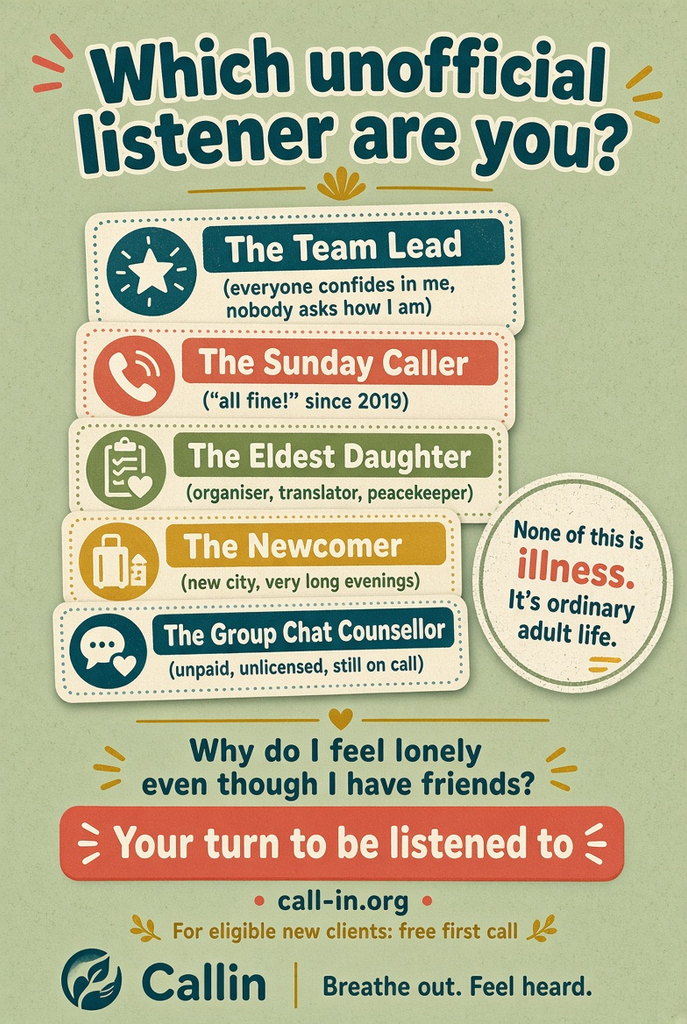
The team lead everyone confides in, who realises nobody ever asks how they are. Callin’s article on why you can’t open up even though you listen to everyone else speaks to this.
The international student who calls home every Sunday and says everything is fine. The eldest daughter who has quietly become the family’s organiser, translator and peacekeeper.
The professional who moved for a dream job and finds the new city exciting, but the evenings long. The person who loves their friends and does not want every hard conversation to become emotional labour for them.
None of this is illness. It looks much the same in Manchester, Manila or Montreal. Talking something through is not a sign that something is wrong with you, and often it is part of how people stay well.
Is Personal Emotional Support a replacement for therapy?
No, Personal Emotional Support is not a replacement for therapy. It is a different kind of support with a different purpose. Therapy involves professional assessment and treatment, while Personal Emotional Support offers ongoing, non-clinical listening.
Some people use both at different times. Some find that regular listening is all they need for now. Others realise, through talking, that they would benefit from professional help, and a good listener will gently point them there.
If you are weighing up your options, Therapy, coaching or emotional support: what do I need? and How do I know if I need emotional support and not therapy? can help. For a wider look at the options, see alternatives to therapy for emotional support and who to vent to when you don’t need therapy.
Why think of emotional support as an ecosystem rather than a choice?
Thinking of emotional support as an ecosystem helps because it makes room for the people who fall between friendship and therapy. If support is framed as one or the other, those people stay unseen. An ecosystem lets every part do its own job well.
In a healthy ecosystem, family and community, peer support, warmlines where they exist, crisis services, therapy and Personal Emotional Support all sit side by side. Each points towards the others when needed. Nobody is replacing anybody.
This view also supports earlier, gentler care. Callin’s article on preventive emotional care explores why waiting until you break is risky. Having somewhere to talk before things pile up can make the hard weeks feel less lonely.
Organisations are part of the ecosystem too, especially those with distributed or international teams. Callin offers workplace wellbeing support for organisations that want a human, non-clinical option alongside the support they already provide.
What does a trustworthy version of this kind of support need?
A trustworthy version of Personal Emotional Support needs clear boundaries, proper training, safeguarding, confidentiality and honesty about what it is not. Without those, a service built on trust cannot earn it. These foundations matter as much as warmth does.
Honesty about limits is part of the care. A good listener is clear that they are not a therapist or a crisis responder, and they know when and how to signpost. That clarity helps you choose the right support at the right time.
It also needs a real human on the other side. AI tools can be useful for some things, but they cannot hold a relationship with you over time in the same way. Callin compares the two in AI chat vs human emotional support.
What questions is this space still asking?
This space is still asking how to make consistent, human support easier to reach before things reach crisis point. The questions below are open, and they matter for anyone who cares about emotional wellbeing. They are worth sitting with.
- Why is it often easier to find crisis support than consistent support before things become a crisis?
- Why do we still think of emotional support as either friendship or therapy?
- What is it worth to you when someone remembers your story?
- If loneliness is a global public health concern, what role should ongoing human connection play?
- Are we underestimating the value of someone whose role is simply to be there and listen?
How can you try Personal Emotional Support with Callin?
You can try Personal Emotional Support with Callin by starting with a free first call session, if you are an eligible new client. There is no obligation to continue afterwards. It is simply a chance to see whether talking with a trained listener feels right.
You do not need the perfect words or a “serious enough” reason. You can begin with “I don’t really know where to start”, and that is enough. To know what to expect, read What Happens in a Callin First Session?
When you are ready, you can explore Callin’s non-clinical emotional support. If something else would suit you better, that is okay too. The most important thing is that your conversation has somewhere to go.
Frequently asked questions
What is Personal Emotional Support?
Personal Emotional Support is ongoing, one-to-one, non-clinical listening from someone whose role is to listen and remember your story over time. It sits between friendship and therapy. It is a proposed way of naming a space many people already recognise.
What is the Support Gap?
The Support Gap is the space between friendship and therapy, where a lot of everyday emotional life happens. It describes the moments when you need someone to talk to but are not in crisis and are not looking for treatment. Callin describes this gap on its About page.
Is Personal Emotional Support the same as therapy?
No, Personal Emotional Support is not the same as therapy. Therapy involves professional assessment and treatment, while Personal Emotional Support offers non-clinical listening and does not diagnose or treat. Some people use both at different times.
What does Human Continuity™ mean at Callin?
Human Continuity™ means Callin keeps you with the same trained listener or coach wherever possible. You are not a stranger after your first session, and you do not have to keep restarting your story. This is what allows support to build over time.
Is Callin a crisis service?
No, Callin is not a crisis or emergency service. If you are in danger or might act on thoughts of harming yourself or someone else, contact your local emergency services or a crisis helpline. You can find a free line in your country at findahelpline.com.
Who are Callin’s listeners?
Callin’s listeners are trained in active listening and complete mandatory Psychological First Aid training from Johns Hopkins University. They follow Callin’s protocols on boundaries, safeguarding and signposting. They are not therapists or clinicians.
Is the first Callin session free?
Yes, eligible new clients can start with a free first call session. There is no obligation to continue or book anything afterwards. It is a chance to see whether Callin feels right for you.
Most relevant UN Sustainable Development Goal
SDG 3: Good Health and Well-Being, in particular Target 3.4, which includes promoting mental health and well-being. Naming the Support Gap, and treating emotional support as an ecosystem of friends, peer support, warmlines, crisis services, therapy and Personal Emotional Support, supports earlier and more accessible human connection.
Sources and further reading
- World Health Organization. Social connection linked to improved health and reduced risk of early death. News release, 30 June 2025. Source of the “1 in 6 people worldwide” loneliness figure from the WHO Commission on Social Connection.
- World Health Organization. Social connection: questions and answers. Source of the WHO definition of loneliness.
- World Health Organization. Commission on Social Connection.
- Find A Helpline. findahelpline.com. Free, confidential crisis lines by country.
- Callin. About Callin. Source of the Support Gap description, founding date and listener training.
- Callin. Everything You Need to Know About Callin and More. Source of company, eligibility, training and first session details.
- Callin. Get Non-Clinical Mental Health Support Online Today. Source of Human Continuity™ and service boundaries.
- United Nations. Sustainable Development Goal 3: Good Health and Well-Being.

Leave a Reply