Asking yourself “Do I need therapy?” is already a sign of self-awareness. You do not need a diagnosis, a crisis, or permission to explore support.
Many people reach this question when life feels heavier than usual, usual coping strategies stop working, or they simply want somewhere private to talk things through without judgement or pressure.
This page is designed to help you understand the options clearly and choose a next step that feels right for you. It draws on guidance from sources such as the NHS, NICE and recognised mental health organisations, while remaining practical and free of clinical jargon where simpler language works better.
You can take a short quiz here to see the support that works for you right now USING THIS LINK.
The information here is useful whether or not you ever book with Callin. Its primary purpose is to give you clearer thinking and a sense of direction, not to steer you toward any single service.
You are not alone in wondering. Large numbers of adults experience periods of stress, low mood, anxiety, loneliness or feeling stuck. Many never receive a formal diagnosis and still benefit from some form of support. The question is less about whether your difficulties are “serious enough” and more about what kind of help matches what you need right now.
How do I know if I need professional mental health support or therapy?
You may benefit from professional mental health support or therapy when emotional or psychological difficulties persist, affect daily life, and do not improve with self-care or informal support from friends and family.
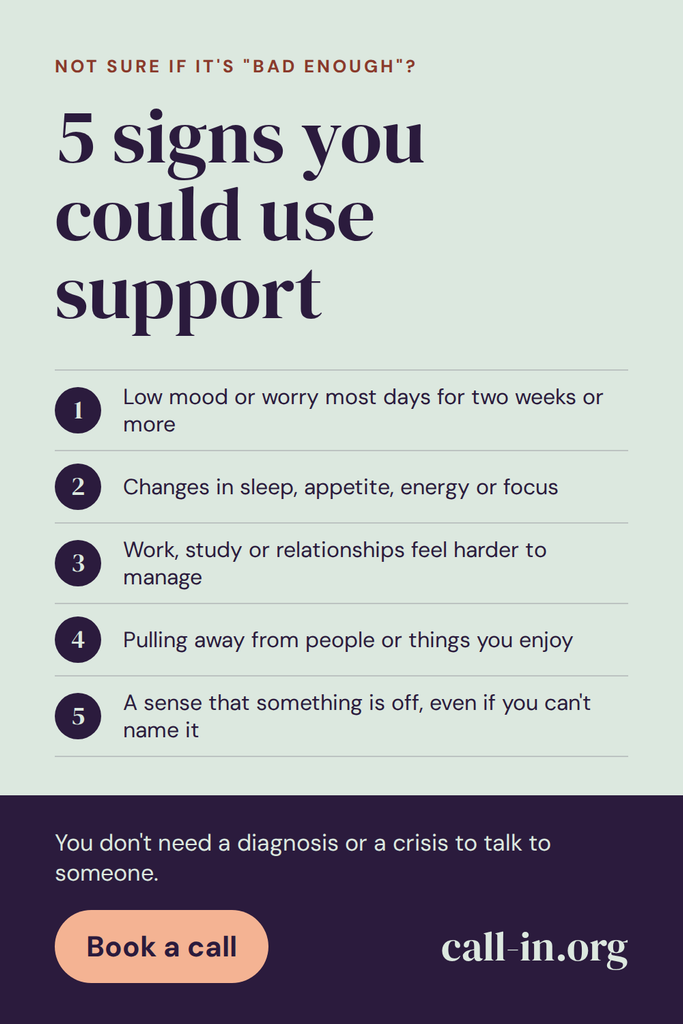
Common indicators include low mood, anxiety, worry or irritability that has lasted most days for two weeks or longer.
Other signs are noticeable changes in sleep, appetite, energy or concentration, difficulty managing work, study, relationships or everyday tasks, and withdrawing from people or activities you usually enjoy.
Some people notice they are stuck in unhelpful patterns that keep repeating, or that they are using alcohol, substances or other coping methods in ways that worry them. A quieter but equally valid signal is simply a persistent sense that something is wrong even if you cannot name it precisely.
You do not need every item on a list. You also do not need to wait until things feel unbearable. NHS guidance and sources such as the National Institute of Mental Health note that seeking help earlier often makes recovery or management easier.
In the UK, Therapy and talking therapies can support people through life transitions, grief, relationship strain, burnout or simply a desire to understand themselves better.
Many people begin therapy not because they are in crisis but because they want tools, perspective and a structured space to work things through with a trained professional.
It is also worth distinguishing between temporary distress and more persistent difficulty. Feeling sad after a breakup, stressed before a big deadline, or low during a period of change is part of ordinary human experience.
When those feelings linger, intensify, or start to limit your ability to function in the ways that matter to you, professional support becomes more relevant.
The two-week marker is a practical guide used by several health organisations, not a rigid rule. Trust your own sense of how much the difficulty is affecting you.
If you are having thoughts of harming yourself or feel unable to keep yourself safe, seek urgent help immediately. In the UK call 999 or go to A&E, or contact NHS 111 and select the mental health option. Samaritans are available 24 hours a day on 116 123. A mental health emergency should be treated with the same seriousness as a physical one. You will not be wasting anyone’s time.
What is the difference between therapy, counselling, non-clinical emotional support and coaching?
These terms are often used loosely in everyday conversation, which can make it harder to choose. Clear distinctions help you match the support to what you actually need.
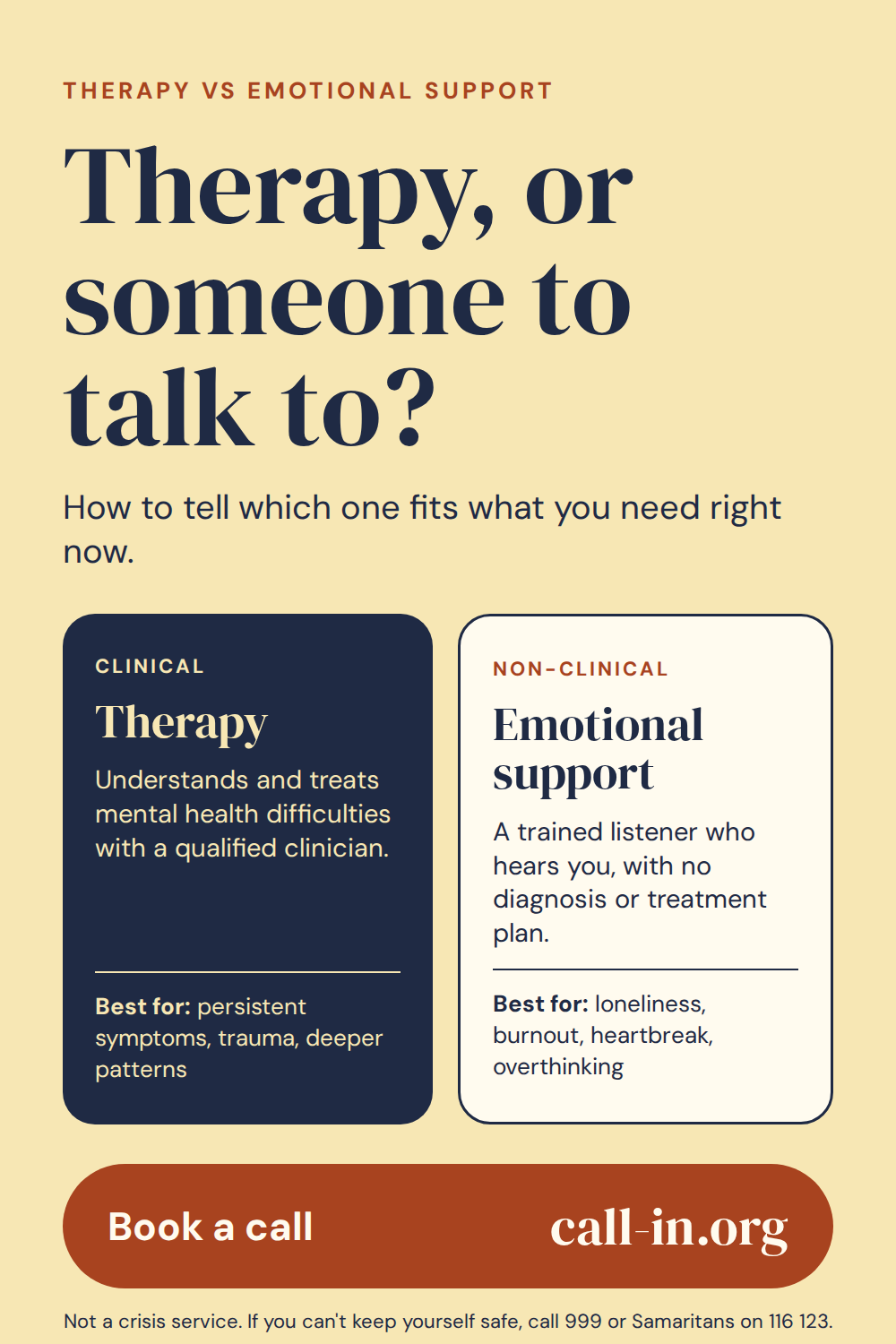
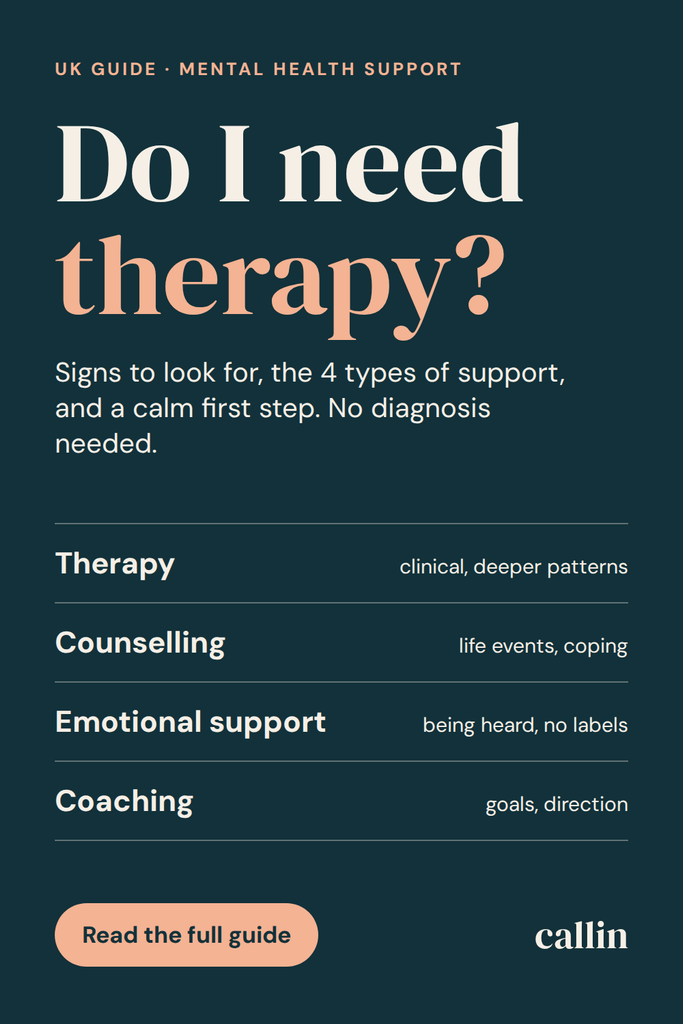
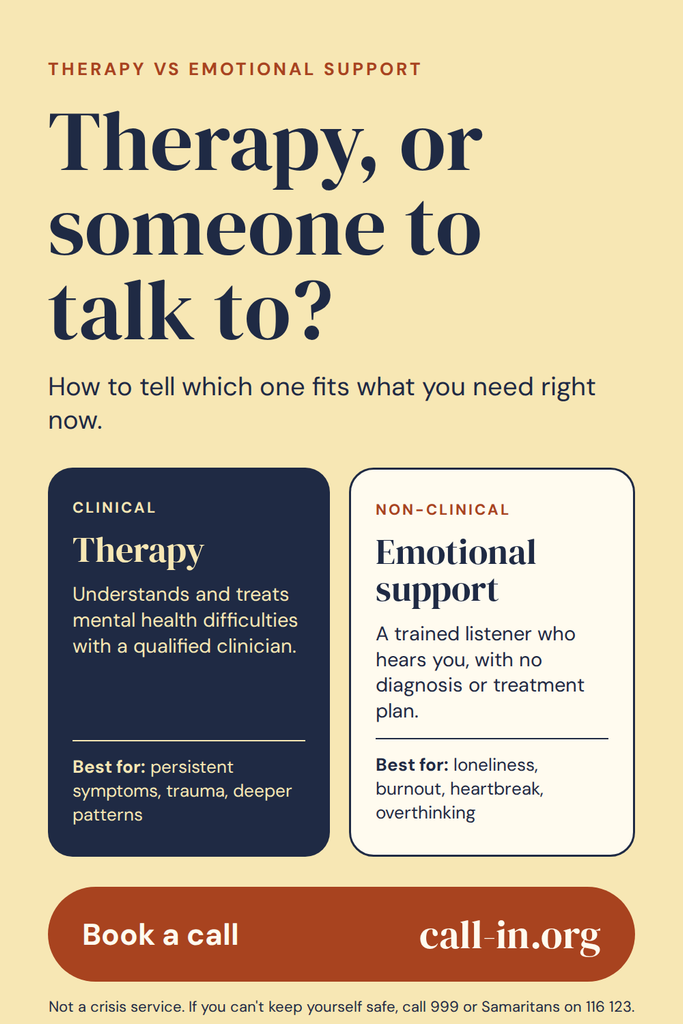
Therapy, sometimes called psychotherapy, focuses on understanding and treating mental health difficulties, emotional patterns and distress. It is provided by qualified clinicians such as psychologists, psychotherapists or some counsellors who have undergone extensive training and work within professional regulatory frameworks.
The aim is usually insight, symptom relief and lasting psychological change. Therapy is often appropriate when symptoms are persistent, when there is trauma or complex history, or when deeper clinical work feels necessary.
Sessions typically involve structured exploration of thoughts, feelings, behaviours and past experiences, and may draw on evidence-based approaches recommended by bodies such as NICE.
Counselling typically explores specific issues, life events or emotional challenges. Trained counsellors help people process difficulties such as bereavement, relationship problems, stress, workplace issues or adjustment to change.
It tends to be more focused on current circumstances and practical coping than on long-term clinical treatment of diagnosed conditions, although the boundary with therapy can sometimes overlap depending on the practitioner’s training and the nature of the work. Many people find counselling helpful for time-limited support around a particular difficulty.
Non-clinical emotional support centres on being heard, validated and accompanied without diagnosis or treatment. Trained listeners or peer supporters offer presence, active listening and continuity. The focus is on giving you space to talk, reflect and feel less alone rather than on assessing symptoms or delivering a clinical intervention.
It suits loneliness, burnout, heartbreak, everyday emotional weight, overthinking, or simply wanting to talk without entering a clinical process. It does not diagnose, treat or replace professional mental health care. Its value lies in human connection, reduced isolation and the relief that comes from being able to speak freely to someone who is trained to listen well.
Coaching is forward-focused. Career or student coaches help with clarity, goals, accountability and practical next steps. It is useful when the main need is direction, structure, motivation or performance rather than emotional processing or clinical care.
A coach will typically work with you on defining what you want to achieve and creating realistic plans to move toward it. Coaching assumes a level of functioning that allows goal-setting and action; it is not designed to address acute mental health symptoms.
Therapy and counselling sit within clinical or quasi-clinical frameworks. Non-clinical emotional support and coaching do not. Many people use more than one form of support at different times or even alongside each other.
For example, someone might see a therapist for structured clinical work while also speaking with a non-clinical listener for ongoing emotional continuity, or work with a career coach while receiving talking therapy for anxiety. The key is matching the type of support to the primary need at any given moment.
Callin provides confidential, online, non-clinical emotional support through trained human listeners, with Human Continuity™ so you can speak with the same person over time and avoid restarting your story. It also offers career coaching and student accountability support.
Callin is not therapy, counselling, a diagnostic service or crisis intervention. It sits in the space between informal support from friends and formal clinical care, offering structured, private conversations when what you need most is to be heard by a trained human being.
When is non-clinical emotional support appropriate?
Non-clinical emotional support can be a good fit when you mainly need a private, non-judgemental space to talk, think aloud and feel less alone.
It is often helpful for feeling lonely or isolated even when surrounded by people, for burnout, stress or mental exhaustion that has built up over time, and for heartbreak, relationship difficulties or family strain that you do not want to burden those closest to you with repeatedly.
It can also support people through grief, loss or major life transitions, through periods of overthinking, low mood or anxiety that have not reached a clinical threshold, and for anyone who wants continuity so they do not have to restart their story each time they seek support. Preferring support without diagnosis, clinical notes or a treatment plan is itself a valid reason to explore this option.
Many people turn to non-clinical support because they are not in crisis and do not feel they need a formal mental health pathway, yet they still carry emotional weight that feels too heavy to hold alone.
Others use it while waiting for NHS talking therapies, alongside therapy, or after completing a course of clinical work when they still value having somewhere consistent to talk. The absence of clinical process can feel less intimidating for those who are hesitant about formal mental health services.
It is less suitable as the sole support when symptoms are severe, functioning is significantly impaired, or you need specialist assessment, medication review or structured therapeutic techniques. In those cases, professional mental health services should be prioritised. Non-clinical support can still sit alongside clinical care for many people, providing an additional layer of human connection and continuity. The two are not mutually exclusive.
If you are unsure whether your difficulties fall into the range where non-clinical support is appropriate, the short assessment on this page can help you reflect. You can also speak with a GP or look at NHS self-referral options for talking therapies if clinical input feels more relevant.
You can read more about non-clinical mental health support on Callin’s dedicated pages, including guides that compare listening services with therapy and explain what Human Continuity™ means in practice.
Can I get support without a mental health diagnosis?
Yes. You do not need a diagnosis to access many forms of help.
NHS talking therapies for anxiety and depression accept self-referrals in England without a formal diagnosis for a wide range of difficulties, including persistent low mood, anxiety, panic, phobias, OCD-related symptoms and stress that is affecting daily life.
You can often refer yourself online without first seeing a GP, although speaking to a GP remains a good option if you prefer that route or if your concerns fall outside the usual scope of those services.
Many private therapists and counsellors also work with people who have no clinical label. The NHS itself states that you do not need a diagnosed mental health condition to access talking therapies.
Non-clinical services such as Callin require no diagnosis, referral or assessment of severity. Ordinary human difficulty is enough. You can come because you feel lonely, exhausted, heartbroken, overwhelmed, misunderstood or simply unable to carry everything alone.
The purpose is not to label or fix you. It is to give you a calm, compassionate space to speak freely, think aloud and feel less alone.
This point matters because many people delay seeking support while they wait to feel “bad enough” or to receive a formal diagnosis. Waiting is not always necessary.
Early, appropriate support can reduce the impact of difficulties and prevent them from becoming more entrenched. Whether you choose clinical talking therapies, private counselling, non-clinical emotional support or a combination, the absence of a diagnosis does not disqualify you from receiving help.
What if I’m struggling but not sure what I need?
Uncertainty is common and completely understandable. The range of options can feel overwhelming, and it is easy to worry about choosing the “wrong” thing or about taking up resources that someone else might need more.
You do not have to decide everything at once. A practical way forward is to notice what feels most pressing right now. Is the dominant need simply to be heard and accompanied?
Do you want clinical tools, structured techniques or a professional assessment? Are you looking for clarity, goals and accountability around work or study? Or do you need urgent safety support because you feel at risk?
Matching the type of help to the primary need at this moment reduces the pressure to find a perfect long-term solution. Many people begin with the most accessible and least intimidating option, then adjust as their understanding of what helps becomes clearer. Starting with non-clinical emotional support does not prevent you from later seeking therapy if that becomes appropriate. Beginning with a GP conversation or NHS self-referral does not prevent you from also using non-clinical support for continuity and everyday emotional weight.
To help you explore options, a short 10-question support-navigation assessment is available on this page. It is designed to prompt reflection on what kind of support might feel useful based on the nature of what you are experiencing and what you are hoping for. It is not a diagnostic or clinically validated tool and does not provide a clinical assessment or diagnosis. Results simply highlight possible directions you can consider. You remain free to take or leave any suggestion. The assessment exists to reduce uncertainty, not to create pressure.
Common myths can also add to the confusion. One is that you have to be in crisis before you are allowed to seek help. Another is that therapy is only for people with serious mental illness. A third is that needing support means you are weak or burdening others. None of these is accurate. Support is a practical resource, not a judgement of character. Many high-functioning people use therapy, counselling or non-clinical listening at various points in their lives precisely because they want to stay well and continue functioning.
Frequently asked questions
Do I need therapy if I am not in crisis?
No. You do not have to be in crisis to benefit from therapy or any other form of support. Many people seek therapy because they feel stuck, want tools for ongoing stress, or simply wish to understand themselves better. Crisis is one reason among many, not a requirement.
Can I talk to someone without going to therapy?
Yes. Non-clinical emotional support exists precisely for this purpose. You can speak with a trained listener about what is on your mind without diagnosis, treatment plans or clinical process. Callin offers this kind of confidential online support with the option of continuity with the same person.
What is the difference between therapy and emotional support?
Therapy is clinical or quasi-clinical work focused on understanding and treating mental health difficulties, usually delivered by qualified practitioners. Non-clinical emotional support focuses on being heard, validated and accompanied. It does not diagnose or treat. Both can be valuable; they serve different primary purposes.
When is non-clinical emotional support appropriate?
It is often appropriate when you need a private space to talk, when difficulties feel heavy but have not significantly impaired daily functioning, or when you prefer support without clinical framework. It is less suitable as the only support when symptoms are severe or specialist clinical input is clearly needed.
Can I get support without a mental health diagnosis?
Yes. NHS talking therapies, many private therapists and non-clinical services such as Callin do not require a diagnosis. Ordinary human difficulty is a valid reason to seek help.
Is Callin therapy or counselling?
No. Callin provides non-clinical emotional support through trained human listeners. It is not therapy, counselling, a diagnostic service or crisis intervention. It also offers career coaching and student accountability support. Callin should not replace professional mental health care when that is needed.
How do I know if I need therapy or just someone to talk to?
Notice what you most want right now. If you want clinical assessment, structured therapeutic techniques or work on deeper patterns, therapy is more likely to fit. If you mainly want a confidential human conversation, continuity and the relief of being heard without clinical process, non-clinical emotional support may be enough. The short assessment on this page can help you reflect.
What if I am not sure which option is right?
Start with the option that feels most accessible and least intimidating. You can adjust later. Speaking to a GP, self-referring to NHS talking therapies, or exploring non-clinical support are all valid first steps. Uncertainty itself does not mean you should wait.
Will I be judged for seeking support?
No reputable service exists to judge you. Support is a practical response to human difficulty, not a verdict on your character or strength. Many people who appear high-functioning still benefit from having somewhere to talk.
What should I do if I feel at risk?
If you or someone else is in immediate danger or you cannot keep yourself safe, contact emergency services (999 in the UK) or go to A&E. For urgent mental health support that is not an emergency, use NHS 111 and select the mental health option. Samaritans (116 123) offer confidential listening at any time.
What should I do next?
Start with the option that feels safest and most accessible for you at this moment.
If you or someone else is in immediate danger or you cannot keep yourself safe, contact emergency services (999 in the UK) or go to A&E. For urgent but non-emergency mental health support in England, use NHS 111 and select the mental health option. Samaritans on 116 123 offer confidential listening 24 hours a day. These routes exist for precisely this purpose. Using them is not an overreaction.
If symptoms are persistent and affecting daily life, speak to your GP or self-refer to NHS talking therapies where available. Early contact with professional services is encouraged by the NHS and by NICE guidance on conditions such as depression and anxiety. Your GP can also help you navigate local services and consider whether other forms of support, including medication in some cases, may be relevant.
If what you mainly want is a confidential conversation with a trained human listener, without diagnosis or clinical process, non-clinical emotional support may be a helpful starting point. Callin offers this online with the option of the same listener over time through Human Continuity™. First sessions are available free for eligible new clients in many cases. The service is designed for adults aged 18 and over who want a private, non-judgemental space to talk. It is available worldwide and is not a crisis service.
If your focus is career direction, workplace stress or student accountability, structured coaching can provide clarity and practical next steps. Callin also offers these forms of support, again with an emphasis on continuity where possible.
You can explore Callin’s emotional support, career coaching and student support pages for more detail. Existing guides on the site, such as the comparison of therapy versus a listening service, explanations of non-clinical mental health support, and information about Human Continuity™, may also help you weigh options without pressure.
There is no single correct answer. Choosing support is not a test of how “bad” things are. It is a practical decision about what would help you right now. Some people need clinical therapy. Some people need a consistent human listener. Some people need both at different times. Some people need coaching focused on goals and structure. The fact that you are reading this page means you are already taking a step toward looking after yourself.
If you would like a calm, confidential space to talk with a trained listener, you are welcome to explore Callin when you feel ready. The page, the assessment and the information here remain useful either way. Support of any appropriate kind is a form of self-respect, not a last resort.