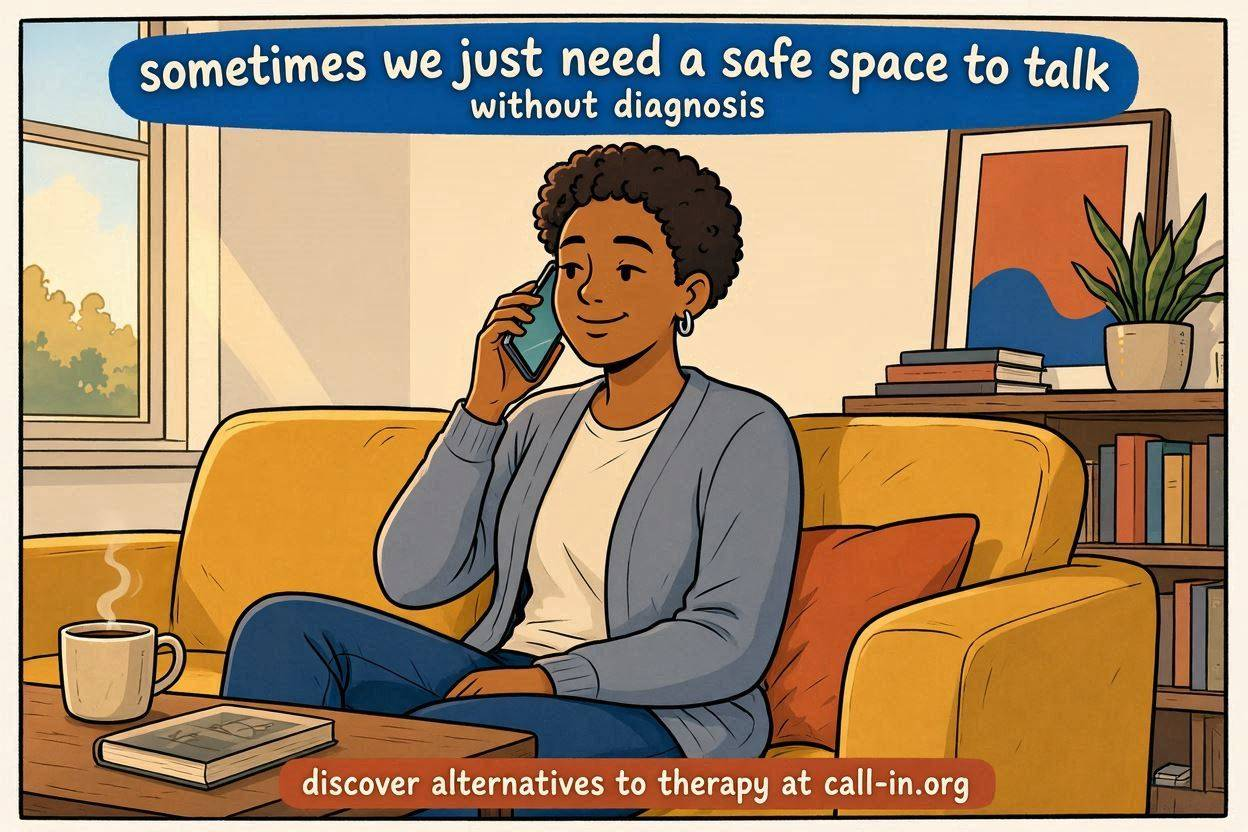
Not everyone who wants to talk needs a diagnosis or a formal treatment plan. Sometimes what you’re looking for is simpler: somewhere to put down a hard day, someone who won’t rush to fix you, a place to be honest without explaining your whole history first.
If you’ve been searching for an alternative to therapy for venting, the good news is that support doesn’t have to start at the clinical end of the spectrum. It can start with simply being heard.
What’s in this guide
- Why People Search for Alternatives to Therapy for Venting
- What Emotional Support Without Therapy Can Look Like
- Where Callin Fits In
- Who Non-Clinical Support Tends to Help Most
- Who May Need a Different Kind of Support
- Real Situations Where People Look for Someone to Vent To
- Frequently Asked Questions
Why People Search for Alternatives to Therapy for Venting
There are a lot of reasons someone starts looking for an alternative to therapy for venting, and most of them have nothing to do with therapy being wrong for them.
Some people simply aren’t ready for the commitment of ongoing clinical sessions. Others have looked into it and found long waitlists, high costs, or a process that feels like a bigger step than what they need right now.
For a lot of people, the issue is less about therapy itself and more about what they’re actually looking for in the moment. They don’t want to be assessed or analysed. They want to say what’s on their mind and have someone actually listen. That’s a different need than working through a diagnosis, and it’s a valid one on its own.
It also helps to understand the difference between venting and what’s sometimes labelled as trauma dumping, because the two often get confused. Venting is a normal, healthy way of processing a difficult day. It doesn’t need a clinical framework to be legitimate, and you don’t need a mental health diagnosis to ask for help.
Then there’s the exhaustion of turning to friends and family, only to be met with advice when what you actually wanted was to be heard.
If you’ve noticed people jumping straight to solutions when you just wanted to vent, you’re not imagining it. Many people searching for alternatives to therapy for venting are really searching for a specific kind of listening: patient, non-judgmental, and without an agenda to fix anything.
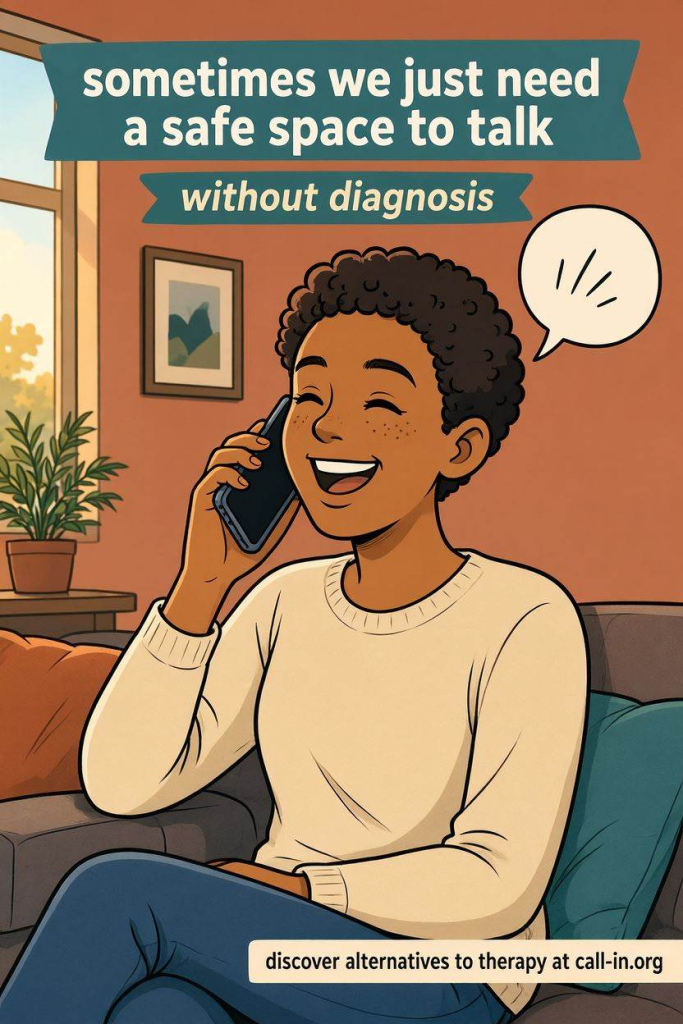
What Emotional Support Without Therapy Can Look Like
Emotional support exists on a spectrum, and therapy is only one point on it. On one end are the people already in your life: friends, family, partners. On the other is professional mental health care. In between sits a wide range of non-clinical options that don’t require a diagnosis, a referral, or a long-term commitment.
Talking to friends is often the first thing people try, and it can genuinely help. But talking to friends doesn’t always feel like enough, especially when everyone is busy, tired, or dealing with their own things. A lot of that connection now happens over text, and texting can’t fully replace a real conversation the way hearing another voice can.
AI tools have also become a common stop for people who want somewhere private to talk. They’re available at any hour and don’t require scheduling, which matters. But AI emotional support has real limits, and most people eventually notice that it can’t fully replace human connection, because part of feeling heard is knowing another person is actually on the other end.
Warmlines are another option worth knowing about. Unlike crisis lines, a warmline is designed for support before things reach a crisis point, offering someone to talk to when you’re struggling but not in danger.
Non-clinical platforms sit in this same space: built for connection and conversation rather than diagnosis or treatment. This is where a service like Callin comes in.
Where Callin Fits In
Callin is built around one idea: a lot of people don’t need treatment, they need somewhere consistent to talk. Instead of starting from scratch with a new person every time, Callin focuses on continuity, so conversations can build on what came before instead of you having to explain your situation again and again.
That continuity matters more than it might seem. Constantly repeating your story, to a new friend, a new app, or a new chatbot session, is its own kind of tiring. It can make you feel like a case file rather than a person. Being able to talk to someone who remembers your context changes the shape of the conversation. It becomes less about catching someone up and more about actually moving forward.
Callin also focuses on human connection rather than automated replies. There’s a difference between a system generating a response and a person actually listening, and that difference tends to show up in how supported someone feels afterward.
None of this makes Callin a replacement for professional care. Callin provides non-clinical emotional support and is not therapy, counselling, diagnosis, or crisis intervention. If you are experiencing a mental health crisis, contact appropriate crisis support services such as Samaritans (UK: 116 123), 988 Suicide and Crisis Lifeline (US), or Lifeline (Australia: 13 11 14).
If you’re looking for someone to talk to when loneliness is the main thing you’re carrying, this kind of ongoing, human support is often what people mean when they say they just want someone to talk to.
Who Non-Clinical Support Tends to Help Most
The right kind of support depends on what’s actually going on for you, and it helps to think about this honestly rather than in absolutes.
Someone who values consistency without the weight of a long-term treatment plan may find that non-clinical support fits well. This tends to be true for people dealing with burnout, where the exhaustion isn’t a single crisis but a slow build-up from busyness culture leaving them lonely and tired, or from tying their self-worth to productivity in a way that leaves little room to just feel okay.
If your priority is having somewhere to think out loud without judgment, that also points toward non-clinical support. This is common for people whose minds won’t switch off, including high achievers who procrastinate despite wanting to do well, or people navigating productivity systems that quietly cause anxiety rather than relief.
Some people are drawn to this kind of support after a period of feeling flat rather than in crisis. If you’ve noticed feeling emotionally numb even when things seem fine on paper, that disconnect is exactly the sort of thing worth talking through, even without a clinical label attached to it.
And for some, it’s simply about loneliness. Not the dramatic kind, but the quiet kind that shows up after a promotion, a move, or a change nobody else seems to notice.
Who May Need a Different Kind of Support
Being honest about limits matters as much as being honest about what non-clinical support can offer.
If you’re dealing with a diagnosed mental health condition, a history of trauma that needs structured processing, or symptoms that are getting worse rather than better over time, a licensed therapist or counsellor is better placed to help. Trained professionals can offer clinical assessment, treatment planning, and specialised techniques that non-clinical support isn’t designed to provide.
The same applies to safety. If you are in crisis, having thoughts of harming yourself, or feeling unsafe in any way, please reach out to a crisis service immediately rather than a non-clinical support platform. In the UK, Samaritans are available on 116 123. In the US, the 988 Suicide and Crisis Lifeline is available by call or text. In Australia, Lifeline can be reached on 13 11 14.
There’s no failure in needing more than a conversation. Recognising when a situation calls for professional or emergency support is one of the most self-aware things a person can do, and it’s just as valid as recognising when you simply need someone to talk to.
Real Situations Where People Look for Someone to Vent To
A lot of what brings people to non-clinical support isn’t one big event. It’s the accumulation of ordinary days.
Picture coming home after a stressful workday with no one to talk to about it. The day replays in your head, but there’s no one nearby to hear the version of it that actually matters to you. This is one of the most common reasons remote workers in particular go looking for someone to vent to, rather than something big or dramatic.
Or consider moving to a new city. The change can be exciting on the surface, but underneath it, it often feels quietly draining, especially in the early weeks before you’ve rebuilt a support system around you.
Some people are working through the end of a relationship, and going through a breakup can leave you feeling unmoored in ways that are hard to explain to people who weren’t part of the relationship.
Others have spent years being the dependable one, and struggle with not knowing how to stop being the strong one for everyone else while getting little support of their own in return.
None of these situations require a diagnosis to be worth talking about. They’re simply part of being a person moving through life, and they’re exactly the kind of thing non-clinical support exists for.
If any of this feels familiar, these related reads go deeper into specific situations:
- Why coming out can leave you feeling emotionally exhausted
- Why promotions can feel surprisingly lonely
- Why it’s hard to keep digital boundaries
- Why texting can feel emotionally draining
- Why constant notifications wear you down
- Why group chats can leave you feeling lonelier, not less
- Why connection can feel shallow even in close relationships
- Why you might crave connection but withdraw from it anyway
- Why adult emotional needs no longer fit neatly into old categories
- How emotional expression shifts across cultures
- How to set boundaries without feeling like a bad person
- Why it’s hard to forgive yourself for one small mistake
Frequently Asked Questions
What can I do if I’m not ready for therapy but still need to talk to someone? You don’t have to choose between therapy and nothing. Non-clinical options like talking to a trusted friend, a warmline, or a platform such as Callin can give you somewhere to process what you’re feeling. These options don’t replace therapy, but they can be a meaningful first step, or simply what you need right now.
Is it normal to want to vent without wanting advice? Yes, and it’s one of the most common things people search for support for. Venting is about being heard, not necessarily about being told what to do next. Wanting that doesn’t mean you’re avoiding a problem, it usually just means you need to process it first.
What is the difference between venting and therapy? Venting is an unstructured release of thoughts and feelings, usually to feel lighter or understood in the moment. Therapy is a structured, clinical process aimed at assessment, treatment, and longer-term change, guided by a licensed professional. Both have value, they’re just designed for different needs.
Can non-clinical emotional support actually help with stress or loneliness? It can, particularly for everyday stress, burnout, and loneliness that don’t require clinical treatment. Having a consistent, non-judgmental space to talk can genuinely ease the weight of a hard week or a lonely stretch of time. It tends to work best as part of a wider support system rather than the only source of connection in your life.
When should I consider therapy instead of a support platform like Callin? If you’re dealing with a diagnosed condition, worsening symptoms, past trauma that needs structured processing, or thoughts of harming yourself, a licensed therapist or crisis service is the appropriate next step. Non-clinical support is not designed to treat these situations. If you’re ever in crisis, contact a crisis line such as Samaritans (116 123 in the UK) or 988 (US) immediately.
Somewhere to Start
You don’t need a crisis, a diagnosis, or a perfect explanation to deserve somewhere to talk. If you’ve been looking for somewhere to vent, reflect, and feel heard without judgment, Callin offers a free 20-minute session to see whether that space feels right for you. There’s no pressure to have it all figured out first. Sometimes the first step is just saying it out loud to someone who’s listening.
Callin provides non-clinical emotional support and is not therapy, counselling, diagnosis, or crisis intervention. If you are experiencing a mental health crisis, contact appropriate crisis support services such as Samaritans (UK: 116 123), 988 Suicide and Crisis Lifeline (US), or Lifeline (Australia: 13 11 14).