
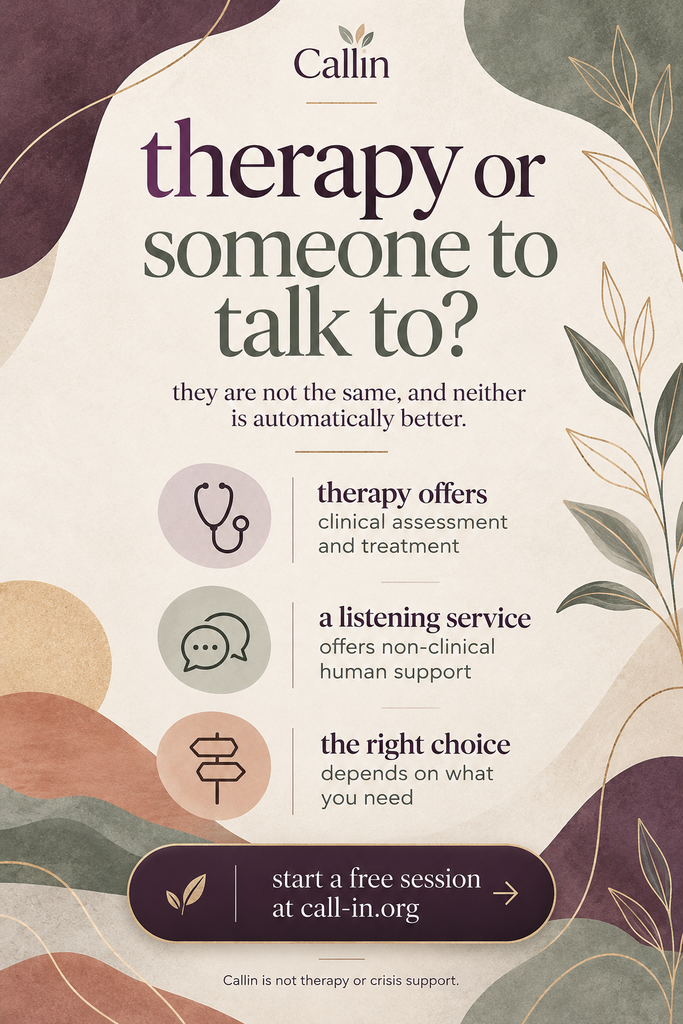
Therapy provides psychological care and may involve assessment, structured treatment, therapeutic techniques, and specialist support.
A listening service provides non-clinical human support when you need someone to talk to about stress, loneliness, grief, heartbreak, burnout, relationships, work, or a difficult period in your life.
The better question is not, Which one is better?
It is: What do I need this support to do for me?
Key takeaways
- Therapy and listening services are different forms of support. One is therapeutic care. The other provides non-clinical human conversation and emotional support.
- Therapy may be the better choice when you want psychological treatment, clinical assessment, specialist support, or structured therapeutic work.
- A listening service like Callin may fit when you mainly need someone to talk to about what is happening in your life without being diagnosed or treated.
- You do not need to be in crisis to ask for emotional support. Loneliness, heartbreak, burnout, work stress, grief, overthinking, and life changes are valid reasons to want someone to talk to.
- Callin is a listening service, not therapy. Callin provides confidential, one-to-one, non-clinical support with trained human listeners.
- Some people use therapy and a listening service together. The important thing is that each service stays within its role.
- Immediate danger or a mental health emergency requires urgent support. Contact emergency or crisis services where you live.
What is the difference between therapy and a listening service?
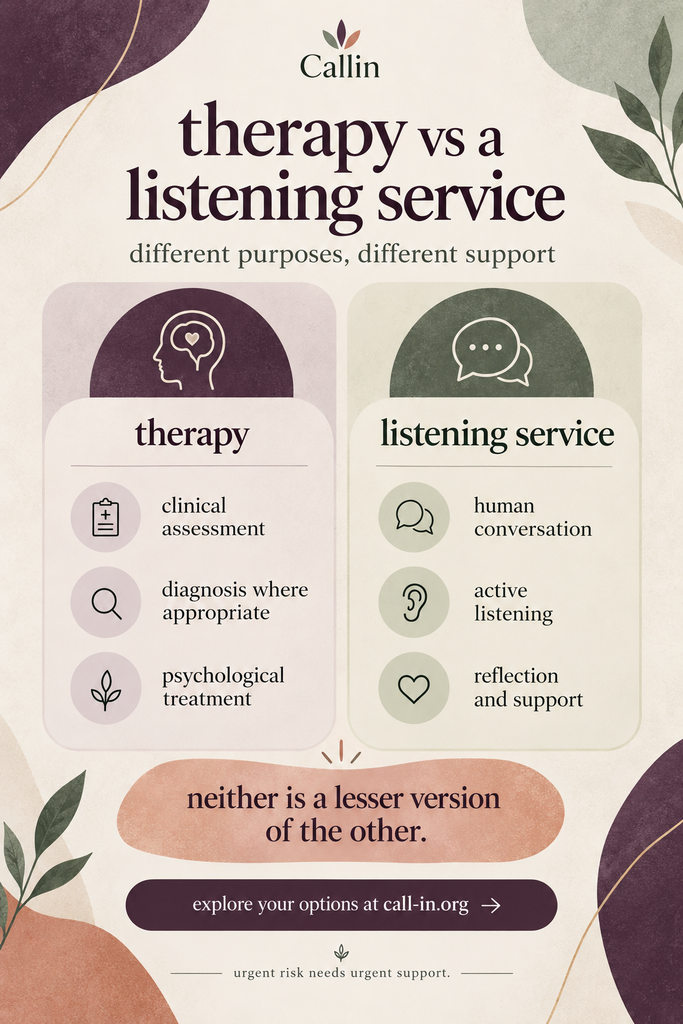
Therapy provides psychological care. A listening service provides non-clinical human support.
That is the clearest distinction.
Therapy can help people explore emotional, psychological, and behavioural difficulties with a suitably trained professional. Depending on the profession, setting, and country, therapy may involve psychological assessment, treatment planning, therapeutic techniques, or work toward agreed goals.
You do not need a diagnosis to benefit from therapy. People use therapy for many reasons, including grief, relationships, trauma, anxiety, depression, behavioural patterns, emotional difficulties, and major life changes.
A listening service has a different purpose.
It gives you somewhere private to talk about what is happening in your life with another human being. The listener may reflect what they hear, ask thoughtful questions, help you organise your thoughts, and give you room to speak without diagnosing or treating you.
A simple way to understand the distinction is this:
Therapy asks what therapeutic or psychological care may help. A listening service asks what you are carrying and whether talking about it would help.
Neither is a lesser version of the other.
They meet different needs.
What is a listening service?
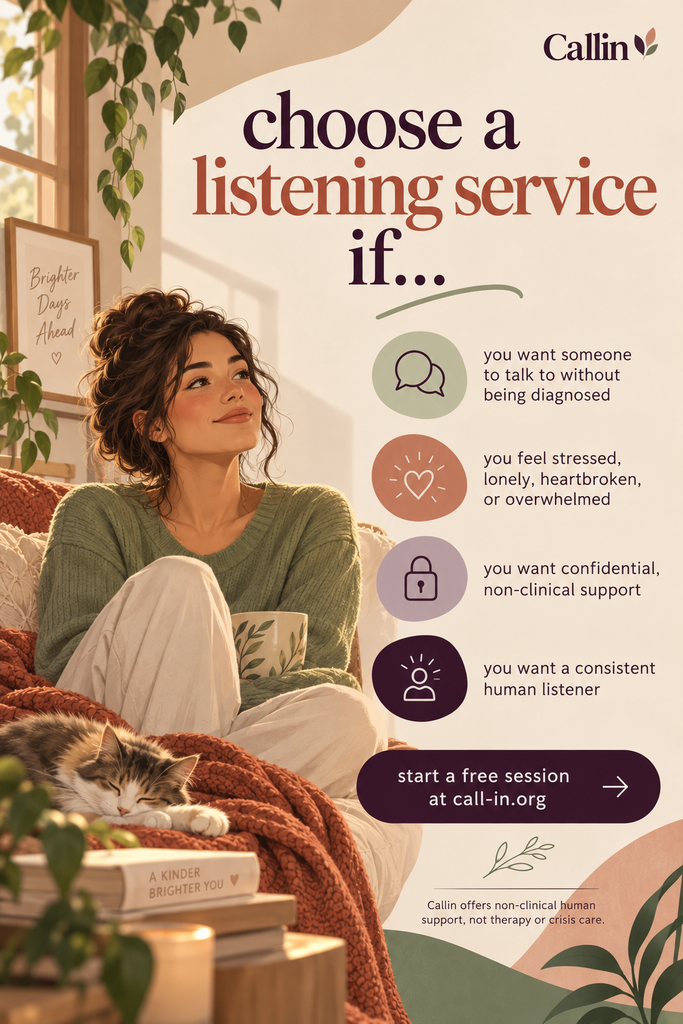
A listening service is a form of non-clinical emotional support where a trained human listens, reflects, asks thoughtful questions, and gives you space to talk without diagnosing or treating you.
You might use a listening service because you feel lonely.
You might be overwhelmed by work, going through a breakup, grieving, struggling with family relationships, worrying about your future, or simply carrying something you do not feel comfortable discussing with people you know.
You do not need a diagnosis.
You do not need to arrive with a treatment goal.
You do not even need to know exactly what is wrong.
Sometimes the starting point really is: I need someone to talk to.
Callin provides confidential, one-to-one, non-clinical emotional support through voice calls, video calls, and private chat.
Callin listeners are trained in active listening and Psychological First Aid. Psychological First Aid is a practical, humane approach to supporting people through distressing experiences. It does not make a listener a therapist, doctor, psychiatrist, or other clinical professional.
Everyone you speak with through Callin is a real human.
Callin is not an AI chatbot.
When should I choose therapy?
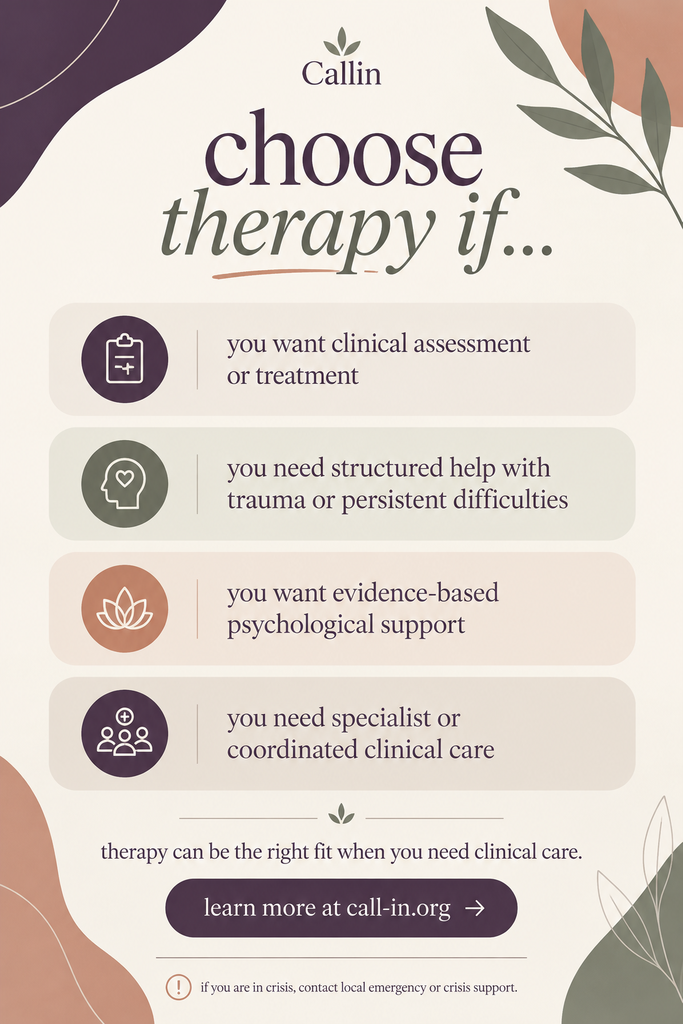
Therapy may be the better option when you want psychological treatment, specialist care, structured therapeutic work, or professional assessment of an ongoing mental health difficulty.
You might consider therapy if emotional or psychological difficulties are significantly affecting your daily life, relationships, work, studies, sleep, behaviour, or ability to function.
Therapy may also be appropriate when you want to work specifically on trauma, recurring patterns, persistent emotional difficulties, or a recognised mental health condition.
You may want therapy if you are looking for a particular therapeutic approach, such as cognitive behavioural therapy, interpersonal therapy, psychodynamic therapy, or another recognised model.
A healthcare or mental health professional may also recommend therapy based on what you are experiencing.
Importantly, you do not need to wait until something becomes severe before considering therapy. You also do not need an existing diagnosis simply to speak with a therapist.
The right route depends on your needs, circumstances, country, access to services, and the kind of support you want.
When should I choose a listening service?
A listening service may suit you when you mainly want a safe, confidential place to talk, reflect, and feel heard without entering a clinical treatment process.
You might want someone to talk to because you are lonely.
Perhaps work is becoming exhausting.
Maybe a relationship has ended and you are trying to make sense of what happened.
You might be grieving, questioning a decision, overwhelmed by university, struggling with family expectations, worried about your career, or simply feeling emotionally full.
None of those situations automatically means you need therapy.
Sometimes you want somewhere outside your existing relationships where you can speak freely.
You may love your friends and still not want to tell them everything.
You may have supportive family members and still worry about being misunderstood.
You may simply want a conversation where you do not have to manage the other person’s feelings while trying to explain your own.
That is one of the roles non-clinical emotional support can play.
Can I use a listening service for anxiety, low mood, burnout, or loneliness?
You can talk about anxiety, low mood, burnout, loneliness, and other emotional experiences with a listening service, but a listening service does not diagnose or treat mental health conditions.
That distinction matters.
For example, you may want to talk about what has been making you anxious, what happens when you start overthinking, how work pressure has been affecting you, or why you have been feeling unusually disconnected from other people.
A listener can give you room to describe your experience and think through what may be contributing to it.
That is different from assessing whether you have an anxiety disorder, depression, trauma-related condition, or another diagnosis.
Callin does not assess symptoms or decide what mental health condition someone may have.
If what you need is clinical assessment or treatment, a suitably qualified healthcare or mental health professional is the appropriate route.
If what you need is a human conversation about what you are going through, non-clinical support may still have a place.
What does Callin mean by exploring root causes?
When Callin talks about exploring root causes, we mean looking at the circumstances, experiences, relationships, pressures, or patterns that you believe may be contributing to how you feel. We do not mean clinical diagnosis or psychological assessment.
Perhaps your stress becomes worse after particular interactions at work.
Maybe you have been feeling lonely since moving to a new city.
Perhaps heartbreak has affected your confidence.
You might notice that university pressure becomes harder when you feel isolated, or that you keep taking responsibility for everyone around you until you become exhausted.
Talking can help you notice context.
It can help you connect experiences that felt separate.
It can also help you think about what might make the situation easier to manage.
That is ordinary human reflection.
A therapist may go further by assessing psychological symptoms, using therapeutic models, identifying a condition where appropriate, and providing evidence-based treatment.
Callin does not do that.
What happens when you talk to someone at Callin?
A Callin session is a confidential conversation with a trained human listener. You decide what you want to talk about, and the listener gives you space to speak, reflect, and consider what may help next.
You do not need to prepare a perfect explanation.
You can start with what happened today.
You can talk about something that has been bothering you for months.
You can say, I don’t even know where to start.
The conversation can include active listening, thoughtful questions, reflection, and practical discussion about healthy ways of coping with what is happening in your life.
The listener does not diagnose you.
They do not prescribe medication.
They do not deliver psychological treatment.
They do not pretend to be your therapist.
Callin is designed to provide a different kind of support.
Will I speak to the same listener each time?
Wherever possible, Callin allows you to continue with the same dedicated listener through its Human Continuity™ approach.
Continuity matters because support can become exhausting when you repeatedly have to explain the same history.
You may not want to introduce the same relationship problem from the beginning every week.
You may not want to explain your family dynamics again.
You may not want to retell the story of what happened at work before reaching the part that is bothering you today.
With continuity, your listener already understands more of the context.
The conversation can continue rather than constantly restart.
This does not turn the relationship into therapy. It simply means non-clinical emotional support can still have consistency.
Is a listening service just a cheaper version of therapy?
No. A listening service is not budget therapy. It is a different type of support with different boundaries, training, and purposes.
Cost may be one reason people search for alternatives to therapy, particularly where private therapy is expensive or public services have long waiting times.
But price should not be the only question.
The more important question is whether the service actually matches what you need.
If you require psychological treatment, choosing a listening service simply because it costs less would not give you the same care as therapy.
Equally, if you do not want clinical treatment and mainly need someone to talk to, paying for therapy solely because it appears to be the only recognised form of emotional support may not be necessary for you.
There are many forms of support.
They include therapy, listening services, coaching, support groups, community organisations, employee assistance programmes, university services, peer support, trusted personal relationships, and self-help resources.
The appropriate option depends on what you need from it.
Can I use therapy and a listening service at the same time?
Yes. Some people use therapy and non-clinical emotional support alongside each other because the two services can serve different purposes.
A therapist might help you work on trauma, persistent anxiety, depression, psychological patterns, or another specific therapeutic goal.
A listening service might provide additional space to talk about ordinary life between appointments.
You might want to discuss a difficult day at work, a disagreement with your partner, loneliness on a quiet weekend, or something that has been occupying your mind.
The boundaries should remain clear.
A listening service should not attempt to replace your therapist, contradict appropriate clinical care, or treat a mental health condition.
Some people benefit from both.
Some people only need one.
Others may prefer support from friends, family, community groups, coaches, mentors, or other resources.
There is no single correct model of support for everyone.
When is a listening service not enough?
A listening service is not enough when you need emergency intervention, crisis care, urgent medical or psychiatric support, or clinical treatment that falls outside the service’s scope.
If you are in immediate danger, believe you may harm yourself or someone else, or need urgent medical or psychiatric care, contact emergency or crisis services where you live.
Find A Helpline can also help you locate crisis and emotional support services in countries around the world.
Callin is not a crisis service.
That boundary is important because responsible support means being clear about what a service can and cannot safely provide.
Being redirected toward more appropriate care is not rejection.
Sometimes it is exactly what responsible support should look like.
Do I need therapy or someone to talk to?
If you want clinical treatment or professional assessment, therapy may be the better starting point. If you mainly want a confidential human conversation about what is happening in your life, a listening service may be enough.
You do not have to diagnose yourself before choosing where to begin.
Instead, ask what you want the support to do.
Do you want psychological treatment?
Do you want help with trauma or an ongoing mental health difficulty?
Do you want a professional assessment?
Or do you mainly want someone who will listen while you talk through stress, loneliness, grief, burnout, relationships, work, or another difficult experience?
You may not know immediately.
That is fine.
Your needs can also change.
You might begin with a listening service and later realise therapy would be more appropriate.
You might complete therapy and still value having a non-clinical space where you can talk.
You might decide that a trusted friend, support group, coach, community organisation, or another form of support fits you better.
The goal is not to force yourself into a category.
It is to find support that matches what you actually need.
What if I want someone to talk to but cannot afford therapy?
If therapy is unaffordable and you mainly need someone to talk to, non-clinical emotional support may be one option to explore. If you need therapy specifically, look for lower-cost clinical routes rather than replacing necessary treatment with a listening service.
Depending on where you live, affordable therapy options may include public health services, charities, university counselling, community mental health programmes, employee assistance programmes, sliding-scale therapists, training clinics, insurance, or nonprofit organisations.
If your need is different, you can also explore listening services, peer support, support groups, or community organisations.
Callin offers paid non-clinical emotional support and eligible new clients can start with a free first call session with no obligation to continue.
The important distinction remains the same.
Affordable support is useful only when it is the right kind of support.
Is Callin therapy?
No. Callin is a non-clinical emotional support service, not therapy, counselling, psychiatric care, medical care, or crisis support.
Callin provides confidential one-to-one conversations with trained human listeners.
You can use Callin when you want somewhere to talk about stress, loneliness, burnout, heartbreak, relationships, work, grief, life changes, overthinking, or other everyday emotional pressures.
Callin listeners can listen, reflect, ask thoughtful questions, and help you consider practical ways forward.
They do not diagnose mental health conditions.
They do not prescribe medication.
They do not provide psychological treatment.
Callin exists for the space where you may not need clinical care, but you also do not want to carry everything alone.
Frequently asked questions
Is a listening service the same as therapy?
No. A listening service provides non-clinical human conversation and emotional support. Therapy provides psychological care and may include assessment, structured therapeutic work, specialist support, and treatment.
Do I need a diagnosis before starting therapy?
No. You do not necessarily need an existing diagnosis to benefit from therapy. People seek therapy for many emotional, behavioural, relational, and psychological reasons.
Can I talk to Callin about anxiety or depression?
You can talk about experiences such as anxiety, low mood, loneliness, stress, or feeling overwhelmed. Callin does not diagnose or treat anxiety disorders, depression, or other mental health conditions.
What can I talk about with a Callin listener?
You can talk about loneliness, relationships, heartbreak, grief, work stress, burnout, family difficulties, university pressure, major decisions, life changes, overthinking, feeling overwhelmed, or something you simply do not feel comfortable discussing elsewhere.
Can I use Callin while seeing a therapist?
Yes, some people may use non-clinical emotional support alongside therapy. Callin does not replace, override, or provide an alternative treatment to care recommended by your therapist or healthcare professional.
Does Callin use AI listeners?
No. Callin conversations are with real human listeners. Callin’s support model is built around human conversation, active listening, and continuity.
What should I do if I am in crisis?
Contact your local emergency services or an appropriate crisis service immediately. Find A Helpline can help you locate crisis support where you live. Callin is not an emergency or crisis service.
Therapy vs. a listening service: which one is right for you?
Therapy is appropriate when you need psychological care. A listening service may be appropriate when what you need most is a safe, confidential conversation with another human being.
Neither option should pretend to be the other.
Sometimes therapy is exactly what you need.
Sometimes you need clinical care, specialist support, or treatment.
And sometimes life is simply difficult.
You are lonely.
Your relationship has fallen apart.
Work is draining you.
You are grieving.
You cannot stop thinking about something.
You have been carrying too much and would like somewhere to put it down for a while.
Those experiences deserve support too.
If you want a confidential, non-clinical space to talk with a real person, Callin offers one-to-one support through voice, video, and private chat. Wherever possible, you can continue with the same dedicated listener through Human Continuity™.
Your first call session is free, with no obligation to continue.
Callin. Breathe out. Feel heard.
Sources and further reading
American Psychological Association, information on psychotherapy.
NHS, guidance on talking therapies.
Find A Helpline, international directory of crisis and emotional support services.

Leave a Reply