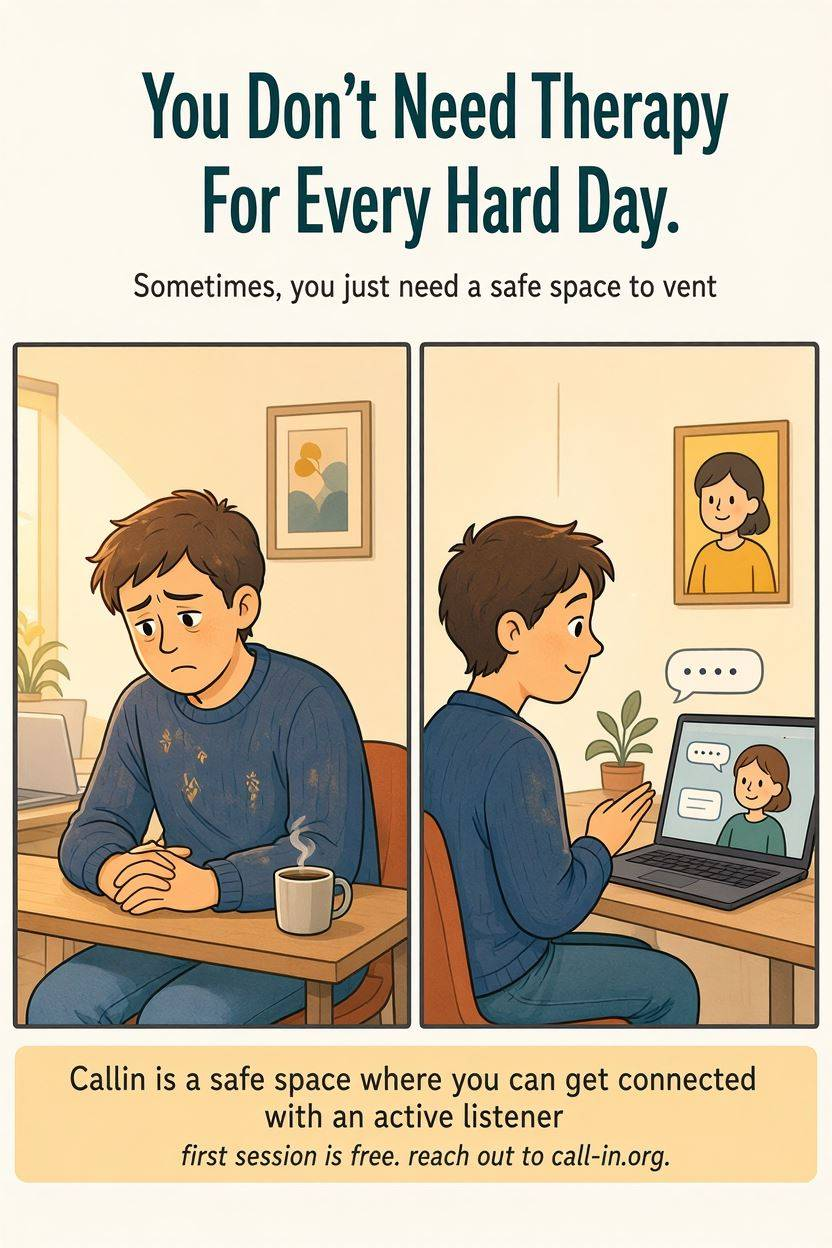
If you need help processing everyday stress, loneliness, or overthinking, non-clinical emotional support is usually enough. If you are dealing with a diagnosable condition, trauma, or patterns that are affecting your daily functioning, therapy is the better fit. This guide breaks down exactly how to tell the difference.
Key Takeaways
- Non-clinical support and therapy solve different problems, not competing versions of the same problem.
- The right choice usually comes down to severity, goal, and how long the struggle has lasted.
- Cost and access matter more than most people admit, and that is a valid factor in this decision.
- You do not need a diagnosis to justify wanting to talk to someone.
- Many people benefit from using both at different points in their life, not one instead of the other.
The Core Difference in One Sentence
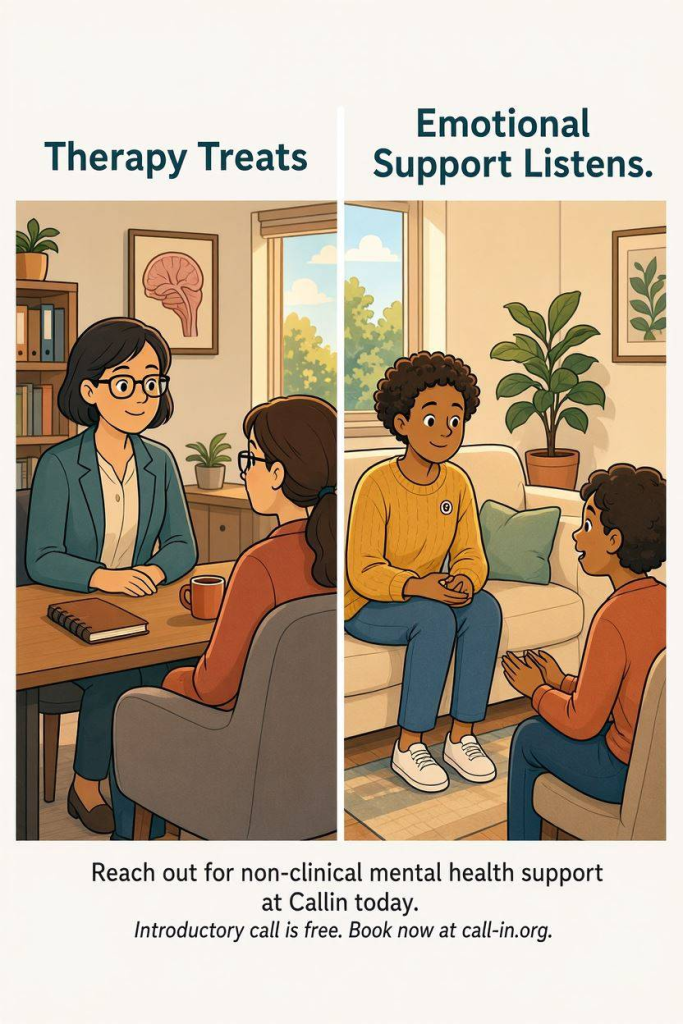
Therapy treats. Non-clinical support listens.
That single distinction explains almost everything else in this guide. Therapy is built around assessment, diagnosis, and a treatment plan aimed at change over time. Non-clinical emotional support is built around being heard, in the moment, without a clinical framework attached to the conversation.
Neither one is a lesser version of the other. They are simply designed for different situations.
Non-Clinical Mental Health Support vs Therapy at a Glance
Non-clinical peer support is typically provided by trained peer listeners, while therapy is delivered by licensed therapists or counselors. The core goal differs too: peer support exists to help you feel heard and process what you’re carrying in the moment, whereas therapy is built around diagnosis and structured, ongoing treatment.
That distinction shapes who each option suits best. Non-clinical support tends to work well for stress, loneliness, venting, and life transitions : the everyday emotional weight that doesn’t require a clinical framework.
Therapy is generally the better fit for diagnosable conditions, trauma, and patterns that keep repeating despite your best efforts. Non-clinical support never involves a diagnosis; therapy does, when it’s clinically appropriate.
Cost and access often differ as well. Non-clinical support is frequently lower-cost or subscription-based and available on demand, sometimes even same-day. Therapy is usually more expensive, may require insurance, and typically runs on a scheduled, weekly-or-biweekly cadence rather than being available whenever you need it.
Both approaches take confidentiality seriously, but in different forms: peer support conversations stay confidential without becoming part of a medical record, while therapy sessions are confidential as part of your official medical record. Time commitment tends to vary too: non-clinical support can be used flexibly, session by session, while therapy is typically an ongoing, longer-term commitment.
Finally, the two differ in how they respond to what you share. Non-clinical support leans on reflective listening with minimal direction, giving you space to think out loud. Therapy takes a more clinical approach, offering guidance and intervention aimed at specific outcomes.
This table is a starting point, not a rulebook. Your actual decision depends on a few specific criteria, which are worth walking through one at a time.
Criteria to Help You Decide
How Severe Is What You Are Dealing With?
Severity is the first and most important filter. Everyday stress, a rough week at work, or the ache of feeling disconnected from people around you can often be eased significantly by talking it through with a trained, non-judgmental listener.
Persistent symptoms are different. If you notice ongoing sadness that will not lift, panic that interferes with basic tasks, or thoughts that concern you, that is a signal to involve a licensed professional. Knowing whether you need emotional support or therapy often starts with being honest about how long a feeling has lasted and how much it is affecting your ability to function.
What Is Your Actual Goal for the Conversation?
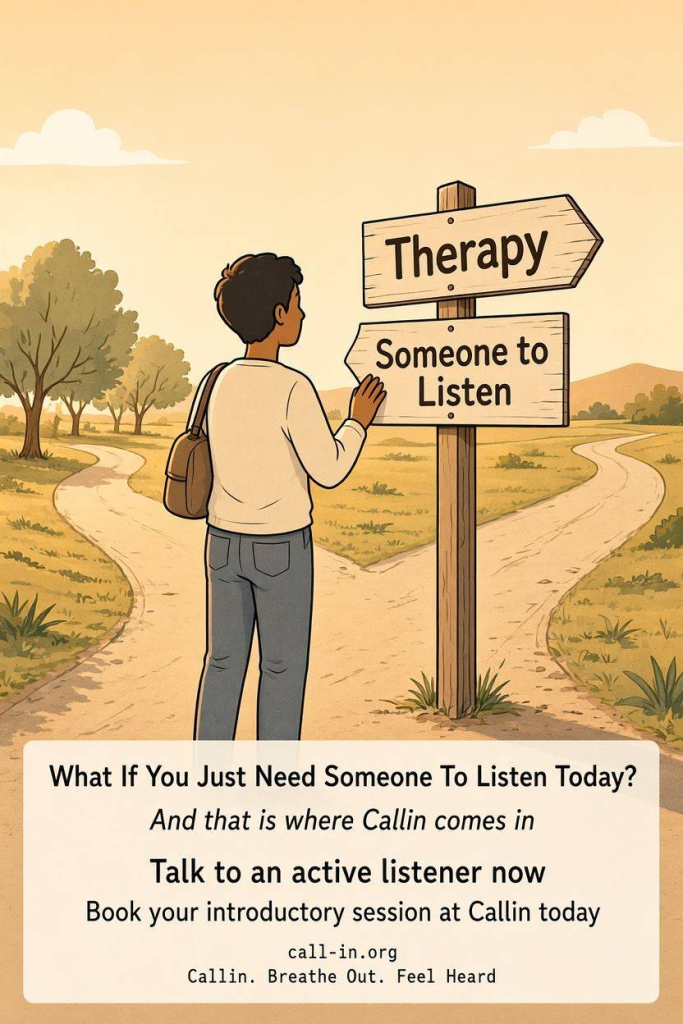
Ask yourself what you want out of talking to someone. If the answer is “I just need to say this out loud,” that points toward non-clinical support. If the answer is “I want to understand why this keeps happening and change it long term,” that points toward therapy.
Neither goal is more valid than the other. They simply call for different tools.
Do You Need or Want a Diagnosis?
Some people specifically want clinical language for what they are experiencing, and that is a legitimate reason to see a therapist. Others simply want to talk without their experience being labeled at all. Asking for help without needing a mental health diagnosis is completely valid, and non-clinical support exists specifically for that preference.
How Much Does Cost and Access Change Your Decision?
This is the practical criterion people are often reluctant to say out loud. Therapy can be expensive, insurance coverage varies widely, and waitlists in many areas stretch for weeks or months. Non-clinical support tends to be faster to access and lower in cost, which makes it a realistic option for people who need to talk now, not in six weeks.
Access is not a lesser reason to choose one path over another. It is a real constraint, and working within it is not settling.
Is This a One-Time Need or an Ongoing Pattern?
A single hard week rarely requires ongoing clinical treatment. A pattern that repeats month after month, especially one tied to trauma or a diagnosable condition, usually benefits from the structure and continuity therapy provides.
If you are unsure which category you fall into, that uncertainty is common, and it is one of the clearest signs that talking to someone, clinical or not, would help you get clarity.
The Verdict: A Simple Way to Decide
Choose non-clinical emotional support if you are dealing with everyday stress, loneliness, burnout, overthinking, or a life transition, and you mainly want to be heard without judgment or a diagnosis.
Choose therapy if you are dealing with a diagnosable condition, unresolved trauma, or a pattern that has lasted months and affects your daily functioning, and you want structured treatment aimed at long-term change.
Choose both if you want ongoing clinical treatment for a specific condition while also having a lower-stakes space to process daily life in between sessions. Many people do exactly this, and it is one of the more underused strategies in emotional wellbeing.
An Idea Worth Sitting With
Most people treat this as a one-time decision, therapy or not therapy, made once and never revisited. In reality, your need shifts constantly. The support that fits you during a divorce is not the support that fits you during a slow, ordinary Tuesday.
Thinking of emotional support as a spectrum rather than a single choice removes a lot of unnecessary pressure. You are allowed to use preventive emotional care on the calm weeks and clinical treatment on the hard ones, without treating either as a failure of the other.
What Non-Clinical Support Cannot Replace
It is worth being direct about this. Non-clinical emotional support is not equipped to diagnose conditions, manage medication, treat trauma directly, or respond to a mental health crisis. If you are in crisis, a licensed professional or emergency service is the right and necessary path, not a peer listener.
Non-clinical support is a strong complement to therapy and a strong option on its own for everyday emotional needs. It was never meant to replace clinical care where clinical care is genuinely required.
Where Callin Fits Into This
Callin was built for the non-clinical side of this decision. It connects people with trained peer listeners for confidential, judgment-free conversations about everyday stress, loneliness, and overthinking, without positioning itself as a replacement for therapy when therapy is what someone actually needs.
Frequently Asked Questions
Can I use non-clinical emotional support if I am already in therapy?
Yes. Many people use non-clinical support between sessions to process daily stress without waiting for their next scheduled appointment. It complements therapy rather than competing with it.
How do I know if my stress is “everyday” or something more serious?
Pay attention to duration and function. A few difficult days that ease with rest and conversation are usually everyday stress. Symptoms that persist for weeks and interfere with work, sleep, or relationships are worth discussing with a licensed professional.
Is non-clinical support less effective than therapy?
It is not less effective, it is designed for a different purpose. Therapy is built for diagnosis and structured treatment. Non-clinical support is built for being heard and processing feelings in the moment. Each is effective for what it is meant to do.
Do I need a diagnosis to talk to someone?
No. You can seek non-clinical emotional support without any diagnosis at all. Wanting to talk to someone is reason enough.
What if I cannot afford therapy right now?
Non-clinical emotional support is often significantly more accessible in both cost and availability, and it can be a meaningful option while you figure out longer-term care, or as an ongoing choice on its own.
Should I choose therapy if I am dealing with trauma?
Trauma generally calls for a licensed professional trained in trauma-informed care. Non-clinical support can still be a helpful supplement, but it should not stand in for clinical treatment when trauma is involved.
Is it normal to go back and forth between the two?
Yes. Needs change with circumstances. Using non-clinical support during calmer periods and therapy during harder ones is a common and healthy pattern, not an inconsistency.
There is no single correct answer that applies to everyone. The right choice is the one that matches what you are actually carrying right now, and it is allowed to change as your life does.

Leave a Reply