
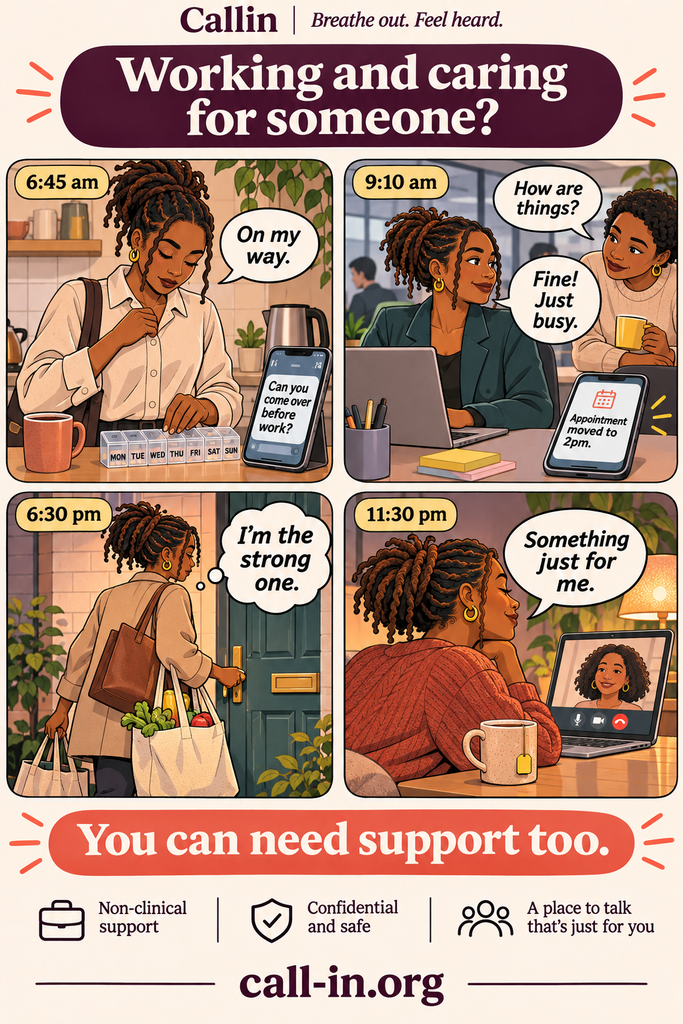
Some of your best people start their working day after getting a parent dressed, a child to a hospital appointment, or a partner settled with their medication. Many of them never mention it at work. This guide is for HR and people leaders who want working carers to feel supported, not penalised, and to have somewhere confidential to talk when the load gets heavy.
The short answer: Employers can support staff who are unpaid carers by recognising that caring is common, making it safe to talk about, offering flexibility and clear leave options, training managers to respond without judgement, and adding a confidential, non-clinical place to talk that sits outside the management chain.
Keep caring separate from performance conversations wherever you can, and review your approach with carers themselves.
Key definitions
- Unpaid carer: Someone who looks after a family member, partner, friend or neighbour who needs support because of illness, disability, older age or another need, without being paid for it.
- Working carer: An employee who combines paid work with unpaid caring responsibilities, whether for a few hours a week or around the clock.
- Sandwich carer: Someone caring for children and an older or ill adult at the same time.
- Carers’ leave: Time off from work to provide or arrange care. Whether it exists, and whether it is paid, depends on the country and the employer.
- Non-clinical emotional support: Confidential, human conversation with a trained listener that does not diagnose, treat, assess or replace therapy, occupational health or medical care.
A quick word on boundaries before we begin. Callin offers non-clinical emotional support, not therapy, counselling, occupational health, medical care, carer assessment, benefits advice or crisis support, and nothing in this article is clinical, legal or employment advice.
If you, a colleague or anyone you are supporting may be in immediate danger or crisis, please contact local emergency services or find a free, confidential helpline in your country at findahelpline.com.
Key takeaways
- Caring is common: the ILO estimates 16.4 billion hours of unpaid care work are done every day worldwide, and a Harvard Business School survey found 73% of US employees had some caring responsibility.
- Many carers stay silent at work: in a 2025 US study, only 49% of working caregivers said their supervisor knew about their caring role.
- Employers often underestimate the impact: in the same Harvard research, only 24% of employers thought caregiving affected performance, while more than 80% of employee carers said it affected their productivity.
- Intensive caring is associated with poorer mental health and reduced working hours, according to the OECD.
- Flexibility, predictable leave options and trained managers matter more than any single benefit.
- A confidential, non-clinical place to talk helps carers who feel they cannot burden family or colleagues, and works alongside an EAP or occupational health.
- A defined three-month pilot with a clear group, privacy-safe measures and a review point is a low-risk way to test a new layer of support.
How many of your employees are unpaid carers?
Probably more than you think. Caring touches every age group and every level of seniority, and much of it is invisible at work.
Globally, the International Labour Organization reports that “16.4 billion hours per day are spent in unpaid care work,” the equivalent of 2 billion people working full time without pay, according to its 2018 report Care work and care jobs for the future of decent work. The OECD’s Health at a Glance 2025 finds that across OECD countries, 13% of people aged 50 and over provide informal care, and 61% of informal carers are women.
National figures tell a similar story. In the United States, Caregiving in the US 2025 from AARP and the National Alliance for Caregiving found 63 million family caregivers, nearly one in four adults, and six in ten of them were employed. In Australia, the Bureau of Statistics counted 3.0 million carers in 2022, 11.9% of people living in households.
Harvard Business School’s report The Caring Company found that 73% of surveyed US employees had some type of current caregiving responsibility. Definitions differ between surveys, so treat each figure as a snapshot of its own country, not a single global number.
Why do working carers often stay silent?
Many fear that saying it out loud will cost them. Worries about career progression, being seen as less committed, or simply not wanting to bring home life to work all keep carers quiet.
The National Alliance for Caregiving’s Working While Caregiving summary found that only 49% of US working caregivers tell their supervisors about their caring role. It also found that working caregivers report higher rates of financial strain and feelings of isolation than caregivers who are not working.
The Caring Company describes the same pattern: “Few employees are willing to admit to their organizations that they are caregivers for fear that it will undermine their career prospects.” The carers it surveyed perceived consequences such as fewer challenging assignments and lower pay rises or bonuses.
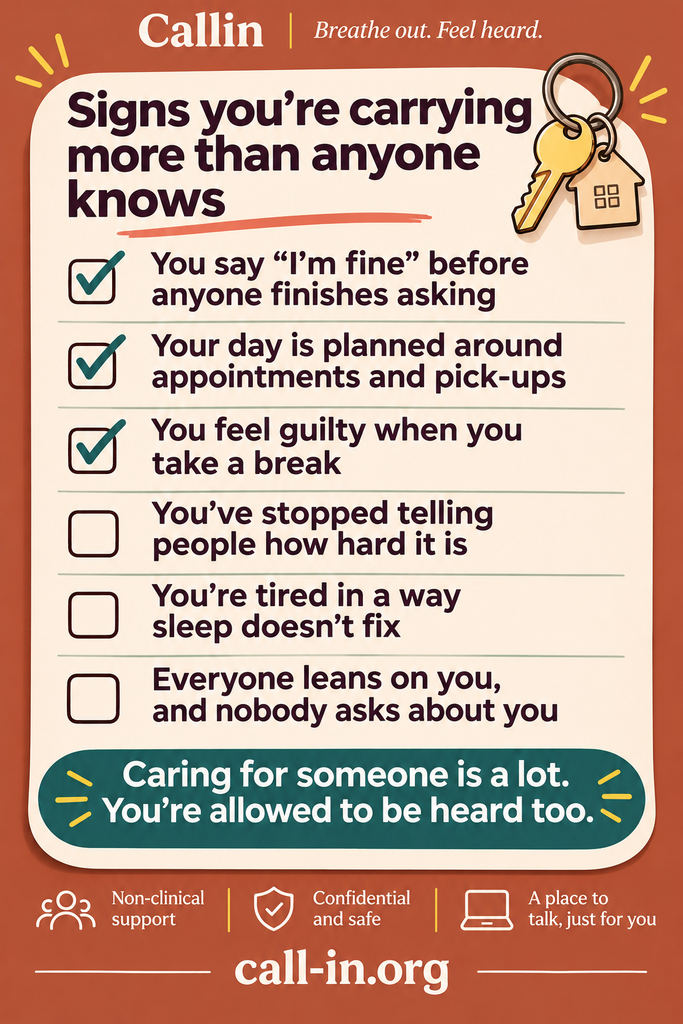
There is often an emotional reason too. Carers are used to being the strong one, and asking for support can feel like a betrayal of the person they care for. Our article on being the strong one for everyone speaks to that feeling, and could be useful to share with staff.
How does caring affect wellbeing and work?
It can affect sleep, health, concentration, money and relationships, and over time it can push people to reduce their hours or leave. Most carers are managing well most days, but the cumulative load is real.
The OECD notes that “intense provision of informal care is associated with negative effects on mental health and labour market participation, such as a reduction of hours worked and earlier retirement.” In the US, half of working caregivers report disruptions such as arriving late, leaving early or taking time off to provide care.
For employers, the impact shows up in ways that are easy to misread. The Caring Company found that more than 80% of employee carers said caregiving affected their productivity, yet only 24% of employers believed caregiving influenced performance. It also found that 32% of surveyed employees had voluntarily left a job because of caring responsibilities.
Carers rarely describe themselves as burnt out; they often just say they are tired. Our article on why you might feel mentally exhausted is written for the individual and may help a carer name what is happening.
What practical support can employers offer?
Start with flexibility and predictability, because those are what carers most often need. Then make sure people know what is available and feel safe using it.
Practical options many employers combine:
- Flexible working: adjustable start and finish times, compressed hours, remote work where the role allows, and the option to reduce hours temporarily.
- Leave options: short-notice time off for emergencies and appointments, plus clear guidance on longer leave.
- A carers policy: a short, plain-language page explaining what is available and how to ask.
- Carer networks: a peer group where carers can share practical tips and feel less alone.
- Practical information: signposting to local carer organisations, care services and benefits advice, without HR giving the advice itself.
- An EAP or occupational health: for people who need structured or clinical support.
- A confidential place to talk: non-clinical emotional support for carers who mainly need to be heard.
If you are building support from scratch, our guide to setting up mental health support in a small company offers a practical starting point, and our explainer on what an EAP is and how it works sets out what an assistance programme usually covers.
How do you stop caring becoming a performance issue?
Separate the caring conversation from the performance conversation, and agree adjustments before problems build up. When a carer is struggling at work, the first question should be “what would help?”, not “what is going wrong?”
Helpful principles for managers:
- Ask early, privately and kindly: a short check-in can open the door without pressure.
- Focus on outcomes: where possible, judge results rather than hours at a desk.
- Agree adjustments in writing: a simple record of what has been agreed protects the employee and the manager.
- Review regularly: caring needs change, sometimes suddenly, so revisit arrangements.
- Protect confidentiality: share details only with the employee’s consent and only with people who need to know.
- Keep standards fair: clear expectations and supportive adjustments can sit side by side.
Our article on why workplace stress needs more than wellness programmes explains why culture and workload matter as much as any benefit.
Why does a confidential place to talk matter for carers?
Because many carers have no one they feel they can offload to. Family members may be part of the caring situation, friends may have drifted, and colleagues may be the last people they want to know.
A confidential, non-clinical conversation gives carers a space that is just for them. They can say the things they feel unable to say elsewhere, such as frustration, grief for the life they expected, or guilt about wanting a break, without being judged or advised.
This is different from carer assessment, benefits advice or therapy, and it does not replace them. It simply recognises that the person holding everyone else together also needs to be heard. Our articles on talking to someone when you do not want to burden your friends and why you might feel guilty for needing support speak directly to carers who hold back.
If you want to explain the difference to staff, our guide to what non-clinical mental health support means sets it out clearly.
How does this work across different countries?
Keep the principles the same and adapt the detail locally. Carers’ rights, leave entitlements, benefits and care systems vary widely across the Nordics, Germany, the Netherlands, Russia, Malta, Cyprus, the UK and Ireland, North America, Australia, New Zealand and beyond.
Some examples, to show the range rather than to advise:
- European Union example: the EU’s work-life balance rules introduced carers’ leave of 5 days per year and a right to request flexible working arrangements for carers, implemented through national law in each member state.
- United Kingdom example: unpaid carer’s leave allows eligible employees to take up to one week of unpaid leave every 12 months to give or arrange care for a dependant.
- OECD overview: about half of OECD countries offer some form of paid leave for informal carers, according to Health at a Glance 2025.
Check what applies in each country where you employ people, and treat national rules as a minimum rather than a ceiling. Consider time zones, languages and cultural expectations about family care too, as these shape whether people feel able to speak up.
Where does Callin fit alongside your existing support?
Callin offers non-clinical emotional support: a confidential, human place to talk, alongside your flexible working policies, EAP and occupational health. It is not therapy, counselling, carer assessment, benefits advice, occupational health or a crisis service, and it does not replace any of them.
Callin has offered this kind of support since June 2023. Callin Support Ltd is UK-registered and supports adults aged 18 and over worldwide through one-to-one online sessions in English. Callin is available 24/7, with sessions booked in advance at a time that suits each person, at any hour, which can help carers whose free time comes late at night or early in the morning. Listeners complete Johns Hopkins University Psychological First Aid training and use active listening, with clear safeguarding and signposting procedures.
Through Human Continuity™, Callin prioritises the same listener for ongoing support wherever operationally possible, so carers do not have to explain their situation from the beginning each time. Callin does not create clinical records, and the content of an employee’s conversations is not shared with their employer. You can read more in our FAQ and privacy policy.
For a wider view of how the layers fit, see our guides to workplace mental health support for employees and how Callin complements EAPs. We do not publish outcome or savings figures for Callin, and we would encourage you to measure impact in your own organisation.
What would a three-month pilot for working carers look like?
A three-month pilot tests a new layer of support with a defined group, clear measures and a decision point at the end. Callin offers a defined three-month pilot for organisations through our workplace wellbeing support for organisations page.
A practical pilot plan might include:
- Before launch: choose a group, such as members of a carers network or one department, agree privacy-safe reporting, and involve carers in the design.
- Month 1, awareness and trust: check through a short anonymous pulse whether staff know the support exists and believe it is confidential.
- Month 2, access and reach: look at aggregate uptake, including early-morning and late-evening sessions, with small numbers suppressed.
- Month 3, early signals: gather anonymous feedback on whether carers felt heard and whether support was easy to fit around caring.
- Review: decide with carers whether to stop, adjust or continue, and keep watching retention and flexible working requests over a longer period.
Pair the pilot with a clear carers policy and trained managers. Our guide to preventive emotional care explains the value of reaching people before they reach breaking point, and our article on the dangers of “I’m fine” shows why so many carers hide how they are really doing.
Ready to support the carers in your workforce?
Supporting working carers starts with flexibility, fair treatment and a culture where caring is not a secret, and it is strengthened by giving people a confidential, human place to talk. If you would like to understand what that feels like first, explore non-clinical mental health support with Callin or read what happens in a Callin first session.
When you are ready to talk about your organisation, enquire about a three-month employee support pilot and agree the measures that matter to you and your carers from day one.
Frequently asked questions
How can employers support employees who are unpaid carers?
Employers can offer flexible working, clear leave options, a plain-language carers policy, trained managers, carer networks and a confidential place to talk. Most importantly, they can make it safe for carers to say what they need without fearing for their careers.
How many employees have caring responsibilities?
It varies by country and by how caring is defined. A Harvard Business School survey found 73% of US employees had some caregiving responsibility, and the OECD finds that 13% of people aged 50 and over across OECD countries provide informal care.
How do we stop caring responsibilities becoming a performance issue?
Separate caring conversations from performance conversations, agree adjustments early and in writing, focus on outcomes where possible, and review arrangements regularly as caring needs change.
Do employees have a legal right to carers’ leave?
It depends on where they work. For example, EU rules set out carers’ leave of 5 days per year, and the UK offers up to one week of unpaid carer’s leave every 12 months. Check local law in each country where you employ people.
Does Callin replace an EAP, occupational health or carer services?
No. Callin works alongside EAPs, occupational health and carer organisations, and signposts to them when needed. It is not therapy, carer assessment, benefits advice or a crisis service.
Can carers book Callin outside working hours?
Yes. Callin is available 24/7, and sessions are booked in advance at a time that suits each person, at any hour. That can help carers whose only free time is early in the morning or late at night.
Will the employer see what carers talk about?
No. The content of an employee’s conversations is not shared with their employer, and Callin does not create clinical records. Callin follows safeguarding and signposting procedures where urgent safety concerns arise.
UN Sustainable Development Goals alignment
At Callin, we are aligning ourselves with the UN SDGs, and this article connects with three of them. This describes alignment only, not United Nations affiliation or endorsement; read more in our guide to mental health and the SDGs and our workplace wellbeing and the UN SDGs page.
- SDG 3: Good Health and Well-being. Supporting carers’ emotional wellbeing helps protect the health of people who look after others.
- SDG 5: Gender Equality. Women carry a larger share of unpaid care, so carer-friendly workplaces support fairer careers.
- SDG 8: Decent Work and Economic Growth. Flexible, supportive work helps carers stay in employment.
Sources and further reading
- International Labour Organization (27 June 2018). Care work and care jobs for the future of decent work: news release. Global data from 64 countries.
- OECD (13 November 2025). Informal carers, Health at a Glance 2025. OECD countries.
- AARP and National Alliance for Caregiving (24 July 2025). New report reveals crisis point for America’s 63 million family caregivers. US data.
- National Alliance for Caregiving and AARP (2025). Caregiving in the US 2025: Working While Caregiving. US data.
- Fuller, J. B. and Raman, M. (2019). The Caring Company. Harvard Business School Project on Managing the Future of Work. US data.
- Australian Bureau of Statistics (2024). Disability, Ageing and Carers, Australia: Summary of Findings, 2022. Australian data.
- European Commission. Work-life balance. European Union example.
- GOV.UK. Unpaid carer’s leave. United Kingdom example.
- United Nations. SDG 3, SDG 5 and SDG 8.

Leave a Reply