
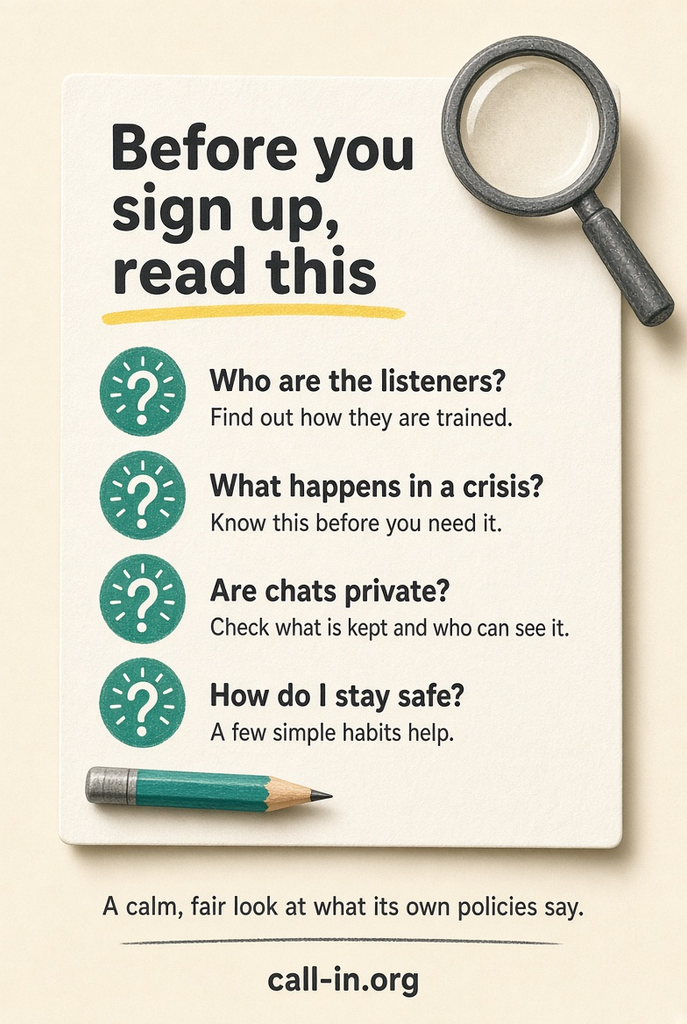
If you are thinking about signing up to 7 Cups, it makes sense to pause and ask whether it is safe. You might be about to share something very personal with a stranger, and you deserve to know who is on the other end and what happens to your words. That is not paranoia. It is good self-care.
This guide answers the question fairly, using what 7 Cups publishes about itself in its safety factsheet, terms of service, privacy policy and FAQ, plus public app store reviews. It is not a takedown. 7 Cups helps a great many people, and the aim here is simply to help you use it, or something else, with your eyes open.
Callin offers non-clinical emotional support. It is not therapy, counselling, diagnosis or crisis intervention, and it can sit alongside therapy rather than replace it. If you are in danger or thinking about ending your life, please call 999 or 112 (or your local emergency number), call Samaritans on 116 123 (UK and Ireland), call or text 988 (US), call Lifeline on 13 11 14 (Australia), or find a helpline in your country at findahelpline.com.
Key takeaways
- 7 Cups has a published set of safety systems, including reporting, automatic flags, trust scores, phone verification and anonymous “secret shopper” checks on listeners.
- 7 Cups listeners are trained volunteers, but its terms of service say it “does not verify the skills, degrees, qualifications, credentials or background” of listeners.
- 7 Cups is not a crisis service: its terms say listeners “are not trained or qualified to assist those in crisis” and that crisis chats will be ended.
- Chats are anonymous and contact details are blocked, but its privacy policy says transcripts may occasionally be reviewed for quality and safety, and aggregated data used for research.
- 7 Cups is open to people aged 13 and over, with extra teen safety measures, so adults and teens share the same wider platform.
- Public reviews are mixed: many people value it, while some users report slow, disengaged or unhelpful listeners.
- If you want ongoing support from the same trained person, a non-clinical service built around continuity, such as Callin, may suit you better.
Is 7 Cups safe to use?
7 Cups can be a reasonably safe place for anonymous, everyday emotional support, as long as you use it for what it is designed for and understand its limits. It has real safety systems, but it is a peer support platform run largely by volunteers, not a clinical or crisis service.
The most useful way to think about safety on 7 Cups is in three parts: who you are talking to, what happens if things go wrong, and what happens to your information. The sections below take each in turn, using 7 Cups’ own documents. For a broader look at how 7 Cups compares with other support, see our existing 7 Cups alternative guide.
What safety measures does 7 Cups have?
According to its Safety on 7 Cups factsheet, 7 Cups uses user reports, automatic phrase detection, risk and trust scores, human review and escalating sanctions to keep the platform safe. It also says it uses machine learning to monitor potentially unsafe language across the platform.
Here are some of the specific measures the factsheet lists:
- Members can review listeners, and anyone can block or flag another user in real time.
- Supervised volunteers review reports and sort them into green, yellow or orange, and red levels. Red flags, such as sexual content, harassment or hate speech, lead to immediate removal pending human review.
- Phone verification is required for members and listeners.
- Anonymous evaluations take place every week, a “secret shopper” style programme where testers chat with listeners and then give them feedback.
- Members cannot talk directly with other members, except in group settings; one-to-one chats are only with listeners.
- Pinned messages at the top of every chat remind you not to share personal details and link to crisis helplines.
That is a thoughtful set of protections for a platform of its size. It is also worth remembering that no reporting system can stop every unhelpful conversation in real time, which is why your own boundaries matter too.
Are 7 Cups listeners vetted?
7 Cups listeners complete an online active listening course, pass a test and practise with a training bot, but 7 Cups’ terms say it does not verify listeners’ skills, qualifications or backgrounds. In other words, listeners are trained volunteers, not checked professionals.
The 7 Cups FAQ explains that new listeners take an Active Listening course, pass a quiz, help a bot that acts like a depressed student, and take an oath to treat people with dignity and respect. They start with a low trust score and can join further training through the 7 Cups Academy. However, the terms of service state that “7 Cups does not verify the skills, degrees, qualifications, credentials or background of any Listeners,” and that listeners and therapists are not employees or agents of 7 Cups.
The terms say 7 Cups does verify the licences of its paid therapists, while adding that it does not guarantee that verification. If background checks matter to you, that is an important difference to know before you start. Our guide on why you might get a different listener every time explains how volunteer platforms are structured.
Is 7 Cups safe if you are in crisis?
No. 7 Cups says clearly that it is not for emergencies, and that its listeners are not trained or qualified to help people in crisis. Its terms state that “all crisis chats will be terminated immediately.”
The safety factsheet explains that new users must confirm they are not suicidal, homicidal or abusing anyone before using 7 Cups. If someone types language that suggests a crisis, that text is not passed to the listener; instead, the person is referred to 988 or another hotline. 7 Cups also keeps a crisis resources page. This is an honest boundary, and it mirrors how Callin works too: neither is a crisis service.
If you are in crisis, please contact emergency services or a crisis line straight away. In the UK and Ireland, Samaritans is free on 116 123, day or night.
Is 7 Cups private and anonymous?
7 Cups chats are anonymous by design, and contact details are blocked, but its privacy policy says chat transcripts may occasionally be reviewed and that aggregated data may be used for research and development. Advertising cookies are also used on the website, with consent in the UK and Europe.
The FAQ says listeners only know what you choose to tell them, and that phone numbers, emails and social media handles are blocked from being shared.
The privacy policy adds that while 7 Cups “generally” does not monitor chats, it may review transcripts to conduct quality control, address safety issues and prevent misuse, and may use aggregated chat data for research and development, while maintaining applicable confidentiality, HIPAA and privacy standards.
The privacy policy also explains that 7 Cups uses targeted advertising cookies to help keep services free, which in the UK, EEA and Switzerland require your explicit consent, and that these advertising features “are never used in any therapy interactions.” If privacy is a priority, it is worth reading your cookie choices carefully when you sign up.
Is 7 Cups safe for teenagers?
7 Cups accepts members aged 13 and over and has extra safety measures for teens, including additional checks for teen listeners. Its teen safety page explains these protocols.
Teen listeners face extra training and mock chats, and teens are encouraged to add a parent or guardian emergency contact. The Apple App Store also rates the app 13+. If you are an adult, it is worth knowing that you are joining a wider community that includes teenagers. Callin, by contrast, is for adults aged 18 and over only.
What do users say about 7 Cups?
Public reviews of 7 Cups are mixed: the app is rated 4.4 out of 5 on the US App Store, 4.0 on the UK App Store and 3.6 on Google Play, as checked on 16 November 2026. Many reviewers value the free, anonymous support, while some users report listeners who are slow, disengaged or quick to suggest therapy.
On the US App Store, the app had 4.4 stars from around 5,700 ratings; the UK App Store showed 4.0 from 564 ratings; and the Google Play listing showed 3.6 from around 22,300 reviews. One long-time member wrote that listeners used to “check up on you” but that some now take a long time to respond. Even a listener reviewing the app said there are listeners who are “slow with responses,” while praising the platform overall.
These are individual experiences, not proof of how every chat goes. But they echo a pattern you might notice yourself: the quality of a volunteer conversation can vary a lot from one person to the next.
How can you stay safe if you use 7 Cups?
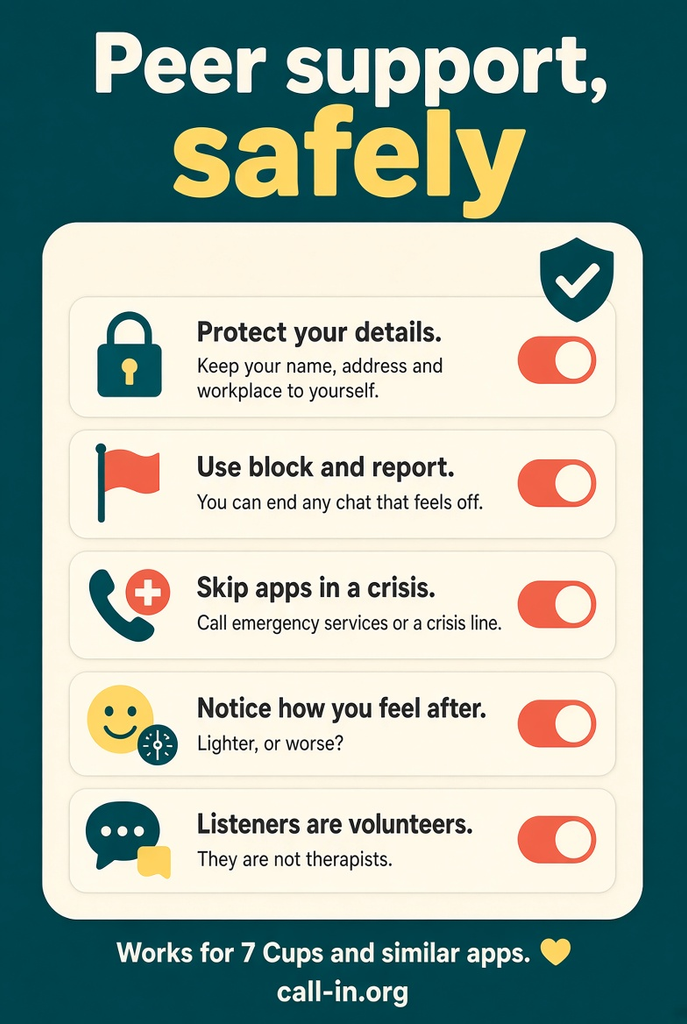
To stay safe on 7 Cups, protect your personal details, use the block and report tools, avoid using it in a crisis and notice how you feel after each chat. These simple habits make any peer support platform safer.
- Do not share your full name, address, workplace, phone number or social media handles.
- If a listener gives advice that feels judgemental, pushy or inappropriate, end the chat and report it.
- Choose listeners whose profiles and reviews you trust, and request them again if a chat goes well.
- Use a crisis line, not 7 Cups, if you feel unsafe or are thinking about harming yourself.
- If chats leave you feeling worse, or you keep retelling the same story, that is useful information about what you need.
If you are weighing 7 Cups against BuddyHelp, our BuddyHelp vs 7 Cups comparison looks at both side by side, and our guide to whether BuddyHelp is legit and safe applies the same questions to BuddyHelp.
What if you want something more consistent?
If you want to talk to the same trained person over time, with clear boundaries and no anonymous rotation, Callin may suit you better than a volunteer chat platform. Callin is a paid, non-clinical emotional support service for adults aged 18 and over.
Callin listeners complete mandatory Psychological First Aid training from Johns Hopkins University and are trained in active listening, working within clear boundaries and safeguarding frameworks. Through Human Continuity™, Callin prioritises keeping you with the same trained listener whenever possible, so your story builds instead of restarting. Callin is available 24/7 and sessions are booked in advance, so you can book at any hour, on Zoom or Google Meet, with private paid chat available on WhatsApp or Telegram.
Callin is run by Callin Support Ltd, registered in England and Wales, and is GDPR-compliant. If you are wondering whether paying for support is worthwhile, our guide on whether 7 Cups is worth paying for and our Callin pricing page can help you compare. When you are ready, eligible new clients can book a complimentary 20-minute first session, with no obligation to continue.
How we wrote this
We based every statement about 7 Cups on its own published pages, checked on 16 November 2026: the safety factsheet, teen safety page, terms of service (effective 20 February 2026), privacy policy, FAQ and crisis resources. App ratings come from the Apple App Store and Google Play on the same date, and user comments are presented as individual experiences. We are Callin, so we are not neutral, but we have tried to be fair and accurate.
Frequently asked questions
Is 7 Cups safe?
7 Cups has meaningful safety systems and can be a reasonably safe place for anonymous peer support, but its listeners are volunteers whose backgrounds are not verified, and it is not designed for crises.
Are 7 Cups listeners background checked?
No. 7 Cups’ terms of service say it does not verify listeners’ skills, qualifications, credentials or backgrounds, although listeners do complete its active listening training.
Can 7 Cups listeners see who I am?
Not unless you tell them. 7 Cups is anonymous by design and blocks the sharing of contact details such as phone numbers and social media handles.
Does 7 Cups read my chats?
7 Cups says it generally does not monitor chats, but may review transcripts for quality control, safety or misuse, and may use aggregated chat data for research.
Can I use 7 Cups if I’m suicidal?
No. 7 Cups says it is not for emergencies and ends crisis chats. Please call emergency services, Samaritans on 116 123, 988 in the US or a helpline at findahelpline.com.
What age do you have to be to use 7 Cups?
7 Cups is open to people aged 13 and over, with extra safety measures for teenagers.
Is there a safer alternative to 7 Cups for ongoing support?
If you want the same trained listener over time, Callin offers non-clinical emotional support for adults with trained listeners and Human Continuity™. It is not a crisis service. Eligible new clients can start with a complimentary 20-minute first session.
Ready to talk to someone who remembers you?
Free, anonymous chat can be a real lifeline on a hard night. If what you need now is steady support from a trained person who knows your story, book a session with Callin. Eligible new clients can start with a complimentary 20-minute first session.
For employers and institutions: if your people need consistent, human support, enquire about Callin for your organisation or a 3-month pilot.
Leave a Reply