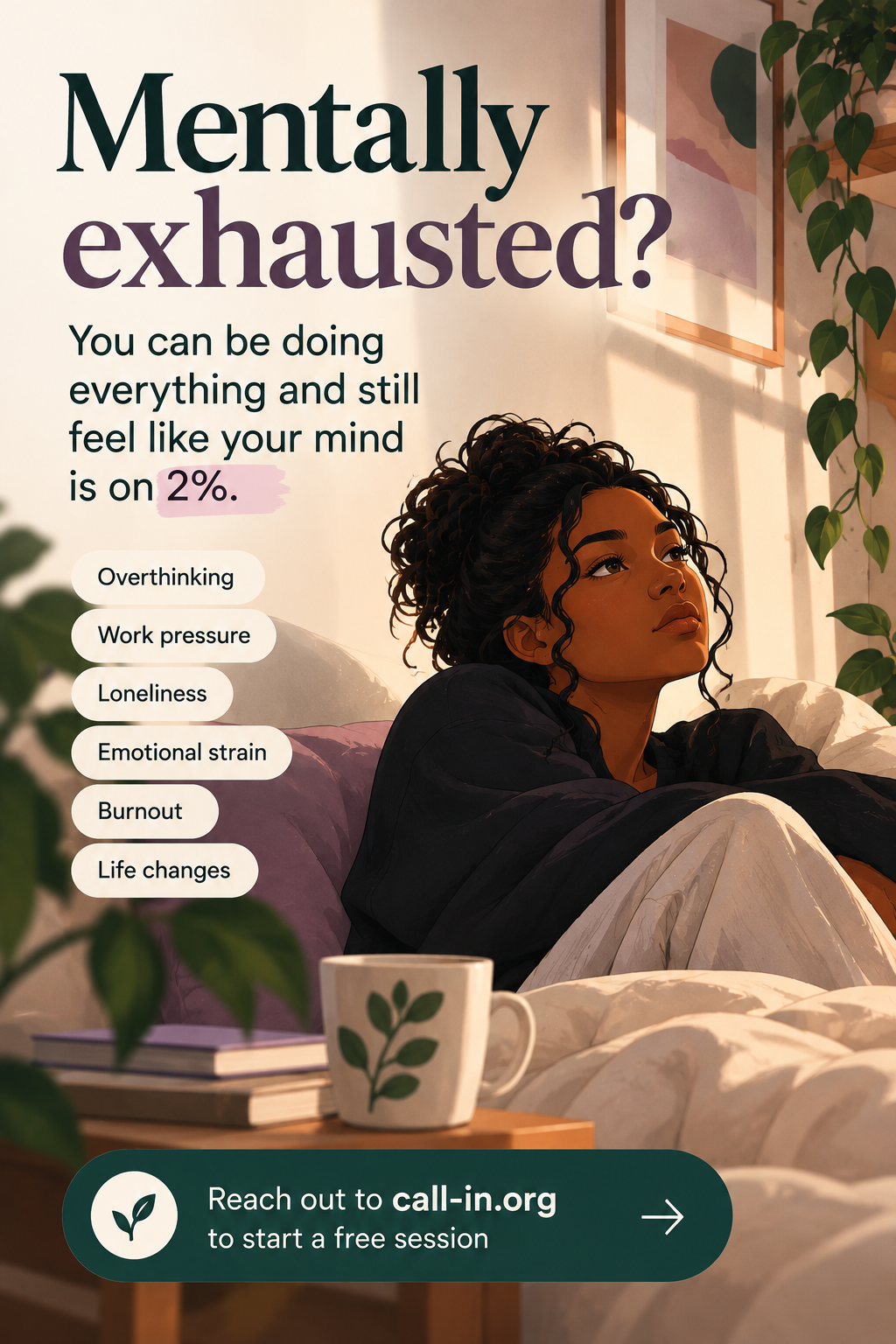
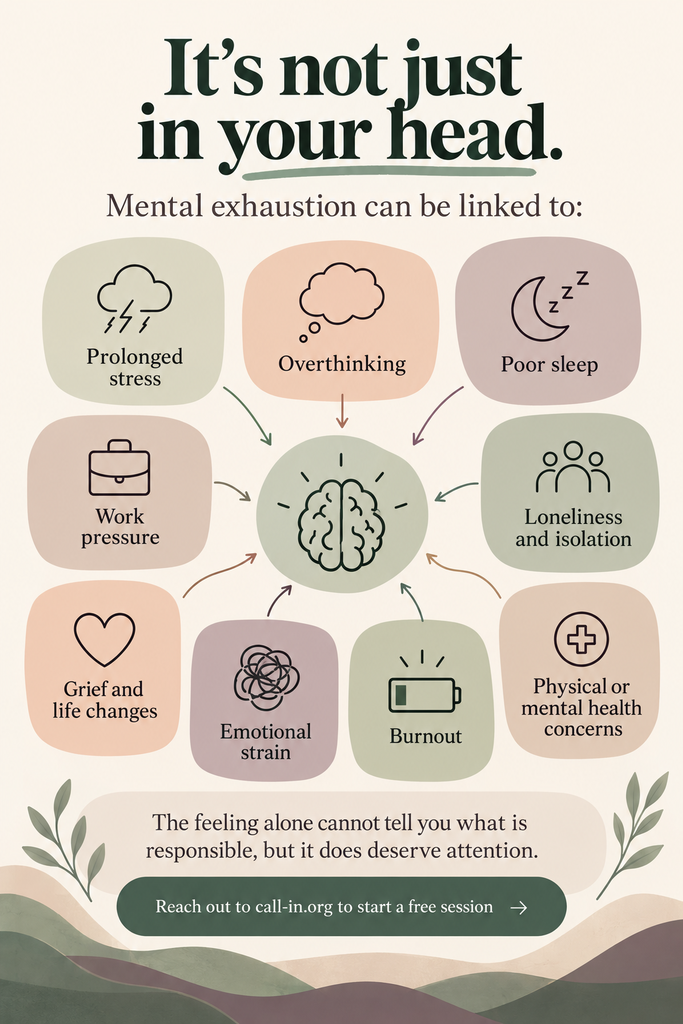
If you’re asking, “Why am I mentally exhausted?”, the answer may involve prolonged stress, overthinking, poor sleep, work pressure, loneliness, grief, emotional strain, burnout, or a physical or mental health concern. Mental exhaustion can leave you drained, irritable, numb, overwhelmed, or unable to enjoy things that normally matter to you.
You can still be going to work.
Attending classes.
Answering messages.
Looking perfectly functional from the outside.
And still feel as though your mind has been running on 2% battery for weeks.
If what you mainly need is somewhere to talk about what has been weighing on you, Callin offers confidential, one-to-one, non-clinical emotional support with trained human listeners. Callin is not therapy, diagnosis, medical care, psychiatric treatment, crisis support, or emergency care.
Sometimes you do not need an immediate label.
You need somewhere to start making sense of what you are carrying.
Key takeaways
- Mental exhaustion means feeling mentally or emotionally depleted. It is a description of an experience, not a diagnosis by itself.
- You can feel mentally exhausted even when you have not been physically busy. Worry, emotional strain, decision-making, overthinking, and hidden responsibilities all require mental energy.
- Burnout, anxiety, depression, grief, poor sleep, stress, and physical health conditions can all overlap with mental exhaustion. The feeling alone cannot tell you which one is responsible.
- Rest matters, but sometimes the conditions you return to after resting also need attention. Workload, relationships, loneliness, boundaries, and ongoing stress may all contribute.
- Persistent exhaustion deserves appropriate professional attention, especially if it affects your work, studies, sleep, relationships, or ability to manage everyday life.
- You do not automatically need therapy because you feel mentally exhausted. Some people need therapy or medical care, while others may benefit from practical changes, emotional support, rest, or several forms of support together.
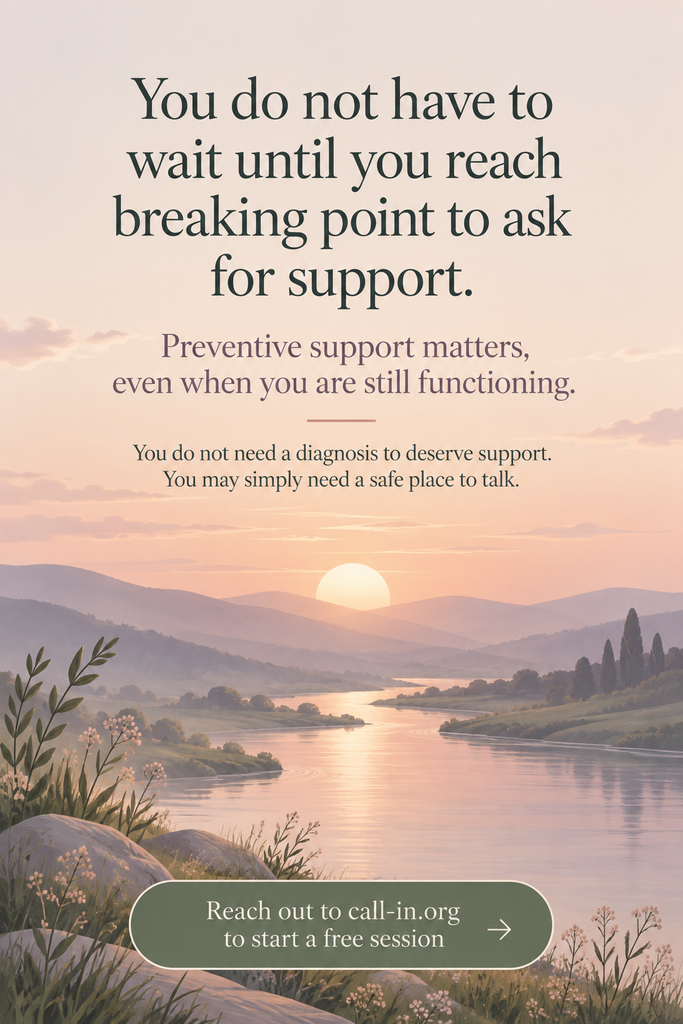
- You do not have to wait until you reach breaking point to ask for support. Preventive support matters while you are still functioning too.
What does mental exhaustion feel like?
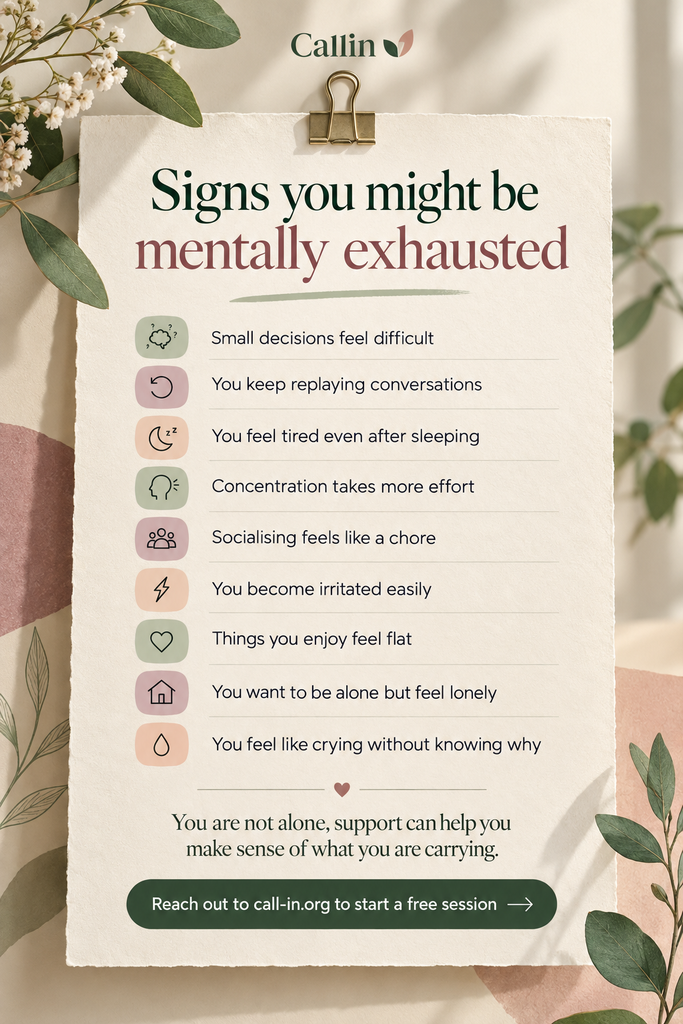
Mental exhaustion can feel like being mentally drained, emotionally depleted, unable to concentrate, easily irritated, overwhelmed by small decisions, or disconnected from things you usually enjoy.
Some people describe racing thoughts.
Others describe the opposite.
Their minds feel strangely blank.
You might notice:
- Small decisions suddenly feel difficult.
- You keep replaying conversations.
- You feel tired even after sleeping.
- Concentration takes more effort.
- Socialising feels like another responsibility.
- You become irritated more easily.
- Things you normally enjoy feel flat.
- You want to be alone but then feel lonely.
- You feel like crying without knowing exactly why.
- Your brain feels full even when you have done very little.
Stress can affect concentration, decision-making, sleep, emotions, and physical wellbeing.
But these experiences are not specific to stress.
Persistent or worsening symptoms deserve proper attention because emotional exhaustion can overlap with physical and mental health conditions.
Why am I mentally exhausted when I haven’t done anything?
You can feel mentally exhausted without doing much physically because thinking, worrying, anticipating problems, regulating emotions, and carrying unresolved concerns all require mental energy.
Your body may be sitting on the sofa.
Your mind, meanwhile, has opened an entire administrative department.
You are replaying yesterday’s conversation.
Wondering whether somebody is upset with you.
Calculating next month’s bills.
Thinking about the assignment you have not started.
Trying to make a relationship decision.
Planning everything that could possibly go wrong tomorrow.
And then asking yourself why you are tired.
Doing less physically does not necessarily mean carrying less emotionally.
However, persistent tiredness should not automatically be assumed to be emotional.
Sleep problems, anaemia, thyroid conditions, medication effects, and other health issues can also contribute.
If unexplained tiredness continues, significantly affects everyday life, or comes with other symptoms, speak with an appropriately qualified healthcare professional.
Can overthinking make you mentally exhausted?
Yes. Persistent overthinking can contribute to mental exhaustion because your brain repeatedly revisits questions, conversations, possibilities, and worries without necessarily reaching a resolution.
You think about what happened.
What might happen.
What somebody meant.
What you should have said.
What you will say next time.
Then your mind kindly schedules a follow-up meeting at 2 am.
Lovely.
The difficulty is that repeated thinking does not always produce additional clarity.
Sometimes you need more information.
Sometimes you need to make a decision.
Sometimes something is outside your control.
And sometimes you need permission to stop trying to settle every uncertainty before you rest.
Try asking:
Is there something useful I can do about this today, or am I repeatedly revisiting a question I cannot answer right now?
If action is possible, choose one manageable step.
If it is not, writing the worry down or talking it through with someone may help you put some distance between yourself and the loop.
Why do I feel mentally drained and overwhelmed all the time?
Feeling mentally drained and overwhelmed can happen when the demands in your life repeatedly exceed the time, energy, control, or emotional resources you have available.
Sometimes there is one obvious source.
Work.
University.
Parenting.
Caregiving.
Money.
A difficult relationship.
Grief.
A major life change.
Sometimes several smaller pressures have accumulated until ordinary tasks begin feeling unusually difficult.
This is why asking only, “How can I become more productive?” may miss the real issue.
A better question can be:
What is using most of my emotional and mental energy right now?
Once you can name the pressure, you have a better chance of deciding what kind of support or change may actually help.
Why do I feel sad or empty for no reason?
You can experience sadness, low mood, or emotional emptiness without being able to identify one obvious cause. Not knowing why you feel low does not make the feeling less real.
Sometimes several pressures have been building quietly.
Sometimes a disappointment affected you more deeply than you realised.
Sometimes you have been functioning for so long that you only notice the emotional cost once things become quieter.
You might wake up feeling low.
Complete your routine.
Go to work.
Talk to people.
Nothing catastrophic happens.
And still feel as though something is missing.
You may then start feeling guilty because you cannot justify the sadness.
But feelings do not become legitimate only after you can explain them.
You can acknowledge that you are struggling before you understand why.
Persistent low mood, hopelessness, loss of enjoyment, or difficulty functioning may need professional assessment.
Why do I feel emotionally numb and unlike myself?
Emotional numbness can feel like being disconnected from your emotions, relationships, interests, or usual sense of yourself. It can occur for several reasons, including stress, grief, depression, medication effects, and other health conditions.
You may still function.
You answer messages.
You work.
You smile when expected.
You laugh at the appropriate moment.
But internally, something feels distant.
Perhaps things that used to excite you no longer create much reaction.
You know you care about people.
You just cannot quite feel the connection in the same way.
There is no reliable way to identify the cause from emotional numbness alone.
If it is persistent, worsening, or occurring alongside low mood, withdrawal, or significant changes in your everyday life, consider speaking with a qualified healthcare or mental health professional.
Why do I feel lonely even when I’m surrounded by people?
You can feel lonely while surrounded by people because loneliness is not only about physical isolation. It can also involve lacking the closeness, understanding, or emotional safety you need.
You might have friends.
A partner.
Colleagues.
Family.
A group chat that apparently never sleeps.
And still feel as though nobody knows what is actually happening with you.
Maybe you are worried about being judged.
Maybe people give advice when you only want to talk.
Maybe everybody thinks you are doing wonderfully because you have become very good at looking as though you are.
Being surrounded by people is not the same as feeling understood.
A useful question is:
Do I need more people around me, or do I need somewhere I feel safer being honest?
For some people, the next step is reconnecting with an existing friend.
For others, it is joining a community, meeting new people, or finding someone outside their immediate circle to talk to.
Read more:
https://call-in.org/ws/what-can-i-do-when-i-feel-alone-and-have-no-one-to-talk-to/
Why am I always supporting everyone else when I’m struggling too?
Always being the strong person for everyone else can become emotionally exhausting when your own needs repeatedly receive less attention.
Perhaps you are the sensible friend.
The responsible sibling.
The problem-solving colleague.
The person everybody calls when something goes wrong.
You listen.
Reassure.
Encourage.
Fix.
Then you go home and realise you have nobody you feel comfortable calling.
There is nothing wrong with caring for other people.
The problem begins when everybody becomes accustomed to receiving your care while you become accustomed to hiding your own needs.
You can be dependable without being permanently available.
You can say:
“I don’t have the energy for this conversation today.”
You can ask somebody to listen without giving advice.
You can admit that you are having a difficult week.
Being dependable should not require becoming emotionally invisible.
Read more:
https://call-in.org/rs/being-the-strong-one-in-your-relationships-is-toxic/
Can grief, heartbreak, or disappointment make you mentally exhausted?
Yes. Grief, heartbreak, rejection, and major disappointment can require significant emotional energy and may leave you feeling mentally exhausted even while everyday life continues.
Loss does not only mean death.
People grieve relationships.
Friendships.
Jobs.
Opportunities.
Businesses.
Homes.
Identities.
Versions of their lives.
Futures they expected to have.
Perhaps something ended and everybody is already asking what you will do next.
You might be asking yourself the same question.
But sometimes the conversation you need is not yet about rebuilding.
Sometimes you need somewhere to say:
“I worked so hard for this, and I am devastated that it did not happen.”
You do not have to rush past disappointment to prove that you are resilient.
Why am I exhausted after sleeping?
Feeling exhausted after sleeping can be linked to poor-quality sleep, ongoing stress, anxiety, a sleep disorder, physical health conditions, or other underlying factors.
The number of hours you spend in bed does not always tell you how restorative your sleep was.
You may struggle to fall asleep because you are worrying.
Wake repeatedly.
Have difficulty switching off.
Or sleep for what seems like enough time and still wake feeling unrefreshed.
A consistent sleep routine, a calmer wind-down period, and reducing things that interfere with sleep may help some people.
But persistent exhaustion after adequate sleep should not automatically be blamed on stress.
A healthcare professional can help investigate possible causes.
Am I burned out, anxious, depressed, or just mentally tired?
Mental exhaustion can occur alongside burnout, anxiety, depression, grief, or ordinary periods of intense stress, but mental exhaustion alone cannot diagnose any of these conditions.
Burnout specifically relates to chronic workplace stress.
The World Health Organization describes burnout as an occupational phenomenon involving exhaustion, increased mental distance or negativity toward work, and reduced professional effectiveness.
Anxiety can involve persistent worry, feeling on edge, difficulty relaxing, sleep disruption, and physical symptoms.
Depression can involve persistent low mood, hopelessness, loss of interest or enjoyment, fatigue, and changes in sleep or concentration.
There can be overlap.
You can also be mentally exhausted without having a mental health disorder.
Online descriptions can help you recognise experiences.
They should not be used to diagnose yourself.
Do I need therapy if I’m mentally exhausted?
Not everyone who feels mentally exhausted automatically needs therapy. Therapy may be appropriate when you want psychological treatment, your distress is persistent or significant, or a mental health difficulty is affecting your everyday life.
Other forms of support may also be useful depending on what is happening.
You might need:
- Rest
- Better sleep
- Medical assessment
- Changes to your workload
- Stronger boundaries
- Relationship changes
- Practical help
- Community or social connection
- Career coaching
- Emotional support
- Therapy
- Several of these at the same time
The core question is:
What do I need this support to help me with?
If you need diagnosis, psychological treatment, medical care, or specialist mental health support, choose an appropriately qualified professional.
If you mainly need a confidential human conversation while you make sense of what you are carrying, non-clinical emotional support may be another option.
How do I recover from mental exhaustion?
Recovering from mental exhaustion usually begins with reducing unnecessary pressure, improving recovery where possible, identifying what is repeatedly draining you, and getting the kind of support that matches the cause.
There is no universal five-step cure.
If work is draining you, recovery may involve workload or boundary changes.
If loneliness is the problem, more sleep alone will not create connection.
If grief is exhausting you, productivity techniques may not address what you are carrying.
If poor sleep has a medical cause, emotional reflection will not replace medical care.
This is why understanding context matters.
Ask:
What keeps making me exhausted?
Not just:
How can I force myself to keep going?
What can I do when everything feels too much?
When everything feels too much, begin by reducing the immediate pressure and choosing one manageable next step rather than trying to solve your entire life at once.
- Start with what you know
You do not need the perfect explanation.
Try:
“I’m tired.”
“I’m worried about work.”
“I haven’t felt like myself.”
“I feel lonely.”
“I miss someone.”
That is enough to begin.
- Separate what needs action from what needs attention
Some problems need decisions.
Others need acknowledgment.
A bill may need a plan.
A workload may need a conversation.
Grief may need time and support.
Not every painful feeling needs to become another task.
- Make one thing smaller
Move one non-urgent responsibility.
Ask for help.
Request clarification.
Take a real break.
Set one boundary.
Small changes may not solve the cause, but they can create breathing room.
- Tell someone the unedited version
Sometimes the opening sentence can simply be:
“I’ve been feeling mentally exhausted, and I don’t really know what to do about it.”
You do not need to tidy the story first.
- Look at what keeps draining you
Rest is important.
So are the conditions waiting for you after the rest ends.
Sometimes the most useful question is not:
“How do I cope better?”
It is:
“What keeps making life so difficult to cope with?”
Where can I talk to someone when I’m mentally exhausted?
If you’re mentally exhausted and need someone to talk to, options can include a trusted person, peer support, community support, therapy, counselling, or a non-clinical emotional support service such as Callin.
The appropriate option depends on what you need.
Sometimes you want advice.
Sometimes you need clinical assessment or treatment.
Sometimes you want another human being to listen while you finally say everything that has been taking up space in your head.
That is the space Callin was created to offer.
Callin provides confidential, one-to-one, non-clinical emotional support with trained human listeners.
You can talk about:
- Mental exhaustion
- Stress
- Loneliness
- Grief
- Heartbreak
- Work pressure
- Difficult relationships
- Overthinking
- Life changes
- Feeling overwhelmed
- Things you simply do not know how to explain yet
You do not need to prepare a speech.
You do not need a diagnosis.
You do not need to know exactly where to begin.
Through Callin’s Human Continuity™ approach, we aim to keep you with the same dedicated listener wherever possible so you do not have to restart your story every time.
If speaking aloud feels difficult, private paid text support is also available.
Eligible new clients can begin with a free introductory session, with no obligation to continue.
Talk to someone at Callin:
https://tidycal.com/m4gyjln/callin-support-free-session
What if I need someone to talk to but don’t want therapy?
If you want someone to talk to but are not looking for psychological treatment, non-clinical emotional support may give you a confidential space to talk, reflect, and understand what is weighing on you.
Therapy and emotional support are not the same thing.
Therapy may involve psychological treatment and structured therapeutic work.
A listening service focuses on conversation, human connection, reflection, and emotional support without diagnosis or treatment.
Neither is automatically better.
The useful question is:
Do I need diagnosis or treatment, or do I mainly need somewhere safe to talk and work out what I think and feel?
Sometimes therapy is exactly the right answer.
Sometimes it is not what you are looking for.
And sometimes both can have a place.
How long does mental exhaustion last?
There is no fixed timeline for mental exhaustion because how long it lasts depends on what is causing it, how long the pressure has been present, and whether the underlying problem changes.
A demanding week may ease after proper rest.
Chronic workplace stress may continue while the conditions remain unchanged.
Grief has no standard timetable.
Persistent low mood or fatigue may need professional assessment.
Rather than asking only how long you should tolerate the feeling, pay attention to whether it is improving, staying the same, worsening, or interfering with your everyday life.
When should I seek professional help for mental exhaustion?
Seek professional health or mental health support if exhaustion, sadness, numbness, anxiety, or fatigue persists, worsens, or significantly interferes with daily life.
Consider professional assessment if:
- You are struggling to work, study, sleep, or manage everyday responsibilities.
- Low mood is persistent.
- You frequently feel hopeless or disconnected.
- You have ongoing unexplained fatigue.
- Anxiety or worry is becoming difficult to manage.
- You have significant changes in sleep, appetite, concentration, or functioning.
- Strategies that usually help are no longer helping.
- You are concerned that something physical may be contributing.
If you are in immediate danger, believe you may harm yourself or somebody else, or cannot keep yourself safe, contact emergency or crisis services where you live.
Find A Helpline:
https://findahelpline.com/
Callin is not a crisis or emergency service.
Frequently asked questions about mental exhaustion
Can overthinking make you mentally exhausted?
Yes. Persistent worry and repetitive thinking can contribute to feeling mentally drained, especially when they interfere with sleep, relaxation, concentration, or decision-making.
Why do I feel exhausted after talking to people?
Social interaction can feel draining when you are already stressed, emotionally overwhelmed, anxious, masking how you feel, or using significant energy to manage other people’s expectations.
Why have I lost my spark?
Loss of enthusiasm can occur with stress, poor sleep, grief, burnout, life changes, depression, and other health concerns. If it persists or significantly affects your life, consider professional assessment.
Is it normal to feel sad when nothing bad has happened?
Low mood can occur without one obvious trigger. Persistent sadness, hopelessness, or loss of enjoyment deserves attention even when you cannot identify a specific cause.
Do I need therapy if I’m mentally exhausted?
Not necessarily. Some people need therapy or medical assessment, while others may benefit from rest, practical changes, emotional support, stronger boundaries, social connection, or another form of help.
Can talking to someone help when I feel overwhelmed?
Talking can help some people express what they are carrying, organise their thoughts, feel supported, and consider possible next steps. It may be one part of a wider support system rather than a solution to every underlying problem.
Is Callin therapy?
No. Callin provides confidential, one-to-one, non-clinical emotional support with trained human listeners. It does not diagnose or treat mental health conditions and does not replace therapy, medical care, psychiatric treatment, or crisis services.
You don’t have to carry everything in your head
Perhaps you have spent so long being reliable that nobody has noticed how tired you are.
Perhaps you are surrounded by people and still feel alone.
Perhaps you have been trying to manage your thoughts, keep working, stay productive, support everybody else, and convince yourself that you are fine.
That is a lot to carry.
You do not have to wait until you reach breaking point before taking your wellbeing seriously.
Sometimes support begins with a diagnosis or treatment.
Sometimes it begins with changing the conditions making life difficult.
And sometimes it begins with one honest sentence:
“I’m exhausted, and I need someone to talk to.”
Callin gives you somewhere to have that conversation with a trained human listener.
Eligible new clients can begin with a free first session, with no obligation to continue.
Talk things through with Callin:
https://call-in.org/emotional-support-when-i-dont-need-therapy/
Callin. Breathe out. Feel heard.
Sources and further reading
World Health Organization: Burn-out as an occupational phenomenon
https://www.who.int/standards/classifications/frequently-asked-questions/burn-out-an-occupational-phenomenon
NHS: Stress
https://www.nhs.uk/mental-health/feelings-symptoms-behaviours/feelings-and-symptoms/stress/
NHS: Tiredness and fatigue
https://www.nhs.uk/symptoms/tiredness-and-fatigue/
NHS: Anxiety, fear and panic
https://www.nhs.uk/mental-health/feelings-symptoms-behaviours/feelings-and-symptoms/anxiety-fear-panic/
NHS: Low mood, sadness and depression
https://www.nhs.uk/mental-health/feelings-symptoms-behaviours/feelings-and-symptoms/low-mood-sadness-depression/
Find A Helpline
https://findahelpline.com/

Leave a Reply