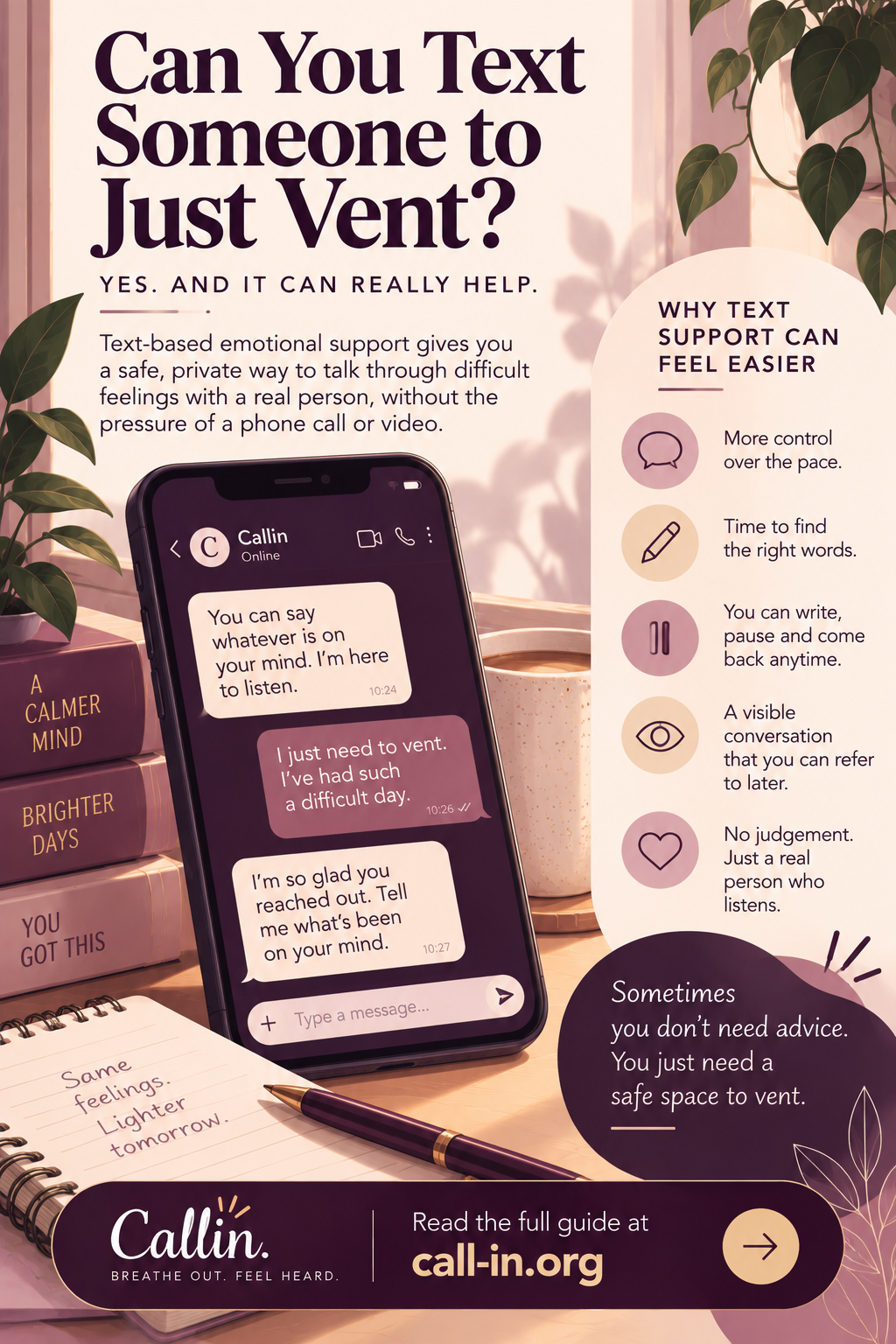
Sometimes you do not need advice. You do not need someone to diagnose what is happening, and you may not even want a phone call.
You may simply be thinking, “i just need to talk to a real person.”
Yes, you can text someone to just vent. Non-formal mental health support: something that is not therapy, but not talking with people that you know. Text-based emotional support gives you a way to talk through difficult feelings with another person without the pressure of speaking on the phone or appearing on video.
At Callin, we understand that for some people, writing feels easier than talking. It gives you a moment to find the words, say what you actually mean, and return to the conversation when you need to. You can learn more of Callin Chats here.
Key takeaways
- You can use text-based services to talk with a real person when you need to vent without making a phone call.
- Text support can feel less demanding when speaking aloud feels uncomfortable or overwhelming.
- Privacy matters, so check how a service handles messages, personal information, and account security.
- Human listeners can offer something different from automated AI responses, particularly when continuity matters.
- Non-clinical emotional support is different from crisis support, emergency services, therapy, and medical care.
Why can a text someone to vent service feel easier than calling?
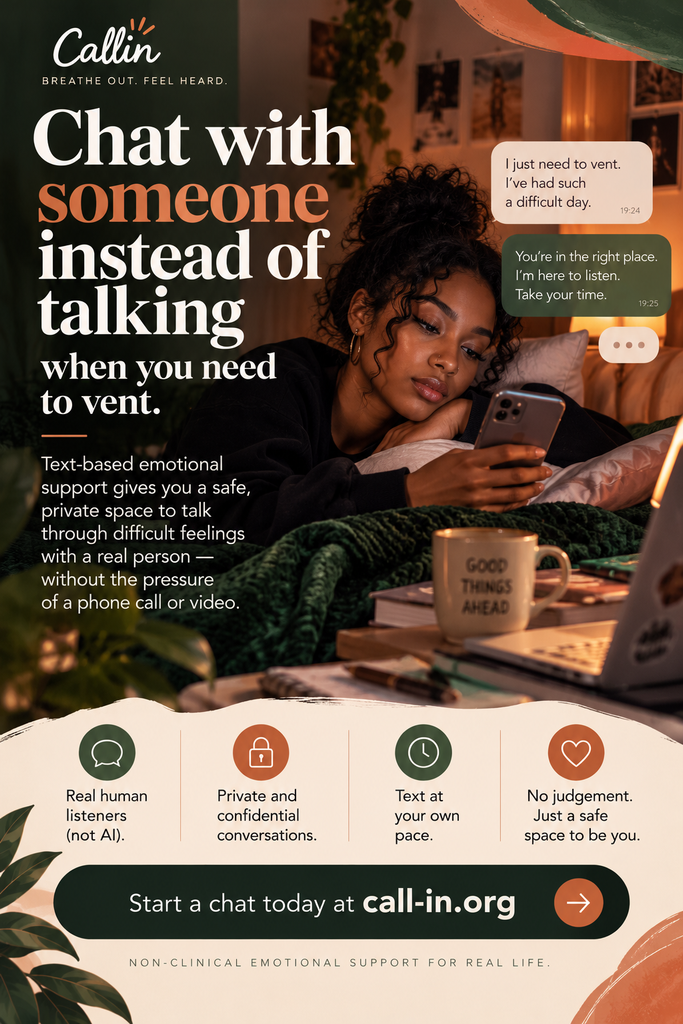
A phone call requires you to respond immediately.
That can be difficult when you are already anxious, upset, tired, or unsure about what you want to say. You may worry about awkward silences, becoming emotional, losing your train of thought, or having to explain yourself perfectly.
Texting gives you more control over the pace.
You can write a sentence and pause. You can think about what you mean before sending it. You can explain something in several messages instead of trying to organise the entire story in your head before you speak.
For someone searching for how to vent to a stranger without calling, this difference can be significant.
Text-based support also creates a visible conversation. You can read what you previously said, see how the conversation developed, and return to something that was discussed earlier.
That continuity can be useful when your thoughts feel scattered.
What if I do not know what to say?
You do not need a perfectly organised explanation.
You can start with something as simple as, “I have had a terrible day and I need somewhere to put it.” You could also say, “I do not really know what I need, but I need to talk.”
A good listener does not need you to arrive with a presentation prepared.
The purpose of non-clinical listening is not to turn your feelings into a diagnosis. It is to give you room to talk, think, and be heard.
If you want to understand more about what supportive listening actually looks like, see our guide to how active listening can help you feel heard without judgment.
Where can you find safe places to vent online by text?
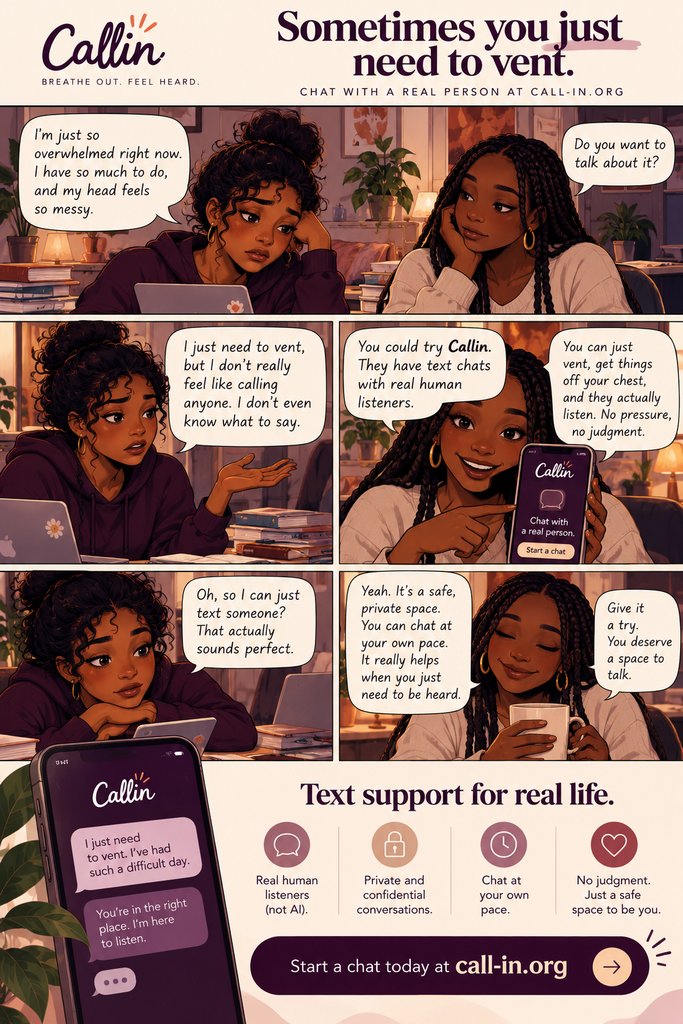
If you are searching for safe places to vent online text, look beyond whether a service simply has a chat box.
Consider who you are actually talking to. Consider whether the service uses trained human listeners, how it handles personal information, whether conversations are private, and whether it clearly explains what the service can and cannot provide.
Public forums are different from private support conversations.
A public post can potentially be seen, copied, quoted, or shared by people you do not know. Even when a community is supportive, you may not know who is reading your post or how long the information will remain available.
Private messaging can reduce that exposure, but private does not automatically mean completely anonymous or risk-free.
That is why the service’s privacy practices matter.
For a broader look at what makes a private emotional support environment useful, read Looking for a Safe Space to Vent Online? Why Holding It In Is Draining You.
How private are messaging platforms such as WhatsApp and Telegram?
Messaging platforms can provide security features that make private conversations substantially different from posting personal experiences in a public forum.
WhatsApp states that personal messages and calls are protected by end-to-end encryption. It also provides additional account-security features such as two-step verification and security notifications.
Telegram requires a little more care when discussing encryption. Telegram distinguishes between Cloud Chats and Secret Chats, with end-to-end encryption specifically applying to Secret Chats.
That distinction matters.
Do not assume that every message on every platform has exactly the same privacy protections. If you are discussing sensitive personal information, check the platform’s current privacy and security settings and understand what type of conversation you are using.
What should you check before using a private text support service?
A few practical questions can tell you a lot about a service.
First, check whether you are communicating with a human or an automated system. Then look for a clear privacy policy explaining what information is collected and how it is handled.
It is also worth checking whether the service explains its boundaries. A responsible non-clinical support service should make clear that it is not a replacement for emergency services, crisis intervention, therapy, diagnosis, or medical care.
Finally, consider continuity.
If you have to explain the same situation from the beginning every time you return, the experience can become tiring. A service that allows meaningful continuity may feel more natural for someone who wants ongoing emotional support.
What are private text lines for emotional support?
Private text lines for emotional support are services that allow people to communicate about everyday emotional and life challenges through messaging.
The phrase can describe different types of services, so it is worth checking exactly what a provider means by emotional support.
Some services focus on crisis intervention. Others provide non-clinical listening for situations such as stress, loneliness, relationship difficulties, work pressure, overthinking, or feeling overwhelmed.
These are not interchangeable forms of support.
A crisis service exists to respond to urgent situations. A non-clinical listening service is intended for conversations that do not require emergency intervention or clinical treatment.
Knowing the difference helps you choose the right type of support rather than expecting one service to do everything.
If you want to explore that distinction in more detail, see What is a Warmline? 5 Key Differences Between Crisis Lines and Peer Support.
What is the problem with apps where you can text real people to vent?
Searching for apps where you can text real people to vent can produce a wide range of results.
Some services connect people with volunteers. Some use professional therapists. Some use artificial intelligence. Others combine several approaches.
There is nothing inherently wrong with any one model, but they provide different experiences.
An AI chatbot can respond immediately and may be useful for brainstorming, information, or general conversation. But an automated response is not the same thing as a conversation with a human listener.
For someone who is specifically thinking, “i just need to talk to a real person,” that distinction can be the entire reason they are searching in the first place.
Why does human continuity matter?
Imagine telling someone the same story three times.
The first time, you explain what happened. The second time, you explain the background. The third time, you are already tired of hearing yourself explain it.
That is one reason continuity can matter in emotional support.
When the same trained listener is available over time, the conversation can build context. You can spend less time reconstructing the history and more time talking about what is happening now.
Continuity does not mean a listener knows everything about you. It means the support experience does not have to feel completely disconnected from one conversation to the next.
For some people, that makes human support feel more personal and less transactional.
Callin explores this idea in more detail in Where Can I Find Ongoing Online Emotional Support From the Same Person?.
Is talking to a human better than talking to AI?
Not necessarily in every situation.
AI can be convenient, available at any hour, and useful for certain types of questions. It can help someone organise thoughts, generate ideas, or find information.
But convenience and human connection are different things.
If your main need is to be listened to by another person, an AI response may not satisfy that need. A human listener can respond to the emotional context of what you are saying, ask a thoughtful question, or simply give you space to continue.
The important question is not whether humans or AI are universally better. It is what kind of support are you actually looking for?
Callin has also explored the question of whether people need someone to talk to rather than an AI response in I Need Someone to Talk to Instead of AI.
Can you chat with a real person online without calling?
Yes.
If you are looking for a chat with a real person online free alternative, you may find services that offer text-based conversations rather than voice or video calls.
The details vary. Some services are free, some operate through memberships or paid sessions, and some offer a mixture of free and paid support.
Before choosing one, look at the service model rather than assuming that free automatically means better.
A service that offers trained human listeners, privacy information, clear boundaries, and continuity may provide a very different experience from an anonymous public forum or automated chatbot.
What should you look for when choosing someone to text when you need to vent?
If you are searching for someone to text when you need to vent, there are a few useful questions to ask before sharing personal information.
Is there a real person on the other side?
If human conversation is what you are looking for, check that the service actually provides human listening rather than presenting an AI chatbot as though it were a person.
Is the support non-clinical or clinical?
Make sure the service matches what you need. Non-clinical listening is different from therapy, psychiatric care, crisis intervention, and emergency services.
Does the service explain its privacy practices?
Look for a clear privacy policy. Understand what information is collected, how your messages are handled, and what account or platform information may be retained.
Can you return to the same person?
If continuity matters to you, find out whether you can continue with the same listener. Starting from zero every time is not necessarily the best fit for everyone.
Does the service know its limits?
A trustworthy service should tell you what it can provide and when another form of support is more appropriate.
Those questions are more useful than simply asking whether an app has a chat function.
When might text-based emotional support be a good fit?
Text support can make sense when you want to talk but do not want a phone or video conversation.
It may also suit you if writing helps you express yourself more clearly, if you are uncomfortable speaking aloud about something personal, or if you want time to think before responding.
It can be particularly useful for everyday experiences such as loneliness, work stress, relationship difficulties, university pressure, career uncertainty, or feeling overwhelmed.
It is not a universal solution.
Some situations call for professional mental health care. Urgent situations require crisis or emergency support. The purpose of non-clinical listening is to provide another option for people who need a human conversation but are not seeking clinical treatment.
Who can you text when you just need to vent?
There is no single right answer.
You might text a trusted friend. You might use a non-clinical listening service. You might speak with a therapist when the situation calls for clinical support. Or you might need urgent crisis or emergency assistance.
The important thing is recognising that these options serve different purposes.
If you simply want somewhere to talk without burdening the people closest to you, you may find our guide to What To Do When You Need To Vent, But Not Therapy useful.
Where does Callin fit?
Callin is designed for people who want human, non-clinical emotional support without having to turn every difficult day into a formal clinical appointment.
The service provides a confidential space to talk through everyday emotional and life challenges with trained human listeners. That can include stress, loneliness, burnout, overthinking, relationship difficulties, breakups, career uncertainty, university pressure, and feeling overwhelmed.
One of the ideas behind Callin is continuity.
Where operationally possible, you can continue speaking with the same listener rather than repeatedly explaining your story to a completely new person. That does not turn the listener into a therapist or make Callin a clinical service.
It simply recognises that human conversations often work better when there is some context from one conversation to the next.
For someone searching for text someone to vent, that difference can matter.
You may not need someone to fix the situation. You may simply want a private place to say what happened, work through what you are feeling, and hear another human response.
Callin sits in that space between handling everything alone, relying entirely on friends or family, and seeking clinical care.
You do not have to turn every difficult feeling into a crisis
There is a strange pressure around emotional support.
Sometimes people think they need to be in a severe enough situation before they are allowed to talk to someone. They wait until the stress is unbearable, the loneliness is overwhelming, or the problem has become impossible to ignore.
But talking to someone does not have to be an emergency decision.
You can want company while thinking through a difficult situation. You can want to vent after a frustrating day. You can feel emotionally overloaded without needing to label the experience as a disorder.
Sometimes the useful thing is simply having somewhere to put the thoughts.
FAQs
Is there someone I can text when I need to vent?
Yes. Some services provide text-based conversations with trained human listeners for non-clinical emotional support. You can also reach out to someone you trust personally, depending on your circumstances and what feels safe.
How can I vent to a stranger without calling?
Look for a text-based emotional support service that clearly states it provides human listening. This allows you to communicate through written messages instead of speaking on the phone or joining a video call.
Are private text lines for emotional support the same as crisis hotlines?
No. They can serve different purposes. Non-clinical emotional support is generally intended for everyday emotional and life challenges, while crisis services are designed for urgent or high-risk situations.
Is texting more private than posting on a public forum?
A private messaging conversation is generally different from posting personal information publicly, but privacy depends on the platform and service. Check the provider’s privacy policy, security features, account settings, and how messages are stored before sharing sensitive information.
Is WhatsApp private enough for emotional support?
WhatsApp states that personal messages are protected by end-to-end encryption by default. However, privacy also depends on account security, device security, backups, and what information you choose to share.
Are Telegram messages end-to-end encrypted?
Telegram distinguishes between Cloud Chats and Secret Chats. Its Secret Chats use end-to-end encryption, while ordinary Cloud Chats use client-server and server-client encryption.
Can Callin replace therapy or crisis support?
No. Callin provides non-clinical emotional support and does not replace therapy, diagnosis, psychiatric care, medical care, emergency services, or crisis support. If you are in immediate danger or need urgent assistance, use the appropriate local emergency or crisis service.
How this connects to the UNSDGs
This article connects most directly with UN Sustainable Development Goal 3, Good Health and Well-Being.
Access to appropriate emotional support can form part of a broader approach to wellbeing, particularly when people have somewhere to discuss everyday stress, loneliness, overwhelm, and life challenges before deciding what kind of support they need.
Callin’s role is non-clinical, so it should be understood as one option within a wider ecosystem of personal, community, professional, and emergency support.
Sources and further reading
World Health Organization, Social Connection: Current information on social connection, social isolation, and loneliness.
WhatsApp Help Center: Information about encryption and account security.
Telegram Privacy Policy: Information about Cloud Chats, Secret Chats, and encryption.
If you want a private conversation with a real person without turning it into something clinical, Callin offers non-clinical human listening for the moments when you simply need somewhere to talk.

Leave a Reply