
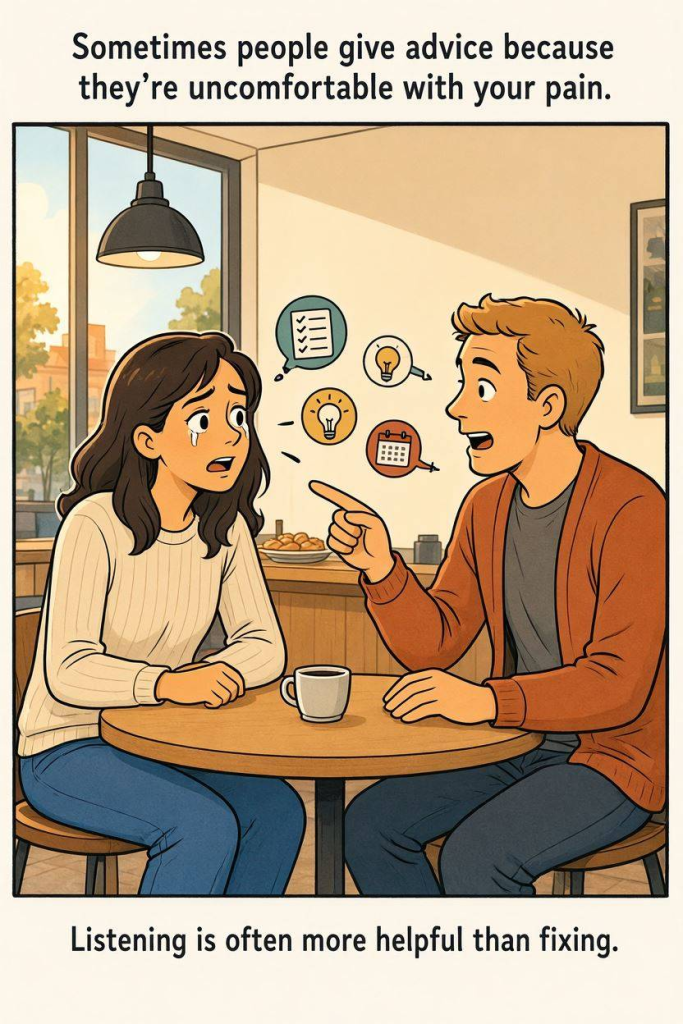
People give unsolicited advice when you want to vent because of something psychologists call the righting reflex, an automatic urge to fix distress rather than sit with it. It is not a sign they do not care about you. Understanding what actually drives unsolicited advice can help you ask for the kind of listening you need, so you feel heard instead of handled.
Key Takeaways
- Unsolicited advice is usually a self-soothing reflex for the listener, not a judgment of you or your ability to solve your own problems.
- Venting and advice-giving serve two different psychological goals, which is why the two people in the conversation often feel like they are talking past each other.
- Saying your feelings out loud, a process researchers call affect labeling, appears to calm the brain’s stress response even before anyone offers a solution.
- Advice can unintentionally undermine your sense of autonomy, one of the core psychological needs identified in self-determination theory.
- A short, specific request at the start of a conversation, sometimes called pre-framing, removes most of the guesswork that leads to unwanted problem-solving.
The Righting Reflex: Why Advice Feels Automatic, Not Malicious

When someone you trust tells you they had a brutal day at work or a painful conversation with a partner, your nervous system reacts too. Watching someone you care about struggle creates a small, real spike of discomfort in the listener’s own body.
Psychologists refer to the urge to immediately resolve that discomfort as the righting reflex, a term that originated in motivational interviewing research and has since become shorthand across counseling and coaching literature for the impulse to correct, fix, or redirect.
The listener is not choosing between comforting you and dismissing you. In their mind, those two things feel like the same act. Offering a solution lets them believe they have done their job as a friend, partner, or parent, even though what actually helped you was never the solution itself.
Why Advice-Giving Can Feel Like a Status Move
Here is an idea worth sitting with: unsolicited advice sometimes carries a quiet, unintentional message of “I know something you don’t.” Even well-meaning people can shift a conversation’s balance this way without realizing it, turning a moment of shared vulnerability into a subtle demonstration of competence.
This does not mean advice-givers are arrogant. It simply means that fixing a problem is a more visible, more measurable form of care than the harder, quieter work of just staying present. If you have ever stopped talking about your problems with people who clearly care about you, this dynamic may be part of why.
Venting vs. Problem-Solving: Two Different Conversational Goals
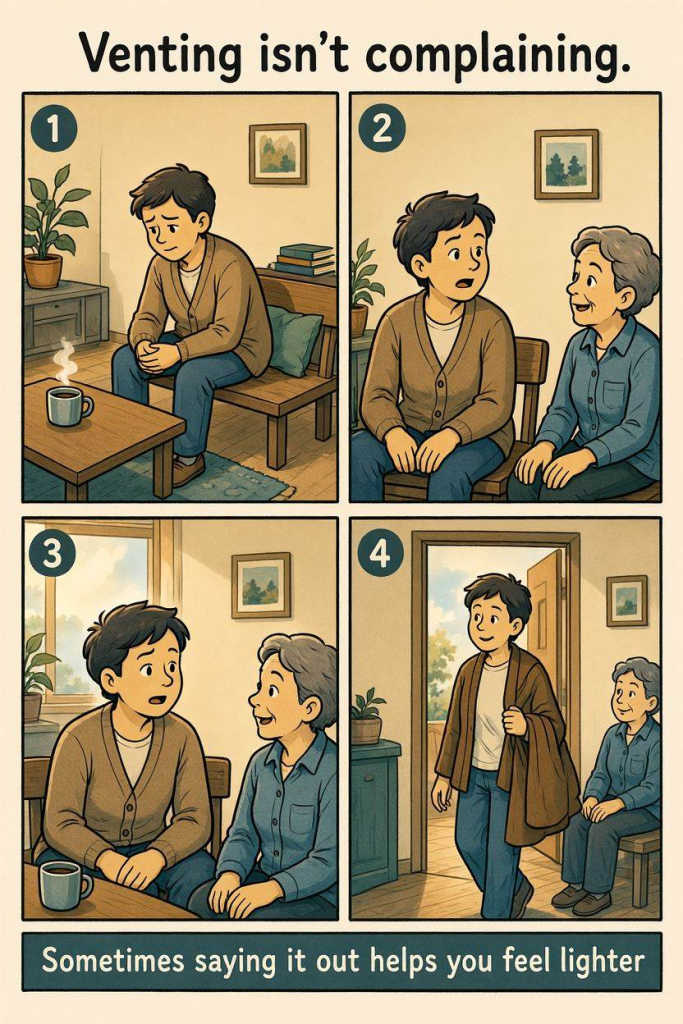
When you vent, your goal is emotional processing. You are trying to untangle a complicated experience, lower your stress response, and hear your own thoughts organized out loud.
The listener, meanwhile, is often operating from an entirely different goal: identifying the problem and resolving it as quickly as possible.
This is not a conflict of values. It is a mismatch of frameworks. You are looking for a companion to sit with you in an unresolved moment. They are trying to build you an exit.
Neither approach is wrong on its own, but when they collide in the same conversation, the person venting usually walks away feeling rushed, judged, or strangely more alone than before they started talking.
What Venting Actually Does for Your Brain
There is real research behind why simply talking helps, even without a single piece of advice. A well-known UCLA neuroscience study on affect labeling found that putting an emotion into words, such as saying “I feel humiliated” instead of just feeling it, reduces activity in the amygdala, the brain’s threat-detection center.
In plain terms, naming your experience out loud appears to help your nervous system downshift out of distress. This is one reason venting can feel physically calming even when nothing about the situation has changed. It also explains why to vent without needing therapy is such a common and valid experience. You are not seeking treatment. You are regulating a normal human stress response.
Advice interrupts this process before it finishes. If a solution arrives halfway through your sentence, your brain never gets to complete the labeling and release that venting is designed to provide.
Why Holding Space Is Harder Than It Looks
Sitting with someone else’s unresolved pain, without trying to organize it into a fixable shape, takes real emotional effort.
It asks the listener to tolerate ambiguity, manage their own anxiety, and accept that some problems do not have a clean answer available in the next five minutes.
Many people have simply never been shown how to do this, especially in cultures that prize efficiency and output.
That may explain why productivity-driven habits create so much background anxiety in the first place: when speed and resolution become the default measure of a “good” response, silence starts to feel like failure, even when silence is exactly what is needed.
Giving advice is, in a sense, a shortcut around this discomfort. It moves the conversation from the emotional to the intellectual, which is a safer, more familiar place for many listeners to stand.
Autonomy, Not Just Comfort, Is What Advice Can Threaten
Self-determination theory, a well-established framework in motivational psychology, identifies three core psychological needs: competence, relatedness, and autonomy.
Unsolicited advice can quietly threaten that third need. Even a helpful suggestion implies that you have not already thought it through, which can feel like a small vote of no confidence in your own judgment.
This is often why advice triggers a flash of irritation that seems disproportionate to the moment. You are not annoyed at the suggestion itself. You are protecting your sense of ownership over your own life.
How to Ask for What You Actually Need
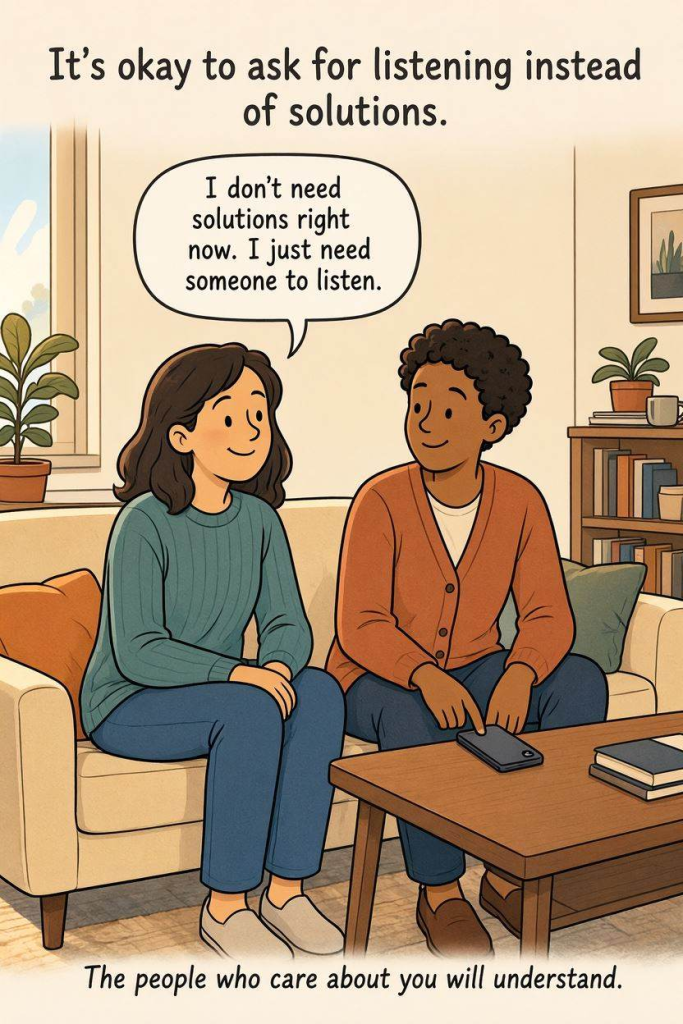
Because the righting reflex is automatic rather than intentional, you can often prevent it simply by naming the kind of conversation you want before you start. This is sometimes called pre-framing, and it works because it gives the listener a clear, achievable goal instead of an ambiguous one.
Simple Scripts That Signal “I Just Need to Vent”
Try a direct, low-pressure opener such as, “I don’t need solutions right now, I just need to get this out loud.” Or, “I already know what I’m going to do, I just need you to listen for a few minutes.”
These short scripts remove the guesswork and quietly tell the listener that silence and attention, not answers, are what a successful conversation looks like this time.
Asking for this kind of listening is not selfish, even though it can feel that way at first. It is a form of setting a boundary without feeling like a bad person, and it is a normal, healthy request. Many people carry unnecessary guilt about needing emotional support at all, when in reality, needing to be heard is one of the most ordinary human needs there is.
When You Don’t Have Anyone Who Can Just Listen

Sometimes the honest answer is that the people around you love you, but they are not equipped, or not currently available, to hold space the way you need in that moment.
That is not a reflection of your relationships failing. It is simply a gap that safe, structured space to vent</a> can fill without asking anything of the people already carrying their own stress.
This is often where trained, non-clinical listening comes in. At Callin, peer listeners are trained specifically to practice active listening rather than problem-solving, so you can process a hard day, a difficult relationship, or a swirl of unfinished thoughts without worrying about burdening a friend, a partner, or a coworker, or receiving advice you never asked for.
Frequently Asked Questions
Is venting actually good for you, or does it just make you feel worse?
Venting itself is not harmful. Research on affect labeling suggests that putting feelings into words can genuinely lower physiological stress. Venting only tends to backfire when it becomes repetitive complaining with no emotional movement, sometimes called co-rumination, rather than a single moment of honest processing.
Why do I feel guilty for asking someone to just listen?
Many people were raised to believe that needing emotional support is a burden on others. In reality, <a href=”https://call-in.org/rs/benefits-of-consistent-emotional-support/”>consistent emotional support</a> is linked to better stress regulation and stronger relationships, and asking clearly for what you need is far kinder to a relationship than silently resenting the wrong kind of response.
What is the difference between a warmline and a crisis line?
A crisis line is designed for acute, safety-related emergencies. <a href=”https://call-in.org/ws/what-is-a-warmline-crisis-line-vs-peer-support/”>A warmline, by contrast, is for everyday emotional support</a>, such as loneliness, stress, or needing to talk something through before it becomes a crisis at all.
How do I stop myself from giving unsolicited advice to other people?
Try asking a simple question before offering a solution, such as, “Do you want me to just listen, or would it help to brainstorm together?” This single question respects the other person’s autonomy and removes the guesswork the righting reflex usually fills in on its own.
Why does venting to some people feel better than venting to others?
It often comes down to perceived responsiveness, a concept from relationship science describing how understood, validated, and cared for you feel in the moment. Some listeners naturally create that feeling. Others, even with good intentions, unintentionally shift the conversation toward fixing instead of feeling.
Is it selfish to tell someone you don’t want advice?
No. It is a clear, respectful boundary that helps the other person succeed at supporting you. Most people would rather know exactly what you need than guess incorrectly and unintentionally leave you feeling dismissed.
What can I do if I don’t have anyone available to just listen right now?
A structured, non-clinical option such as <a href=”https://call-in.org/rs/vent-to-someone-emotional-support/”>talking to someone trained in emotional support</a> can help you process the moment without waiting for a friend’s schedule to open up or worrying about how much you are asking of them.
The frustration of being met with advice when all you wanted was to be heard is not a flaw in your relationships. It is a predictable, well-documented gap between two very different conversational goals. Once you understand the righting reflex for what it is, an automatic, caring, if slightly misdirected impulse, you can start asking for the kind of listening that actually helps, and give yourself permission to simply be heard.

Leave a Reply