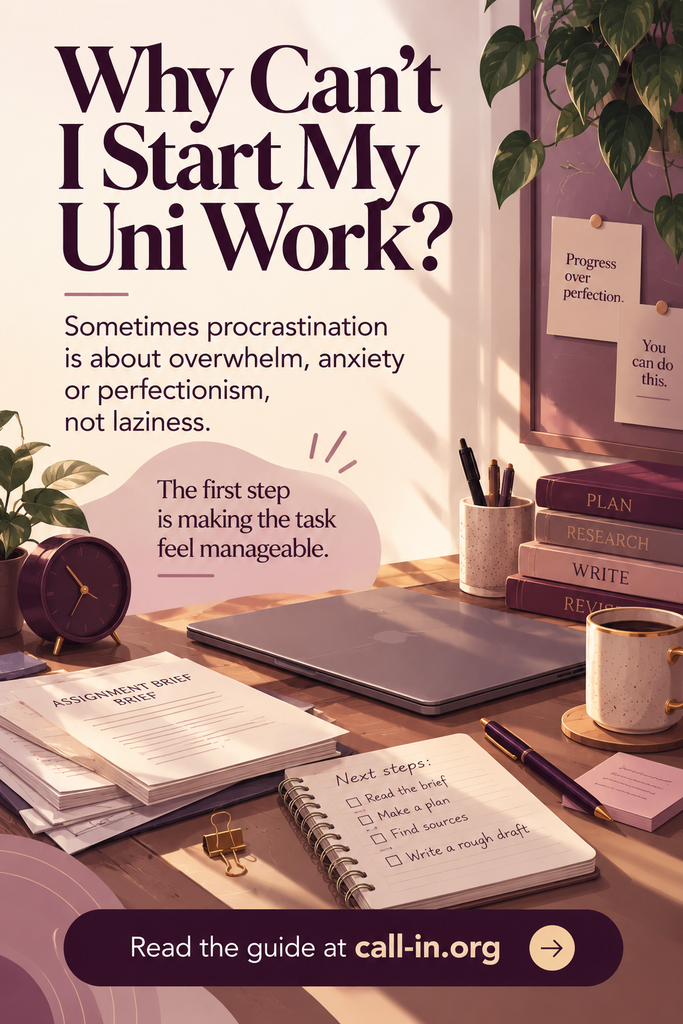
Procrastination, burnout, and stress, are part of the things that make university life hard. University life introduces an unprecedented level of independence, but with that independence comes an intense amount of pressure. For many students, this pressure manifests as a frustrating, invisible barrier.
And you can talk about it and how to move forward with us. Talk to your student accountability coach today.
You care deeply about your degree, you understand the importance of your grades, and you know exactly what the deadlines are. Yet, when you sit down at your desk, you find yourself completely unable to open the necessary documents or begin writing.
This experience is frequently referred to as academic paralysis or executive dysfunction. It is a deeply isolating state of mind that affects millions of students worldwide every single semester.
When you are stuck in this state, it is easy to assume that you are simply lazy or that you lack the discipline required for higher education. However, behavioral psychology reveals a completely different reality.
At Callin, we understand this very clearly. Procrastination is rarely a time-management issue or a reflection of your intellect. Instead, it is an emotional regulation problem. When the anxiety, perfectionism, and fear associated with a university assignment become too intense, your brain treats the task as a threat and triggers a freeze response.
Overcoming this cycle requires moving past self-blame and implementing practical, structured strategies. This comprehensive guide explores why academic paralysis happens, how perfectionism fuels procrastination, and how working with a zero judgment student accountability partner can help you break the loop and regain control of your academic life.
Key Takeaways for Overcoming Procrastination in University
- Procrastination is emotional avoidance: You are not lazy. Your brain is treating an overwhelming task as a psychological threat and triggering a freeze response.
- Perfectionism triggers paralysis: The fear of writing a bad first draft stops you from writing anything at all. Separate the creation phase from the editing phase.
- Micro-steps bypass the freeze response: Turn massive goals like writing an entire essay into a tiny, physical, low-stakes movement like typing one heading.
- Isolation reinforces the cycle: Hiding your struggle builds up shame. Sharing your goals with an external accountability partner removes the emotional weight.
- Action generates motivation: Do not wait until you feel calm or inspired to study. Motivation follows action, not the other way around.
Why can’t I just start my coursework?
When you ask yourself why you cannot just start your university work, you are likely looking for a logical explanation for an illogical behavior. You want to do the work, so why won’t your body cooperate?
The answer lies in how human brains process emotional weight. A university assignment is rarely just an assignment. In your mind, that single piece of work may represent your GPA, your future career prospects, your financial security, your self-worth, and your fear of disappointing your family.
When a task carries that much psychological weight, the emotional pressure becomes incredibly high. Your amygdala, the part of the brain responsible for processing threats, recognizes the intense stress associated with the essay or dissertation.
Because it cannot distinguish between physical danger and emotional vulnerability, it signals your nervous system to avoid the threat. This is where the avoidant behavior begins.
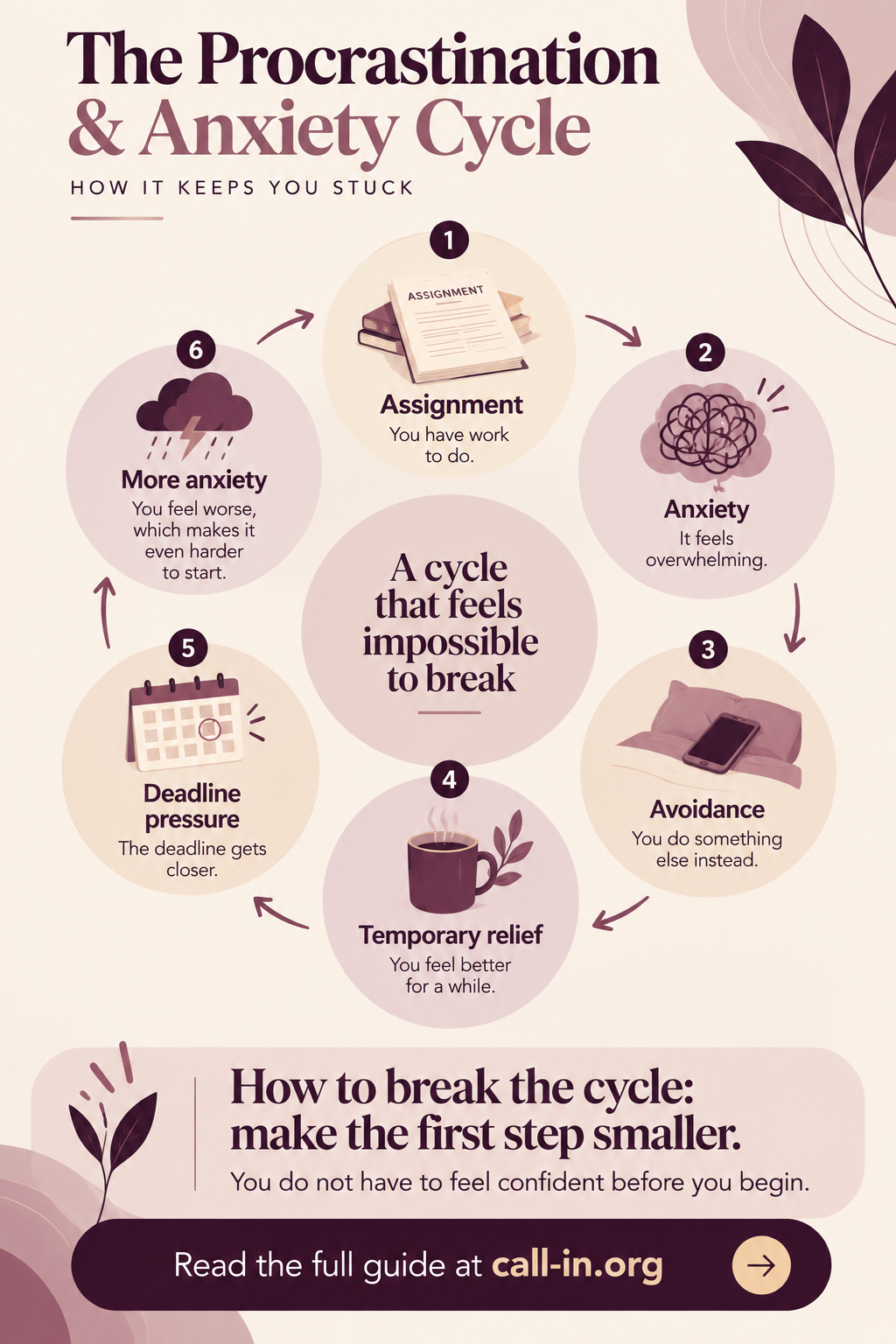
The operational cycle of academic procrastination typically follows a predictable, destructive pattern:
- The Threat Encounter: You sit down to begin your university project or exam revision.
- The Emotional Spike: You immediately experience feelings of overwhelm, confusion, or a fear that your work will not be good enough.
- The Avoidance Pivot: To escape this uncomfortable emotional state, your brain seeks immediate relief through a distraction, such as checking your phone or cleaning.
- The Temporary Relief: Your anxiety drops momentarily because you have moved away from the perceived threat.
- The Shame Spiral: As time passes, the deadline creeps closer, the unfinished work grows more urgent, and you feel intense guilt for wasting time.
- The Increased Paralysis: The task now carries even more negative emotion than before, making it twice as hard to start the next time you try.
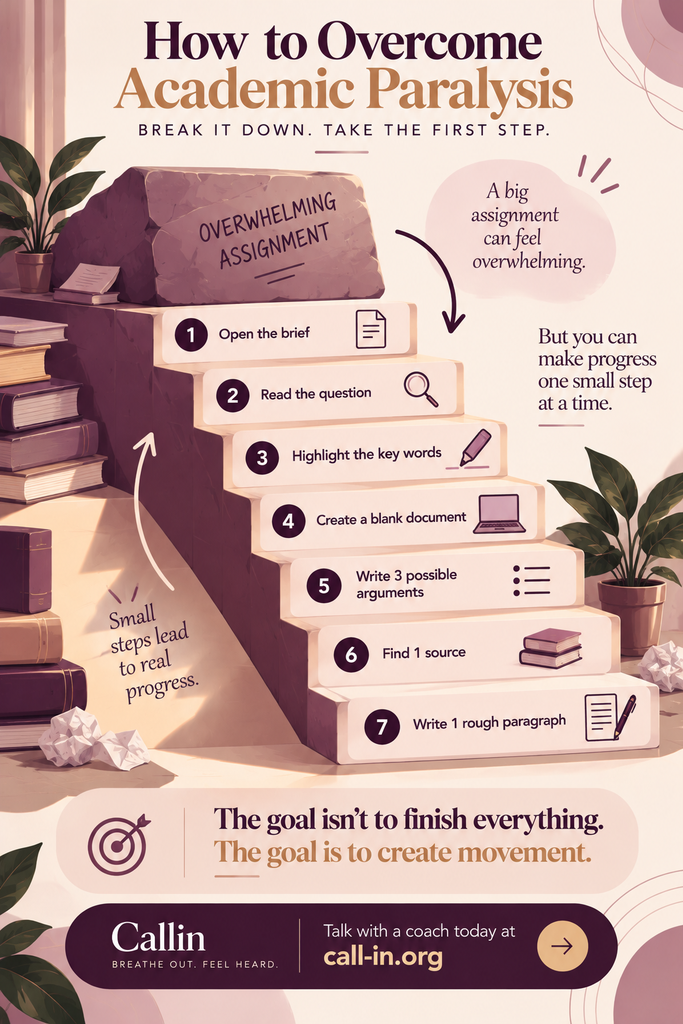
Breaking this cycle requires lowering the emotional stakes of the task. If you treat the assignment as a monumental test of your ultimate life success, you will continue to avoid it. If you reduce the task to a series of tiny, mechanical steps, you bypass the threat detection system in your brain.
Instead of focusing on the massive end goal, you must learn to focus exclusively on the next immediate action. Do not ask how you are going to finish a ten page research paper. Instead, ask what you can realistically achieve in the next ten minutes. By making the entry point incredibly small, you reduce the friction required to get started.
Am I just lazy when I procrastinate on school work?
One of the most damaging aspects of academic paralysis is the internal dialogue that accompanies it. Students often label themselves as lazy, unmotivated, or unsuited for higher education. This labeling is not only inaccurate, but it also actively prevents recovery.
Laziness implies a conscious, comfortable choice to do nothing. A lazy person feels content while avoiding work. A student experiencing academic paralysis, however, is in a state of high distress. They are actively suffering while doing nothing.
True academic paralysis is frequently tied to temporary or chronic challenges with executive function. Executive dysfunction refers to a disruption in the cognitive processes that allow us to plan, focus attention, remember instructions, prioritize tasks, and regulate our impulses.
When your brain is overwhelmed by anxiety or stress, your executive functioning capabilities are severely compromised.
It is important to understand the common cognitive factors that contribute to this feeling of being frozen:
- Task Initiation Deficits: The mental energy required to switch from a state of rest or distraction to a state of complex cognitive labor feels impossibly high.
- Working Memory Overload: When you look at an assignment brief, your brain struggles to hold all the criteria, formatting rules, and research points at once, leading to a cognitive shutdown.
- Prioritization Blindness: Every single task on your to-do list feels equally urgent and important, leaving you unable to decide where to place your initial focus.
- Time Blindness: An inability to accurately estimate how long a task will take causes you to either underestimate the timeline or feel like you do not have enough time left to even try.
It is vital to note that you should not diagnose yourself with clinical executive dysfunction or conditions like ADHD based on procrastination alone.
Executive difficulties can happen to anyone who is under prolonged stress, experiencing low moods, or suffering from chronic burnout. Only a qualified psychological or medical professional can perform a formal assessment.
What matters most in the immediate term is how you treat yourself when you identify these patterns. If you respond to a lack of task initiation by calling yourself lazy, you increase the shame and anxiety attached to your university work.
This simply reinforces the avoidance loop. If you instead recognize that your brain is experiencing a temporary cognitive block due to overwhelm, you can pivot toward practical, non-judgmental problem solving.
At Callin, our student accountability coaches specialize in helping you navigate these precise cognitive blocks without judgment or institutional pressure.
Why do I procrastinate when I care so much about my grades?
It feels entirely contradictory to procrastinate on something that you care about deeply. You might have scholarships depending on your performance, or you might be paying significant tuition fees out of pocket. You want to succeed more than anything, yet your actions do not align with your desires. This paradox occurs because high care often breeds high anxiety.
When you care immensely about your grades, your academic performance becomes intertwined with your identity. You begin to view your marks as a direct metric of your intelligence, your worth as a human being, and your potential for a successful life. When the stakes are that high, every single assignment feels like a high-wire act with no safety net.
This deep level of care gives rise to a specific, paralyzing form of perfectionism. Perfectionism is not the desire to do well; it is the fear of doing poorly. It manifests as a series of rigid, unyielding internal rules that dictate how you must work:
- The Expectation of Flawlessness: Believing that your first draft must be brilliant, articulate, and completely free of structural flaws as soon as you type it out.
- The All or Nothing Mindset: Thinking that if you cannot dedicate a perfect, uninterrupted four hour block to studying, there is no point in starting at all.
- The Fear of External Judgment: Experiencing intense anxiety about what your lecturer, your peers, or your family will think if your work is anything less than stellar.
- The Competence Shield: Avoiding the work entirely so that if you do fail, you can tell yourself it was because you ran out of time, not because you lacked the actual intelligence to succeed.
Procrastination serves as a temporary coping mechanism against these perfectionistic fears. If you do not write the essay, you cannot write a bad essay. If you do not submit the project, your abilities cannot be judged. The relief is brief, but to an anxious brain, it is incredibly addictive.
To break this pattern, you must consciously decouple your performance from your self-worth. You are a whole person separate from your academic transcripts.
When you sit down to work, remind yourself that you are not testing your value as a human being; you are simply completing a specific, limited administrative task for a university course. Lowering the emotional weight of the outcome is the quickest way to free your mind up for the actual process of writing.
How do I stop being a perfectionist and just do my coursework?
Defeating perfectionism requires a radical shift in how you view the writing process. Many students look at published journal articles or polished textbooks and assume that the authors produced that high-quality prose on their very first attempt.
This assumption is entirely false. Every great piece of academic writing is the result of multiple messy, disorganized, and completely imperfect drafts.
Perfectionism demands that you act as both the creator and the editor at the exact same time. You try to generate new ideas while simultaneously critiquing your vocabulary, fixing your grammar, and judging your arguments. This simultaneous creation and editing creates immense cognitive friction, leading directly to academic paralysis.
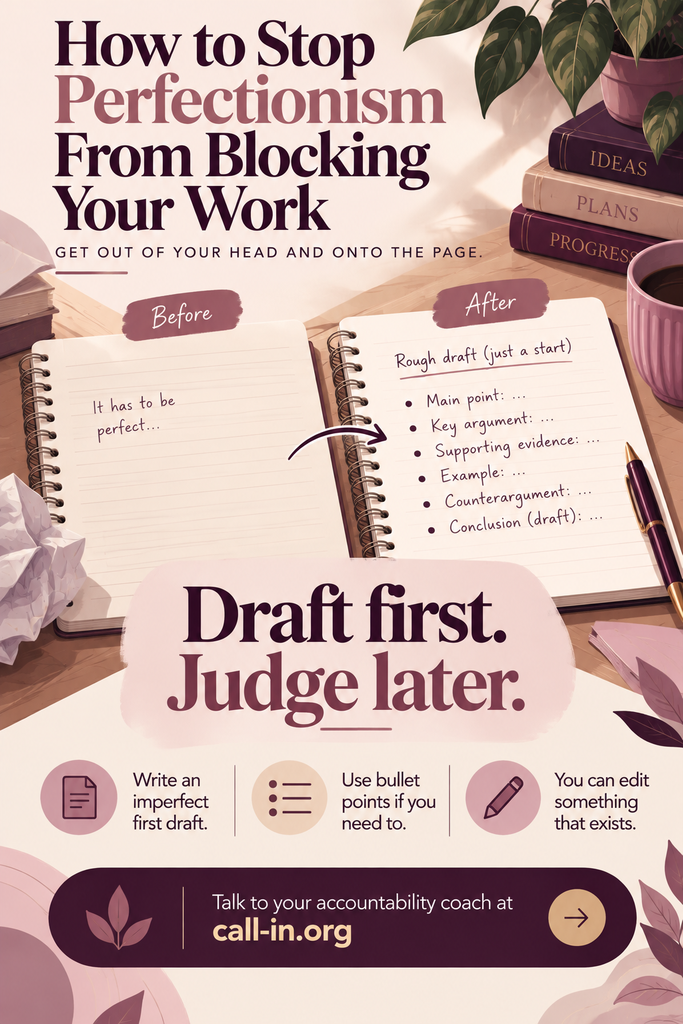
To bypass this barrier, you must learn to split the writing process into distinct, isolated phases. Your first objective is purely to create material. Your second objective is to improve it. You cannot edit a blank page, but you can always fix a poorly written page.
Here is a structured, five step method designed to bypass perfectionism and initiate the writing process:
- The Brain Dump: Spend ten minutes writing down absolutely everything you know about the topic. Do not use academic language. Do not worry about punctuation, structure, or citations. Write as if you are explaining the topic to a friend in a casual conversation.
- The Skeletal Framework: Look at your brain dump and pick out three or four recurring themes or main points. Turn these points into rough, simple headings. This gives your document an instant structure without requiring perfection.
- The Single Sentence Expansion: Underneath each heading, write just one or two sentences explaining what that section will cover. Do not try to write full paragraphs yet. Just plant a conceptual flag in the ground.
- The Evidence Integration: Go to your research materials or reading list. Find one quote, data point, or source that matches each of your headings. Paste them directly into the document underneath your sentences.
- The Polishing Phase: Only after you have a messy, fragmented document filled with raw notes and quotes should you step into the role of the editor. Now, you can begin to smooth out transitions, elevate your vocabulary, and check your formatting.
By utilizing this method, you lower the emotional stakes of the first draft. You give yourself explicit permission to write poorly. When you accept that your initial attempt can be messy, disorganized, and deeply flawed, the fear of starting vanishes.
You are no longer trying to produce a masterpiece; you are simply trying to build a rough foundation that you can refine later.
How do I overcome procrastination in my studies?
When you are deeply frozen by academic paralysis, abstract advice like “just use a planner” or “stay motivated” is completely useless. You need concrete, actionable interventions that target the nervous system and clear the cognitive fog.
Overcoming this state requires a mixture of psychological resetting and behavioral micro-steps.
The absolute first step is to name the problem out loud or write it down. When you keep your anxiety trapped in your head, it feels like an insurmountable, shapeless storm. By naming the exact nature of your block, you shrink its power.
Ask yourself what specifically is making you feel frozen. Are you confused by the assignment instructions? Are you terrified that you do not have enough references? Are you overwhelmed by the sheer volume of readings? Once you identify the specific obstacle, you can create a targeted plan to solve it.
Next, you must dramatically reduce the physical size of the task. Your brain cannot process an objective as massive as writing an entire dissertation.
Frequently Asked Questions About Student Procrastination
Why do I procrastinate so much when I try to study?
Student procrastination is an emotional freeze response triggered by your nervous system, not a lack of willpower. When you sit down to study and feel overwhelming anxiety, perfectionism, or a deep fear of failure, your brain misinterprets the university task as a mental threat.
To protect you from this stress, your brain forces a pivot to short term mood repairs like scrolling on social media, sleeping, or cleaning.
How do I stop procrastinating and start my university work?
You can stop procrastinating by breaking your workload down into micro steps that require minimal effort. Lower the stakes by giving yourself permission to write a messy, imperfect first draft. Use a ten minute timer to build initial momentum, separate the brainstorming phase from the editing phase, and speak with an external student accountability partner to reduce the psychological isolation of your workload.
Is university procrastination a sign that I’m lazy or that I have a symptom of executive dysfunction?
Severe difficulty initiating tasks, prioritizing assignments, and managing your time can be signs of temporary or chronic executive dysfunction. High stress, academic burnout, and generalized anxiety severely impair your brain’s executive functioning capabilities.
However, you should not diagnose yourself based on procrastination alone, as chronic conditions require professional medical or psychological assessment.
What is the difference between laziness and severe procrastination?
Laziness is a voluntary, comfortable choice to avoid responsibility without feeling any guilt. Severe procrastination is an involuntary, highly distressing state where you desperately want to complete your university work but feel completely frozen by anxiety and overwhelm. A lazy person enjoys their downtime, while a student experiencing procrastination is actively suffering from shame and stress.
How can a student accountability partner break the procrastination cycle?
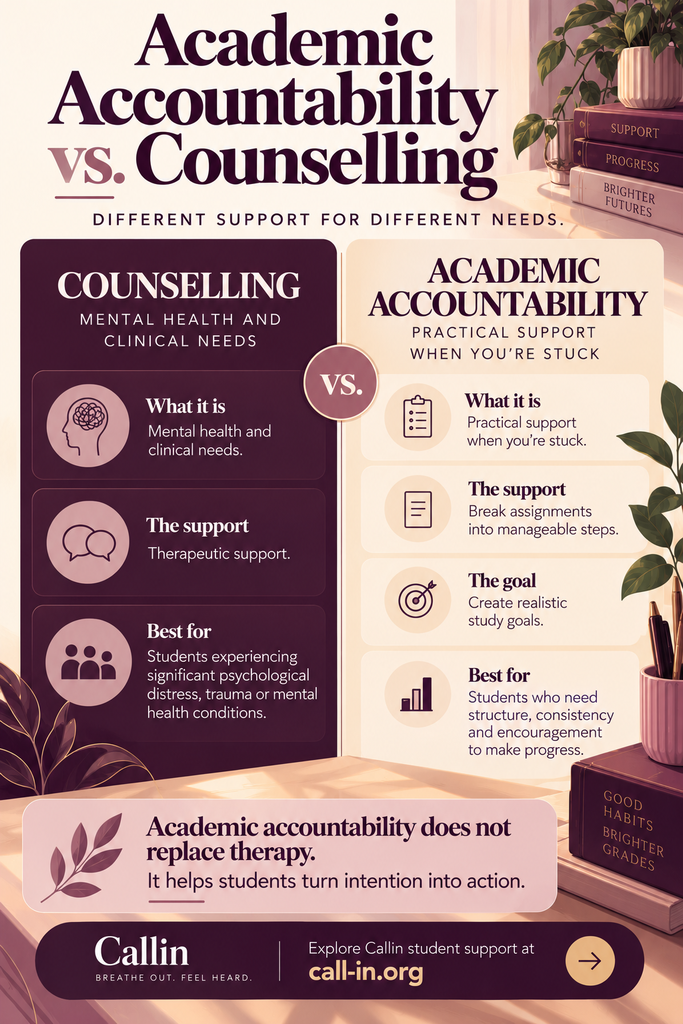
At Callin, an academic accountability partner introduces gentle external structure to your study routine. Knowing that a real, zero judgment human is waiting for you to complete a specific task creates a positive sense of commitment. This external structure overrides internal anxiety, breaks down task isolation, and replaces the pressure of high stakes performance with small, manageable milestones.

Leave a Reply