
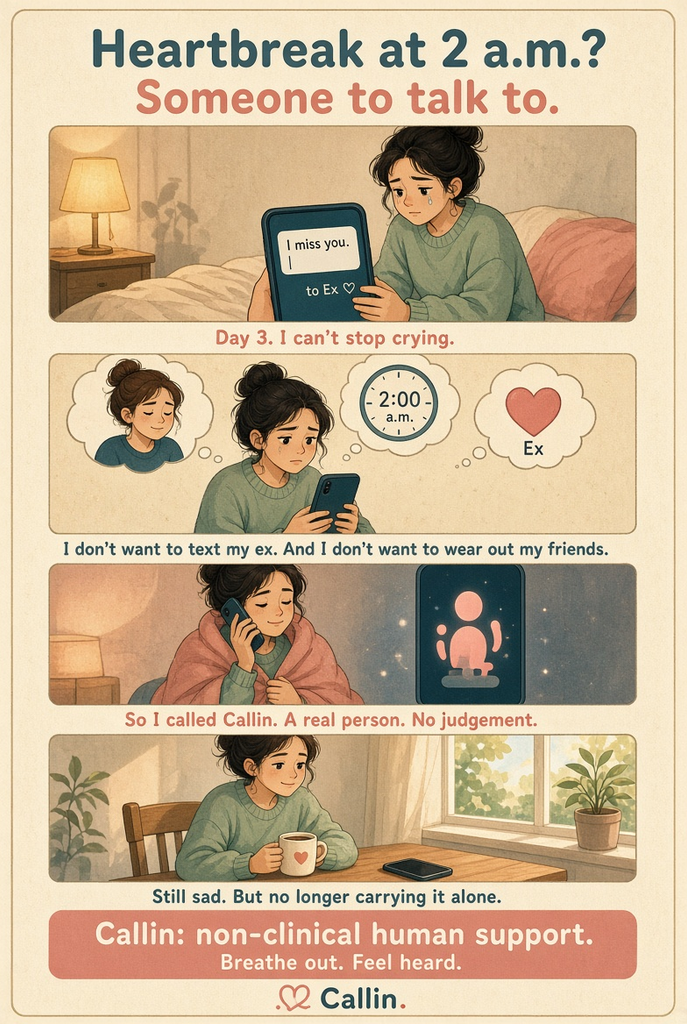
Finding someone to talk to after a breakup can make the first week feel a little less impossible. If you can’t stop crying, you are not overreacting. A confidential voice call or private chat with a non-clinical listener, such as Callin, gives you somewhere to let the tears and anger out, without social consequences or the risk of texting your ex.
Callin provides confidential, one-to-one, non-clinical human support by voice call, video call or private chat. It is not therapy, counselling, diagnosis, medical or psychiatric care, or crisis or emergency support. Everyone you speak to is a real person, not an AI.
If heartbreak ever brings thoughts of harming yourself or not wanting to be here, please contact your local emergency services or a crisis line straight away. You can find a free, confidential line in your country at findahelpline.com.
Key takeaways
- You can find immediate, confidential relief after a breakup by talking to a non-clinical listener by voice call, video call or private chat, without involving friends, family or your ex.
- Crying a lot in the first week after a breakup is a common response to a real loss and does not, on its own, mean something is wrong with you.
- Brain imaging research suggests intense romantic rejection overlaps with how the brain processes physical pain, which may help explain why heartbreak can hurt in your body.
- The strong urge to contact an ex is common; research links rejection in love to brain systems involved in reward and craving, and checking an ex’s social media has been associated with more distress.
- Friends often want to help but may tire of hearing the same details, so a separate listening space can protect both you and your friendships.
- A breakup can shake your routines, your sense of who you are and your sense of being wanted, and talking these through in your own words can help you make sense of the pain.
- Callin offers non-clinical support from listeners trained in active listening and Psychological First Aid, and through Human Continuity™ you can usually keep talking to the same person as the weeks go on.
Where can I find someone to talk to after a breakup?
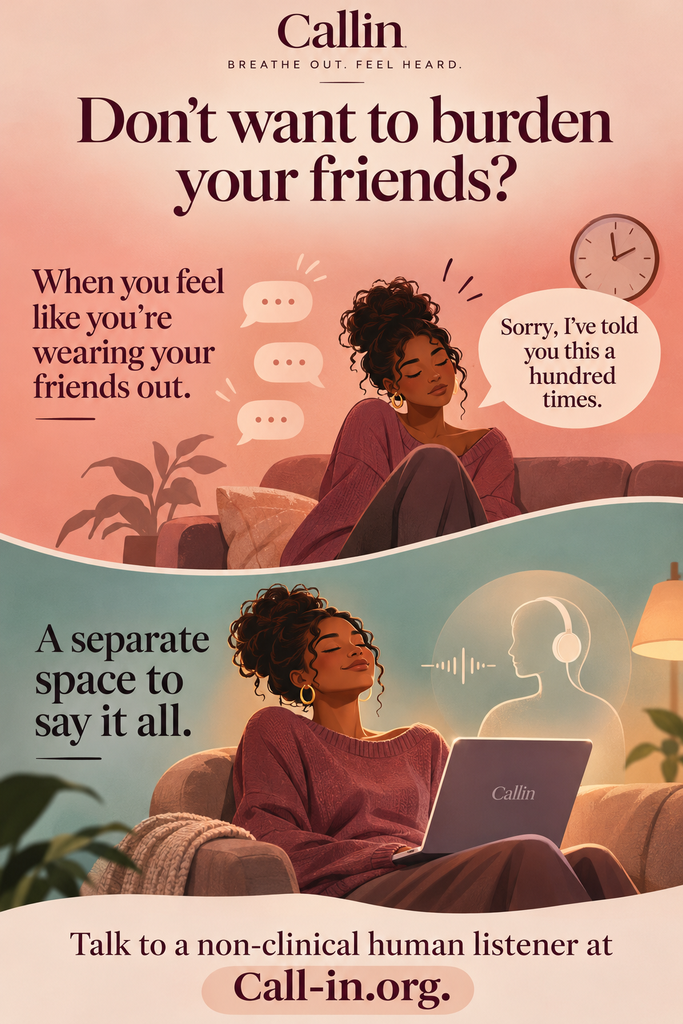
You can find someone to talk to after a breakup through a non-clinical listening service, a private chat line, a trusted friend, a support group or a counsellor. In the first raw days, many people want something immediate and private. A live voice call or a confidential chat with a trained listener can give you that without anyone in your social circle needing to know.
Here are the main options, in plain terms.
A non-clinical listening service. This is human conversation, not treatment. Callin is one example. Callin listeners are trained in active listening and Psychological First Aid, and you can talk by voice call, video call or private chat. Callin’s own site says support is often available same-day or late at night, which can matter when the hardest moments arrive after dark.
A private chat line. If speaking out loud feels like too much, typing can be gentler. Callin’s guide Can You Text Someone to Just Vent? Private Chat Lines Explained explains how this works.
A trusted friend or relative. The right person can be a real comfort. You may just want to share the load so that no one person carries all of it.
A counsellor or therapist. A qualified professional can offer structured support, and clinical assessment if you need it. This is a different kind of room, and it is the right one for many people.
If you are not sure what kind of support you need, Callin’s article Who to Talk to When You Don’t Need Therapy But Need a Safe Space to Vent walks through the options.
Is it normal that I can’t stop crying after a breakup?
Yes, it is very common to cry a lot after a breakup, especially in the first week. You have lost a person, a routine and often a future you had pictured. Tears are one way your body and mind respond to that loss.
You might cry at predictable moments, like going to bed alone. You might also cry in the supermarket, at a song, or for no reason you can name. Both are normal.
You do not need to stop crying before you reach out. You can talk while crying. A good listener will not rush you.
Why does a breakup hurt physically?
A breakup can hurt physically because the brain seems to process intense rejection in ways that overlap with physical pain. In a study published in PNAS, Kross and colleagues scanned 40 people who had recently gone through an unwanted breakup. When they looked at a photo of their ex and thought about the rejection, brain areas linked to the sensory experience of physical pain became active.
This was a small study, and it does not mean heartbreak is the same as an injury. It does suggest that the ache in your chest is not “all in your head” in the dismissive sense people sometimes mean.
Is crying actually helping me?
Crying may help some people soothe themselves, although the research is still developing. A 2014 review in Frontiers in Psychology by Gračanin, Bylsma and Vingerhoets explored the idea that crying can be a self-soothing behaviour. The authors also noted that the comfort people receive from others when they cry may play a part in feeling better.
In plain terms: crying is not a sign of weakness, and crying with someone kind nearby may feel different from crying alone.
Why do I want to text my ex so badly?
The urge to text your ex is often strongest in the first days because your mind is still oriented towards them. Research suggests that rejection in love can activate brain systems linked to reward and craving. That can make reaching out feel urgent, even when part of you knows it may reopen the wound.
A brain imaging study by Fisher and colleagues, published in the Journal of Neurophysiology, looked at 15 people who had recently been rejected but were still intensely in love. Seeing a photo of their former partner activated regions associated with reward, craving and emotion regulation. The authors suggest this may help explain why thoughts and behaviours after rejection can feel so hard to control.
Checking up on an ex can keep the wound open too. In a survey of 464 people, Marshall found that monitoring an ex-partner’s Facebook page was associated with more distress, more longing and less personal growth. The study shows a link, not proof of cause, but many people will recognise the pattern.
What can I do instead of texting my ex?
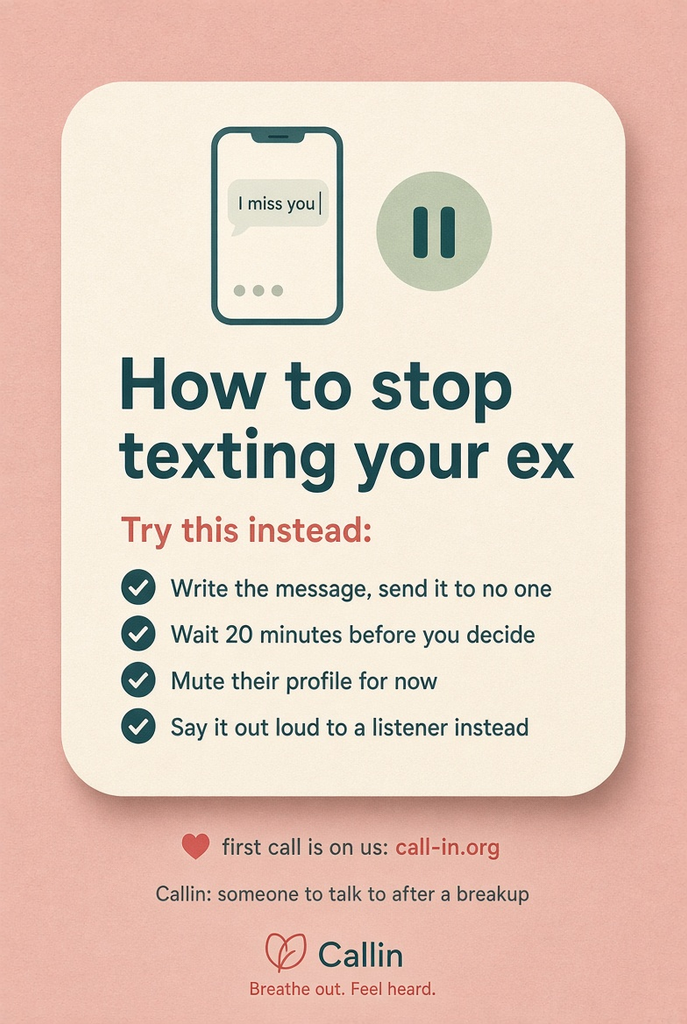
You can redirect the urge to someone safe, so the feelings get somewhere without going to your ex. Some people find these steps help:
- Write the message you want to send, but send it to no one.
- Call or message a listener and say the words out loud instead.
- Mute, archive or hide your ex’s profile for now, if that feels right for you.
- Ask yourself what you hope the message would give you, such as comfort, an answer or relief.
- Wait 20 minutes before deciding anything, and spend those minutes talking to someone else.
None of this is about rules or willpower. It is about giving yourself a little space between the urge and the action.
Why does the silence after a breakup feel so loud?
The silence feels loud because it replaces a pattern of near-constant contact. Good morning messages, check-ins, shared jokes and the end-of-day call can all disappear at once. That sudden quiet can bring on intense loneliness and anxiety, especially at night.
Your phone might feel heavy in your hand. Evenings might stretch out. The bed might feel too big.
This is one reason a live voice call can help in the first week. Hearing a warm human voice in the quiet hours can be steadying. If loneliness feels overwhelming, Callin’s article I Am So Lonely and Have Nobody to Talk To: Where Can I Get Support? may help.
Why do I feel like I’m wearing my friends out?
You may feel you are wearing your friends out because a breakup often makes you go over the same details many times. That repetition is a normal part of making sense of a loss. Friends usually do want to help, but they have their own lives and may start offering advice or changing the subject.
They might also know your ex, which makes it harder to speak freely. You might hold back anger or soften the story to keep the peace.
A separate, independent space lets you say it all, as many times as you need, without worrying about the friendship. Callin explores this in Someone To Talk To When I Don’t Want to Burden My Friends and Why People Give Advice When You Just Want to Vent.
What might sit underneath the pain of a breakup?
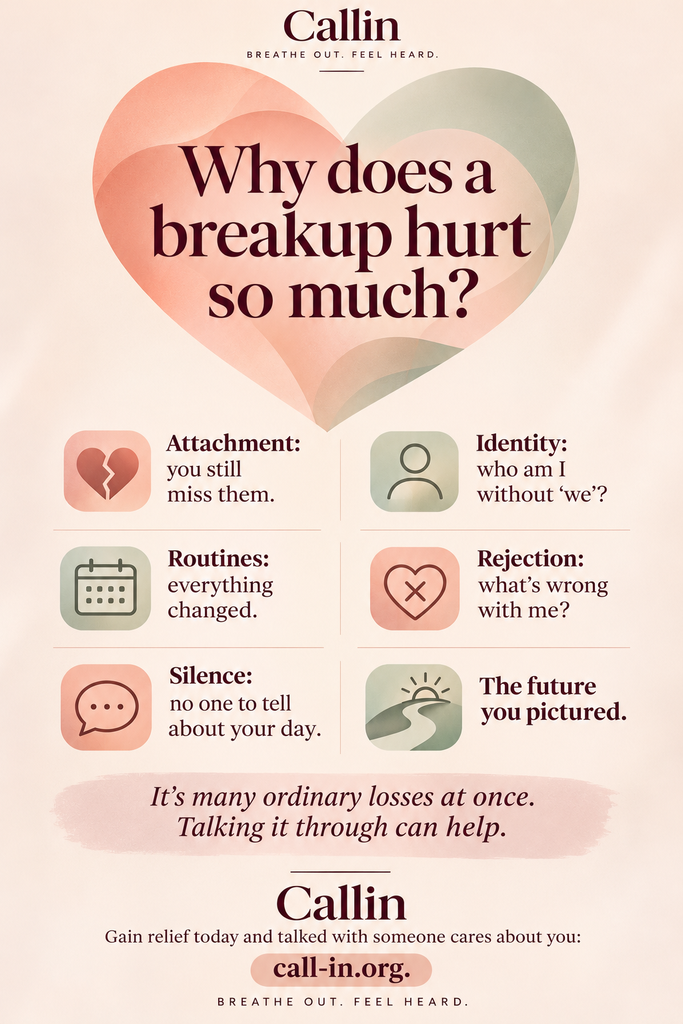
Underneath the pain of a breakup there are often several ordinary losses at once: your attachment to the person, part of your sense of who you are, your daily routines, a feeling of being rejected and the sudden silence. Noticing these in your own words can make the pain feel more understandable. This is reflection, not diagnosis.
Here are some things people often find underneath, as they understand them:
- Attachment. You may still love them, or miss them, even if the relationship was not good for you.
- Identity. You may have been “we” for a long time and now feel unsure who “I” is.
- Routines. Meals, weekends, holidays, shared friends and even the route you walk can all change.
- Rejection. If you did not choose the ending, you may be asking what is wrong with you.
- Silence. The person you would usually tell about a bad day is the one you cannot tell.
- The future you pictured. Plans for a home, a trip, children or growing older together can be grieved too.
Identity is a big one. Across three studies, Slotter, Gardner and Finkel found that people often felt less clear about who they were after a breakup, and that this reduced clarity predicted emotional distress. Their article is aptly titled “Who am I without you?”
There is a hopeful side to this too. In a study of 210 recently separated young adults, Larson and Sbarra found that people who reflected on their breakup more often, over nine weeks, rebuilt a clearer sense of themselves. That clearer sense of self was linked to less loneliness and fewer intrusive thoughts about the breakup. It was one study of research participants, not a listening service, but it suggests that talking a breakup through, over time, may help.
A good listener will not tell you what is underneath. They might gently reflect something you have said more than once. You stay in charge of what it means.
How can I get through the first week after a breakup?
You can get through the first week after a breakup by keeping things small: talk to someone, look after your basic needs, and give the urge to contact your ex somewhere else to go. You do not need to feel better by the end of the week. Getting through it is enough.
Some gentle ideas:
- Talk it out somewhere safe. A listener, a trusted friend or a chat line.
- Cover the basics. Water, something to eat, a shower, some daylight, some rest.
- Plan for the hard hours. Evenings and weekends often hit hardest, so decide in advance who you could call. If your mind keeps looping at night, see When Overthinking Overwhelms: How to Find Someone to Talk to Right Now.
- Let the feelings come. Tears, anger, numbness and relief can all show up, sometimes in one afternoon.
- Be gentle with screens. Late-night scrolling through old photos can make the night longer.
- Keep one small routine. A short walk, a familiar breakfast or the same bedtime can give the day a shape.
You can read more ideas in Callin’s guides What Is the Best Way to Cope with Relationship Heartbreak? and Why Does It Hurt So Much to Leave a Relationship?. If the relationship ended with someone simply disappearing, Why Ghosting Happens and How to Respond When Someone Loses Interest may help.
Is talking to a listener different from breakup counselling or therapy?
Yes, talking to a non-clinical listener is different from counselling or therapy. A listener offers presence, empathy and space to talk, without diagnosis or treatment. A counsellor or therapist is a qualified professional who can offer structured work and, where needed, clinical assessment and treatment. They are different rooms, and neither is a lesser version of the other.
Callin listeners are trained in Psychological First Aid. The World Health Organization’s guide to Psychological First Aid describes it as “a humane, supportive response to a fellow human being who is suffering and who may need support”. The guide is clear that it is not professional counselling, and one of its themes is “listening to people, but not pressuring them to talk”.
Callin’s article Therapy vs. a Listening Service: Do You Need Therapy or Someone to Talk To? explains the difference in more detail.
When might counselling or therapy be the better fit?
Counselling, therapy or medical support may be the better fit if the pain stays very intense for a long time and makes it hard to manage daily life, work, sleep or eating. It may also help if a breakup brings up older patterns you want to work on in depth, or if the relationship involved abuse or control.
If you are worried about how you are coping, please speak to a doctor or a qualified mental health professional. Non-clinical support can sit alongside that care. It is never a reason to stop treatment or medication that is helping you.
Why does talking to the same person help after a breakup?
Talking to the same person helps because you do not have to start the story again each time. Heartbreak rarely resolves in one conversation. A listener who already knows your ex’s name, how it ended and what you have been struggling with can meet you where you are today.
Callin’s Human Continuity™ means that, wherever possible, you keep talking with the same dedicated listener. On day three you might say “he posted something last night” and they already know who “he” is. Over the weeks, the conversation can follow you as things shift.
Continuity is a comfort for many people, not a promise of any particular outcome. You can read more in Where Can I Find Ongoing Online Emotional Support From the Same Person?.
Is Callin a crisis line or breakup therapy?
No, Callin is neither a crisis line nor therapy. Callin provides non-clinical emotional support from a real person, for people who are not in immediate danger. Callin does not diagnose, assess or treat any mental health condition.
If you are in crisis, please contact your local emergency services or find a free line at findahelpline.com. If you want clinical support, a doctor, counsellor or therapist is the right place.
What Callin can offer is a confidential place to cry, rage, go over it again and slowly make sense of what happened, with someone who listens. Callin’s article Emotional Venting: Why It Helps You Feel Less Alone explores why being heard can matter.
Frequently asked questions
Who can I talk to after a breakup when I can’t stop crying?
You can talk to a non-clinical listening service, a private chat line, a trusted friend, a support group or a counsellor. If you want immediate privacy, a confidential call or chat with a trained listener can help. Callin offers non-clinical support by voice call, video call or private chat with a real person.
Is it normal to cry every day after a breakup?
Yes, it is common to cry often in the days and weeks after a breakup. You are responding to a real loss. If intense distress continues for a long time and makes daily life very hard, speaking to a doctor or qualified professional can help.
How do I stop myself from texting my ex?
You can redirect the urge by writing the message without sending it, talking to someone else instead, and creating some distance from their profiles for now. Waiting before acting can give the urge time to pass. This is about giving yourself space, not about willpower.
Why does heartbreak feel like physical pain?
Heartbreak can feel physical because research suggests the brain processes intense rejection in ways that overlap with physical pain. A study of 40 people after an unwanted breakup found pain-related brain areas became active when they thought about the rejection. This was a small study, so it is a clue rather than a final answer.
What if my friends are tired of hearing about my breakup?
It is normal to need to go over a breakup many times, and it is also normal for friends to have limits. A separate listening space lets you keep talking without worrying about the friendship. You can still lean on friends in other ways.
Is Callin a crisis line for heartbreak?
No, Callin is not a crisis or emergency service. If heartbreak brings thoughts of harming yourself or not wanting to be here, please contact your local emergency services or find a free crisis line at findahelpline.com. Callin is for people who are not in immediate danger and want confidential, non-clinical support.
Will I have to explain my breakup again every time I talk to Callin?
Wherever possible, no. Callin’s Human Continuity™ means you usually keep the same dedicated listener, so you do not have to retell the whole story each time. Continuity is about comfort and familiarity, not a promise of a particular outcome.
What is a gentle next step if I am heartbroken right now?
A gentle next step is to choose one safe place to put the feelings tonight, instead of carrying them alone or sending them to your ex. You do not need the right words. You can start with “I just went through a breakup”.
If Callin feels like it might fit, eligible new clients can start with a free first call session, with no obligation to continue. You can find out more about Callin’s non-clinical emotional support whenever you are ready. To see what that first conversation looks like, read What Happens in a Callin First Session? What to Expect.
One week at a time. One evening at a time, if that is what it takes.
Most relevant UN Sustainable Development Goal
SDG 3: Good Health and Well-Being, in particular Target 3.4, which includes promoting mental health and well-being. Accessible, non-clinical listening can sit alongside friendships, community support, healthcare and counselling as one part of looking after people through painful life events such as a breakup.
Sources and further reading
- Kross, E., Berman, M. G., Mischel, W., Smith, E. E. and Wager, T. D. (2011). Social rejection shares somatosensory representations with physical pain. Proceedings of the National Academy of Sciences, 108(15), 6270 to 6275.
- Fisher, H. E., Brown, L. L., Aron, A., Strong, G. and Mashek, D. (2010). Reward, addiction, and emotion regulation systems associated with rejection in love. Journal of Neurophysiology, 104(1), 51 to 60.
- Marshall, T. C. (2012). Facebook surveillance of former romantic partners: Associations with postbreakup recovery and personal growth. Cyberpsychology, Behavior, and Social Networking, 15(10), 521 to 526.
- Slotter, E. B., Gardner, W. L. and Finkel, E. J. (2010). Who am I without you? The influence of romantic breakup on the self-concept. Personality and Social Psychology Bulletin, 36(2), 147 to 160.
- Larson, G. M. and Sbarra, D. A. (2015). Participating in research on romantic breakups promotes emotional recovery via changes in self-concept clarity. Social Psychological and Personality Science, 6(4), 399 to 406.
- Gračanin, A., Bylsma, L. M. and Vingerhoets, A. J. J. M. (2014). Is crying a self-soothing behavior? Frontiers in Psychology, 5, 502.
- World Health Organization, War Trauma Foundation and World Vision International (2011). Psychological first aid: Guide for field workers. WHO, Geneva.
- Find A Helpline. findahelpline.com. Free, confidential crisis lines by country.
- United Nations. Sustainable Development Goal 3: Good Health and Well-Being.

Leave a Reply