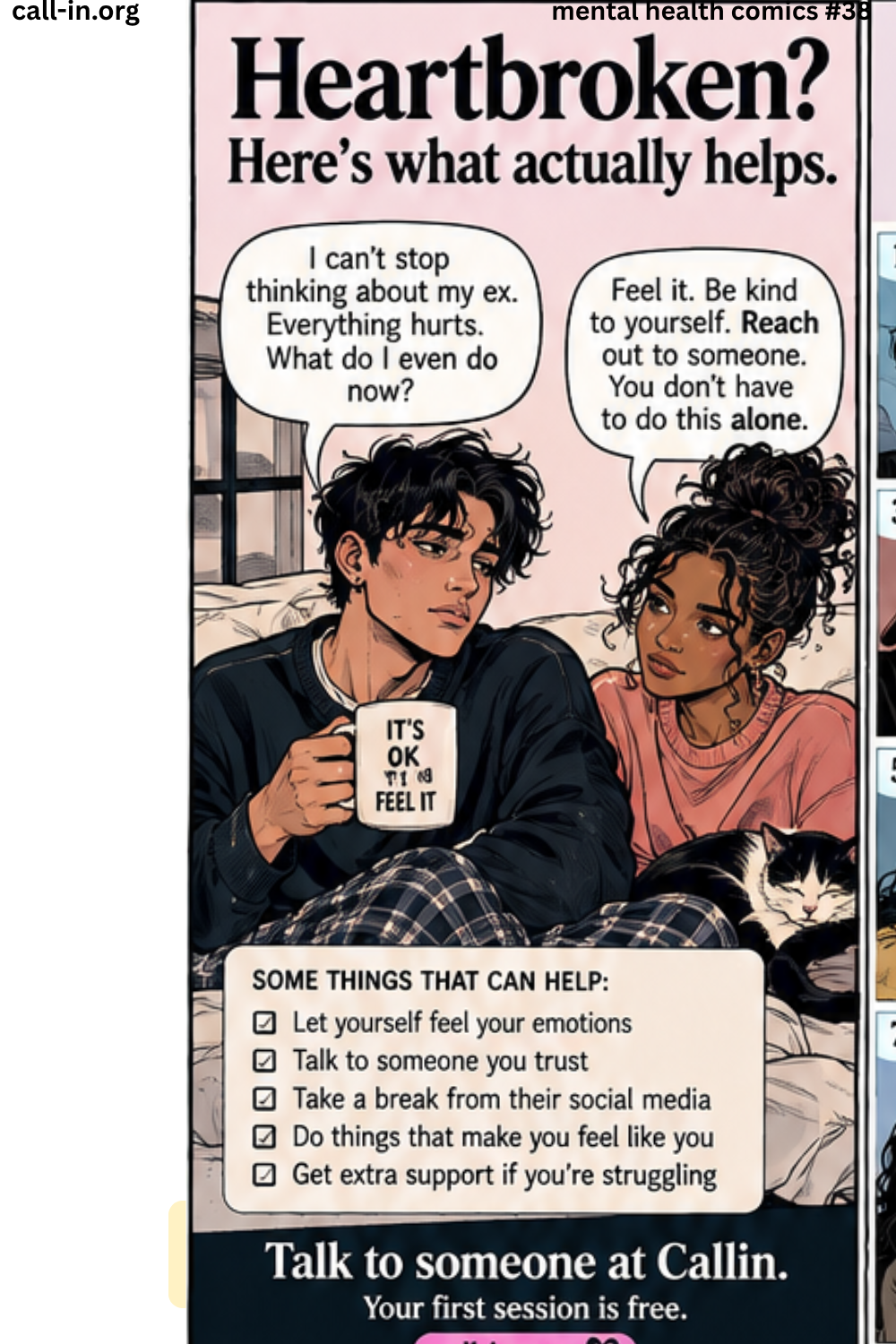
A breakup can end a relationship, a routine, a future, and a version of you. No wonder it hurts.
To deal with heartbreak, begin by treating it as a real loss, not a personal failure. Heartbreak can disturb sleep, concentration, appetite, confidence, routines, and your sense of who you are, but it does not mean you are unlovable or permanently broken.
Healing usually comes through time, honest support, protective boundaries, and small acts that make life feel like yours again.
Key Takeaways
- Heartbreak affects the mind, body, identity, routines, and sense of safety. It is more than simply feeling sad.
- There are no scientifically established seven stages that everyone experiences in order. Heartbreak is usually less organized than that.
- The hardest day after a breakup is different for everyone and may arrive well after the relationship ends.
- Feeling unlovable is a common response to rejection, but it is not reliable evidence about your worth.
- Healing does not require pretending you are fine. It usually requires enough safety, distance, connection, and time for your life to become recognizable again.
- You can always reach out to Callin to talk about relationship hearbreak. Your first session is free using this link.
What Does Heartbreak Do to a Person?
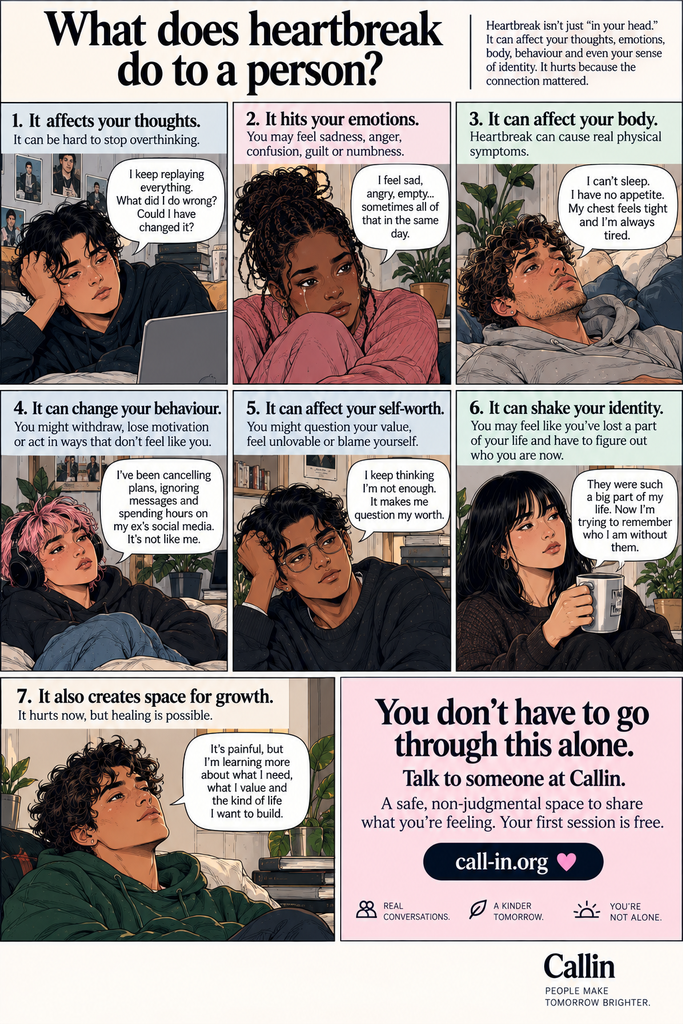
Heartbreak is a form of loss. You may lose a partner, but you may also lose your daily routines, mutual friends, shared plans, physical affection, financial arrangements, inside jokes, and the person you automatically contacted when something happened.
That helps explain why a breakup can feel strangely physical. Research has found that intense social rejection and physical pain involve some overlapping neural systems, although the experiences are not identical.
Your body is not being ridiculous when emotional pain feels like pressure in your chest, heaviness in your limbs, nausea, exhaustion, or a genuine ache. (Proceedings of the National Academy of Sciences)
Heartbreak can also affect sleep, appetite, concentration, motivation, and memory. You might replay conversations, struggle to work, wake up reaching for your phone, or feel briefly normal before remembering what happened.
That sudden drop in your stomach is your mind updating itself to a reality it did not choose.
A breakup does not remove one person from your life. It can remove a witness, a routine, a future, a social world, and a version of yourself in one event.
Why Is Life So Hard After a Breakup?
Relationships quietly become systems. You develop patterns around when you eat, where you go, who sends the morning message, how weekends work, and who hears the small stories that seem too unimportant to tell anyone else.
When the relationship ends, the person disappears from the role, but the system keeps expecting them. The relationship may have ended in one conversation. The habits built around it did not receive the memo.
This is why ordinary moments can feel brutal. Buying groceries, hearing a song, finishing work, or making coffee can suddenly expose the absence. You are not only missing the dramatic parts of love. You are missing its infrastructure.
A breakup can also disrupt what psychologists call self-concept clarity, which is the sense that you know who you are. Research suggests that romantic breakups can temporarily make the self feel less clear, especially when two lives and identities have become closely intertwined. (Personality and Social Psychology Bulletin)
Questions such as “Who am I without them?” are therefore not melodramatic. They are part of rebuilding an identity that may have contained a great deal of “we.”
What Are the 7 Stages of Heartbreak?
There is no clinically agreed sequence of seven stages of heartbreak. Popular stage models can help people name what they are experiencing, but they should not be treated as a timetable, a diagnosis, or seven emotional hoops you must jump through correctly.
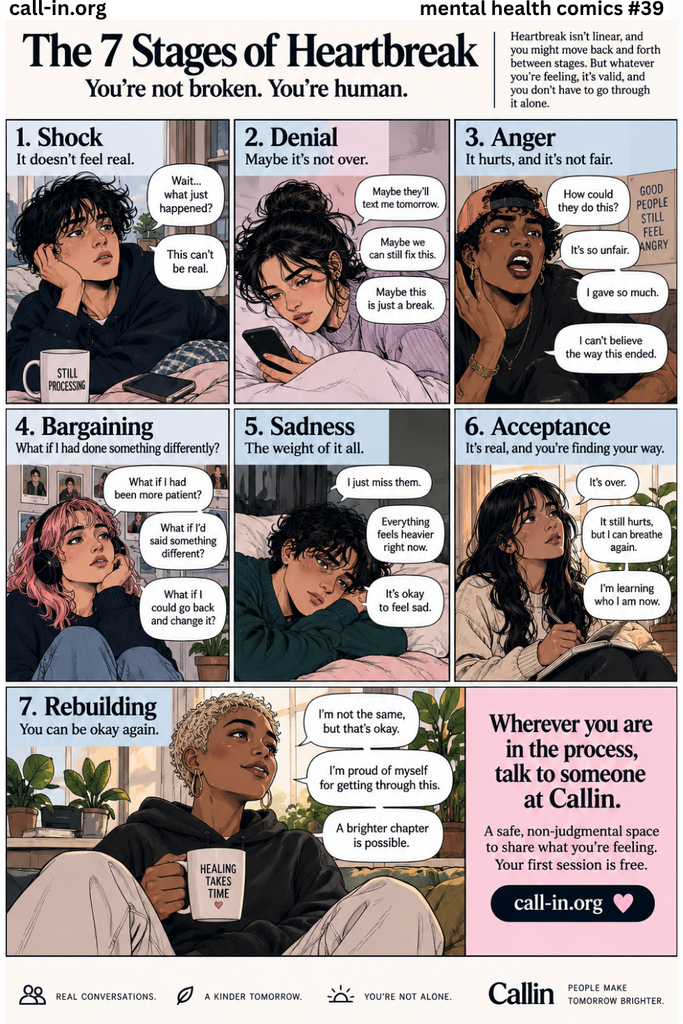
Heartbreak is usually messier. You can feel acceptance at breakfast, anger at lunchtime, longing at midnight, and strangely peaceful again the following morning. Emotional recovery has terrible project management.
Still, seven common experiences often appear after a breakup:
1. Shock and Searching for Answers
Your mind tries to understand what happened. You may reread messages, reconstruct conversations, or search for the exact moment everything changed.
Answers can provide perspective, but searching can become endless when your mind believes one final piece of information will remove the pain.
2. Denial
Part of you may behave as if the breakup is temporary or unreal. You might expect a message, imagine an immediate reunion, or avoid telling other people because saying it aloud makes it feel final.
Denial is sometimes the mind’s way of letting reality arrive in manageable pieces.
3. Bargaining
Bargaining sounds like, “If I change this, perhaps they will come back.” You may offer solutions, make promises, or imagine versions of the relationship in which every problem could have been prevented.
Reflection can be useful. Taking responsibility for the entire relationship, including another adult’s choices, is not the same thing.
4. Relapse and Renewed Longing
You may contact your ex, check their social media, revisit old photographs, or feel convinced you have returned to the beginning. This does not erase the progress you made.
Recovery is not ruined by one difficult evening. Healing is better understood as a trend than a flawless streak.
5. Anger
Anger can appear toward your ex, yourself, a third person, unsupportive relatives, or the universe for having such poor timing. It often protects more vulnerable feelings such as humiliation, grief, helplessness, or fear.
Anger contains information. It may reveal where a boundary was crossed or where you abandoned your own needs to keep the relationship alive.
6. Sadness and Identity Rebuilding
As the argument with reality quiets, sadness can become more noticeable. You may begin grieving not only the person, but the imagined future attached to them.
This is also when a quieter question emerges: what belongs to me now? Old interests, friendships, values, and ambitions can slowly become visible again.
7. Acceptance and Redirected Hope
Acceptance does not mean approving of what happened, forgetting the relationship, or becoming delighted about the breakup. It means the loss is no longer renegotiated every day.
Hope gradually stops pointing backward. Life begins to contain possibilities that do not require the relationship to restart.
These experiences may overlap, repeat, or never appear at all. Even the creators and advocates of grief-stage frameworks caution that stages are not a linear checklist. (Grief.com)
What Is the Hardest Day After a Breakup?
There is no universal hardest day after a breakup. Research has not identified a particular day when heartbreak reliably reaches its peak for everyone.
For one person, the worst moment is the breakup itself. For another, it is the first silent weekend, a birthday, returning home after collecting their belongings, or discovering that their ex is dating again. Sometimes the hardest day arrives when the initial shock wears off and everyone else assumes you must be feeling better.
The hardest day is often the day the loss becomes real in a new way.
That can be unsettling because you may believe a bad day means you are going backward. More often, it means you encountered another part of the loss. Anniversaries, familiar places, mutual friends, and unexpected reminders can create temporary waves without resetting your recovery.
How Long Do You Feel Bad After a Breakup?
There is no honest answer measured in an exact number of days. The length of breakup grief depends on the relationship, the circumstances of the ending, your support system, previous losses, attachment, living arrangements, betrayal, discrimination, financial consequences, and whether you still have regular contact.
A study of young adults found that depressive symptoms often increased temporarily around a breakup and then returned toward previous levels within roughly three months. However, the researchers emphasized important limitations, including the characteristics of the sample. That finding should not become a countdown clock for every relationship or every person. (Journal of Affective Disorders Reports)
You may also encounter the claim that it takes exactly 11 weeks to recover from a breakup. That popular statistic is often given more certainty than the original research supports.
One frequently cited study surveyed young adults who had experienced a breakup within the previous six months, with the average breakup having occurred around 11 weeks earlier. It did not establish a universal recovery deadline. (The Journal of Positive Psychology)
Some people feel substantially better within weeks. Others need months or longer, particularly after a long relationship, divorce, abuse, infidelity, shared parenting, or the loss of a home and community.
A better question may be: is the pain gradually changing? You do not need to feel good every day. Look for small signs of movement, such as longer periods of concentration, fewer compulsive checks, better sleep, genuine laughter, or moments when your future feels imaginable again.
Why Do I Feel Unlovable After a Breakup?
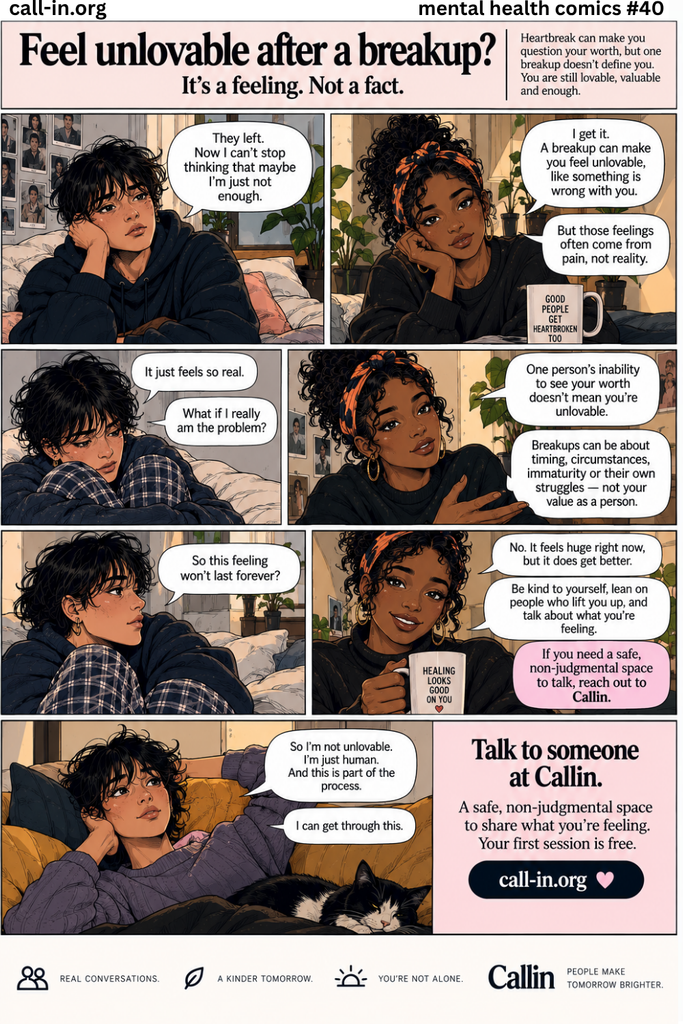
Rejection is an event, but the mind often turns it into an identity.
“My relationship ended” becomes “Nobody will stay.”
“This person stopped choosing me” becomes “I am impossible to love.”
“We were incompatible” becomes “There is something fundamentally wrong with me.”
These conclusions can feel convincing because heartbreak temporarily destabilizes identity and self-worth. If the relationship was central to how you saw yourself, losing it can make your entire value feel questionable.
But a relationship ending is evidence that a relationship ended. It is not a peer-reviewed measurement of your lovability.
Perhaps you made mistakes. Most people do. You can examine your behavior, apologize where appropriate, and become more emotionally responsible without converting those mistakes into a lifelong verdict against yourself.
Compatibility is also not the same as worth. A person can be funny, loyal, attractive, complicated, generous, occasionally infuriating, and still be the wrong partner for a particular person. Human relationships would be far simpler if goodness guaranteed compatibility. Unfortunately, love did not consult a spreadsheet.
Does the Dumper Ever Feel Bad?
Yes, the person who ends a relationship can feel sadness, guilt, grief, doubt, loneliness, relief, or regret. Sometimes several of those emotions exist at once.
Research into breakup adjustment has found that initiators may experience more guilt while reporting less overall distress on average than people who did not initiate the breakup. These are averages, not rules. Some initiators are devastated, while others feel mainly relieved or certain about their decision. (Family Process)
Their sadness also does not automatically mean they want to return. A person can miss you and still believe the relationship should end. They can love aspects of the relationship while recognizing that it was not working.
Wondering whether your ex feels bad is understandable. Sometimes the question underneath it is, “Did I matter?”
You probably did. But your healing cannot depend on gaining access to an emotion inside another person that you cannot see or verify. Their remorse, or lack of it, does not decide the value of what you gave.
Does Heartbreak Feel Different for LGBTQ+ People?
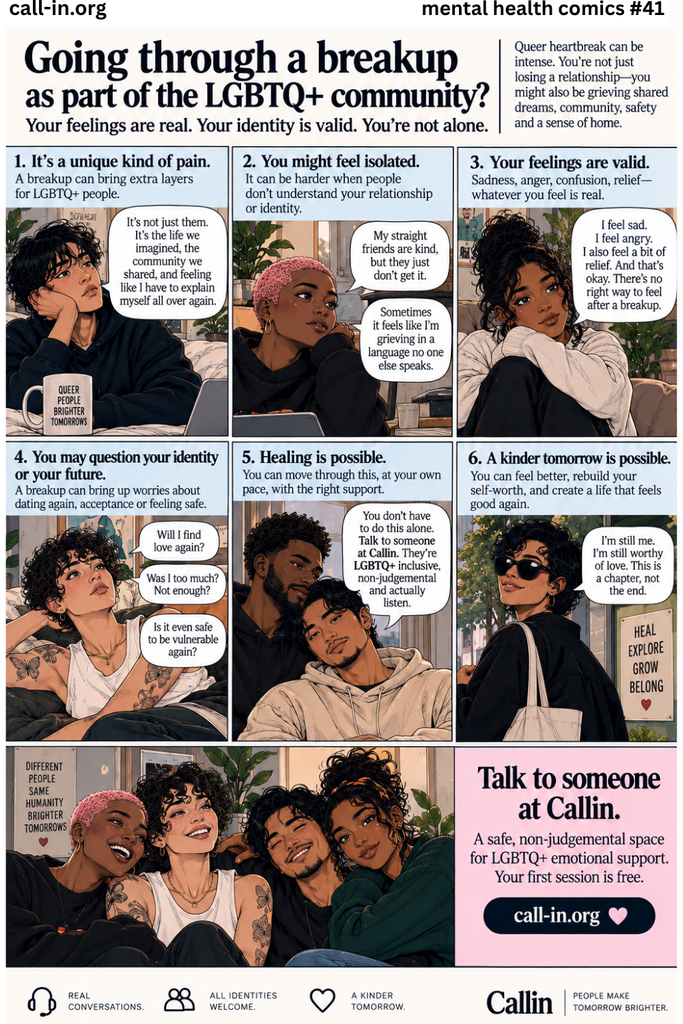
Heartbreak is human. Gay, lesbian, bisexual, transgender, queer, and straight people can all experience rejection, grief, anger, confusion, and loneliness after a relationship ends.
The surrounding losses, however, can be different.
An LGBTQ+ breakup may involve losing chosen family, shared queer spaces, an affirming community, or the person who witnessed a significant part of your coming-out or identity journey. There may be concerns about being outed, returning to an unsupportive household, seeing an ex within a smaller local community, or grieving a relationship that was never publicly recognized.
Research on LGBTQ+ breakups suggests that community, family recognition, identity, and minority stress can shape how relationship loss is experienced. The pressure for a queer relationship to appear successful can also make it harder to speak honestly when that relationship is painful or ending. (The Sociological Review)
Not every LGBTQ+ person experiences these challenges, and queer heartbreak is not automatically more traumatic. The important point is that support should understand the whole loss, not erase its social and cultural context. People looking for a judgment-free space may find this guide to LGBTQ+ non-clinical emotional support helpful.
Straight people can also face losses that are poorly understood by others, including co-parenting changes, the breakup of a family unit, financial upheaval, or pressure to “move on” without talking about it. Men in particular may discover that their emotional support system was almost entirely contained within the relationship.
Different context. Same human need to be taken seriously.
What Are Some Things People Do After a Breakup?
People do many things after a breakup. Some cry. Some become astonishingly productive. Some download three dating apps before the other person has collected their toothbrush. Others get a haircut significant enough to alarm close friends.
Common responses include:
- Repeatedly checking an ex’s social media
- Rereading messages and studying old photographs
- Contacting the ex for answers or reassurance
- Talking about the breakup with friends
- Withdrawing from other people
- Working, exercising, drinking, gaming, or dating to avoid thinking
- Removing reminders of the relationship
- Trying to remain friends immediately
- Rebuilding routines and reconnecting with neglected interests
- Seeking therapy, peer support, spiritual care, or someone who can listen
A behavior can be common without being helpful. The useful question is not only, “Does this make me feel better now?” It is also, “What does this do to me tomorrow?”
For example, checking an ex’s social media may briefly reduce uncertainty while creating fresh information to analyze. Research has found an association between monitoring an ex online and greater distress, longing, and difficulty moving forward, although this does not prove that social media checking alone causes the distress. (Cyberpsychology, Behavior, and Social Networking)
What to Do When Dealing With Heartbreak
There is no perfect breakup routine, but several approaches tend to make recovery more possible.
Stabilize the Ordinary Parts of Life
Heartbreak creates emotional chaos, so simple structure can become protective. Regular meals, sleep, movement, showers, work boundaries, and time outside may sound almost offensively basic when your heart feels pulverized.
They will not solve the loss. They give your nervous system a steadier place from which to process it.
Create Distance From Repeated Injury
Some people benefit from a period of no contact or from muting an ex on social media. This is not necessarily punishment, manipulation, or a secret strategy for making someone miss you. It can simply reduce the number of times your mind is asked to reopen the same wound.
Complete separation is not always possible. You may share children, work, friends, housing, or practical responsibilities. In those situations, predictable and limited communication can be more realistic than dramatic disappearances.
Let Yourself Tell the Story
People often need to describe what happened more than once. Repetition helps the mind organize an experience that still feels confusing.
The difference between processing and rumination is not always obvious. Processing gradually creates understanding or emotional movement. Rumination circles the same unanswerable question until you feel smaller.
A trusted friend, journal, support group, counselor, or trained listener can provide somewhere for the story to go. If you mainly need to speak without being diagnosed or given a five-point life overhaul, these alternatives to therapy for venting may help.
Rebuild Yourself in Small Pieces
After a breakup, people are sometimes told to “find themselves.” This sounds magnificent but is not particularly useful at 2:00 a.m.
Identity often returns through ordinary choices. Cook something you like. Call the friend you lost touch with. Rearrange the room. Revisit a neglected interest. Make one weekend plan that is not secretly designed around bumping into your ex.
You are not required to become a completely new person. You are discovering which parts of you were quiet, shared, compromised, or waiting.
Choose Support That Matches the Need
Different moments call for different kinds of support. A friend may offer warmth and history. A support group may reduce isolation. A therapist can help with persistent distress, trauma, repeated relationship patterns, or mental health concerns. A doctor can assess significant changes in sleep, appetite, anxiety, or physical health.
Sometimes you simply need someone to hear the uncensored version without becoming impatient, frightened, or personally involved. If that is where you are, you may also relate to feeling as though you are alone with no one to talk to.
When Heartbreak Needs More Than Time and Listening
Heartbreak is painful, but it should not automatically be treated as a mental illness. Many people gradually recover with time, connection, reflection, and practical support.
More specialized help may be appropriate if your distress is becoming more intense, you cannot function, you are barely eating or sleeping, substances have become your main coping mechanism, the relationship involved abuse or stalking, or you are experiencing thoughts of harming yourself.
If you are in immediate danger in the UK, call 999 or go to A&E. For urgent mental health help that is not an emergency, the NHS advises calling 111 and selecting the mental health option. You can also call Samaritans free on 116 123. (NHS urgent support, Samaritans)
You Do Not Have to Perform Recovery
There is a peculiar pressure after a breakup to look as though you are thriving. People want the gym transformation, the glamorous holiday, the confident photograph, and the caption announcing that losing you was actually a tremendous business error.
Real recovery is usually quieter.
It is the first meal you enjoy without thinking about them. The evening you do not check their profile. The conversation that reminds you that you are interesting outside the relationship. The morning when your first thought belongs to your own life.
For people who want an objective, confidential, non-clinical place to process heartbreak, Callin offers sessions with trained active listeners, including the option of speaking with the same dedicated listener over time. A first session is free and can last from 20 minutes to one hour depending on what you need, with no diagnosis, judgment, or pressure to continue, and you can read what happens in a first Callin session before deciding whether it feels right.
You do not need to pretend the relationship meant nothing in order to heal. It can have mattered deeply and still be over. You can miss someone and protect your peace. You can feel rejected and remain lovable.
One day, the breakup will become part of your story rather than the place where your whole story stopped.
That is not forgetting. That is your life becoming yours again.
Frequently Asked Questions About Heartbreak
Should I Contact My Ex After a Breakup?
It depends on why you want to contact them and what usually happens afterward. Practical communication may be necessary when you share children, belongings, housing, or work. If contact repeatedly leaves you distressed, confused, or hoping for reassurance they cannot offer, temporary distance may be kinder to you.
Does No Contact Help After a Breakup?
No contact can reduce fresh emotional triggers and create space for new routines. It is not a universal rule, and it should not be used as a trick to control your ex. Where total separation is impossible, limited, practical communication may offer similar protection.
How Do I Stop Thinking About My Ex?
Trying to forcibly suppress every thought can make the thoughts more persistent. It may help to reduce triggers, give yourself a defined place to process the breakup, and gently return your attention to the activity in front of you. The goal is not immediate forgetting. It is gradually spending less of your life inside the thought.
Can Exes Be Friends?
Some can, but friendship tends to be difficult when one person is secretly waiting for reconciliation or when contact repeatedly reactivates the breakup. Time, honest intentions, and clear boundaries matter. You do not owe immediate friendship to prove that you are mature.
Do I Need Therapy for Heartbreak?
Not necessarily. Heartbreak is a normal response to relationship loss, and many people recover with time and social support. Therapy may be valuable when the breakup activates trauma, depression, severe anxiety, harmful coping, persistent functional difficulties, or relationship patterns you want to understand.
Will I Ever Love Someone Again?
Nobody can honestly predict when another relationship will appear. What can return is your capacity for connection, trust, curiosity, attraction, and hope. Those capacities belong to you. They were expressed through the relationship, but they were never owned by it.